
Digital marketing in luxury real estate is defined as a precision-led demand architecture that attracts high-net-worth buyers through targeted content, performance campaigns, and data-driven relationship management. Over 85% of property buyers begin their search online, which means your listing’s digital presence is its first showing. The role of digital marketing in luxury property sales goes far beyond posting photos on a portal. It builds brand authority, filters qualified buyers from casual browsers, and creates a compounding trust signal that accelerates closings at premium price points. Stu Harvey brings experience from 250+ personal career transactions to his work with sellers, including thoughtful planning for property marketing.
How digital marketing strategies uniquely serve luxury property sales
Traditional real estate marketing operates on volume. Print ads, open houses, and MLS syndication cast wide nets and accept that most inquiries will not convert. Luxury property sales require the opposite logic. Fewer leads, higher close rates, and a buyer profile that demands discretion and relevance at every touchpoint.
Digital marketing builds brand equity and buyer trust rather than simply amplifying listings. This distinction matters because a high-net-worth buyer researching a $5 million property in Rancho Santa Fe is not responding to a banner ad. They are evaluating the agent’s authority, the property’s narrative, and the quality of the experience before they ever make contact.

The table below shows where traditional and digital approaches diverge in the luxury segment.
| Factor | Traditional marketing | Digital marketing |
|---|---|---|
| Reach | Broad, geography-limited | Targeted by wealth signals and intent |
| Lead quality | High volume, low qualification | Lower volume, higher close rate |
| Brand control | Platform-dependent | Agent-owned narrative |
| Buyer privacy | Limited | Private portals and gated content |
| Performance data | Lagging indicators | Real-time analytics and optimization |
The shift from platform dependency to agent-owned narrative is the most underappreciated advantage. When your brand lives on a curated website with exclusive content rather than a generic listing portal, you control the story. Buyers who find you through intent-driven search or a referral from a trusted source arrive pre-qualified by the quality of your content alone.
Key distinctions that define luxury digital marketing:
-
Precision targeting replaces mass reach, focusing spend on verified high-net-worth audiences
-
Exclusivity signals, such as gated content and private listing previews, filter serious buyers
-
Brand narrative is built through consistent content rather than one-off campaign bursts
-
Privacy protection is built into the lead capture and follow-up process from the start
What digital tactics effectively drive luxury property sales
Short-form video is the single highest-leverage tactic available to luxury agents right now. Video walkthroughs generate approximately 500% more engagement than static photography. That number reflects a behavioral shift: affluent buyers want to experience a property before committing to a showing, and a well-produced 90-second walkthrough does that better than any floor plan.
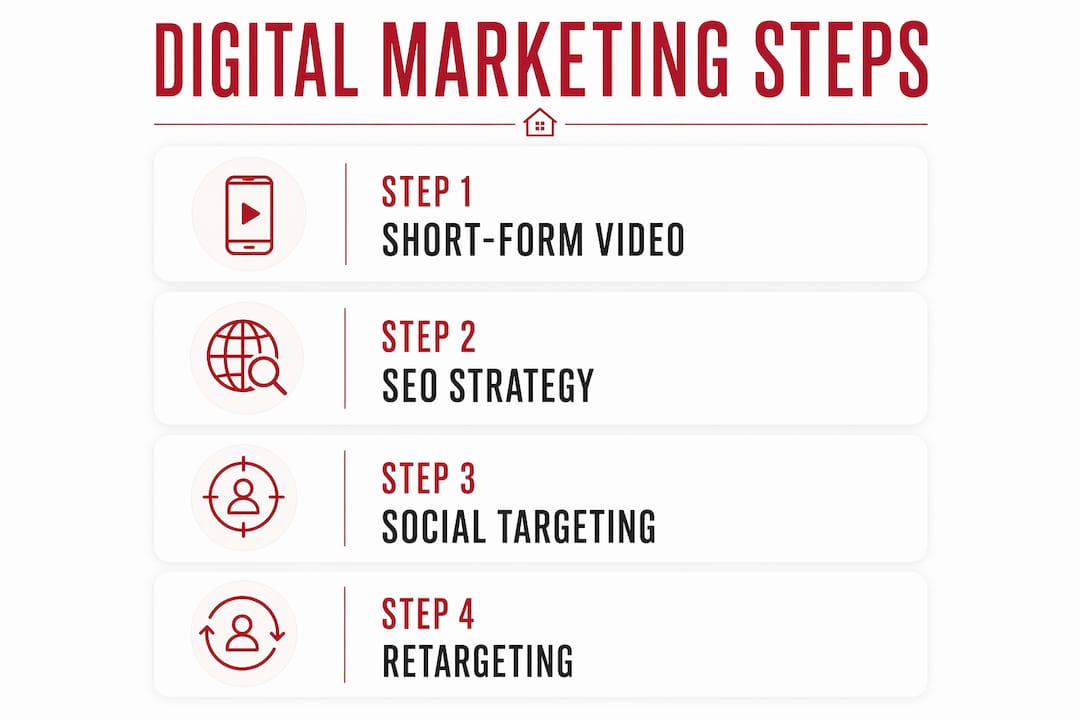
SEO for luxury real estate is not about ranking for “homes for sale.” Luxury buyers conduct quiet, research-heavy, lifestyle-led searches that require hyper-specific content clusters. Pages targeting “oceanfront estates in La Jolla with private access” or “Rancho Santa Fe equestrian properties under 10 acres” attract buyers who already know what they want. That intent specificity translates directly into higher inquiry quality.
Social media targeting on Facebook and Instagram has matured to the point where you can reach audiences defined by income brackets, investment behavior, and luxury lifestyle interests. Lead form submissions on these platforms increase 40 to 70 percent when ads are targeted to wealth signals rather than broad demographic categories. The cost difference is significant: qualified luxury leads cost far less per closed transaction than volume-based campaigns that require heavy filtering.
Retargeting is the tactic most luxury agents underuse. A buyer who visited your property page three times in two weeks is signaling intent. A retargeting sequence that serves them a virtual tour, a neighborhood lifestyle video, and a client testimonial over the following 10 days keeps your listing front of mind without a single cold call.
Pro Tip: Build a proof stack before you launch any campaign. This means assembling sold price records, client testimonials, press mentions, and market data into a single, well-designed page on your website. Buyers who encounter your proof stack during their research phase arrive at first contact already trusting your authority.
Effective digital tactics for luxury homes, ranked by impact:
-
Short-form video walkthroughs (90 seconds, cinematic production quality)
-
Intent-driven SEO content clusters targeting specific property types and neighborhoods
-
Facebook and Instagram campaigns targeting high-net-worth behavioral signals
-
Retargeting sequences using video, testimonials, and market data
-
Automated lead qualification flows that score and segment inquiries before human follow-up
How data intelligence and CRM integration improve performance
Data intelligence transforms digital marketing from a cost center into a compounding asset. Every buyer interaction, from a page visit to a video play to a form submission, generates a signal. The agents who capture and act on those signals close faster and at better prices than those who treat each lead as a fresh start.
CRM platforms like Salesforce, HubSpot, or real estate-specific tools like Follow Up Boss allow you to segment your pipeline by buyer intent, geography, and readiness. A buyer who has visited your La Jolla listings page four times and watched two video tours is in a different follow-up sequence than someone who downloaded a neighborhood guide once. Treating them the same wastes both your time and theirs.
Here is how to operationalize data intelligence across a luxury sales cycle:
-
Tag every lead at entry with source, property interest, and engagement depth so your CRM segments automatically from the first touchpoint.
-
Score leads by behavior, not just demographics. A buyer who watches 80% of a property video ranks higher than one who only opened an email.
-
Personalize follow-up sequences based on the specific property type and neighborhood the buyer engaged with, not a generic drip campaign.
-
Review performance data weekly to identify which content pieces are generating the highest-quality inquiries and reallocate budget toward them.
-
Build long-cycle nurture tracks for buyers who are 6 to 18 months from purchasing. Performance-led digital architectures compound over years, and the agent who stayed relevant through a long research phase wins the listing appointment.
The San Diego luxury market, where Stuharveyestates operates, rewards agents who understand lifestyle-driven buyer behavior. Buyers in La Jolla and Coronado are not just purchasing square footage. They are purchasing a lifestyle, and your CRM data should reflect that by tracking which lifestyle content drives the deepest engagement.
How luxury real estate professionals can implement digital marketing effectively
The starting point is your website. Luxury real estate websites should function as private client portals with exclusive, proof-backed content rather than generic brochure sites. This means gated neighborhood guides, private listing previews for registered buyers, and a design language that signals premium positioning from the first page load.
Content strategy must align with how affluent buyers actually research. They read architectural style guides, study school district data, compare coastal access options, and evaluate agent track records before making contact. Your content library should answer every one of those questions at a depth that generic portals cannot match. The San Diego neighborhoods guide from Stuharveyestates is a strong example of this approach: specific, locally authoritative, and useful to a buyer who is serious about the market.
Visual production quality is non-negotiable. Drone footage, twilight photography, and cinematic interior video are table stakes in the luxury segment. Buyers comparing a $4 million property in La Jolla against one in Malibu will make initial judgments based on production quality before they read a single word of copy.
Pro Tip: Design your inquiry sequence to protect exclusivity. Instead of a generic contact form, use a short qualification intake that asks about timeline, budget range, and property type. This signals to serious buyers that your process is selective, and it gives you the data you need to personalize the first conversation.
Additional implementation priorities for luxury real estate professionals:
-
Develop a signature content framework, such as a neighborhood lifestyle series or a market intelligence report, that you publish consistently
-
Partner with luxury lifestyle brands, interior designers, and architects for co-branded content that reaches their affluent audiences
-
Maintain consistent brand messaging across your website, social profiles, email sequences, and listing presentations
-
Use digital marketing insights specific to Southern California to calibrate your channel mix and messaging for the local market
Key takeaways
Digital marketing in luxury real estate succeeds when it builds compounding brand authority and attracts pre-qualified buyers through precision targeting, not volume.
| Point | Details |
|---|---|
| Digital marketing as demand architecture | Luxury digital marketing builds trust and brand equity, not just listing visibility. |
| Video drives the highest engagement | Short-form video walkthroughs generate up to 500% more engagement than static images. |
| SEO requires intent-specific content clusters | Target hyper-specific searches like property type and neighborhood to attract qualified buyers. |
| CRM data compounds over time | Behavioral scoring and long-cycle nurture tracks close more deals at better prices. |
| Your website is your primary sales tool | Build a private client portal with gated content, not a generic listing brochure. |
What 15 years in this market taught me about digital marketing
Most agents approach digital marketing as a lead generation expense. I spent the first few years of my career thinking the same way, measuring success by inquiry volume and cost per lead. That framework is wrong for luxury real estate, and it took a few expensive campaigns to prove it.
The agents who consistently close at the top of the market are not running the most ads. They are building the most trusted brands. Every piece of content, every client testimonial, every sold record you publish online is a brick in a wall of proof that a high-net-worth buyer will examine before they ever call you. That wall takes years to build and is nearly impossible for a competitor to replicate quickly.
I have also found that the buyers who come through well-designed digital channels are qualitatively different from those who come through portals or cold outreach. They arrive knowing your track record, understanding your market focus, and already aligned with your positioning. Those conversations close faster and with less friction because the trust was built before the first call.
The uncomfortable truth is that most luxury agents underinvest in digital marketing because the results are not immediate. A content cluster targeting La Jolla oceanfront buyers takes months to rank. A retargeting sequence takes weeks to show results. But building a luxury portfolio that generates consistent demand requires exactly that kind of long-term thinking. The agents who commit to it early create a compounding advantage that short-term campaign thinkers cannot match.
— Stu
Explore luxury listings with Stuharveyestates
Stuharveyestates combines over 15 years of Southern California luxury market expertise with a digital-first approach that connects serious buyers to the right properties faster. Every listing is presented with cinematic video, intent-driven content, and a personalized buyer journey designed for high-net-worth clients.
Whether you are searching for a coastal estate in La Jolla, a private compound in Rancho Santa Fe, or a luxury investment property in San Diego’s most sought-after neighborhoods, Stuharveyestates provides the market intelligence and discretion that premium transactions require. Browse current luxury listings or request a private consultation to discuss your buying or selling objectives with Stu directly.
FAQ
What is the role of digital marketing in luxury property sales?
Digital marketing serves as a demand architecture that builds brand authority, targets high-net-worth buyers through precision channels, and creates trust before the first conversation. It replaces volume-based advertising with intent-driven content and data-informed follow-up.
How does video content impact luxury real estate marketing?
Short-form video walkthroughs generate approximately 500% more engagement than static photography, making them the highest-leverage content format for luxury property marketing.
Why is SEO different for luxury real estate?
Luxury buyers conduct research-heavy, lifestyle-led searches that require hyper-specific content clusters targeting property types, neighborhoods, and lifestyle attributes rather than generic high-volume keywords.
How does CRM integration improve luxury real estate digital marketing?
CRM platforms allow agents to segment buyers by intent and behavior, personalize follow-up sequences, and maintain long-cycle nurture tracks that convert research-phase buyers into clients over 6 to 18 months.
What makes a luxury real estate website effective?
Effective luxury websites function as private client portals with gated content, proof-backed agent credentials, and a design standard that signals premium positioning from the first page load.