
Southern California’s luxury real estate market rewards investors and buyers who do their homework and punishes those who rely on headlines. To properly analyze the Southern California luxury market, you need to move past county-level data and into the granular world of micro-market segmentation, off-market transaction flows, and price tier dynamics that vary dramatically from one enclave to the next. This guide breaks down the specific tools, frameworks, and real-world examples you need to read the market accurately, spot genuine opportunities, and avoid the traps that catch even experienced buyers off guard.
Table of Contents
Key takeaways
| Point | Details |
|---|---|
| Luxury thresholds vary by submarket | Entry prices differ sharply across Los Angeles, Orange County, and Ventura, requiring localized analysis. |
| Price resets signal opportunity | Steep year-over-year declines in specific submarkets can reveal recalibration windows for smart buyers. |
| Scarcity drives enclave pricing | Trophy micro-markets like Laguna Beach operate on structural scarcity, not broader market sentiment. |
| Off-market deals shape true pricing | A significant share of super-prime transactions never appear in public data, distorting visible comps. |
| Submarket modeling beats broad trends | Luxury price trajectories differ significantly by segment, making submarket analysis the only reliable framework. |
Analyze the Southern California luxury market by segment first
Before you can interpret any data point, you need to understand how the Southern California luxury market is actually structured. It is not one market. It is a collection of distinct submarkets, each with its own entry price threshold, buyer profile, and pricing logic.
The table below shows how dramatically luxury entry points diverge across key Southern California markets as of early 2026:
| Market | Luxury Entry Price (Feb 2026) | Year-over-Year Change |
|---|---|---|
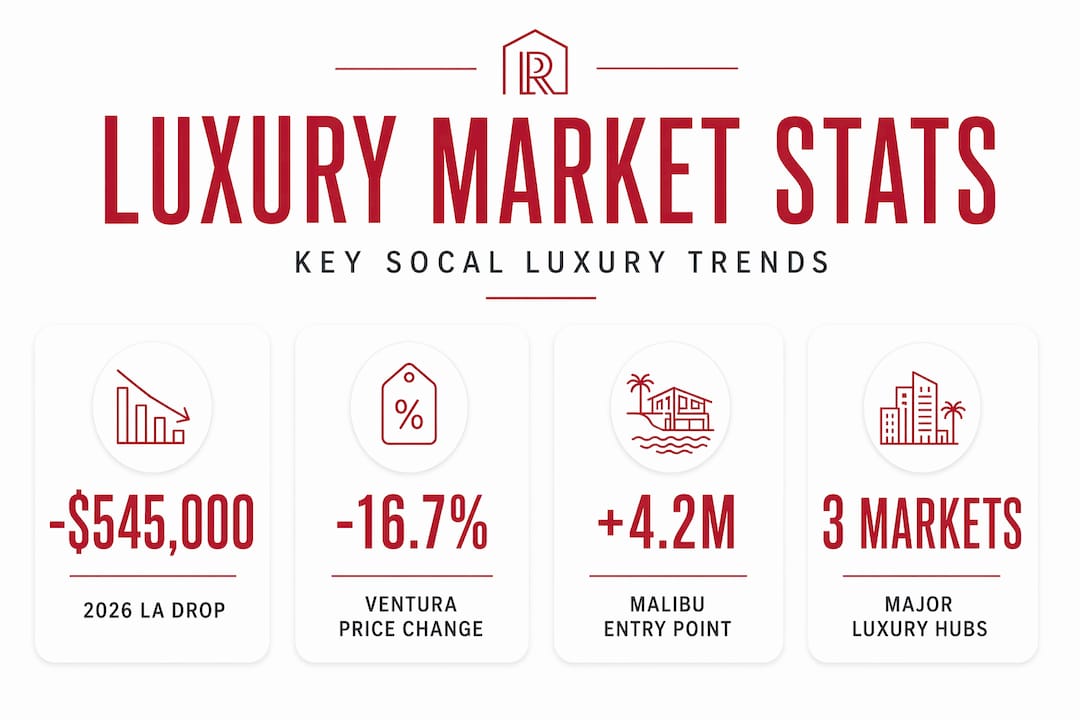
| Los Angeles | $3,272,500 | -7.8% |
| Orange County | ~$2,800,000 | Moderate softening |
| Oxnard/Thousand Oaks/Ventura | Significantly lower tier | -16.7% |
| Laguna Beach enclaves | $5M+ (trophy tier) | Stable to rising |
The Los Angeles luxury threshold sat at $3,272,500 in February 2026, with a year-over-year price change of -7.8%. That number alone tells a story, but it is not the full story. Los Angeles also maintains some of the deepest million-dollar inventory in the country, with over 9,300 listings monthly on average. Depth and price direction can move in opposite directions, and that tension is exactly where analytical skill matters.
The Oxnard, Thousand Oaks, and Ventura corridor tells a different story entirely. That market experienced a -16.7% year-over-year price reset as of February 2026, the steepest luxury decline among major Southern California markets. This is not a market in freefall. It is a market correcting after an outsized run-up, and for buyers with the right timing, that distinction matters enormously.
Coastal and resort-driven markets add another layer of complexity. Areas like Malibu, Newport Beach, and La Jolla carry lifestyle premiums that resist standard valuation models. Buyers in these markets are not just purchasing square footage. They are purchasing access, views, and a specific community identity that cannot be replicated inland. Understanding why San Diego’s luxury buyers prioritize lifestyle factors helps explain why coastal pricing holds even when broader metrics soften.
Pro Tip: Always define your luxury tier before pulling data. A $3M property in Pasadena and a $3M property in Malibu are not comparable assets. The local luxury tier, not the price tag alone, determines what the number actually means.
Reading inventory depth and pricing trends accurately
Once you understand how the market segments, the next step is interpreting the data signals that reveal where each segment is headed. This is where most buyers and investors make analytical mistakes, either reading too much into a single metric or ignoring the data that contradicts their assumptions.
Here is a practical framework for reading Southern California luxury market data with accuracy:
-
Measure inventory depth in million-dollar-plus tiers. The most useful unit of analysis in Southern California luxury is million-dollar-plus inventory depth, tracked monthly. A rising inventory count signals softening demand or seller overconfidence. A shrinking count signals absorption pressure and potential price support.
-
Track days on market by price band, not by neighborhood. A 90-day average in a $5M to $8M price band tells you something very different from a 90-day average at $2M to $3M. Segment your days-on-market analysis by price tier to catch the divergences that neighborhood-level data obscures.
-
Identify price resets versus price corrections. A price reset is a structural adjustment after an overextended run-up, like what happened in the Ventura corridor. A price correction is a demand-driven pullback. The recovery trajectory for each is completely different, and conflating the two leads to poor timing decisions.
-
Watch sales velocity alongside list price changes. A market where list prices are falling but sales velocity is holding steady is actually a healthy market finding its floor. A market where both are declining simultaneously is a different situation entirely.
-
Account for the off-market gap. Los Angeles ranks third globally in $10M-plus sales, with 250 such transactions totaling $4.6 billion in the past 12 months. Many of those deals never appear in public MLS data. When you analyze visible pricing, you are working with an incomplete picture of what the market is actually clearing at.
Pro Tip: Pull 90-day rolling averages rather than point-in-time snapshots when tracking luxury pricing trends. Single-month data in a low-volume market like the $10M-plus tier can swing dramatically based on just two or three transactions.
Micro-market dynamics and scarcity value in trophy enclaves
Not every part of the Southern California luxury market responds to macroeconomic signals the same way. In certain enclaves, scarcity is the dominant pricing force, and understanding that distinction separates buyers who overpay from those who recognize genuine value.
Trophy micro-markets share a set of identifiable characteristics:
-
Finite supply with no meaningful new construction. Gated oceanfront communities, hillside estates with protected view corridors, and historic neighborhoods with strict zoning all share one trait. You cannot build more of them.
-
Lifestyle amenities that attract a global buyer pool. Private beach access, proximity to world-class dining and culture, and community exclusivity pull buyers from outside the local market, insulating prices from regional economic softness.
-
Record sales that occur quickly. An ocean-view home in Laguna Beach’s Three Arch Bay sold for $13.6M, setting a record for the enclave and closing after just 10 days on market. That is not a fluke. It reflects what happens when a genuinely scarce asset meets a motivated, qualified buyer.
-
Price floors that hold during broader market softness. Structural scarcity in Laguna Beach and similar Orange County enclaves means gated oceanfront properties command premiums that broader market trends simply do not reach.
Beverly Hills, Rancho Santa Fe, and certain pockets of La Jolla behave similarly. The La Jolla market combines coastal scarcity with a highly educated, globally connected buyer base that sustains demand even when interest rates create hesitation elsewhere.
The practical takeaway is this: when you analyze a scarcity-driven enclave, interest rate sensitivity and inventory depth matter far less than they do in a standard luxury market. Your analysis framework needs to shift toward tracking comparable record sales, monitoring how quickly properties absorb, and understanding the lifestyle factors that define the community’s appeal to its specific buyer pool.
Accessing off-market opportunities in Southern California
A meaningful share of the most significant Southern California luxury transactions never appear on any public platform. Trusted networks and discretion strategies are critical for accessing LA super-prime off-market listings, and the same principle applies across the broader SoCal luxury tier.
Understanding why sellers choose off-market routes helps you position yourself to access those opportunities:
-
Privacy and discretion. High-profile sellers often prefer to avoid public listings that attract unqualified inquiries, media attention, or unwanted scrutiny of their personal circumstances.
-
Pricing flexibility. Off-market transactions allow sellers to test price points without the stigma of a public price reduction. For buyers, this creates negotiating room that a competitive listed property rarely offers.
-
Speed and certainty. Sellers who know their buyer is pre-qualified and serious will often accept a slightly lower price in exchange for a clean, fast transaction without open houses or contingency delays.
Building access to this layer of the market requires genuine relationship investment. That means working consistently with agents who specialize in specific enclaves, attending community events in target neighborhoods, and maintaining relationships with estate attorneys and family office advisors who often know about properties before they reach any market at all.
The risks of off-market acquisitions are real and worth naming. Without competitive bidding, you lose the market validation that a multiple-offer situation provides. You also have less comparable data to anchor your offer. The solution is rigorous independent valuation and a clear understanding of the enclave’s historical pricing, not just the seller’s asking price.
Pro Tip: When evaluating an off-market opportunity, build your own comp set from both public records and any accessible off-market sales data your agent can provide. Relying solely on the seller’s broker for pricing context is a structural conflict of interest.
Parallel strategies from off-market luxury deal structures in other high-demand coastal markets confirm that discretion, relationship depth, and independent valuation are the consistent factors that separate successful off-market buyers from those who overpay.
My take on what the data actually tells you
Individual Southern California markets can behave differently, so broad regional averages may not describe the property or neighborhood a buyer is considering.
What I have learned is that the headline data, the county-level medians and the year-over-year percentage changes, tells you almost nothing useful on its own. The Ventura corridor’s steep price decline and the Laguna Beach enclave’s record sales happened in the same market cycle, at the same time. If you read only the aggregate, you miss both the risk and the opportunity.
The other thing I would push back on is the assumption that public listings represent the real market at the top of the price spectrum. They do not. The $10M-plus tier in Los Angeles operates through a network of relationships that most buyers never access. If you are searching for a trophy property using only what is publicly listed, you are shopping in a curated subset of what is actually available. That is not a criticism. It is just the reality of how this market works, and knowing it changes how you approach your search.
What actually moves the needle for my clients is combining rigorous submarket data analysis with genuine network access. Neither works without the other. The data tells you where to look. The network gets you in the door.
— Stu
Work with an expert who knows the market from the inside
Knowing how to analyze the Southern California luxury market is one thing. Having the network, the data access, and the local expertise to act on that analysis is something else entirely. Stu Harvey brings more than 15 years of real estate experience and 250+ personal career transactions to his work with clients. His service areas include La Jolla, Rancho Santa Fe, and Del Mar.
Whether you are an investor tracking micro-market opportunities or a buyer searching for a specific lifestyle property, Stu Harvey provides direct access to both listed and off-market inventory, paired with the kind of honest, data-grounded guidance that leads to confident decisions. Explore current luxury listings in Southern California or reach out directly to discuss your specific search criteria and market questions.
FAQ
What does it mean to analyze the Southern California luxury market?
Analyzing the Southern California luxury market means examining submarket-specific data including inventory depth, price tier thresholds, days on market, and off-market transaction volume rather than relying on broad regional averages.
Why is the Southern California luxury market unique compared to other regions?
Southern California combines coastal scarcity, a global buyer pool, and extreme micro-market variation. Trophy enclaves like Laguna Beach and Beverly Hills operate on structural scarcity dynamics that insulate them from broader market softness.
How do off-market deals affect luxury market analysis?
Off-market transactions represent a significant share of super-prime sales in Los Angeles, meaning public pricing data often understates true market activity and can distort comparable valuations.
What are the key price thresholds for luxury real estate in Southern California?
Luxury entry points vary sharply by submarket. Los Angeles sat at $3,272,500 in February 2026, while trophy coastal enclaves like Laguna Beach operate well above $5 million for premium properties.
How should investors approach submarket selection in Southern California luxury real estate?
Focus on submarket volatility modeling rather than broad trends. Markets experiencing steep price resets after run-ups offer different risk-reward profiles than structurally scarce coastal enclaves with record-setting sales velocity.