
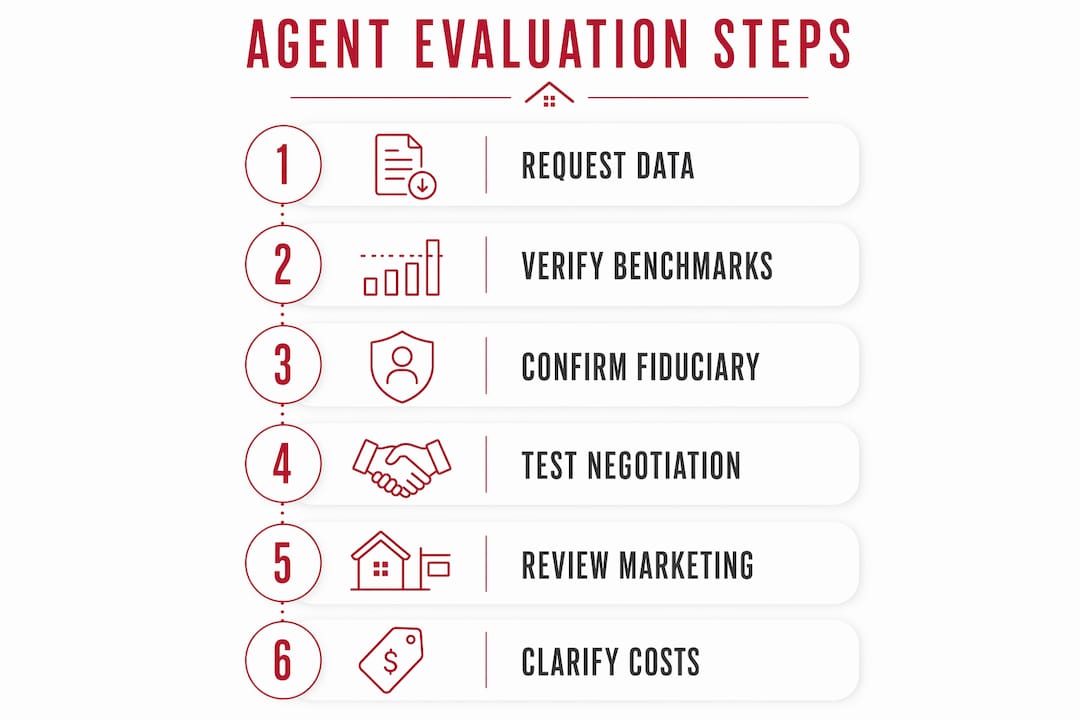
To evaluate a luxury real estate agent means to conduct structured due diligence on verified performance data, fiduciary obligations, negotiation process, and marketing sophistication before signing any representation agreement. The best luxury real estate agents separate themselves not through awards or branding but through measurable results, ethical clarity, and bespoke marketing plans built for affluent buyers. This guide gives homebuyers, sellers, and investors a practitioner-level framework to assess luxury real estate brokers with the same rigor they apply to any high-value financial decision. The tools you need include list-to-sold price ratio analysis, scenario-based interview questions, and agency relationship disclosures.
Which performance metrics reveal true luxury agent expertise?
The two most reliable numbers to request when you evaluate a luxury real estate agent are list-to-sold price ratio and average days on market within your specific price bracket. Sales volume and award plaques tell you nothing about consistency. A ratio above 98% in a market where the average sits at 94% signals genuine negotiation strength. Average days on market below the local benchmark shows the agent prices correctly and attracts qualified buyers fast.
The critical step most buyers skip is benchmarking these numbers against local luxury market data, not national averages. A 45-day average days on market in La Jolla is very different from the same figure in a slower inland market. Always request figures specific to the $2 million and above segment, not the agent's full book of business.
Transaction quality matters more than transaction count. An agent who closed 12 properties above $3 million with consistent results outperforms one who closed 40 mixed-price deals. Ask for a deal-by-deal breakdown covering price bracket, days on market, and final sale price versus list price.
Pro Tip: Ask agents to provide their performance data in writing, then cross-reference it against public MLS records or county assessor data. Any hesitation to provide written figures is itself a data point.
| Metric | Strong Benchmark | Warning Sign |
|---|---|---|
| List-to-sold price ratio | 97%–100% in luxury segment | Below local market average |
| Average days on market | Below local luxury median | Significantly above market median |
| Transaction consistency | 10+ luxury deals per year | Sporadic or mixed-price volume |
| Price bracket focus | Majority above $2 million | Mostly entry-level with few luxury deals |
How do you verify fiduciary duties and agency relationships?
Agency relationships define whether an agent owes you full fiduciary loyalty or only limited transactional duties. A fiduciary owes you loyalty, confidentiality, disclosure, obedience, reasonable care, and accounting. A transactional licensee owes you honesty and basic competence, but nothing more. The difference is enormous in a $5 million negotiation where your motivation, budget ceiling, and timeline are sensitive information.
Clarify the agency relationship before your first substantive conversation. If you disclose your maximum budget to an agent who turns out to be a transactional licensee, that information carries no legal protection. Early oversharing before establishing a formal client relationship is one of the most common and costly mistakes luxury buyers make.
Use the following questions to confirm the agent's ethical and legal obligations before hiring:
- "Are you offering me full agency representation or a transactional relationship?"
- "Will you provide a written agency disclosure before we discuss my budget or timeline?"
- "Do you adhere to the REALTOR® Code of Ethics, and can you explain your duties under Articles 1 and 2?"
- "Have you ever represented both buyer and seller in the same transaction, and how did you manage that?"
- "How do you handle confidential client information if a deal falls through?"
Agents who answer these questions with precision and without hesitation demonstrate the professional discipline that high-value transactions require. Vague or deflective answers are a red flag, not a minor concern.
What interview questions reveal an agent's negotiation process?
Scenario-based questions reveal how an agent actually makes decisions from listing to closing, not how they describe themselves in a pitch meeting. The goal is to hear process, not performance claims. An agent who says "I'm a great negotiator" tells you nothing. An agent who explains exactly how they maintained leverage through an appraisal gap on a $4.2 million property tells you everything.
Use these scenarios in your interviews:
- "A competing offer comes in $200,000 above yours with no contingencies. Walk me through how you advise me and what you do next."
- "The appraisal comes in $150,000 below the agreed price. What is your step-by-step response?"
- "The seller's agent calls you directly and asks about my motivation for buying. How do you handle that call?"
- "You discover a material defect during inspection that the seller's disclosure did not mention. What do you do, and in what order?"
- "We are two weeks from closing and the seller requests a 30-day extension. How do you protect my position?"
Listen for agents who describe specific tools, timelines, and decision criteria. Data-driven negotiation that preserves your position through appraisal and contingency periods is the standard you should expect, not a bonus feature.
Pro Tip: Reward process answers, not outcome boasts. If an agent spends more than 30 seconds telling you how many deals they have closed before answering the scenario, redirect them. You are testing judgment, not listening to a highlight reel.

The negotiation competencies worth verifying in every interview include: leverage management, appraisal gap strategy, contingency sequencing, confidentiality under pressure, and documentation discipline. An agent who cannot articulate their process on at least three of these five areas is not ready for a luxury transaction.
How to evaluate luxury real estate marketing plans beyond MLS
A luxury property listed only on MLS is undermarketed. Robust marketing plans for high-end listings include professional video, targeted digital advertising, international buyer outreach, private previews, and editorial-quality photography. The difference between a $4.8 million sale and a $5.3 million sale often comes down to how many qualified buyers saw the property and how compellingly it was presented.
Request actual examples of past luxury listings, not mock-ups or templates. Review the photography quality, the listing copy, the video production, and the distribution channels used. Auditing real marketing outputs from past listings tells you far more than any marketing deck the agent prepares for your meeting. Pay attention to how effectively the agent tells a home's story digitally, because affluent buyers often form strong impressions before ever stepping inside.
The agent's own digital presence matters too. An agent marketing a $6 million property should have a professional website, active social media with high production value, and relationships with platforms that reach global buyers. For context, San Diego luxury listings now compete for international buyers from markets including Canada, the UK, and Asia Pacific, making global reach a genuine requirement rather than a nice-to-have.
| Marketing Element | Traditional Approach | Luxury Standard |
|---|---|---|
| Photography | Standard MLS photos | Architectural photography with staging |
| Video | None or basic walkthrough | Cinematic production with aerial footage |
| Distribution | MLS and local portals | Global platforms, private networks, editorial placements |
| Open houses | Public weekend showings | Curated private previews for qualified buyers |
| Digital advertising | Boosted social posts | Targeted campaigns reaching high-net-worth audiences |
Understanding digital marketing's role in luxury property sales is now a baseline competency, not a differentiator. Agents who cannot explain their digital distribution strategy in specific terms are not operating at the level your property deserves.
What costs and contract terms should be clarified upfront?
Commission transparency is a mandatory part of agent evaluation, not a conversation to defer until you are already emotionally committed to working with someone. Luxury transactions involve significant commission dollars, and the structure of those fees affects your net proceeds or acquisition cost directly.
Fee structures in luxury real estate vary more than most clients realize. Some agents charge a flat percentage regardless of sale price. Others use tiered structures that adjust at certain price thresholds. Marketing costs are sometimes bundled into commission and sometimes billed separately. Knowing which model applies before you sign protects you from surprises at closing.
Ask every candidate these questions before signing any agreement:
- "What is your commission rate, and is it negotiable based on price or transaction complexity?"
- "Are marketing costs included in your commission, or are they billed separately?"
- "What is the contract duration, and what are the terms for early termination?"
- "Do you require exclusivity, and what does that mean for my ability to work with other agents on off-market opportunities?"
- "Are there any referral fees or third-party arrangements that could affect your advice?"
Fee clarity is not about negotiating the lowest commission. It is about understanding the full financial picture so you can compare candidates on equal terms and confirm that your agent's incentives align with your goals.
Key takeaways
Selecting the right luxury agent requires verified performance data, confirmed fiduciary status, scenario-tested negotiation skills, and a marketing plan built for affluent buyers.
| Point | Details |
|---|---|
| Audit performance metrics | Request list-to-sold price ratio and days on market benchmarked against local luxury data. |
| Confirm fiduciary status | Establish full agency representation in writing before disclosing budget or motivation. |
| Use scenario interviews | Test negotiation judgment with specific deal scenarios, not resume claims. |
| Demand a real marketing plan | Review actual past listing outputs, not templates, to judge marketing quality. |
| Clarify all fees upfront | Understand commission structure, marketing costs, and contract terms before signing. |
What 15 years of evaluating agents taught me
Most clients walk into agent interviews looking for someone they like. That instinct is understandable, but it is the wrong filter for a $3 million transaction. I have seen charming agents lose clients hundreds of thousands of dollars because they could not manage an appraisal gap, and I have seen quiet, methodical agents deliver results that exceeded every expectation because their process was airtight.
The single biggest mistake I observe is clients rewarding confidence over competence. An agent who speaks with authority about their sales record is performing for you. An agent who walks you through exactly how they handled a difficult inspection negotiation last month is showing you their actual capability. Those are very different things.
Fiduciary clarity is the non-negotiable I push hardest. In markets like Rancho Santa Fe and La Jolla, where off-market deals and private networks matter enormously, you need an agent whose loyalty is legally and contractually yours. Anything less is a structural conflict of interest at the worst possible time.
The clients who get the best outcomes are the ones who treat agent selection like the high-stakes due diligence it actually is. They bring written questions, they request data in writing, and they walk away from agents who cannot answer scenario questions with specificity. That discipline, applied before you sign anything, is worth more than any negotiation tactic after the fact.
— Stu
Start your search with Stuharveyestates
Stuharveyestates brings more than 15 years of Southern California luxury market expertise and over $1.2 billion in completed transactions to every client relationship. The evaluation criteria in this article reflect exactly how Stuharveyestates approaches every engagement: verified performance data, full fiduciary representation, and marketing plans built for the buyers your property deserves.
Whether you are buying, selling, or building a luxury real estate portfolio in markets like La Jolla, Coronado, or Rancho Santa Fe, Stuharveyestates provides the personalized guidance and local depth that high-value transactions require. Browse current luxury listings in Southern California and connect directly with Stu to begin a conversation grounded in transparency and results.
FAQ
What is the most reliable metric to evaluate a luxury real estate agent?
List-to-sold price ratio benchmarked against local luxury market data is the most reliable single metric. It reveals negotiation strength and pricing accuracy better than sales volume or awards.
How do i confirm an agent's fiduciary duties before hiring?
Ask for a written agency disclosure before any substantive conversation and confirm the agent offers full representation, not a transactional licensee relationship. Fiduciaries owe you loyalty, confidentiality, and full disclosure by law.
What questions should i ask a luxury agent in an interview?
Use scenario-based questions that test negotiation process, appraisal gap management, and confidentiality handling. Agents who describe specific decision steps rather than past outcomes demonstrate the judgment luxury transactions require.
How do luxury real estate marketing plans differ from standard listings?
Luxury marketing plans include cinematic video, architectural photography, global digital distribution, and curated private previews for qualified buyers. Standard MLS listings alone do not reach the affluent buyer pool that commands premium prices.
When should commission and fees be discussed with a potential agent?
Fee structure, marketing cost allocation, and contract terms should be discussed and confirmed in writing before signing any representation agreement. Treating this as an afterthought creates financial misalignment at the worst possible time.