
A luxury home lifestyle fit analysis is the process of evaluating how well a property’s features, floor plan, location, and amenities align with a buyer’s daily routines, wellness needs, and long-term goals. This is not the same as a standard home valuation. Where traditional appraisals focus on price per square foot and finish quality, a lifestyle fit analysis asks a more personal question: does this home actually work for the life you want to live? For buyers and investors in the $1.3 million and above market, getting that answer right is the difference between a satisfying purchase and a costly mismatch.
What is a luxury home lifestyle fit analysis and why does it matter now?
A luxury home lifestyle fit analysis is the industry’s answer to a shift in what high-net-worth buyers actually want. Realtor.com defines entry-level luxury as properties near the 90th price percentile, starting just under $1.3 million nationally, with ultra-luxury above $5.5 million. At those price points, buyers are not just purchasing square footage. They are purchasing a way of living.
The shift is measurable. 62% of luxury real estate agents now rank lifestyle as a more important purchase motivator than taxes or economic and political stability. That figure comes from Sotheby’s International Realty’s 2026 Mid-Year Luxury Outlook. It tells you that the old framework of “location, price, finishes” no longer captures what moves buyers at this level.
The concept of livable luxury captures this evolution well. It describes a move away from aesthetic extravagance toward homes that integrate with the owner’s actual routines, health priorities, and social preferences. A home gym, a spa room, a floor plan that flows from private quarters to outdoor entertaining without crossing the kitchen twice: these are not upgrades. They are requirements for buyers who know what they need.
Stuharveyestates has built its methodology around this reality. With experience from 250+ personal career transactions, Stu Harvey focuses on helping buyers find properties that fit their lives and budgets.
Why lifestyle fit has become a critical factor for luxury homebuyers
Buyer psychology at the luxury level is driven by a specific set of priorities that go well beyond aesthetics. High-net-worth buyers consistently prioritize privacy, autonomy, and control over their daily environment. These are not soft preferences. They are the core drivers behind property selection, and they demand a structured evaluation process.
Three forces are reshaping how buyers think about fit:
-
Longevity and aging in place. 38% of luxury agents report that aging-in-place considerations are actively reshaping buyer preferences in the $10 million and above segment. Buyers want homes that work for them now and in 20 years.
-
Wellness infrastructure. The wellness real estate market is projected to exceed $1.1 trillion by 2029. Buyers are treating air quality systems, circadian lighting, and dedicated wellness rooms as baseline expectations, not premium add-ons.
-
Time efficiency. Properties that reduce friction in daily life, through reliable smart home technology and proximity to private amenities, carry a premium valuation among sophisticated buyers. Time is the scarcest resource at this income level.
“Luxury is now defined less by finishes and more by community, acoustic privacy, and a feeling of control within the home environment.” This shift means that a lifestyle fit analysis must account for factors that never appear on a standard listing sheet.
Understanding these drivers is what separates a buyer who is satisfied five years after closing from one who regrets the purchase within two.
Key components of a luxury home lifestyle fit analysis
A thorough lifestyle assessment covers six distinct categories. Each one addresses a different dimension of how a home supports or conflicts with a buyer’s life.
| Assessment category | What it evaluates | Example criteria |
|---|---|---|
| Functional floor plan | Daily movement and space logic | Kitchen-to-outdoor adjacency, private vs. social zones |
| Wellness infrastructure | Health and recovery support | Home gym, spa room, air filtration, circadian lighting |
| Technology integration | Friction reduction | Smart home systems, security, climate automation |
| Neighborhood fit | Community and exclusivity | Acoustic privacy, social context, proximity to amenities |
| Aging and adaptability | Long-term usability | Single-level access, flex rooms, multigenerational layout |
| Privacy and autonomy | Control over environment | Lot size, gate access, sight lines, mature landscaping |
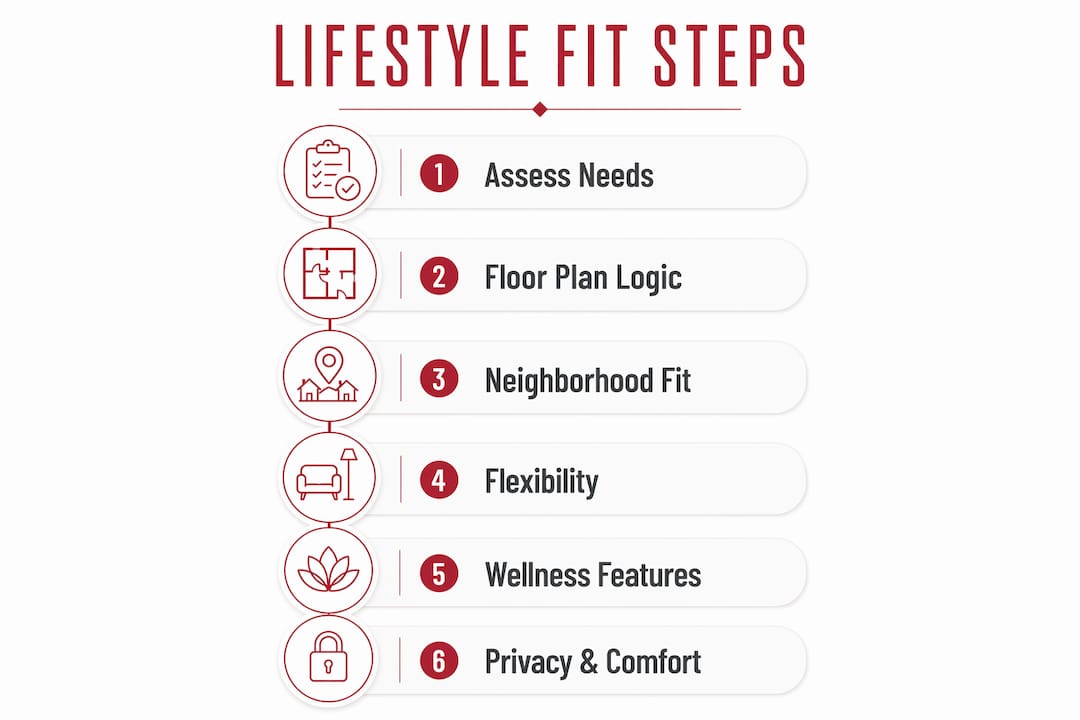
Successful luxury floor plans optimize logical adjacencies to simplify daily flow. That means placing kitchens adjacent to outdoor living areas and keeping private bedroom zones separated from entertaining spaces. A home that forces you to walk through a formal dining room to reach the pool fails the functional flow test, regardless of how beautiful the finishes are.

Neighborhood fit is equally specific. Lifestyle fit encompasses subtle neighborhood factors like acoustic privacy, social context, and mature lot characteristics. A buyer who values quiet mornings and controlled social interaction will not thrive in a neighborhood with high foot traffic, even if the home itself is perfect.
Pro Tip: When evaluating a property, walk the floor plan at the time of day you would normally be home. Morning light, traffic noise, and kitchen-to-living flow reveal fit issues that a midday showing will never expose.
Luxury floor plans are increasingly designed for flexibility. Spaces like home offices or wellness rooms can evolve with the owner’s needs over time. That adaptability is a core component of long-term home fit, especially for buyers planning to hold a property for a decade or more.
How to conduct a lifestyle fit analysis in practice
A structured process prevents the most common mistake in luxury buying: falling in love with a home’s aesthetics before confirming it supports your actual life.
-
Assess your lifestyle needs and routines. Write down how you spend a typical week at home. Do you work from home? Entertain frequently? Prioritize fitness? These answers define your non-negotiables before you ever view a property.
-
Identify the features that support your priorities. Convert your routines into specific home requirements. A remote worker needs a dedicated, acoustically private office. A fitness-focused buyer needs a gym with proper ceiling height and ventilation, not a converted closet.
-
Work with an agent who knows the local market deeply. A knowledgeable agent filters listings against your lifestyle criteria before you spend time on showings. Stuharveyestates applies this approach across La Jolla, Rancho Santa Fe, and the broader Southern California market, using local market knowledge built over 15 years.
-
Evaluate each property using a fit checklist. At every showing, assess:
-
Does the floor plan support your daily movement without friction?
-
Are wellness features present and functional, not decorative?
-
Does the neighborhood match your privacy and community preferences?
-
Can the home adapt to your needs over the next 10 to 20 years?
-
Does the technology infrastructure reduce or add complexity to daily life?
-
-
Assess long-term value and adaptability. A home that fits your life today but cannot adapt to future needs is a short-term solution at a long-term price. Evaluate resale potential, maintenance demands, and structural flexibility before committing.
Pro Tip: Ask the listing agent for the home’s utility and maintenance history. Properties with complex systems and high operational costs often create the daily friction that luxury buyers are specifically trying to avoid.
The most common pitfall is skipping step one. Buyers who skip the self-assessment phase end up evaluating homes against vague preferences rather than concrete criteria. That leads to indecision, extended searches, and, in the worst cases, purchases that feel wrong within the first year.
How lifestyle fit analysis differs from traditional luxury home valuation
Traditional luxury home valuation focuses on three variables: location, comparable sales, and finish quality. These are objective and measurable. They tell you what a home is worth on the open market. They do not tell you whether the home is worth it to you.
| Valuation method | Primary focus | What it misses |
|---|---|---|
| Traditional appraisal | Price per square foot, comps, finishes | Functional flow, wellness fit, privacy quality |
| Lifestyle fit analysis | Buyer routines, wellness needs, adaptability | Market price benchmarking |
| Combined approach | Both market value and personal fit | Nothing, when done correctly |
A lifestyle fit analysis adds the subjective layer that traditional valuation ignores. Comfort, privacy, acoustic quality, and emotional connection to a home are not captured in a comparative market analysis. Yet these factors drive buyer satisfaction and long-term investment performance more than finish quality does.
Luxury is now defined less by visible extravagance and more by how well a home reduces friction and supports the owner’s sense of control. A $4 million home with a perfect lifestyle fit will outperform a $5 million home with a poor one, both in daily satisfaction and in resale appeal to the next buyer with similar priorities.
For investors, this distinction matters in a different way. A property with strong lifestyle fit characteristics, wellness infrastructure, privacy, adaptability, attracts a narrower but more motivated buyer pool at resale. That translates to faster sales and stronger pricing in a competitive market. The 2026 investor’s guide from Stuharveyestates covers this dynamic in detail for the Southern California market.
Key Takeaways
A luxury home lifestyle fit analysis is the most reliable tool for ensuring a high-value property purchase delivers long-term satisfaction and investment performance.
| Point | Details |
|---|---|
| Lifestyle outranks traditional factors | 62% of luxury agents rank lifestyle above taxes and political stability as the top purchase driver. |
| Wellness is now a baseline expectation | Air quality, circadian lighting, and dedicated fitness spaces are requirements, not upgrades, at the luxury level. |
| Floor plan logic determines daily fit | Logical adjacency of spaces, like kitchen-to-outdoor flow, directly affects how well a home supports real routines. |
| Lifestyle fit and valuation are complementary | Traditional appraisals measure market price; lifestyle fit analysis measures personal and functional value. |
| Adaptability protects long-term investment | Homes with flexible spaces and aging-in-place features hold value better and attract stronger resale demand. |
What 15 years in luxury real estate taught me about lifestyle fit
Most buyers come to me focused on the wrong things. They have a price ceiling, a neighborhood shortlist, and a mental image of what the home should look like. What they rarely have is a clear picture of how they actually live and what they need a home to do for them every single day.
I have watched buyers fall in love with a property’s architecture and then quietly grow frustrated within a year because the kitchen is too far from the outdoor dining area, or the master suite faces a neighbor’s roofline, or the home office has no acoustic separation from the main living space. These are not small complaints. At this price level, they are expensive ones.
The clients who end up most satisfied are the ones who do the lifestyle work before they start viewing properties. They know they need a home gym with proper ventilation, not a converted bedroom. They know they want a neighborhood where they can walk to a private beach or a members-only club without getting in a car. They have thought about where they will be in 15 years and whether the home can grow with them.
My advice: treat the lifestyle fit analysis as the first step, not an afterthought. The market in La Jolla and Rancho Santa Fe moves fast. Buyers who know exactly what they need make decisions with confidence. Buyers who are still figuring it out lose properties to buyers who are not.
The definition of luxury has shifted. It is no longer about the most impressive home on the block. It is about the home that fits your life so well that you stop thinking about it and just start living.
— Stu
Stuharveyestates: personalized lifestyle fit analysis for Southern California buyers
Stuharveyestates brings a structured lifestyle fit evaluation to every buyer consultation, combining 15 years of local market expertise with a process built around your specific routines, priorities, and long-term goals.
Whether you are searching for a wellness-focused estate in Rancho Santa Fe, a private coastal property in La Jolla, or a neighborhood that matches your lifestyle, Stuharveyestates filters the market against your criteria before you spend time on showings. With more than 15 years of real estate experience, Stu Harvey offers guidance tailored to each buyer's priorities. Browse current luxury listings and connect with Stu directly to start your lifestyle fit evaluation today.
FAQ
What is a luxury home lifestyle fit analysis?
A luxury home lifestyle fit analysis is a structured evaluation of how well a property’s features, floor plan, location, and amenities align with a buyer’s daily routines, wellness needs, and long-term goals. It goes beyond price and finish quality to assess functional and personal compatibility.
How is lifestyle fit different from a home appraisal?
A home appraisal measures market value using comparable sales, location, and finish quality. A lifestyle fit analysis measures personal and functional value, including privacy, wellness infrastructure, floor plan logic, and adaptability to future needs.
Why do luxury buyers prioritize lifestyle over price?
62% of luxury real estate agents rank lifestyle as a more important purchase motivator than taxes or economic stability. At the luxury price level, buyers have already cleared the financial threshold and are optimizing for quality of daily life.
What features matter most in a luxury lifestyle assessment?
The most critical features are functional floor plan logic, wellness infrastructure such as gyms and air quality systems, acoustic privacy, smart home technology, and the home’s ability to adapt to the owner’s needs over time.
Does lifestyle fit affect resale value?
Properties with strong lifestyle fit characteristics, including wellness features, privacy, and adaptable floor plans, attract a motivated buyer pool at resale. That typically produces faster sales and stronger pricing compared to homes with poor functional fit.