
Luxury investment properties are distinct real estate assets defined by exclusivity, complex market behavior, and multiple revenue streams that separate them structurally from typical residential homes. The reasons why luxury investment properties differ from residential real estate go far beyond price. Branded residences tied to names like Four Seasons or Ritz-Carlton, hospitality-linked estates, and amenity-rich coastal homes in markets like La Jolla and Rancho Santa Fe operate under entirely different rules of value, demand, and income generation. Understanding these luxury property investment differences is the foundation of any sound strategy for investors and homebuyers entering the premium segment.
Why luxury investment properties differ from residential real estate
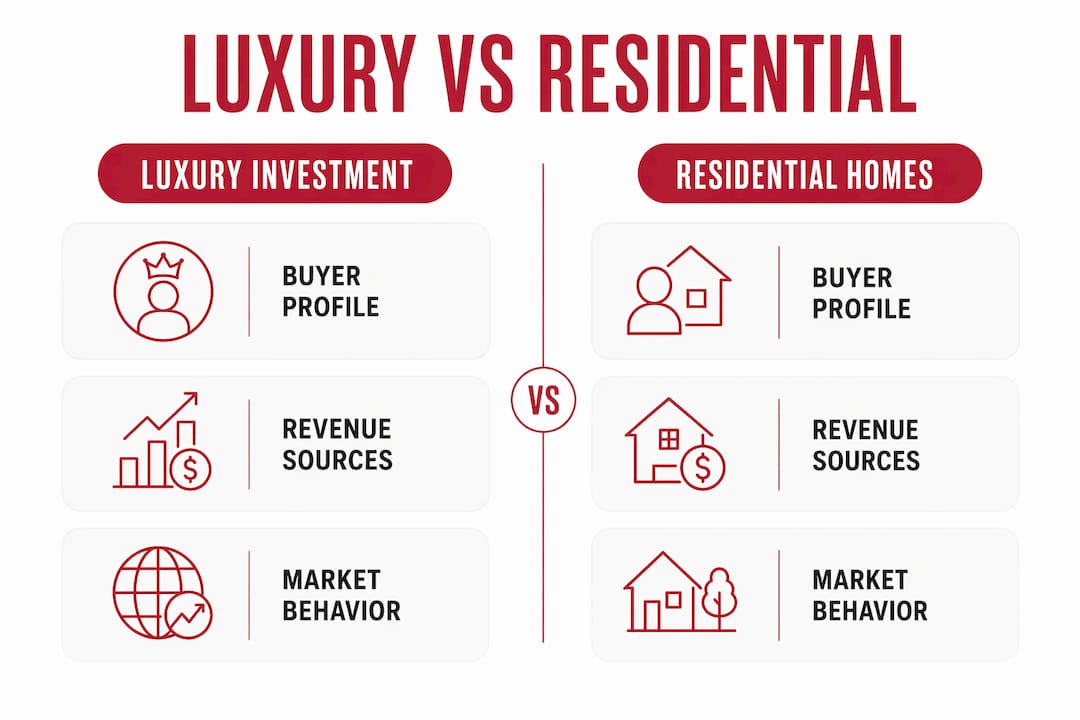
The most fundamental difference is who is buying and why. Ultra-high-net-worth buyers treat luxury real estate as a cornerstone of long-term wealth strategy, not a shelter purchase driven by mortgage rates or affordability calculations. That distinction changes everything about how these markets move.
Michael Altneu of Coldwell Banker has noted that luxury demand is shaped by wealth strategy rather than affordability, which explains why the luxury segment often holds or grows in value during periods when the broader residential market contracts. When the Federal Reserve raises rates and first-time buyers exit the market, high-net-worth buyers frequently accelerate purchases, viewing price softness as an entry opportunity.

Transactions in the luxury segment are structurally more complex. Buyers often operate through family offices, international holding structures, or trust arrangements. Some markets, particularly in coastal California, have limited luxury inventory that drives prices above asking. Others require extended negotiation because the buyer pool is smaller and each transaction is unique. Neither pattern resembles the volume-driven, comparable-sales logic of standard residential real estate.
Luxury buyers also prioritize personalization, legacy, and lifestyle amenities in ways that standard residential buyers do not. A buyer acquiring a $10 million estate in Rancho Santa Fe is not comparing it to a $500,000 tract home. They are evaluating the property as a generational asset, a lifestyle platform, and a portfolio holding simultaneously.
-
Luxury buyers are less sensitive to interest rate movements than residential buyers
-
Transactions frequently involve international capital, family offices, or trust structures
-
Limited inventory in premium markets creates pricing dynamics absent in residential segments
-
Legacy and personalization drive demand beyond standard affordability metrics
-
Market cycles in luxury real estate diverge significantly from the broader housing market
Pro Tip: If you are evaluating a luxury property as an investment, model it against comparable luxury transactions in the same submarket, not against regional residential medians. The two datasets measure entirely different buyer behaviors.
How branded residences change the investment equation
Branded residences represent the clearest structural departure from conventional residential real estate. These are properties tied to luxury hotel brands or premium marques, such as Four Seasons Private Residences, Aman, or Bulgari Hotels, that provide operational infrastructure, service standards, and a trust mechanism that justifies significant price premiums over non-branded luxury stock.
Knight Frank projects branded residence schemes will grow from 611 in 2025 to 1,019 by 2030. That projection signals a structural shift in how premium real estate is developed, marketed, and valued globally. North America and the Middle East are leading the expansion of standalone branded projects, which operate independently of adjacent hotels and rely entirely on brand equity and management agreements to sustain value.
The brand functions as more than a marketing label. It sets operational service standards, governs property management, and provides resale premium durability that non-branded luxury stock cannot replicate. Savills and Knight Frank both highlight that branded residences absorb a growing portfolio share among high-net-worth investors precisely because of these liquidity and operational advantages.
| Feature | Branded residence | Standard luxury home |
|---|---|---|
| Price premium | Significant, brand-justified | Location and finish dependent |
| Operational infrastructure | Hotel-grade management included | Owner-arranged or absent |
| Rental optionality | Managed rental program available | Self-managed or third-party |
| Resale durability | Brand equity supports long-term value | Market-cycle dependent |
| Buyer profile | Global HNWIs, portfolio investors | Regional buyers, lifestyle purchasers |
Pro Tip: When evaluating a branded residence, review the management agreement terms carefully. Brand permanence and the operator’s track record matter more than the brand name alone. A well-known brand with a weak operator agreement can erode the very premium you paid for.
For investors building a lasting luxury portfolio, branded developments offer a structural advantage that standard residential acquisitions simply cannot match.
Revenue complexity: luxury investments versus residential rentals
Standard residential rental properties generate income from one source: rent. Luxury investment properties, particularly those with hospitality links, generate income across rooms, food and beverage, events, recreation, memberships, and ancillary services. That difference in revenue architecture requires a completely different analytical framework.
TRevPAR, or Total Revenue per Available Room, captures the full income picture for hospitality-linked luxury assets in a way that RevPAR, which measures only room revenue, cannot. For an investor evaluating a luxury resort property or a branded residence with a rental program, using RevPAR alone would systematically undervalue the asset. TRevPAR reflects events revenue, spa income, dining, and membership fees, all of which contribute materially to net operating income.
Underwriting a luxury investment property correctly means separating value drivers into two distinct components: the real estate factors, which include location, land value, and liquidity, and the operator-driven factors, which include dynamic pricing, service quality, and cost management. Operational failure in a luxury property affects revenue far more severely than in a standard residential rental, where the income model is straightforward and tenant-driven.
Short-term rental luxury homes, when designed specifically for guest experience, outperform traditional long-term rentals on a per-night basis. The key word is “designed.” A luxury home with a pool, high guest capacity, and a destination location is a fundamentally different investment vehicle than a residential property rented on a month-to-month basis.
-
Hospitality-linked luxury properties generate income from rooms, F&B, events, recreation, and memberships
-
TRevPAR is the correct metric for full income modeling, not RevPAR
-
Underwriting must separate real estate value from operator-driven revenue components
-
Operational quality directly affects revenue in ways absent from standard residential rentals
-
Short-term luxury rentals require purpose-built design to achieve premium returns
For investors comparing rental strategies, a detailed short-term vs. long-term rental analysis clarifies where luxury assets generate the strongest risk-adjusted returns.
Why luxury short-term rentals outperform standard residential rentals
The short-term rental market has split into two distinct tiers, and the divide is widening. Average homes listed on platforms like Airbnb or Vrbo face rising supply, normalization of pandemic-era demand, and declining occupancy rates. Luxury short-term rentals designed for experience, however, are performing differently.
The top 10% of luxury rentals continue to command rising revenue despite broader market normalization. Properties with 16 or more guest capacity, resort-grade amenities like pools, saunas, and home theaters, and destination locations near coastlines or mountain ranges are capturing a disproportionate share of premium travel demand. This is not a temporary trend. It reflects a structural shift in how affluent travelers allocate leisure spending.
Properties that lack a distinctive experience fall behind as supply increases. A four-bedroom home with standard finishes in a suburban location competes on price alone, which is a losing strategy in a saturated market. A six-bedroom oceanfront property in a market like San Diego, with a private pool and concierge-level design, competes on experience, which is a far more defensible position.
Operators and investors in this segment must commit to continuous reinvestment. Guest expectations in the luxury short-term rental category rise each year. A property that delivered premium returns in 2022 without updates will underperform by 2026 if the amenity set has not kept pace with competitor properties. Luxury short-term rental success requires treating the asset like a hospitality business, not a passive residential investment.
San Diego’s coastal markets, including properties in Ocean Beach and downtown, illustrate this dynamic well. Stuharveyestates has worked with investors acquiring properties like 4963 Long Branch Ave and 101 Market St Unit 108 specifically for their short-term rental potential, where location and design quality drive returns that no standard residential rental in the same zip code can match.
Key takeaways
Luxury investment properties outperform residential homes in value durability and income potential because they operate under different market cycles, revenue models, and buyer demand structures.
| Point | Details |
|---|---|
| Different market cycles | Luxury buyers are less rate-sensitive, creating demand patterns that diverge from residential markets. |
| Branded residence growth | Knight Frank projects branded schemes to grow from 611 to 1,019 by 2030, signaling structural investment opportunity. |
| Multi-stream revenue | Hospitality-linked luxury assets require TRevPAR modeling to capture full income beyond rent alone. |
| Short-term rental split | The top 10% of luxury rentals outperform as experience-driven demand separates premium from average properties. |
| Underwriting discipline | Separating real estate and operator-driven value components is required for accurate luxury investment analysis. |
What 15 years in luxury real estate taught me about these differences
Most investors who come to me after losing money on a luxury property made the same mistake: they applied a residential investment framework to an asset that required a completely different model. They looked at price per square foot, compared it to nearby sales, and assumed the income would follow. It does not work that way.
Luxury investment properties require you to think like an operator, not just an owner. When I work with clients evaluating a branded residence or a high-capacity short-term rental in La Jolla, the first conversation is always about revenue architecture. What are the income streams? Who manages them? What does operational failure look like, and what does it cost? Those questions do not exist in residential real estate analysis.
The branded residence trend is the most significant structural shift I have seen in this market in over a decade. The projected growth to more than 1,000 schemes globally by 2030 is not a marketing story. It reflects genuine investor demand for assets that combine real estate appreciation with operational income and brand-backed liquidity. Clients who understood this early have built positions that outperform standard luxury stock by a meaningful margin.
My honest view is that the residential vs. luxury investment distinction is not primarily about price. It is about complexity. Luxury investments reward investors who do the work to understand multi-stream revenue, management agreements, and market cycle behavior. Those who treat a $5 million property the same way they would treat a $500,000 rental will consistently underperform. The lifestyle real estate priorities driving San Diego’s luxury market in 2026 make this distinction more important than ever.
— Stu
Find your next luxury investment with Stuharveyestates
Stu Harvey brings more than 15 years of real estate experience and 250+ personal career transactions to his work with buyers and sellers. Whether you are evaluating a branded residence, a short-term rental investment, or a legacy estate in La Jolla or Rancho Santa Fe, the advisory process combines deep local market knowledge with the kind of revenue and operational analysis that luxury investments demand.
Stuharveyestates provides access to premium listings, personalized investment guidance, and neighborhood-level insights that generic platforms cannot replicate. Start your search with the luxury listings portal to explore active opportunities across San Diego’s most sought-after coastal markets. For buyers who want structured guidance through the acquisition process, the San Diego buyers guide outlines exactly how Stuharveyestates supports informed, confident decisions at every stage.
FAQ
What makes luxury investment properties different from residential homes?
Luxury investment properties differ from residential homes in market cycle behavior, buyer profiles, revenue complexity, and value drivers. High-net-worth buyers treat them as wealth strategy assets, not affordability-driven purchases, which creates fundamentally different demand and pricing dynamics.
What is a branded residence and why does it matter for investors?
A branded residence is a luxury property tied to a hotel brand or premium marque that provides operational infrastructure, managed rental programs, and price premium durability. Knight Frank projects these schemes to grow from 611 to 1,019 globally by 2030, reflecting strong investor demand for brand-backed liquidity.
Why should luxury investors use TRevPAR instead of RevPAR?
TRevPAR captures total revenue across rooms, food and beverage, events, and recreation, while RevPAR measures only room income. For hospitality-linked luxury investments, using RevPAR alone systematically undervalues the asset and produces inaccurate return projections.
Are luxury short-term rentals better investments than standard residential rentals?
The top 10% of luxury short-term rentals outperform standard residential rentals when the property is purpose-built for guest experience, with high guest capacity, premium amenities, and a destination location. Average homes without distinctive features lose bookings as short-term rental supply increases.
How do I evaluate a luxury investment property correctly?
Accurate luxury investment analysis requires separating real estate value drivers, such as location and land value, from operator-driven revenue components, including dynamic pricing and service quality. Applying a standard residential comparable-sales model to a luxury investment asset produces unreliable valuations.