
Luxury properties stall on the market for one reason above all others: the marketing plan treats them like ordinary listings. A generic 30-day campaign, standard MLS photos, and a few social posts will not move a $4 million home in La Jolla or a $7 million estate in Rancho Santa Fe. A proper luxury property marketing plan functions more like a product launch than a real estate transaction. It requires research, phased execution, premium visual production, and constant adaptation based on real buyer data. This guide walks you through exactly how to build one that performs.
Table of Contents
Key Takeaways
| Point | Details |
|---|---|
| Plan for 90 days, not 30 | Luxury listings require multi-phase timelines with different messaging and channels in each phase. |
| Staging drives buyer visualization | 83% of buyers’ agents say staging helps clients picture themselves in a home, directly influencing offers. |
| Visuals must be ready at launch | Publishing without professional photos and video weakens pricing power and buyer engagement from day one. |
| Microsites multiply engagement | Buyers visit single-property websites four to nine times before requesting a private showing. |
| Data should drive adjustments | Marketing refreshes with new visuals cost far less than price reductions and add meaningful exposure time. |
Building your luxury property marketing plan: foundation first
Before a single ad runs or a listing goes live, the groundwork determines whether the entire campaign succeeds or collapses. This preparation phase is where most sellers lose ground, and where the best agents create a genuine competitive edge.
Start with a deep market analysis. Study comparable luxury sales from the last 12 months in your specific neighborhood, not just the broader city. Pay attention to days on market, original versus final sale price, and what the listings that sold quickly had in common visually and narratively. That pattern tells you what the local affluent buyer actually responds to.
Next, identify what makes this specific property irreplaceable. Not just “ocean views” but the precise lifestyle it delivers. Is it the sunrise angle from the primary suite? The indoor-outdoor flow built for year-round entertaining? Understanding San Diego’s luxury buyers prioritizing lifestyle real estate matters because your messaging must speak to the life the buyer will live, not the building they will own.
Defining your buyer persona matters more at this price point than almost anywhere else. Affluent buyers at $3 million and above are not browsing casually. Luxury marketing success depends on precision targeting toward smaller, more demanding audiences who value privacy and exclusivity. Use behavioral data from your CRM, past transaction history, and referral network to identify whether your ideal buyer is a relocating executive, a multigenerational family, an international buyer, or a move-up local.
Pro Tip: Never launch before your visual assets are fully production-ready. Launching without professional photos undermines your pricing power and trains early buyers to negotiate harder.
Staging and production budget benchmarks
| Asset Type | Estimated Cost | Impact |
|---|---|---|
| Full property staging | $2,000–$8,000 | High: drives buyer visualization |
| Architectural photography (45–80 images) | $1,200–$3,500 | Critical: first impression in every channel |
| Cinematic listing video | $2,800–$7,500 | High: emotional engagement and sharing |
| Twilight / aerial drone imagery | $400–$1,200 | Strong: twilight photos outperform daytime by 22–31% |
| Single-property microsite | $800–$2,500 | High: repeat visits and lead capture |
Developing a phased, bespoke campaign structure
This is where a generic plan and a true luxury real estate strategy separate. Structure your campaign in three distinct phases over 60 to 90 days, each with its own messaging focus, channel mix, and success metrics.

Phase 1: Awareness and excitement (days 1–21)
The goal here is controlled exposure with maximum impact. This is when your best visual assets deploy across every premium channel simultaneously. Think of it as a coordinated launch day, not a gradual rollout. Fresh, high-quality imagery hits the global luxury portals, your social platforms, and your agent network on the same morning.
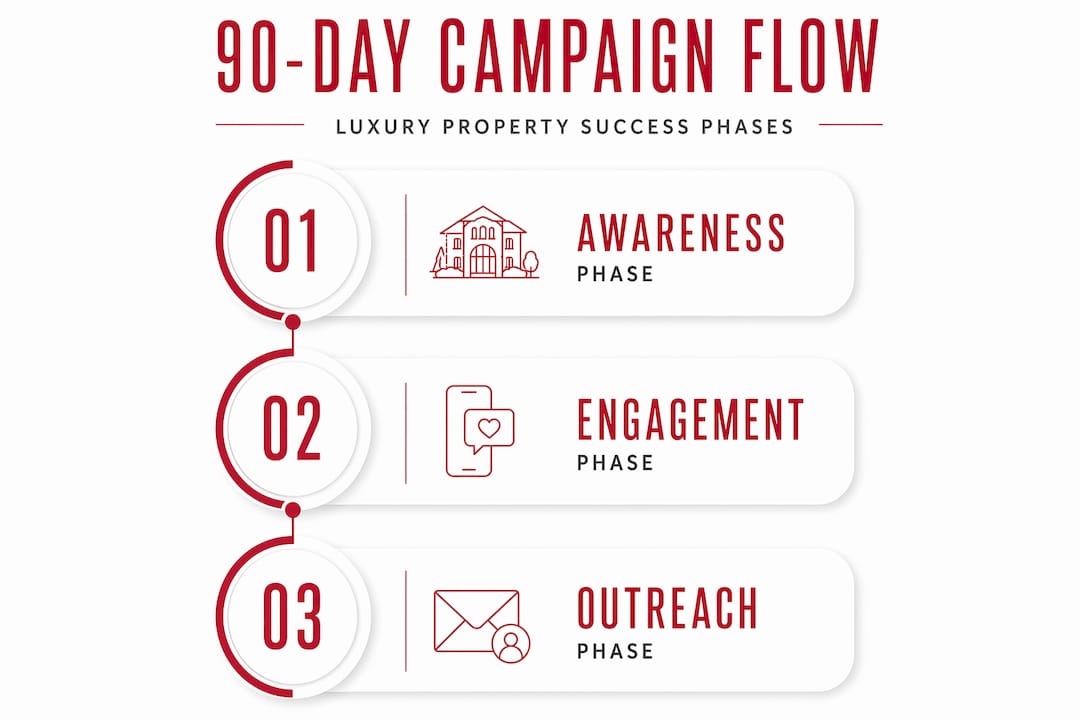
Phase 2: Engagement and adaptation (days 22–50)
This is where most campaigns go wrong by staying static. By now you have real data: which photos generate the most saves, how long buyers spend on the property website, what feedback your showing agents are hearing. Use that intelligence. Shift messaging toward the specific features generating the most interest. If buyers consistently mention the chef’s kitchen but ignore the media room, your Phase 2 content leads with food and entertaining.
Phase 3: Targeted outreach and relationship nurturing (days 51–90)
Phase 3 narrows focus to your most qualified prospects. This means invitation-only broker events, private showings for pre-qualified buyers, and direct outreach through your referral network. Private events and invitation-only showings consistently convert at higher rates for luxury properties than any broad advertising push.
Here are the premium channels worth investing in across all three phases:
-
Cinematic listing films posted natively on YouTube, Instagram, and syndicated to luxury portals
-
3D virtual tours embedded on your single-property microsite
-
Global portals like Sotheby’s International Realty or Leading Real Estate Companies of the World
-
Paid social ads on Instagram and Facebook with behavioral targeting for high-net-worth users
-
Direct email campaigns to your private buyer database and affiliated agents
-
Print placement in regional luxury lifestyle publications for physical brand presence
Pro Tip: Customize your messaging for cultural context. A relocating tech executive from Seattle and a multigenerational family from Mexico City respond to entirely different stories about the same property. Build both.
Executing premium visual and digital marketing
Production quality is not optional at the luxury level. It is the product. The moment a buyer lands on your listing or microsite, the visual experience signals whether this property is worth their time or not. A documented plan integrating brand, budget, and KPIs is proven to drive better outcomes precisely because it forces these production decisions early, before launch pressure creates shortcuts.
Here is what your visual and digital execution should include:
-
Architectural photography: Budget $1,200 to $3,500 for a 45 to 80 image package from a photographer who specializes in residential architecture, not commercial real estate. The lighting, staging, and lens choices are meaningfully different.
-
Twilight and aerial drone imagery: Twilight photos consistently generate stronger emotional reactions than daytime shots. Drone footage contextualizes a property’s relationship to the ocean, golf course, or canyon in ways that ground-level photography cannot.
-
Virtual staging compliance: When using virtual staging for vacant rooms, every altered photo requires a clear “Virtually Staged” label. MLS boards mandate per-photo disclosures on each modified image and disclosure in the listing remarks. Skipping this risks removal and fines.
-
Story-driven microsites: A single-property website consolidates every asset: the film, the photo gallery, the 3D tour, the neighborhood story, and a lead capture form. Buyers return to these sites repeatedly before committing to a showing.
Pro Tip: For paid social, define your qualified lead criteria before the campaign launches. Defining lead criteria pre-launch dramatically improves ad efficiency and reduces wasted spend on low-intent traffic.
SEO and content for long-term visibility
Beyond paid channels, a luxury property benefits from curated digital content that ranks organically. A neighborhood guide, a lifestyle feature on the area, and a property-specific story page all build search presence that works continuously. Buyers researching San Diego luxury neighborhoods often start with organic search weeks before they contact an agent.
Monitoring results and adapting your campaign
A luxury campaign that runs without measurement is a budget drain. Build in formal review checkpoints at day 21, day 45, and day 75. At each checkpoint, assess the following:
-
Photo view counts and save rates on MLS and portal listings
-
Website traffic to the property microsite, including time on site and return visits
-
Showing request volume and quality, specifically pre-qualified versus exploratory inquiries
-
Feedback themes from showing agents, noting any consistent objections
-
Paid social click-through rates and cost per qualified lead against your pre-defined criteria
When engagement drops without a showing conversion, resist the instinct to cut price immediately. Marketing refreshes with new visuals and restaged rooms cost $1,500 to $4,500 and add 30 to 60 days of fresh exposure without signaling distress to the market. A price reduction tells every buyer that the property was overpriced. A fresh campaign tells them there is something new to see.
Client communication matters as much as the metrics themselves. Send weekly performance summaries that show photo views, showing counts, and feedback summaries. Sellers who see data feel confident. Sellers who feel ignored push for price cuts.
“Effective luxury property marketing integrates storytelling, emotional connection, and measurable conversion tracking rather than treating the listing as a static asset.” — Luxury Presence
My take on what actually moves luxury properties
Individual listings benefit from the same careful preparation as a product launch: a defined audience, strong presentation, and a clear sequence of marketing activities. Each element should reflect the property and the buyers most likely to consider it.
The conventional wisdom says you need maximum exposure and as many leads as possible. I disagree entirely. In luxury real estate, more leads is not the goal. The right buyers are. A hundred unqualified inquiries wastes everyone’s time and can actually signal to serious buyers that the property is struggling. Twenty deeply qualified prospects, each reached through precision targeting and a compelling story, closes deals.
I have also seen what happens when sellers skip staging because they think their home “shows well enough.” It does not. The camera sees differently than the human eye, and real estate storytelling only works when the visual material gives buyers something emotionally compelling to connect with. Every dollar spent on staging before a shoot pays back at the negotiating table.
The final lesson I keep learning is that relationships close luxury transactions, not advertising alone. The broker who brings the buyer almost always knows the property through a personal conversation, a curated email, or a private event. Build those relationships before you need them.
— Stu
How Stuharveyestates brings your marketing plan to life
At Stuharveyestates, every listing begins with a bespoke marketing plan built specifically for that property, that neighborhood, and that buyer pool. With more than 15 years of real estate experience and 250+ personal career transactions, Stu Harvey brings practical experience to planning each listing campaign. Browse current luxury listings to see how premium marketing presentation translates directly into buyer engagement. Whether you are preparing a La Jolla estate or a Rancho Santa Fe compound for market, Stuharveyestates develops the full campaign: cinematic production, single-property websites, targeted digital outreach, and the private network access that moves properties at price. Contact Stu directly to get a personalized plan built around your specific property and timeline.
FAQ
What is a luxury property marketing plan?
A luxury property marketing plan is a bespoke, multi-phase campaign strategy that combines premium visual production, targeted buyer outreach, and data-driven adaptation to sell high-end homes at the right price. It treats the listing as a product launch rather than a standard MLS entry.
How long should a luxury marketing campaign run?
Most luxury properties benefit from a 90-day phased campaign rather than a short 30-day push, because average days on market are longer and each phase requires different messaging and channel strategies.
When should I use virtual staging in luxury listings?
Virtual staging works well for vacant or under-furnished rooms, but every altered image must include a “Virtually Staged” label per MLS compliance rules. Skipping disclosures risks listing removal and ethical violations.
What metrics indicate a luxury campaign is working?
Track photo view rates, microsite return visits, qualified showing requests, and paid social cost per lead. Consistent showing requests with positive feedback confirm the campaign is reaching the right buyers at the right message.
Is a price reduction better than a marketing refresh?
A marketing refresh with new visuals and restaged photography is almost always preferable. It adds 30 to 60 days of renewed market exposure without the price-distress signal that a reduction sends to sophisticated luxury buyers.