
A luxury property needs assessment is a structured pre-transaction analysis that aligns a buyer’s lifestyle goals, investment criteria, and architectural preferences with a property’s physical condition, regulatory constraints, and market realities. The industry term for this process is a feasibility and site study, though “needs assessment” accurately describes its buyer-facing purpose. For properties priced at $2M and above, this evaluation is not optional. It is the difference between a confident acquisition and a costly mistake. Stu Harvey brings experience from 250+ personal career transactions to his work with buyers. A thoughtful assessment helps clarify priorities and identify questions to resolve before closing.
What does a luxury property needs assessment include?
A luxury property needs assessment covers far more ground than a standard home inspection. It is a strategic pre-transaction analysis that examines environmental constraints, zoning compliance, structural condition, and lifestyle alignment in one coordinated review.
The core components of a thorough assessment include:
-
Environmental and site constraints. Grading limitations, flood zone designations, historic preservation overlays, and easements all define what a buyer can actually do with the land. Legal boundaries and buildable envelopes are examined before any schematic planning begins.
-
Structural and systems evaluation. Roof condition, foundation integrity, HVAC capacity, electrical panels, and plumbing age are assessed against the property’s scale. A 12,000-square-foot estate has mechanical systems that dwarf those in a standard home.
-
Regulatory and zoning compliance. Setback requirements, height restrictions, and local design review board rules can block planned renovations entirely. Identifying these early prevents expensive redesigns after purchase.
-
Future-proofing factors. Energy efficiency, ceiling heights, and glazing all affect long-term marketability. Smart home infrastructure, solar readiness, and EV charging capacity are now standard evaluation points in 2026.
-
Lifestyle alignment. Privacy features like gated access and long private drives, proximity to private schools or marinas, and accessibility for aging-in-place needs are all measured against the buyer’s stated priorities.
Pro Tip: Ask your advisor to map each assessment finding directly to your stated must-haves and deal-breakers before the inspection report is finalized. This turns a technical document into a decision tool.
How does a luxury property needs assessment differ from a standard appraisal?
The standard appraisal process and a luxury property needs assessment serve different purposes. A standard appraisal produces a single market value number for lender use. A luxury evaluation produces a detailed narrative that explains why that number is what it is, and what risks or premiums the property carries beyond comparable sales data.

| Factor | Standard appraisal | Luxury property evaluation |
|---|---|---|
| Report length | 10–15 pages | 20–40 page narrative addendum |
| Comparable search radius | 1–2 miles, 6 months | Up to 10 miles, 12–18 months |
| Data sources | MLS public records | MLS plus auction archives, private networks |
| Value drivers | Square footage, beds, baths | Architectural provenance, privacy, scarcity |
| Valuation methods | Sales comparison | Cost, market, and scenario analysis combined |
| Onsite inspection time | 30–60 minutes | 1–4 hours |
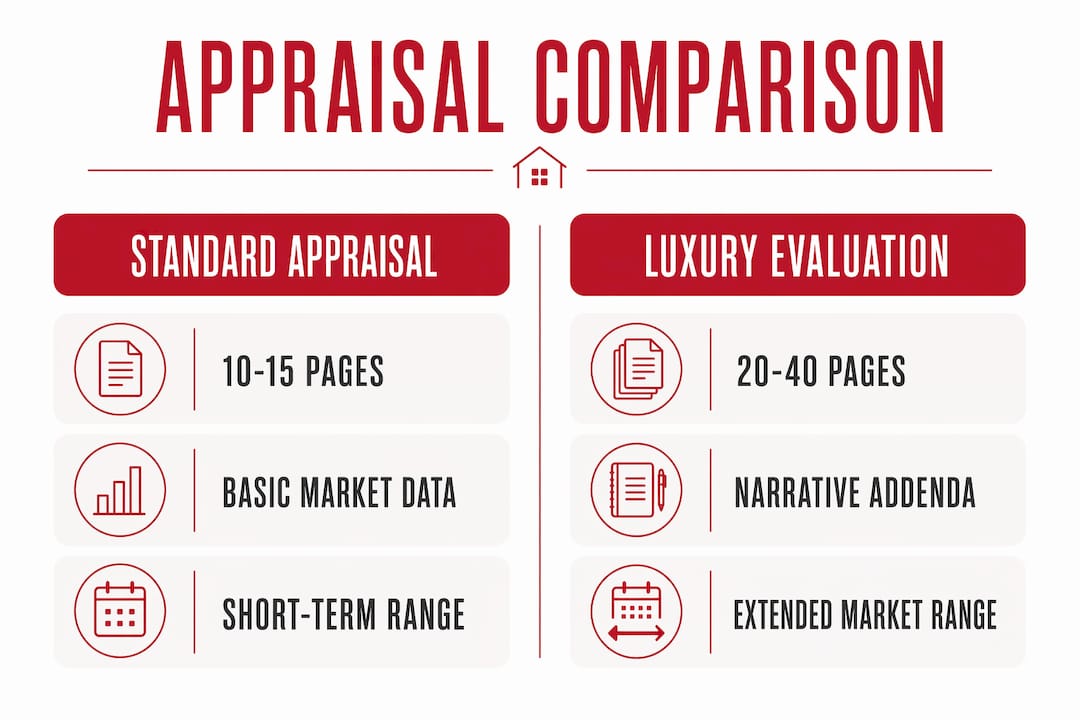
Algorithms cannot fully value scarcity or architectural provenance. A home designed by a recognized architect commands a premium that no automated valuation model can calculate. That gap is exactly what the narrative addendum addresses.
Properties over $1.5M often require two independent appraisals to satisfy lender requirements. That requirement reflects the inherent complexity of valuing assets where comparable sales are rare and buyer pools are global.
Luxury appraisers also rely on private network data and auction archives to find relevant benchmarks. A Rancho Santa Fe estate may have only three true comparables sold in the past 18 months, and two of those may have been off-market transactions invisible to standard MLS searches.
Pro Tip: When reviewing a luxury appraisal report, go straight to the comparable selection rationale. If the appraiser cannot explain why each comparable was chosen, the valuation is weaker than it looks.
Why is a luxury property needs assessment vital before buying or selling?
Skipping a thorough assessment on a $3M property to save time is a false economy. The financial exposure from undiscovered issues or regulatory conflicts can exceed the cost of the assessment by orders of magnitude. Here is what a well-executed evaluation protects against:
-
Hidden capital costs. A luxury home with aging mechanical systems, a failing seawall, or a roof requiring full replacement can carry $500,000 or more in deferred maintenance. The assessment quantifies these costs before you commit.
-
Regulatory surprises. A buyer who plans to add a guest house may discover the lot has no remaining buildable envelope under current zoning. That discovery after closing is a permanent constraint on the property’s value and utility.
-
Lender confidence. Narrative appraisal reports explain the rationale behind comparable selection and value adjustments. Without that documentation, high-value loans stall in underwriting.
-
Lifestyle misalignment. A buyer prioritizing privacy who purchases a property with a public easement running through the rear garden has a fundamental problem no renovation can solve.
-
Negotiation leverage. A documented assessment gives buyers concrete grounds to negotiate price reductions or seller credits. Sellers who commission their own assessment before listing can preempt objections and justify their asking price with evidence.
Liquidity in luxury real estate is limited compared to standard residential markets. That limited liquidity makes pre-purchase due diligence more critical, not less. A buyer who overpays for a $4M property in a thin market may wait years to recover that premium.
Sellers benefit equally. Preparing a comprehensive documentation package with architectural plans, permits, and smart home system details gives appraisers the information they need to support a strong valuation. Sellers who leave appraisers to find this information independently risk undervaluation.
What are best practices for conducting a luxury property needs assessment?
A thorough assessment requires the right team, the right preparation, and a clear understanding of what you are trying to learn. These practices separate effective evaluations from checkbox exercises:
-
Engage appraisers with specific luxury market expertise. A generalist appraiser working a $4M estate in La Jolla will struggle to find relevant comparables and may undervalue intangible premiums. Seek appraisers who specialize in the specific submarket and price tier.
-
Build a complete fact pack before the assessment begins. Architectural plans, restoration documents, specialized permits, and smart home system details all support a more accurate valuation. Sellers who provide this documentation upfront reduce the risk of value being left on the table.
-
Understand local regulatory complexity early. Coastal Commission rules in Southern California, historic district overlays in older neighborhoods, and HOA architectural guidelines all affect what a buyer can build or modify. These constraints should be mapped before the purchase contract is signed.
-
Apply scenario-based valuation for rare properties. For a one-of-a-kind oceanfront estate or a historically significant compound, multi-method valuation approaches combining cost analysis, market data, and hypothetical development scenarios produce a more defensible value range than any single method alone.
-
Assess upgrade flexibility and lifecycle costs. A property that cannot accommodate future technology upgrades or accessibility modifications has a shorter effective lifespan as a luxury asset. Lifestyle and long-term value alignment should be explicit criteria in every assessment.
Pro Tip: Commission your own independent assessment even if the seller provides one. Seller-prepared documentation is valuable input, but your assessment should reflect your specific goals and risk tolerance, not theirs.
Building a lasting luxury real estate portfolio starts with this kind of disciplined due diligence at the acquisition stage. Properties that pass a rigorous assessment tend to hold value better through market cycles.
Key Takeaways
A luxury property needs assessment is the most cost-effective tool available for protecting a high-value real estate decision, because it surfaces hidden risks, regulatory constraints, and valuation gaps before they become irreversible.
| Point | Details |
|---|---|
| Definition and scope | A needs assessment is a pre-transaction feasibility study covering site, structure, regulation, and lifestyle fit for $2M+ properties. |
| Appraisal differences | Luxury evaluations require 20–40 page narrative addenda, extended comparable searches, and multi-method valuation approaches. |
| Financial protection | Assessments quantify deferred maintenance, regulatory constraints, and capital needs before a buyer commits. |
| Seller advantage | Sellers who prepare complete documentation packages support stronger appraisals and reduce the risk of undervaluation. |
| Expert selection | Appraisers with specific luxury submarket experience produce more defensible valuations than generalists. |
What 15 years in luxury real estate taught me about assessments
Most buyers treat the needs assessment as a hurdle to clear before closing. That framing is wrong. The assessment is the moment when a transaction either earns its price or reveals that it should not proceed at the agreed terms.
I have seen buyers in La Jolla skip detailed site reviews on oceanfront properties, only to discover post-closing that Coastal Commission restrictions blocked the addition they had planned for two years. The property was still beautiful. But it was not the property they thought they were buying.
The 2026 luxury market in Southern California has added new layers to this process. San Diego’s luxury buyers are prioritizing lifestyle real estate in ways that make energy performance, privacy infrastructure, and technology readiness genuine value drivers, not just nice-to-haves. An assessment that does not address these factors is already outdated.
The other misconception I encounter regularly is that assessments are only for buyers. Sellers who invest in a pre-listing evaluation consistently achieve better outcomes. They walk into negotiations with documented evidence supporting their price. They preempt the objections that kill deals in the final week. And they close faster because the buyer’s due diligence confirms what the seller already knows.
The assessment is not an obstacle. It is the most valuable tool in the transaction.
— Stu
Work with Stuharveyestates on your next luxury property decision
Stu Harvey brings more than 15 years of real estate experience to his work with buyers and sellers. Whether you are buying or selling in La Jolla, Rancho Santa Fe, or across San Diego County, the assessment process is where informed decisions begin. Stu Harvey’s team combines deep local market knowledge with a disciplined evaluation framework to ensure your property goals align with market and regulatory realities. Start with the curated luxury listings to find properties that match your criteria, or contact the team directly for a personalized consultation on your specific situation. Also explore the San Diego neighborhoods guide to understand how location shapes long-term value.
FAQ
What is a luxury property needs assessment?
A luxury property needs assessment is a pre-transaction feasibility study that evaluates a property’s physical condition, regulatory constraints, and lifestyle fit for buyers and sellers of homes priced at $2M and above. It goes beyond a standard inspection to cover zoning, environmental limits, and long-term marketability.
How long does a luxury property appraisal take?
Onsite inspection for a luxury property typically takes 1–4 hours, with the full appraisal report taking 2–4 weeks to complete. Properties over $1.5M often require two independent appraisals to satisfy lender requirements.
What makes a property qualify as luxury real estate?
Luxury real estate is defined by a combination of price threshold, location, architectural quality, privacy features, and scarcity. Intangible factors like architect pedigree and gated access and privacy carry measurable weight in valuation beyond material costs alone.
How does the luxury property valuation process differ from standard appraisals?
Luxury valuations require narrative addenda of 20–40 pages, comparable searches extending up to 10 miles and 18 months back, and multi-method approaches combining cost, market, and scenario analysis. Standard appraisals rely primarily on nearby recent sales and produce much shorter reports.
Why should sellers commission a needs assessment before listing?
Sellers who prepare complete documentation packages, including architectural plans and permit records, give appraisers the evidence needed to support a strong valuation. Pre-listing assessments also reduce the risk of buyer objections derailing a deal during the final due diligence period.