
A luxury property repositioning strategy is a comprehensive plan to shift a real estate asset to a higher market class by upgrading its physical quality, amenities, management, branding, and tenant profile. This goes far beyond a standard renovation. Experienced syndicators and institutional investors use repositioning to unlock two compounding value drivers: net operating income (NOI) growth and cap rate compression. Together, these mechanisms can produce returns that a simple refurbishment cannot match. Understanding how each component works is the difference between a profitable reposition and an expensive cosmetic upgrade.
What is a luxury property repositioning strategy?
A luxury property repositioning strategy is a multi-dimensional upgrade that moves an asset from one market class to a higher one, typically from Class C or B to Class B or A. The strategy covers physical improvements, operational changes, brand alignment, and a deliberate shift in the target tenant or guest profile. Each dimension must work together. Upgrading finishes without changing management or marketing produces a renovated but underperforming asset.
The financial logic is direct. Repositioning increases rents, reduces vacancy, and compresses the cap rate applied to the property’s value. Investors who understand this dual mechanism can underwrite deals with far greater precision than those who treat repositioning as a renovation budget line.

Repositioning is not a niche tactic. JLL identifies obsolescence risk as one of the primary threats to commercial and residential portfolios, and repositioning as the primary defense. That framing matters: it positions this strategy as risk management, not just value creation.
What core components define a luxury repositioning?
Successful repositioning covers five interconnected areas. Skipping any one of them weakens the others.
-
Physical unit upgrades. Kitchens, bathrooms, flooring, and fixtures must meet the standards of the target market class. In multifamily assets, comprehensive upgrades typically require $1–3 million in 100-unit buildings to achieve a genuine class shift.
-
Common areas and exterior. Lobbies, landscaping, lighting, and curb appeal signal the property’s new positioning before a prospective tenant or guest steps inside. These elements drive first impressions and justify premium pricing.
-
Distinctive amenities. Dog parks, smart home technology, co-working spaces, and fitness centers are now baseline expectations in Class A luxury assets. Adding them converts a functional property into a lifestyle product.
-
Operational upgrades. New property management, improved leasing processes, and tighter maintenance standards protect the physical investment and support higher rents. Poor operations erode even the best renovation.
-
Rebranding and tenant profile adjustment. New signage, updated marketing, and a deliberate tenant turnover strategy gradually replace existing tenants with qualified residents willing to pay market-rate luxury rents.
Pro Tip: Start the tenant transition plan before construction begins. Coordinating lease expirations with renovation phases reduces vacancy loss and keeps cash flow predictable throughout the repositioning period.
In luxury hospitality, the component list expands further. Repositioning extends beyond décor to include redefining food and beverage concepts, service models, and brand or operator alignment. A hotel that renovates its rooms but keeps a dated restaurant concept sends a mixed signal to the market.
How does repositioning create financial value beyond refurbishment?
The financial case for repositioning rests on two mechanisms working simultaneously: NOI growth and cap rate compression.
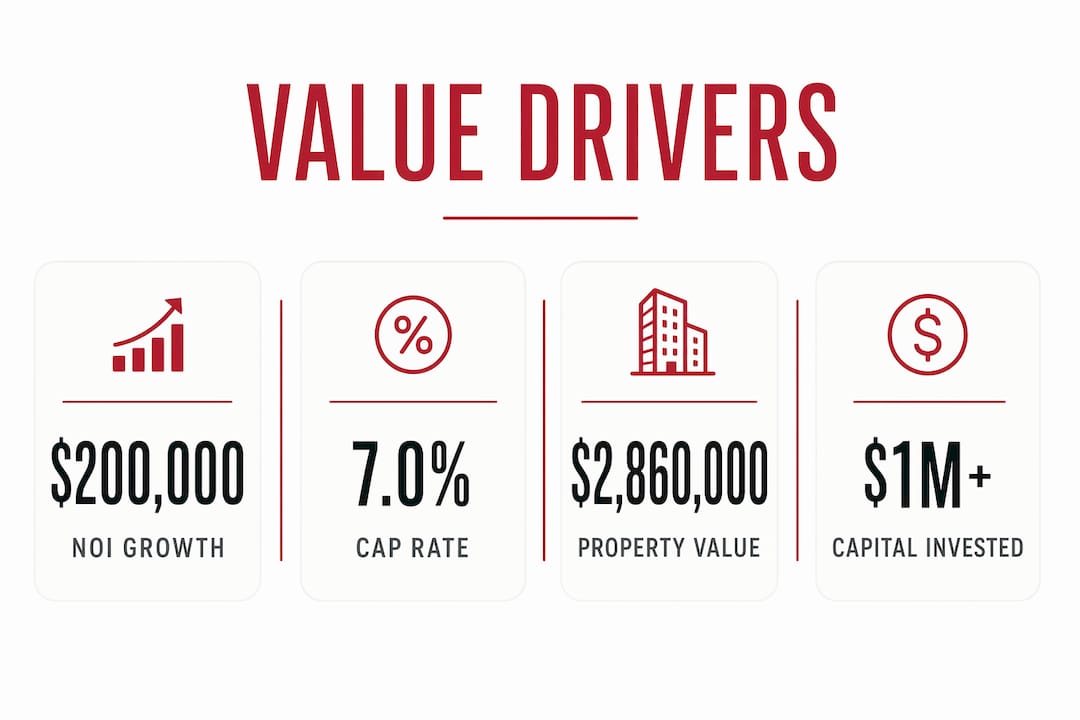
NOI growth comes from higher rents, better occupancy, and tighter operating expenses. Cap rate compression happens when the market assigns a lower risk premium to a higher-class asset. A lower cap rate applied to a higher NOI produces a dramatically larger valuation.
The numbers make this concrete. A property generating $200,000 in NOI at a 7% cap rate is worth approximately $2.86 million. After repositioning, the same property generating $280,000 in NOI at a 5.5% cap rate is worth approximately $5.09 million. That is a 78% increase in value from a combination of income growth and multiple expansion. No cosmetic renovation produces that result.
“Value creation combines NOI uplift and valuation multiple compression, which must be incorporated in underwriting to avoid overpaying.” — Deal Run
This distinction matters in underwriting. Investors who model only rent increases miss half the value creation. Accurate NOI to value modeling requires assumptions for both the going-in cap rate and the stabilized cap rate at exit. The spread between those two numbers is where repositioning profit lives.
Risk is real. Repositioning requires significant capital, extended timelines, and management bandwidth. Thorough underwriting must stress-test rent assumptions, construction costs, and lease-up timelines. The difference between a successful reposition and a failed one is almost always the quality of the underwriting, not the quality of the renovation.
| Scenario | NOI | Cap Rate | Estimated Value |
|---|---|---|---|
| Pre-repositioning | $200,000 | 7.0% | $2,860,000 |
| Post-repositioning | $280,000 | 5.5% | $5,090,000 |
| Value increase | $80,000 | 1.5% compression | $2,230,000 (78%) |
What strategic framework guides an effective repositioning concept?
A repositioning concept fails when it is designed without a defined target market. Market analysis must come first. Investors need to identify the optimal tenant or guest segment, understand their lifestyle priorities, and build every subsequent decision around that profile.
PHG advises treating repositioning as an interlocking system of four elements: target persona, product and amenity standards, brand or operator alignment, and the operational model. Each element must reinforce the others. A luxury persona requires luxury amenities. Luxury amenities require a brand that can credibly deliver them. That brand requires an operational model capable of sustaining the standard.
The framework works as follows:
-
Define the target segment. Identify who will pay the target rent or rate, what they value, and what competing properties they are currently choosing.
-
Set product standards. Specify the finish level, amenity package, and service model required to win that segment.
-
Align brand and operator. Select a brand or management company whose standards and distribution match the target segment’s expectations.
-
Build the operational model. Staff, systems, and processes must support the brand promise at the required cost structure.
-
Assess compliance and sustainability. Future regulations on energy efficiency, accessibility, and environmental standards affect both construction costs and long-term asset resilience.
Pro Tip: If market analysis reveals that the target segment is already well-served by competing properties, repositioning may not be the right strategy. PHG notes that some assets are better suited for a sale or operational improvement program than a full reposition.
Reviewing the 2026 luxury market outlook before committing to a concept helps investors align their repositioning thesis with current demand patterns rather than assumptions from a prior cycle.
What practical steps drive successful repositioning execution?
Execution separates repositioning concepts from repositioning results. The physical work, the brand introduction, and the relaunch must be managed as a single coordinated program.
-
Phase construction with decision gates. Break renovation into phases with defined owner review points. This preserves flexibility to adjust scope, budget, or timeline based on market feedback during the project.
-
Protect operations during partial openings. In hospitality assets, partial openings during renovation require careful guest communication and rate management. A poor experience during transition can damage the brand before the reposition is complete.
-
Plan the reopening at least 90 days before project completion. Tiered rate introduction linked to occupancy triggers avoids demand shocks and supports a smooth pricing ramp-up. Waiting until completion to think about pricing is one of the most common and costly mistakes in repositioning.
-
Treat brand or operator change as a primary value lever. PHG’s experience shows that brand introduction can double revenue and unlock the full value potential of a repositioned asset. Access to international distribution, investor credibility, and premium pricing all follow a credible brand change.
-
Apply a surgical capital spend approach. Sibley Grove recommends focusing spend on elements that drive guest or tenant perception. Replacing functional mechanical systems without a clear business case consumes capital without producing visible value.
Effective luxury property marketing is the final execution lever. Digital channels, professional photography, and targeted outreach to qualified buyers or tenants must be ready before the property relaunches. A repositioned asset with weak marketing underperforms its potential from day one.
How do market trends in 2026 shape repositioning decisions?
The macro environment in 2026 creates specific conditions that favor well-executed luxury repositioning.
-
Sustainability and regulatory compliance are now design requirements, not optional upgrades. JLL’s analysis of at-risk assets shows that properties failing to address energy and environmental standards face accelerating obsolescence. Repositioning that incorporates green building standards protects long-term value.
-
Lifestyle priorities are driving luxury demand. San Diego markets show that luxury buyers in 2026 are prioritizing wellness amenities, outdoor access, and flexible living spaces. Repositioning concepts that ignore these preferences miss the current demand signal.
-
Technology and AI are operational differentiators. Smart home features, AI-assisted property management, and digital leasing platforms are now expected in Class A assets. They also reduce operating costs, which directly supports NOI growth.
-
Global buyer behavior continues to favor established luxury markets. Southern California markets like La Jolla and Rancho Santa Fe attract international capital, which supports premium valuations for well-repositioned assets.
-
Timing repositioning with major renovation cycles is the most capital-efficient approach. Luxury Hospitality Advisors emphasize that proactive planning aligned with market cycles produces better outcomes than reactive repositioning triggered by distress.
Key Takeaways
A luxury property repositioning strategy creates value through NOI growth and cap rate compression, requiring coordinated upgrades to physical quality, operations, branding, and tenant profile.
| Point | Details |
|---|---|
| Repositioning vs. renovation | Repositioning shifts market class; renovation only updates finishes without changing competitive position. |
| Dual value mechanism | NOI growth combined with cap rate compression can increase asset value by 78% or more. |
| Concept clarity is critical | Define the target segment, product standards, and brand alignment before committing capital. |
| Reopening timing matters | Plan pricing and marketing at least 90 days before project completion to avoid demand shocks. |
| Surgical capital spend | Focus investment on elements that directly affect tenant or guest perception, not wholesale system replacement. |
What matters when evaluating repositioning projects
The most common mistake I see is investors who treat repositioning as a renovation with a better marketing budget. They upgrade the finishes, take new photos, and raise the asking rent. Then they wonder why occupancy lags. The problem is not the renovation. The problem is that they never defined who they were repositioning for.
Concept clarity is the single most important factor in a successful reposition. Before a dollar of capital is committed, the investor needs a clear answer to one question: who is the target tenant or buyer, and what does that person expect that the current property does not deliver? Every subsequent decision flows from that answer.
I have also seen investors underestimate the power of brand and operator change. In luxury assets, the brand is not just a logo. It is a distribution channel, a credibility signal, and a pricing anchor. Bringing in the right operator can do more for revenue than a full renovation of the physical plant.
Timing the relaunch is where I see the most avoidable losses. Investors who rush to market before the property is truly ready damage the new positioning before it has a chance to establish itself. The 90-day pre-opening planning window is not a suggestion. It is the minimum required to build demand, train staff, and set pricing at a level the market will accept.
My advice to any investor considering a luxury reposition: partner with advisors who have done it before in your specific asset class. The variables in multifamily repositioning are different from hospitality repositioning, and both are different from single-family luxury revitalization. Specialized experience is not a luxury. It is a requirement.
— Stu
Luxury property opportunities with Stuharveyestates
Stu Harvey brings more than 15 years of real estate experience and 250+ personal career transactions to his work with clients. His service areas include La Jolla, Rancho Santa Fe, and surrounding Southern California communities.
Investors and real estate professionals looking to act on a repositioning thesis need access to the right assets at the right time. Stuharveyestates provides curated luxury property listings across Southern California’s premier neighborhoods, with the local market knowledge to identify properties where repositioning creates the strongest value case. Whether you are evaluating a specific asset or building a broader portfolio, Stuharveyestates offers the personalized guidance and market depth to support every stage of the process.
FAQ
What is the difference between repositioning and renovating a luxury property?
Renovation updates a property’s physical condition without changing its market class. Repositioning is a comprehensive strategy that shifts the asset to a higher class by upgrading physical quality, operations, branding, and the target tenant profile simultaneously.
How much does luxury property repositioning typically cost?
Costs vary by asset type and scope. In multifamily assets, a genuine class shift typically requires $1–3 million in a 100-unit building, covering unit renovations, common areas, amenities, and operational changes.
What is cap rate compression and why does it matter in repositioning?
Cap rate compression occurs when a higher-class asset commands a lower risk premium from the market. Combined with NOI growth, compression can increase a property’s value by 78% or more, making it the most powerful financial argument for repositioning over simple renovation.
When is repositioning not the right strategy?
Repositioning requires significant capital and management time. If market analysis shows the target segment is already well-served by competitors, or if the asset’s physical condition requires cost-prohibitive investment, selling or pursuing operational improvements may produce better returns.
How do I start planning a luxury property reposition?
Begin with market analysis to define your target tenant or guest segment. Then build a concept covering product standards, brand alignment, and the operational model. Engage specialized advisors early, and plan the reopening and pricing strategy at least 90 days before project completion.