
A luxury real estate market report is a structured data analysis that segments high-end property markets by price tier, tracks transaction metrics, and identifies demand trends to guide investment decisions. These reports go far beyond a simple high-end real estate overview. They quantify exactly where a market sits, who is buying, and what economic forces are reshaping values at the top of the price spectrum. For investors and analysts working in premium property, understanding how to read and apply a luxury property report is as critical as the transaction itself.
What is a luxury real estate market report and how is it structured?
A luxury real estate market report organizes property data into distinct price tiers rather than treating all high-end homes as a single category. The standard segmentation used by sources like Realtor.com divides the market into three percentile bands: entry-level luxury at the 90th percentile, high-end luxury at the 95th percentile, and ultraluxury at the 99th percentile. Nationally, the entry-level luxury threshold sat at approximately $1.21 million in February 2026. That single number tells you the floor, but the real analytical value lives in the spread between tiers.
The metrics inside these reports give investors a precise read on market health. The Institute for Luxury Home Marketing tracks key market indicators including sales-price-to-list-price ratio, days on market, and price per square foot. Each metric serves a distinct purpose. Days on market reveals whether demand is absorbing supply quickly or whether sellers are sitting. Price-per-square-foot normalizes comparisons across properties of different sizes. The sales-price-to-list-price ratio is arguably the most telling: when it falls below 95%, buyers hold negotiating power; when it exceeds 100%, the market is competitive enough to produce bidding situations even at the luxury tier.

One critical limitation: many reports draw from active MLS listing data, which reflects asking prices rather than verified closed sales. This means a report can show apparent strength while actual transaction values tell a different story. Analysts who rely solely on listing data risk overestimating market momentum.
| Metric | What it measures |
|---|---|
| Sales-price-to-list-price ratio | Buyer vs. seller negotiating power at close |
| Days on market | Speed of demand absorption at the luxury tier |
| Price per square foot | Normalized value comparison across property sizes |
| Active inventory count | Supply pressure and market balance |
| Price tier thresholds | Entry-level, high-end, and ultraluxury segmentation |
Pro Tip: Cross-reference any luxury market analysis against closed sales data from county records, not just MLS listings. The gap between asking and final sale price is where real investment risk hides.
What economic and demographic factors shape luxury market reports?
Luxury market reports do not exist in isolation. The data they contain reflects forces that operate well above the local level, and understanding those forces separates a sophisticated analyst from someone who simply reads the headline numbers.
The most significant demand driver entering 2026 is generational wealth transfer. According to Sotheby's International Realty, over $6 trillion in wealth transferred in 2025 alone, directly fueling luxury property acquisitions by younger high-net-worth buyers. This is not a gradual trend. It is a structural shift that will appear in luxury market reports as sustained demand at the entry-level and high-end tiers for the next decade.
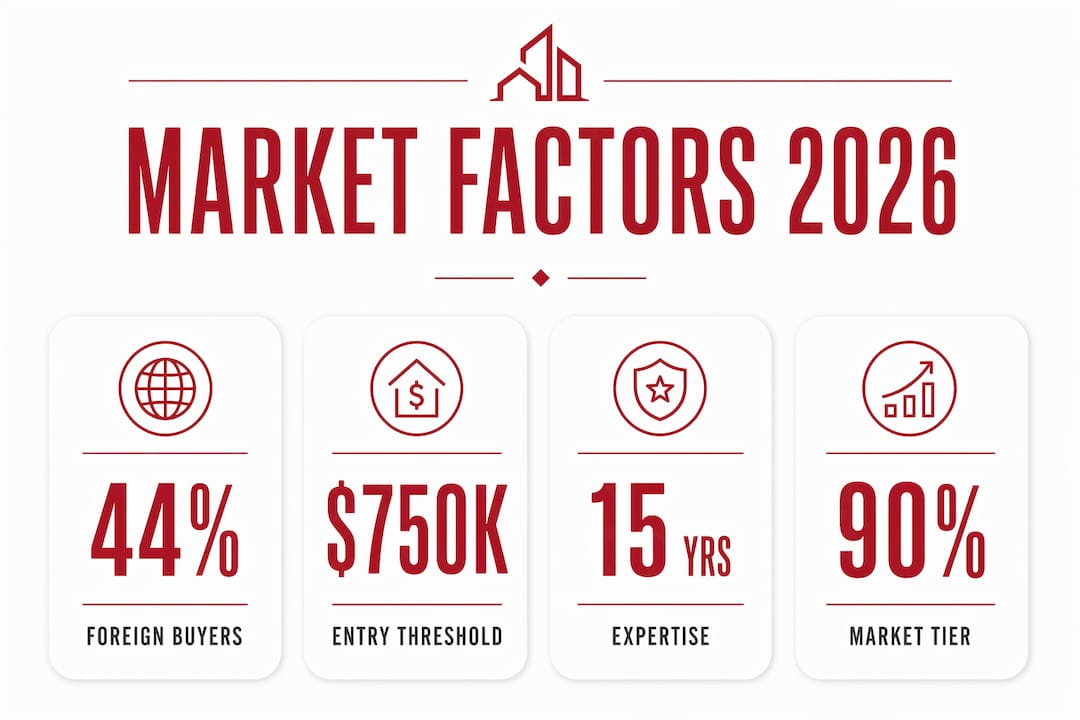
Foreign buyer activity adds another layer of complexity. Sotheby's 2026 Luxury Outlook documents a 44% surge in foreign buyer activity driving U.S. luxury real estate demand. International currency volatility plays a direct role here. When the U.S. dollar weakens relative to the euro or British pound, American luxury properties become comparatively cheaper for foreign buyers, compressing days on market and pushing sale prices toward or above list price in coastal markets. Reports that do not account for this dynamic will misread the source of demand.
Beyond price tiers, consumer profiles within the luxury segment are fragmenting into distinct archetypes: aspirational buyers, selective splurgers, and traditionalists. Each group responds differently to market conditions, which means a single price-tier analysis can mask divergent behavior within the same segment.
Key economic signals to monitor alongside any luxury market briefing:
- Interest rate environment: Luxury buyers rely more heavily on cash transactions, which insulates the segment from rate-driven demand destruction that affects mid-market properties.
- Equity market performance: High-net-worth buyers often liquidate equities to fund real estate purchases. A sustained equity rally typically precedes a surge in luxury transaction volume.
- Supply pipeline: New construction at the luxury tier is constrained by land scarcity in coastal and resort markets, which structurally limits inventory and supports pricing.
- Currency exchange rates: Favorable rates for foreign buyers amplify demand in gateway cities and resort destinations beyond what domestic economic conditions would predict.
Pro Tip: When reading a luxury real estate market briefing, note whether the report distinguishes between domestic and foreign buyer activity. Markets with high foreign buyer concentration behave differently during global economic stress events.
How do luxury thresholds vary by region and reporting source?
The definition of luxury real estate is not universal, and this is where many investors make their first analytical error. Realtor.com uses a percentile-based segmentation model, defining luxury as the top 10% of listings in a given market. Redfin defines luxury as the top 5%. These are not interchangeable definitions, and comparing reports that use different methodologies produces misleading conclusions.
The regional variation in absolute dollar thresholds is even more striking. According to Realtor.com's February 2026 data, luxury thresholds vary dramatically by location: San Antonio's 90th percentile entry point sits around $750,000, while Heber, Utah's entry-level luxury begins above $7.25 million. That is nearly a tenfold difference for properties that both qualify as "entry-level luxury" within their respective markets.
| Market | Luxury entry threshold (approx.) | Market character |
|---|---|---|
| San Antonio, TX | $750,000 | Supply-rich Sunbelt metro |
| National average | $1.21 million | Broad market benchmark |
| Coastal California | $2M+ (varies by submarket) | Constrained coastal supply |
| Heber, UT | $7.25 million | Resort and second-home market |
Coastal and resort markets operate under fundamentally different supply dynamics than Sunbelt metros. In markets like La Jolla or Rancho Santa Fe, geographic constraints and zoning restrictions limit new supply, which means price appreciation is structurally supported even during periods of broader market softness. Sunbelt metros with active construction pipelines face the opposite dynamic: supply can outpace demand quickly, compressing both prices and days-on-market metrics.
For investors building a luxury real estate portfolio, the practical implication is clear. A report showing "softening luxury demand" in Phoenix tells you nothing about La Jolla. Always anchor your analysis to reports that specify the geographic scope and the percentile definition being used.
How investors and analysts use luxury market reports strategically
A luxury market report is only as useful as the decisions it informs. Investors who extract maximum value from these documents follow a structured approach rather than scanning for headline price trends.
-
Identify emerging markets before they reprice. Reports that track price-per-square-foot growth by tier reveal which markets are transitioning from mid-market to luxury status. When a market's 90th percentile threshold rises faster than its median price, capital is concentrating at the top. That is an early signal of gentrification or resort-market maturation.
-
Profile the buyer pool, not just the price tier. Deloitte's Global Powers of Luxury 2026 notes that luxury market health depends on brand desirability and consumer emotional connection, not just transaction volume. In real estate terms, this means understanding whether demand is driven by primary residence buyers, investors, or second-home purchasers. Each group has a different sensitivity to economic cycles.
-
Separate listing data from transaction data. Reports built on active MLS data show seller expectations. Reports built on recorded sales show market reality. The gap between these two data sources is where negotiating leverage lives. An analyst who tracks both simultaneously can identify markets where sellers are overpricing relative to what buyers will actually pay.
-
Monitor supply at each tier independently. A market can show strong demand at the ultraluxury tier while the entry-level luxury segment is oversupplied. Treating the luxury market as a single unit produces investment decisions that are right on average but wrong in practice.
-
Contextualize with macroeconomic signals. The San Diego luxury market, for example, reflects the intersection of domestic demand, foreign buyer activity, and constrained coastal supply. Reading a local luxury property report without understanding the global capital flows feeding it produces an incomplete picture.
Key takeaways
A luxury real estate market report is most valuable when read across multiple tiers, compared against closed sales data, and interpreted through the lens of regional supply dynamics and global demand drivers.
| Point | Details |
|---|---|
| Tiered segmentation matters | Reports use 90th, 95th, and 99th percentile bands; never treat luxury as a single category. |
| Listing data has limits | MLS-based reports reflect asking prices, not verified sales; always cross-reference with recorded transactions. |
| Regional thresholds vary widely | Luxury entry points range from $750K in San Antonio to $7.25M in Heber, UT; definitions are not portable across markets. |
| Demand drivers are global | A 44% surge in foreign buyer activity and $6 trillion in wealth transfer are reshaping luxury demand in 2026. |
| Consumer profiles are fragmenting | Aspirational buyers, selective splurgers, and traditionalists behave differently within the same price tier. |
What 15 years of reading these reports actually taught me
Most investors read a luxury market report and focus on the number that confirms what they already believe. That is the single most expensive habit in this business. I have reviewed hundreds of reports across Southern California markets, and the pattern is consistent: the insight that matters is almost never in the headline metric. It is in the spread between asking price and closed price, or in the divergence between days on market at the 90th percentile versus the 99th.
The regional definition problem is more serious than most analysts acknowledge. I have watched investors apply national luxury benchmarks to La Jolla or Rancho Santa Fe and completely misread the market. When Realtor.com reports a national entry-level luxury threshold of $1.21 million, that number is irrelevant to a buyer evaluating a $3.5 million property in a coastal submarket where the 90th percentile starts at $2.8 million. The report is not wrong. The application is wrong.
The foreign buyer data from Sotheby's deserves more attention than it typically receives. A 44% surge in foreign buyer activity does not distribute evenly across all luxury markets. It concentrates in coastal gateway cities, resort destinations, and markets with strong international community ties. San Diego captures a disproportionate share of that demand because of its proximity to international buyers, its lifestyle profile, and its constrained supply. That is not visible in a national luxury market briefing. It requires local data layered on top of the macro picture.
My honest recommendation: use national and regional reports to establish context, then validate every conclusion with local transaction data from county records. The reports are the map. The closed sales are the territory. When they disagree, trust the territory.
— Stu
Explore luxury listings and neighborhood insights with Stuharveyestates
Stuharveyestates brings over 15 years of Southern California luxury expertise and more than $1.2 billion in closed transactions to every client engagement. If the market data in this article has sharpened your thinking about where and when to move, the next step is applying those insights to real properties. Browse current luxury property listings across San Diego's most sought-after submarkets, or explore the detailed neighborhood guides for La Jolla and Coronado to understand local supply dynamics, buyer profiles, and pricing trends at the submarket level. Market reports tell you what the data says. Stu tells you what it means for your specific situation.
FAQ
What is a luxury real estate market report?
A luxury real estate market report is a structured analysis that segments high-end property markets by price tier, typically using the 90th, 95th, and 99th percentiles, and tracks metrics like days on market, price per square foot, and sales-price-to-list-price ratio to identify trends and guide investment decisions.
How is luxury real estate defined in market reports?
Luxury real estate is defined differently depending on the reporting source and geography. Realtor.com uses the top 10% of listings in a given market, while Redfin uses the top 5%; nationally, the entry-level luxury threshold was approximately $1.21 million in February 2026, but local thresholds range from $750,000 in San Antonio to over $7 million in resort markets like Heber, Utah.
Why do luxury market reports differ from standard real estate reports?
Luxury market reports apply percentile-based segmentation rather than fixed price cutoffs, track buyer profiles including foreign buyers and cash purchasers, and incorporate macroeconomic signals like currency volatility and generational wealth transfer that have outsized influence on high-end property demand.
Can luxury market reports be used to predict price movements?
Luxury market reports identify leading indicators such as inventory absorption rates, days on market by tier, and the ratio of foreign to domestic buyers, but they reflect seller expectations more than verified transaction values when built on MLS data. Pairing report data with recorded county sales produces a more reliable forecast.
What is the difference between a luxury market report and a luxury market briefing?
A luxury real estate market briefing is typically a shorter, more frequent summary of current conditions, while a full luxury market report provides deeper segmentation analysis, historical trend comparisons, and demographic data. Briefings are useful for tracking momentum; full reports are necessary for investment-grade decision-making.