
A luxury real estate portfolio review is a structured, comprehensive evaluation of all high-value property holdings within an investor’s portfolio, designed to assess performance, manage risk, and align assets with long-term wealth objectives. Unlike a single-property appraisal, this process examines how your entire collection of luxury assets works together, or against each other, to produce returns, generate tax exposure, and support estate planning goals. For high-net-worth individuals holding properties across La Jolla, Rancho Santa Fe, or multiple markets, understanding what a luxury real estate portfolio review involves is the first step toward protecting and growing generational wealth.
Portfolio-level strategy determines how multiple properties interact to grow value, limit risk, and guide investment decisions. That means decisions about one asset ripple across markets and asset classes. A review captures those ripple effects before they become costly surprises.
What is a luxury real estate portfolio review and what does it measure?
A luxury real estate portfolio review measures individual asset health, portfolio-wide performance, governance quality, and tax exposure simultaneously. It goes well beyond asking whether a property has appreciated. The review answers whether your entire portfolio is optimally structured for your current financial goals, risk tolerance, and estate planning needs.
At the asset level, the review examines net operating income (NOI), operating expenses, cash flow after debt service, and leverage risk. At the portfolio level, it tracks metrics including internal rate of return (IRR), time-weighted return (TWR), and multiple on invested capital (MOIC). These figures reveal whether your capital is working as hard as it should across all holdings.

Full operational audits extend beyond surface financials to evaluate NOI after expenses and debt service coverage ratios, which are essential for identifying hidden cost risks. Gross rent figures alone can mislead. A property generating strong top-line revenue may still underperform once maintenance costs, vacancy rates, and financing costs are factored in.
Key metrics tracked in a luxury portfolio review:
-
NOI and cash-on-cash return at the individual property level
-
IRR and MOIC across the full portfolio to measure capital efficiency
-
Debt service coverage ratio (DSCR) to assess leverage risk
-
Geographic and asset-type diversification to identify concentration risk
-
Tenant quality and lease terms for income stability
Centralizing documentation for leases, valuations, partnership agreements, and cash-flow transactions enables consistent performance metrics across all assets. Without a centralized data repository, comparing performance across a portfolio that includes direct holdings, joint ventures, and fund interests becomes unreliable.
Pro Tip: Before your review begins, consolidate all property records, including lease agreements, insurance policies, and recent appraisals, into a single digital repository. This alone can cut review time by weeks and dramatically improve the accuracy of your performance benchmarks.
How does governance shape the quality of a portfolio review?
Governance is the operational backbone of any effective luxury portfolio assessment. Without it, even accurate financial data produces incomplete conclusions. Effective governance for UHNW real estate includes maintaining an asset register, conducting annual valuations, standardizing preventive maintenance, and reviewing ownership structures for compliance.
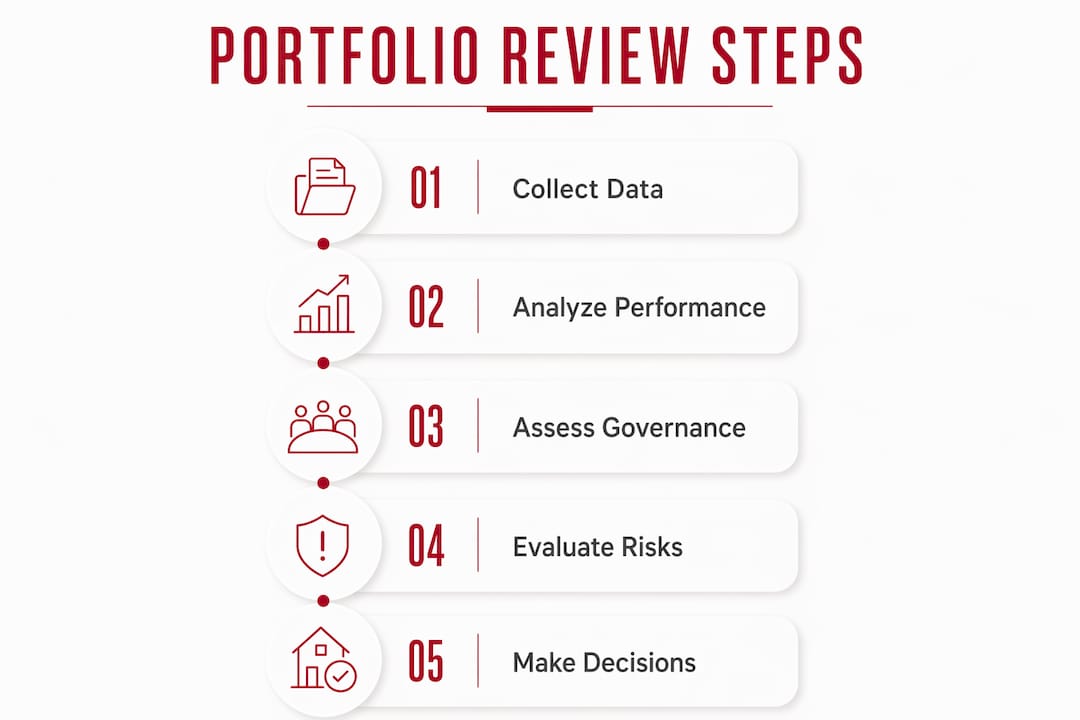
A well-governed portfolio distinguishes clearly between residences and investment properties. This distinction affects how expenses are categorized, how depreciation is claimed, and how assets are treated in estate documents. Blurring that line creates tax exposure and complicates estate transfers.
The governance review process typically follows this sequence:
-
Audit the asset register. Confirm that every property is accurately recorded with current valuations, ownership entity, and encumbrances.
-
Review decision rights. Confirm who has authority to approve capital expenditures, refinancing, and dispositions. Ambiguity here creates uncoordinated risk.
-
Assess maintenance protocols. Verify that preventive maintenance schedules exist and are followed. Deferred maintenance is a hidden liability that rarely appears in financial statements.
-
Examine cross-jurisdictional compliance. Properties held in multiple states or countries require separate compliance reviews for local tax, reporting, and ownership laws.
-
Evaluate capital expenditure planning. Confirm that multi-year capex plans exist for each property and are funded appropriately.
Documented approval authority and capital commitment protocols are required to maintain portfolio integrity and prevent failures from unintegrated capital deployments. This is especially critical for family offices managing luxury holdings across multiple generations.
Pro Tip: Assign a single point of accountability for each property in your portfolio, whether that is an asset manager, a family office officer, or a trusted advisor. Diffuse responsibility is the most common cause of governance breakdowns in UHNW real estate.
For investors building or refining their holdings, long-term portfolio construction requires governance structures that scale with the portfolio’s complexity.
What tax, estate, and legal factors does a portfolio review address?
Tax strategy is where luxury real estate portfolio reviews generate some of their most significant financial value. In 2026, luxury portfolio reviews typically address entity structures, cost segregation studies, and multi-year 1031 exchange strategies to optimize taxation and estate transfer efficiency.
The tax and legal layer of a portfolio review covers several interconnected areas:
-
Entity structure review. Properties held in LLCs, trusts, or family limited partnerships each carry different liability protections and tax treatments. The review confirms that current structures still serve their intended purpose given changes in tax law or family circumstances.
-
Estate planning document alignment. Federal estate tax exemption limits change, and estate documents must reflect current law. A review cross-references property ownership against wills, revocable trusts, and beneficiary designations.
-
Cost segregation analysis. Accelerated depreciation through cost segregation studies can generate substantial near-term tax savings on luxury properties. The review identifies which assets have not yet been studied and quantifies the potential benefit.
-
1031 exchange planning. Multi-year exchange strategies allow investors to defer capital gains taxes when repositioning assets. The review maps which properties are candidates for exchange and models the tax impact of each scenario.
-
Coordination with advisors. Effective tax review requires input from CPAs, estate attorneys, and real estate counsel working from the same data set. Siloed advice produces gaps.
Luxury real estate reviews are most effective when part of a holistic wealth strategy involving coordinated tax and estate advisors. A review that stops at property-level financials without addressing entity structures and estate documents leaves the most consequential decisions unexamined.
The role of a real estate attorney in transactions extends naturally into portfolio reviews, particularly when ownership structures need to be restructured or when properties are being repositioned across entity boundaries.
How do you use portfolio review findings to make better decisions?
Portfolio review findings are only valuable if they drive decisions. The luxury real estate analysis process produces a prioritized set of opportunities and risks that should directly inform your next 12 to 36 months of asset management.
The most common decision categories that emerge from a review are shown below:
| Finding type | Typical decision triggered |
|---|---|
| Underperforming asset (low IRR, high capex) | Reposition, refinance, or dispose |
| Concentration risk (single market or asset type) | Acquire diversifying assets or reduce exposure |
| Tax inefficiency (missed depreciation, wrong entity) | Restructure entity or commission cost segregation |
| Governance gap (no capex plan, unclear decision rights) | Implement asset management protocols |
| Estate misalignment (property not in trust) | Update estate documents with attorney |
High-net-worth luxury real estate fits uniquely for diversification, inflation hedging, lifestyle benefits, and legacy value, but requires careful alignment with investor goals. Investment suitability depends on liquidity, tax profile, and geographic diversification. A review surfaces the gaps between where your portfolio is and where it needs to be.
Scenario planning and stress testing are underused tools in luxury portfolio management. Model what happens to your portfolio’s cash flow if vacancy rates increase by 15%, if interest rates rise by 200 basis points, or if a key market softens. These scenarios reveal which assets are genuinely resilient and which carry hidden fragility.
Pro Tip: Treat your portfolio review findings as a living document, not a one-time report. Schedule a 90-day follow-up to confirm that identified actions, such as entity restructuring or capex funding, have actually been executed. Most value leakage happens in the gap between recommendation and implementation.
For investors tracking lifestyle-driven acquisition trends in markets like San Diego, review findings should also account for how lifestyle properties are classified and whether they are being managed to their full investment potential.
Key takeaways
A luxury real estate portfolio review creates value only when it integrates operational audits, governance structures, and tax strategy into a single coordinated process.
| Point | Details |
|---|---|
| Define the review scope clearly | Include all holdings: direct properties, joint ventures, and fund interests, not just primary assets. |
| Centralize documentation first | Consolidate leases, valuations, and agreements before analysis begins to produce reliable metrics. |
| Governance prevents financial leakage | Documented decision rights and maintenance protocols protect wealth as effectively as financial optimization. |
| Tax strategy is a core review layer | Entity structures, cost segregation, and 1031 planning can generate returns that exceed property appreciation. |
| Review findings must drive decisions | Schedule follow-up accountability checkpoints to confirm that identified actions are actually implemented. |
What I’ve learned from reviewing luxury portfolios over 15 years
Most investors approach a portfolio review expecting a financial report. What they actually need is a governance and strategy audit that happens to include financial data. The numbers tell you what happened. Governance tells you why, and what will happen next if nothing changes.
The most expensive mistake I see consistently is treating lifestyle properties as purely personal assets. A beachfront home in La Jolla or an estate in Rancho Santa Fe carries real carrying costs, real tax implications, and real estate planning consequences. Ignoring those because a property “isn’t really an investment” is how families lose significant wealth across generations.
I have also found that the advisors who add the most value in a portfolio review are the ones who have worked together before. A CPA who has never spoken to your estate attorney will give you technically correct but strategically incomplete advice. The review process itself should force that coordination. If your advisors are not in the same room, or at least the same conversation, the review is incomplete.
The luxury real estate market in Southern California continues to reward investors who treat their holdings as a managed portfolio rather than a collection of individual transactions. Markets like La Jolla and Rancho Santa Fe have shown consistent long-term appreciation, but that appreciation is only fully captured when the underlying portfolio structure is sound.
— Stu
Work with Stuharveyestates on your portfolio review

Stu Harvey brings more than 15 years of real estate experience and 250+ personal career transactions to his work with property buyers and sellers. Whether you are acquiring a new asset to fill a diversification gap, repositioning an underperforming property, or simply want a professional second opinion on your current holdings, Stu Harvey’s team provides the local market depth and personalized advisory approach that generic wealth managers cannot match. With service areas including La Jolla, Rancho Santa Fe, and greater Southern California, Stu Harvey Estates helps clients assess properties in relation to their goals. Browse current listings to identify properties that align with your portfolio objectives.
FAQ
What is a luxury real estate portfolio review?
A luxury real estate portfolio review is a structured evaluation of all high-value property holdings that assesses financial performance, governance quality, tax efficiency, and alignment with an investor’s long-term wealth strategy. It differs from a single-property appraisal by examining how all assets interact at the portfolio level.
How often should a luxury portfolio review be conducted?
Most high-net-worth investors benefit from a formal portfolio review annually, with a lighter mid-year check on key metrics like NOI, debt coverage, and capex spending. Major life events, such as estate changes or significant market shifts, should trigger an immediate review regardless of schedule.
What metrics matter most in a luxury real estate analysis?
The most critical metrics are NOI, IRR, MOIC, and debt service coverage ratio at both the asset and portfolio level. Operational audits that go beyond gross revenue figures are required to accurately identify cost drift and leverage risk.
Why does governance matter in a luxury portfolio assessment?
Governance prevents financial leakage by establishing clear decision rights, maintenance protocols, and compliance processes across all holdings. Without governance structures, even financially strong portfolios accumulate hidden inefficiencies and tax exposure over time.
How does a portfolio review support estate planning?
A review cross-references property ownership structures against current estate documents, identifies assets not yet transferred into trusts, and models the tax impact of different transfer strategies. Coordinated advisor input from CPAs and estate attorneys is required to translate review findings into effective estate planning decisions.