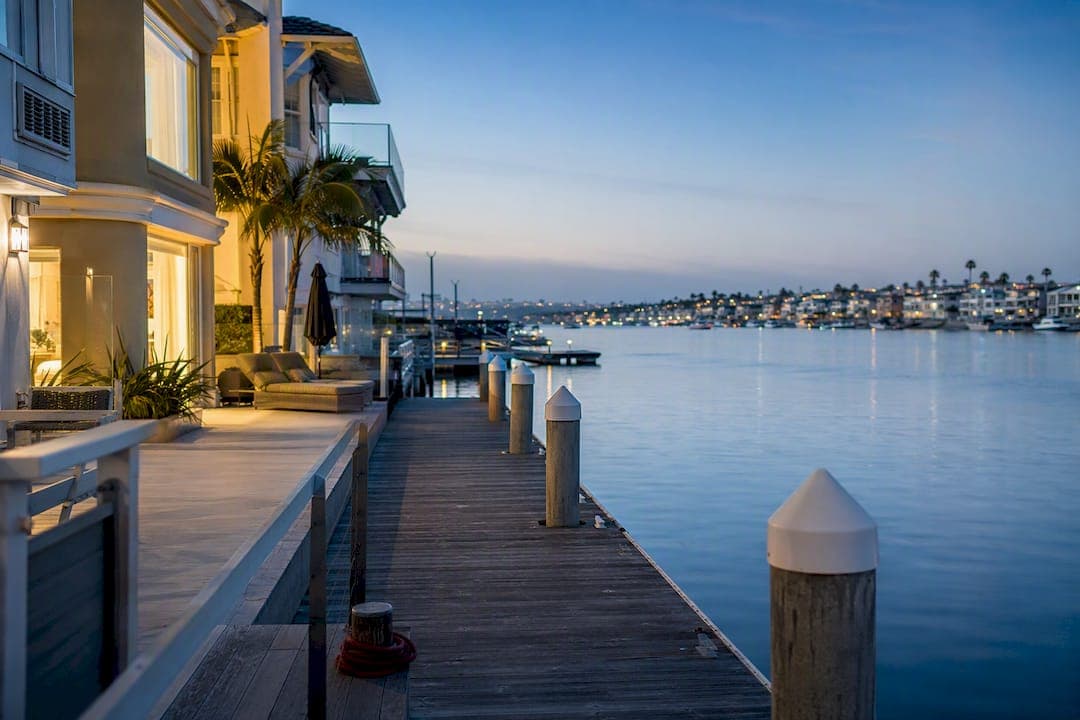
If you want boardwalk energy and beach-block density, Balboa Peninsula is home. If you want a boat slip and a village square in the same zip code, look at Balboa Island or Lido Isle. Village charm with bluff views points to Corona del Mar, and gated resort privacy means Newport Coast or Crystal Cove. Family neighborhoods with better school access and bigger lots sit inland at Eastbluff, Dover Shores, and the Port Streets. Read on for the specifics on each cluster before you start touring.
TL;DR:
Balboa Peninsula offers the most authentic beach town experience but faces heavy summer crowds and parking pressures that diminish winter appeal.
Private docks on Balboa Island and Lido Isle command a premium, with scarce inventory moving quickly once correctly priced, and require careful confirmation of dock transferability.
Corona del Mar provides village charm and ocean views for buyers prioritizing walkability, with bluff-top estates reaching the highest per-square-foot prices but less boat access.
Newport Coast and Crystal Cove offer larger lots and resort-style privacy at higher median prices, with restrictions on short-term rentals and a focus on seclusion rather than walkability.
Inland neighborhoods like Eastbluff and the Port Streets present larger lots, better schools, and quieter streets, making them ideal for families seeking affordability and stability with less seasonal fluctuation.
Table of Contents
-
What Are the Best Newport Beach Neighborhoods for Beach Living?
-
Where Can You Find Island Living With a Private Dock in Newport Beach?
-
What Makes Corona del Mar a Popular Newport Beach Community?
-
Are Newport Coast and Crystal Cove Worth the Gated Community Premium?
-
Is Fashion Island a Good Fit for Condo Buyers in Newport Beach?
-
What Recreation Does the Back Bay Offer Newport Beach Residents?
-
Local-Market Perspective From Stu Harvey on Buying in Newport Beach
-
What Are the Demographics and Community Cultures Across Newport Beach?
-
What Public Transportation and Connectivity Options Exist in Newport Beach?
-
What Development or Zoning Changes Could Affect Newport Beach Neighborhoods?
-
Author Perspective: How to Choose the Right Newport Beach Neighborhood
-
How Stu Harvey Estates Helps You Find the Right Newport Beach Neighborhood
What Are the Best Newport Beach Neighborhoods for Beach Living?
Balboa Peninsula is the closest thing Newport Beach has to a classic Southern California beach town, packed onto a narrow strip between the ocean and the harbor. The Wedge draws bodyboarders and spectators during summer south swells, Newport Pier anchors the fish market and morning surf crowd, and the Balboa Fun Zone keeps the peninsula’s tip lively with a Ferris wheel and arcade games that have run for decades.
-
Housing spans tight beach cottages and condos near the pier to multimillion dollar strand homes fronting the sand.
-
Summer weekends bring heavy foot traffic and parking pressure, which cuts both ways for owners who rent short term.
-
Winter months are noticeably quieter, appealing to buyers who want a primary residence rather than a seasonal party house.
Where Can You Find Island Living With a Private Dock in Newport Beach?
Balboa Island and Lido Isle deliver a version of Newport Beach real estate you cannot get on the mainland: walk to a bakery, then walk home to your own boat slip. Marine Avenue on Balboa Island is the retail spine, a few dense blocks of shops and cafes reachable by the Balboa Island Ferry or the bridge off Jamboree Road.
-
Homes with private docks carry a real premium, and inventory is scarce enough that bayfront listings tend to move fast once priced right.
-
The Balboa Island Museum documents community traditions like the Balboa Island Parade and Art Walk, both signs of how tight-knit the island culture stays.
-
Expect HOA rules on Lido Isle and tighter street parking on both islands, especially during summer visitor season.
Pro Tip: Ask about dock insurance and available slip permits before you fall in love with a bayfront listing. Not every dock transfers cleanly with the sale, and coverage requirements vary by association.
What Makes Corona del Mar a Popular Newport Beach Community?
Corona del Mar reads like a small coastal village stitched onto the bluffs south of the harbor entrance, with East Coast Highway carrying the boutiques, restaurants, and coffee shops that give the neighborhood its walkable center. Sherman Library & Gardens sits a block off the highway, and the tide pools below Little Corona are a weekend ritual for families.
-
Housing ranges from compact beach cottages near the village to bluff-top estates with unobstructed ocean views, with the bluff tier commanding the highest per-square-foot prices in the neighborhood.
-
CdM suits buyers who want daily walkability over boat access.
-
Visitation is steady year round rather than sharply seasonal, since the appeal leans on the village and views more than a single beach event.
Are Newport Coast and Crystal Cove Worth the Gated Community Premium?
Newport Coast is the hillside answer to Newport Beach’s other, denser neighborhoods: large lots, guarded gates, and resort-caliber amenities baked into nearly every community. Proximity to Pelican Hill and direct access to Crystal Cove State Park give this cluster a different rhythm entirely, more Aspen weekend than boardwalk stroll.
-
Median pricing across Newport Coast and Crystal Cove tends to run higher than most other Newport Beach clusters, reflecting lot size and privacy rather than beach proximity alone.
-
Guard-gated HOAs are standard, and buyers should review CC&Rs closely since some restrict short-term rentals.
-
This cluster fits buyers prioritizing seclusion, scenic canyon or ocean views, and resort infrastructure over walk-to-everything convenience.
Is Fashion Island a Good Fit for Condo Buyers in Newport Beach?
Newport Center and Fashion Island form the closest thing Newport Beach has to a downtown, an open-air retail and dining hub surrounded by mid-rise and high-rise condo towers. This is lock-and-leave living: no yard to maintain, valet-adjacent convenience, and a five-minute walk to nearly every errand.
-
Condo pricing here tends to undercut single-family coastal homes elsewhere in the city, opening the door for buyers priced out of beachfront blocks.
-
New restaurant and retail openings keep the district evolving, which matters if amenity access drives your decision.
-
Professionals, empty nesters, and investors chasing rental demand from a mobile tenant base tend to gravitate here over families needing more square footage.
What Is Living Near Mariner’s Mile and Westcliff Like?
Mariner’s Mile runs along Pacific Coast Highway on the harbor’s north shore, a working strip of yacht brokerages, marine service shops, and restaurants with water views. It is Newport Beach’s commercial waterfront more than a residential pocket, though Westcliff just inland offers a quieter, walkable residential counterpart.
-
Yacht sales, boat repair, and harbor-view dining dominate the Mariner’s Mile commercial frontage.
-
Westcliff’s tree-lined streets and small shopping corridor give it a neighborhood feel distinct from the traffic on PCH.
-
The trade-off is straightforward: marina lifestyle and harbor views come with steady Pacific Coast Highway traffic noise, while Westcliff trades some of that view for calmer streets.
What Recreation Does the Back Bay Offer Newport Beach Residents?
Upper Newport Bay, known locally as the Back Bay, protects one of Southern California’s most significant coastal wetlands, and the city manages it as a nature preserve with trail access built for daily use, not just weekend visits. The Back Bay Loop draws runners, cyclists, and birdwatchers along a route that circles the estuary.
-
The preserve’s protected status limits development around its edges, which keeps the setting quiet but also caps how much new housing supply ever appears nearby.
-
Dover Shores and Eastbluff sit closest to the Back Bay and offer private beach access points that outsiders rarely find on their own.
-
Families and buyers drawn to nature over nightlife tend to settle here rather than closer to the peninsula’s beach crowds.
Pro Tip: Walk the Back Bay Loop trail at sunrise before you tour homes nearby. It tells you more about the neighborhood’s actual daily rhythm than any listing photo will.
Which Newport Beach Neighborhoods Suit Families Best?
Newport Heights, the Port Streets section of Harbor View, Dover Shores, Eastbluff, and Bayshores form the practical, less-touristed side of Newport Beach real estate. These neighborhoods trade beachfront proximity for bigger lots, better school access, and quieter cul-de-sac streets, which is exactly the calculation many buyers with kids are making.
-
The Port Streets earns its nickname from streets named after harbors worldwide, and its cul-de-sac layout keeps through traffic minimal.
-
Bayshores stands apart for its private-dock lots on a small lagoon, a rare combination of family neighborhood and boat access that almost never comes up for sale.
-
Relative pricing across this group runs below the peninsula and the islands, making it the entry point for buyers who want Newport Beach schools without island-level price tags.
Local-Market Perspective From Stu Harvey on Buying in Newport Beach
A Newport Beach home search should balance lifestyle, budget, property needs, and due diligence. The largest home on paper may not be the best fit for how you want to live.
Bayfront and island inventory moves fast once priced correctly, since scarcity and private-dock amenities keep demand ahead of supply. Before writing an offer, confirm HOA rental restrictions, dock insurance requirements, and beach or strand easements. These details get overlooked constantly, and they can quietly limit renovation plans or short-term rental income after closing.
What Are the Demographics and Community Cultures Across Newport Beach?
Newport Beach’s population skews older and more affluent than the Orange County average, but the character shifts sharply block by block. Balboa Peninsula carries a younger, more transient feel in summer, filled with renters and vacation visitors, then settles into a smaller year-round community of longtime homeowners once the season ends. Balboa Island runs the opposite direction: a tightly knit, multigenerational community where the same families have owned homes for decades and community events like the Balboa Island Parade draw the whole island out.
Corona del Mar leans toward established professionals and retirees drawn to the village pace, while Fashion Island’s condo towers attract a mix of empty nesters downsizing from larger coastal homes and younger professionals who want walkability without yard maintenance. Newport Coast and Crystal Cove skew toward executive and entrepreneurial households seeking privacy behind guard gates, often with school-age kids attending nearby private schools.
The family neighborhoods, Eastbluff, Dover Shores, Newport Heights, and the Port Streets, hold the city’s highest concentration of households with children, largely because of proximity to Newport Beach schools and larger lot sizes. Community culture there centers on neighborhood schools, youth sports leagues, and block-level social ties rather than the boating or beach-club circuit that dominates island and peninsula life. Across nearly every neighborhood, homeowners associations and neighborhood groups play an outsized role in local culture, hosting everything from holiday boat parades to summer concert series.
How Safe Are Newport Beach Neighborhoods?
Newport Beach consistently ranks among the safer cities in Orange County, and most residential neighborhoods report low rates of violent crime relative to national averages. Property crime, largely vehicle break-ins and theft from unlocked cars, tends to concentrate in visitor-heavy zones like Balboa Peninsula and the beaches near Newport Pier during peak summer months, when parking lots and beach access points draw large crowds.
Gated communities in Newport Coast and Crystal Cove add another layer of physical security through guard staff and controlled access, which appeals to buyers prioritizing privacy alongside safety. Inland family neighborhoods such as Eastbluff, Dover Shores, and the Port Streets report some of the lowest incident rates in the city, consistent with their quieter, lower-traffic street layouts.
Island communities like Balboa Island and Lido Isle benefit from limited vehicle access and a small, recognizable resident base, both of which tend to deter casual property crime. That said, no neighborhood is immune to seasonal upticks tied to tourism, and buyers should ask their agent for current crime statistics specific to the block they’re considering rather than relying on citywide averages, since block-by-block variation matters more here than in most cities.
What Public Transportation and Connectivity Options Exist in Newport Beach?
Newport Beach is a driving city first, and public transit plays a secondary role for most residents. Orange County Transportation Authority buses run routes along Pacific Coast Highway and Jamboree Road, connecting Newport Beach to neighboring Costa Mesa, Irvine, and the John Wayne Airport area, but frequency and coverage make it more useful for commuters than for daily errands.
The Balboa Island Ferry remains the most iconic local transit link, carrying cars, bicycles, and pedestrians across the narrow channel between the island and the Balboa Peninsula since the 1900s. It is slow by design, but it saves a long drive around the harbor and functions as much as a community fixture as a transportation option.
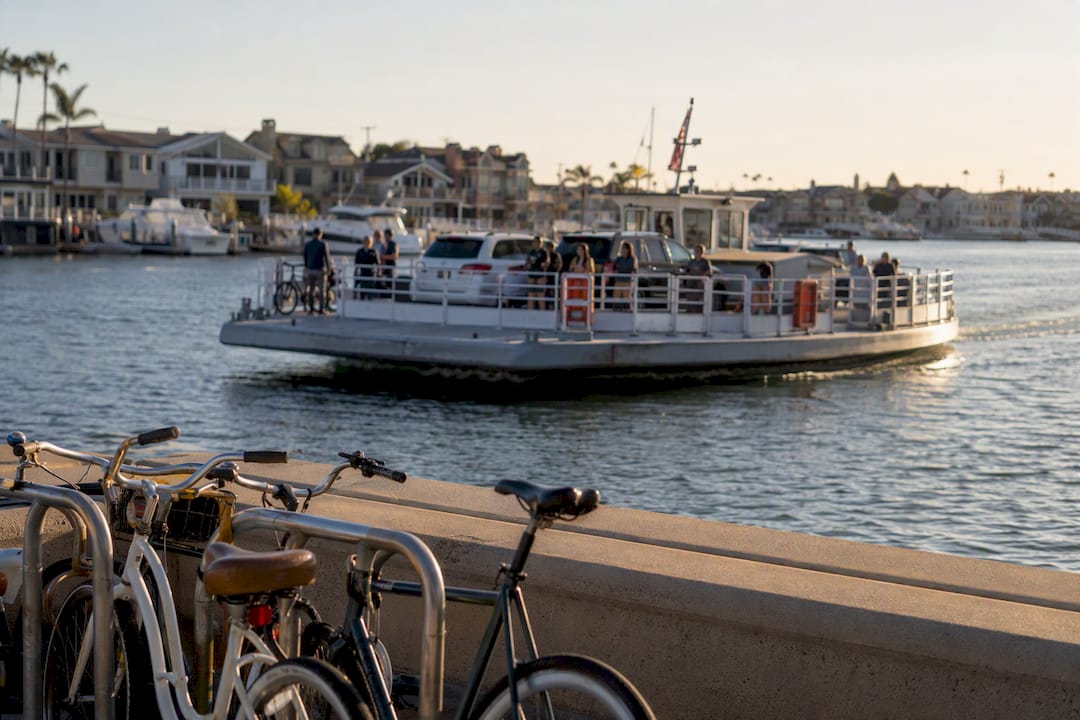
Walkability varies enormously by neighborhood. Balboa Island, Corona del Mar’s village core, and Fashion Island all score well for pedestrian access to shopping and dining, while Newport Coast, Eastbluff, and the Port Streets are built around car-dependent street layouts typical of suburban Orange County. John Wayne Airport sits roughly 15 minutes from most Newport Beach neighborhoods by car, a convenience that matters for buyers who travel frequently. Bike lanes along the Back Bay Loop and the beachfront boardwalk offer some of the best non-vehicle connectivity in the city, though they serve recreation more than commuting.
What Development or Zoning Changes Could Affect Newport Beach Neighborhoods?
Newport Beach maintains strict height limits and design review standards across most residential zones, particularly along the coastline, which has historically kept large-scale redevelopment limited compared to other Southern California beach cities. The city’s General Plan governs land use decisions and gets revisited periodically, with recent public discussion focused on balancing housing production mandates from the State of California against the city’s traditionally low-density coastal character.
Newport Center and the area around Fashion Island have seen the most active development conversation in recent years, as mixed-use and residential density proposals near the retail core continue to surface. Buyers considering condos in that cluster should ask about any pending entitlements nearby, since new construction can affect both views and traffic patterns.
Coastal Commission oversight adds another layer of review for any project near the shoreline, which tends to slow major changes to beachfront zones like Balboa Peninsula and Corona del Mar’s bluff areas. Back Bay’s protected status as a nature preserve effectively locks in its boundaries, meaning that cluster’s supply of adjacent buildable land will stay limited for the foreseeable future. Buyers focused on long-term value should check current zoning designations and any pending city council items for their specific neighborhood rather than assuming today’s rules will hold indefinitely.
Island vs. Mainland: What Are the Real Trade-Offs?
Choosing between Balboa Island or Lido Isle and a mainland neighborhood comes down to three practical friction points: parking, access, and seasonal crowding. Island streets are narrow, and visitor parking during summer weekends can turn a five-minute errand into a twenty-minute search for a spot, especially near Marine Avenue.
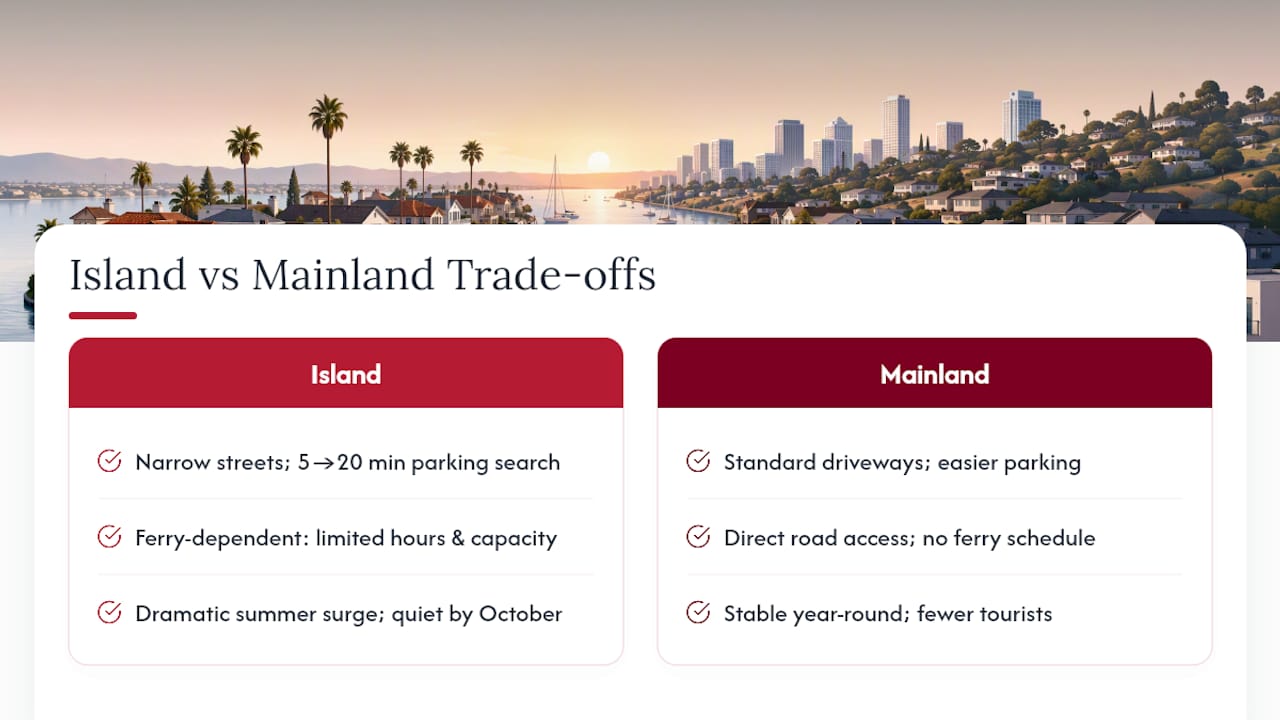
Access via the Balboa Island Ferry is charming but limited by operating hours and capacity, meaning late-night returns or moving large furniture often means the longer bridge route instead. Mainland neighborhoods carry none of that friction. Standard driveways, faster in-and-out access, and no ferry schedule to plan around.
Seasonality cuts differently for each. Islands see a dramatic summer population surge from day visitors and renters, then quiet down substantially by October, which owners either love for the energy or tolerate for the investment upside. Mainland neighborhoods like Eastbluff, Dover Shores, and the Port Streets stay comparatively stable year round, since they draw fewer tourists and more long-term residents. For buyers weighing a primary residence against a part-time or rental property, that seasonal swing matters as much as square footage or price per foot.
Author Perspective: How to Choose the Right Newport Beach Neighborhood
Pick based on how your typical Tuesday should feel, not how your ideal Saturday looks. Decide if you actually want waterfront access enough to give up a yard, and be honest about your budget’s time on market, since scarce bayfront homes move fast while inland listings give you more room to negotiate. Visit prospective streets at different times of day, and walk specific blocks with a local agent before writing an offer.
— Stu Harvey
How Stu Harvey Estates Helps You Find the Right Newport Beach Neighborhood
Stu Harvey Estates gives buyers something most online listing searches cannot: a walkthrough of what daily life actually feels like on a specific Newport Beach block, from dock insurance quirks on Balboa Island to HOA rental limits in Newport Coast. That local read, paired with more than 15 years of Southern California transaction experience, means you spend less time guessing which neighborhood fits and more time touring the ones that actually do.
Whether you’re drawn to Corona del Mar’s village charm or a private-dock lot on Bayshores, browsing current Newport Beach listings is the fastest way to see what’s actually available right now in each cluster. If you’re also weighing whether to refresh a coastal property before listing it, a partner resource on coastal interior styling is worth a look. Reach out to start a neighborhood-specific search built around how you actually want to live.
Sources
FAQ
What Are the Best Neighborhoods in Newport Beach?
It depends on lifestyle: Balboa Peninsula suits beach-first buyers, Balboa Island and Lido Isle suit boaters, Corona del Mar suits village-and-view seekers, and Newport Coast suits buyers wanting gated privacy. Real estate agents work across all of these clusters to match buyers with the right fit.
What Are the Wealthiest Neighborhoods in Newport Beach?
Newport Coast, Crystal Cove, and the bayfront blocks of Balboa Island and Lido Isle typically carry the city’s highest median sale prices, driven by large lots, gated privacy, or private-dock access.
Which Celebrities Live in Newport Beach?
Newport Beach has long attracted entertainment and business figures drawn to its privacy and coastline, though specific current residents are not publicly confirmed and change over time.
Is Newport Beach Democrat or Republican?
Orange County has trended more politically mixed in recent election cycles, and Newport Beach itself has historically leaned Republican, though voter registration in coastal Orange County communities has grown more competitive over the past decade.
Should I Choose an Island Neighborhood or a Mainland One in Newport Beach?
Choose an island like Balboa Island or Lido Isle if walkability and dock access matter more than parking ease; choose a mainland neighborhood like Eastbluff or Dover Shores if you want easier daily access and less seasonal crowding.