
Virtual tours are defined as immersive, interactive digital experiences that replicate an in-person property walkthrough, and their role of virtual tours luxury home marketing has become central to how serious sellers compete. The 2026 NAR Profile reports that 60% of buyers who used the internet found virtual open house tours extremely helpful. That number signals a clear shift: virtual tours are no longer a bonus feature. They are a core marketing asset, sitting alongside professional photography and cinematic video as standard deliverables for any luxury listing. For sellers in markets like La Jolla and Rancho Santa Fe, skipping a virtual tour means leaving serious buyers behind.
How do virtual tours enhance property visualization in luxury real estate?
Virtual tours give luxury buyers something static photos cannot: spatial understanding. A 360-degree walkthrough lets a buyer stand in the primary suite, look toward the ocean view, and mentally place their furniture. That kind of depth creates genuine emotional connection, not just visual interest.
Lifestyle-driven tours go further. Rather than presenting rooms in sequence, they simulate how a buyer would actually live in the property. A morning walk from the master bedroom to the terrace coffee station, a glance at the chef’s kitchen from the open dining area. Luxury buyers connect emotionally to this kind of narrative experience far more than they do to a static floor plan. That emotional connection accelerates decision-making in ways that data presentations simply cannot.

The SHA Residences virtual experience in Dubai demonstrates the scale of this effect. That campaign reached 6.5 million people and generated 100 qualified sales offers within 60 days. The tour was built around lifestyle storytelling, not just room dimensions. That result is not an outlier. It is what happens when immersive technology meets a clear narrative strategy.
Modern platforms now integrate AI-driven conversational guides directly into the tour interface. These guides answer buyer questions in real time, 24 hours a day, across multiple languages. That capability matters enormously for international buyers evaluating Southern California properties from abroad.
Key features that define high-performing luxury virtual tours:
-
360-degree navigation with full floor plan integration, so buyers can orient themselves spatially
-
Lifestyle staging that shows the property in use, not just empty rooms
-
AI conversational guides that respond to buyer questions without requiring agent availability
-
Measurement tools embedded in the tour, allowing buyers to check room dimensions independently
-
Multi-language support to reach global buyers without friction
Pro Tip: Build your virtual tour around a lifestyle narrative first. Start with the view or the most emotionally compelling space, not the front door. Buyers remember how a property made them feel, not its square footage.
What are the main benefits of virtual tours for luxury sellers?
The primary benefit of virtual tours for luxury sellers is lead quality, not lead volume. Buyers who complete a full virtual walkthrough arrive at physical showings already committed. They have measured the rooms, evaluated the finishes, and decided the property fits their lifestyle. That pre-qualification effect reduces wasted showings and focuses seller time on genuinely motivated buyers.
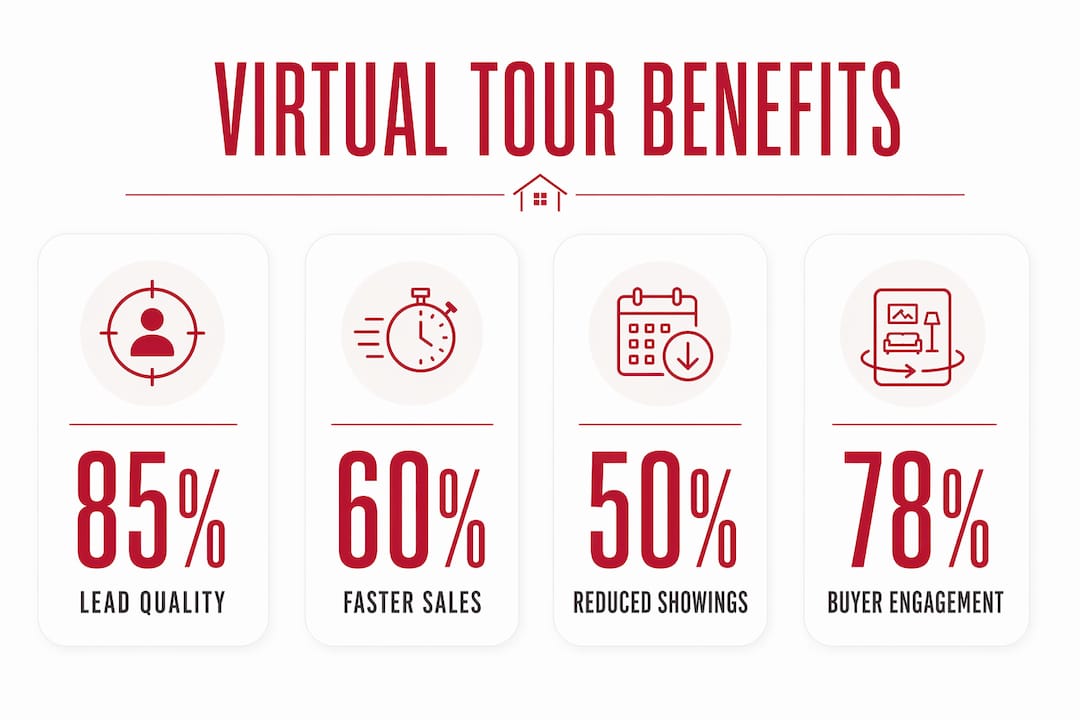
Luxury buyers use virtual tours as a filter before requesting in-person access. They share tour links with spouses, architects, and interior designers. They return to the tour multiple times before making contact. Each of those behaviors signals serious intent, and a good virtual tour platform captures all of it as engagement data.
The visibility benefits are equally concrete. Listings with virtual tours on major portals generate notably more engagement than listings without them. For luxury properties, that advantage is amplified because the buyer pool is smaller and more selective. A virtual tour badge on a listing signals quality and seriousness to exactly the right audience.
Four measurable benefits luxury sellers gain from virtual tours:
-
Higher lead quality. Buyers who tour virtually arrive at showings pre-qualified and motivated.
-
Reduced showing waste. Sellers spend less time hosting buyers who are not serious.
-
Global reach. International buyers in Asia, Europe, and the Middle East can evaluate properties without traveling.
-
Engagement analytics. Platforms track which rooms buyers revisit, how long they spend, and where they drop off, giving agents precise follow-up intelligence.
The digital marketing for luxury homes landscape rewards sellers who combine strong virtual tour content with targeted distribution. A tour that no one sees produces no leads. Distribution strategy matters as much as production quality.
How should luxury marketers integrate virtual tours with broader digital strategy?
Virtual tours work best as part of a unified marketing system, not as standalone assets. The most effective approach pairs cinematic video with interactive 360-degree tours. Each format serves a different buyer need. Combining virtual tours with cinematic video creates a strategy that addresses both emotional and technical buyer requirements simultaneously.
Cinematic video handles emotional storytelling. It sets the mood, establishes the neighborhood context, and creates the first impression that makes a buyer want to know more. The 360-degree interactive tour then handles the detailed evaluation phase. Buyers who feel emotionally connected from the video will spend significantly more time inside the interactive tour.
Distribution channels for virtual tours in luxury marketing:
-
Property website and listing pages. Embed the tour directly so buyers never have to leave to find it.
-
Email campaigns. Send tour links to qualified buyer lists with a personal note from the agent.
-
Social media. Short clips from the tour perform well on Instagram and YouTube as entry points.
-
MLS and portal listings. Virtual tour badges on Realtor.com and similar portals increase click-through rates.
-
Neighborhood and lifestyle content. Pair the property tour with La Jolla neighborhood guides or Rancho Santa Fe context pages to give buyers the full picture.
| Format | Primary purpose | Best used for |
|---|---|---|
| Cinematic video tour | Emotional storytelling | First impressions and social media |
| 360-degree interactive tour | Spatial evaluation | Self-paced buyer research |
| AI-guided digital twin | Buyer Q&A and qualification | International and remote buyers |
| VR walkthrough | Experiential connection | Pre-construction and high-value launches |
The goal is to meet buyers at every stage of their decision process. A buyer in Tokyo evaluating a Del Mar property needs a different experience than a local buyer doing a second look. A well-integrated strategy serves both.
What are the latest technology innovations changing virtual tours in 2026?
The most significant technology shift in 2026 is the rise of AI-driven digital twins. Platforms like Kukan AI now produce digital twins with interactive conversational guides that answer buyer questions in 40 or more languages, delivered within 48 to 72 hours of a property scan. That turnaround time removes one of the last practical barriers to making virtual tours standard on every listing.
For unbuilt luxury developments, game engine workflows have become the production standard. Structured game-engine pipelines create single-source digital twins that deliver consistent brand presentation across every media format globally. A developer can produce one master digital twin and deploy it across web, social, print, and VR without rebuilding assets for each channel. That consistency matters enormously for luxury brands where visual quality is a direct signal of property quality.
Post-visit engagement tools represent another meaningful advance. Advanced platforms let prospects favorite specific units during a tour and generate personalized URLs that sales teams can track. When a buyer returns to the same unit three times in a week, that behavior tells an agent exactly where to focus follow-up. That kind of data did not exist in traditional open house formats.
Virtual reality combined with physical space walkthroughs creates the highest level of buyer attachment. VR experiences increase buyer memory and emotional connection in ways that even high-quality video cannot match. One Lake Austin development used VR to presell $500 million in real estate before construction completed. That result reflects what happens when technology is deployed with a clear sales objective, not just as a marketing novelty.
Pro Tip: Ask your virtual tour provider for a post-visit analytics report after the first two weeks. The rooms buyers revisit most are the rooms they are trying to convince themselves about. That data tells you exactly what to address in your follow-up conversation.
Key Takeaways
Virtual tours are the most effective tool for pre-qualifying luxury buyers, reducing wasted showings, and extending marketing reach to global audiences who cannot visit in person.
| Point | Details |
|---|---|
| Virtual tours pre-qualify buyers | Buyers who complete a full tour arrive at showings motivated and ready to decide. |
| Lifestyle narrative drives results | Tours built around emotional storytelling outperform room-by-room walkthroughs in buyer engagement. |
| AI and digital twins raise the bar | Platforms delivering multilingual digital twins within 48–72 hours make virtual tours viable for every listing. |
| Integration multiplies impact | Pairing cinematic video with interactive 360-degree tours addresses both emotional and technical buyer needs. |
| Analytics sharpen follow-up | Engagement heatmaps and personalized URLs tell agents which buyers are most serious and why. |
What I’ve learned after 15 years of selling luxury properties with virtual tours
The agents who treat virtual tours as optional are the ones who call me asking why their listing has been sitting for 90 days. I stopped thinking of virtual tours as a nice-to-have around 2019. By 2022, I refused to list a property without one. The market had moved, and sellers who did not move with it paid for it in price reductions.
What I see most luxury marketers get wrong is the production brief. They hand a photographer a floor plan and say “make it look good.” That produces a technically competent tour with zero emotional pull. The brief should start with the buyer. Who are they? Where are they coming from? What does their life look like, and how does this property fit into it? When you answer those questions first, the tour becomes a story, not a slideshow.
The other mistake I see constantly is treating the virtual tour as the end of the marketing process. It is actually the beginning of a conversation. The engagement data a good tour generates is more valuable than the tour itself. When I know a buyer has visited the primary suite seven times and spent four minutes on the outdoor kitchen, I know exactly what to say when I call them. That intelligence closes deals.
Luxury real estate marketing in 2026 rewards sellers who treat technology as a relationship tool, not a production checkbox. The virtual tour is your first handshake with a buyer you may never meet in person. Make it count.
— Stu
How Stuharveyestates uses virtual tours to connect buyers with premier listings
Stuharveyestates pairs immersive virtual tours with deep local knowledge to give qualified buyers a genuine feel for Southern California’s most sought-after properties before they ever step through the door.
Every listing in the Stuharveyestates portfolio is presented with the kind of detail that serious buyers expect. From coastal estates in La Jolla to private compounds in Rancho Santa Fe, each property is marketed with the full suite of digital tools that today’s global buyers rely on. If you are ready to see what that looks like in practice, browse current luxury listings and experience the difference that professional virtual tour marketing makes. Stu Harvey brings 15+ years of real estate experience and 250+ personal career transactions to his work with buyers and sellers.
FAQ
What is the role of virtual tours in luxury home marketing?
Virtual tours give luxury buyers an immersive, self-paced way to evaluate properties remotely, pre-qualifying them before physical showings. They function as a primary marketing asset alongside professional photography and cinematic video.
How do virtual tours attract international luxury buyers?
AI-driven platforms now deliver multilingual digital twins within 48–72 hours, allowing buyers in Asia, Europe, and the Middle East to evaluate properties in their own language without traveling. That capability directly expands the qualified buyer pool for any luxury listing.
Do virtual tours actually help sell luxury homes faster?
The SHA Residences campaign generated 100 qualified sales offers in 60 days after its virtual experience reached 6.5 million people. Buyers who complete a virtual tour arrive at showings pre-qualified and motivated, which compresses the sales timeline.
What technology should luxury sellers prioritize for virtual tours in 2026?
AI-guided digital twins, 360-degree interactive tours with embedded measurement tools, and post-visit engagement analytics are the three most impactful technologies for luxury listings in 2026. VR walkthroughs add the highest level of emotional connection for pre-construction or flagship properties.
How do virtual tours fit into a broader digital marketing strategy?
Cinematic video combined with interactive 360-degree tours creates a unified strategy that handles both emotional storytelling and detailed spatial evaluation. Distributing tours through email campaigns, social media, and MLS portals maximizes reach to the right buyer segments.