
San Diego has a reputation for perfect weather, but if you’ve ever driven from the coast to Escondido on a June morning, you know the story is more complicated. What does microclimate mean in San Diego real estate? It refers to the localized atmospheric conditions — temperature, humidity, fog frequency, and wind — that vary dramatically across small geographic areas, sometimes just a few miles apart. These variations, which climatologists call localized near-surface climate zones, affect far more than your morning commute. They shape your comfort at home, your energy bills, your maintenance costs, and ultimately, what your property is worth.
Table of Contents
-
Using microclimate knowledge to make smarter property decisions
-
My take on microclimate: the most underestimated factor in San Diego real estate
Key takeaways
| Point | Details |
|---|---|
| Microclimates vary block by block | San Diego neighborhoods just miles apart can differ by 10°F or more on the same morning. |
| Coastal homes face unique wear | Salt air accelerates corrosion and mold growth, raising maintenance costs over time. |
| Inland heat strains materials | UV exposure and temperature swings degrade roofing and exterior finishes faster inland. |
| Comfort drives buyer demand | Areas with favorable microclimates command higher prices due to lifestyle appeal and lower utility costs. |
| Visit homes multiple times | Touring at different times of day and in different seasons reveals the true microclimate experience. |
What microclimates in San Diego actually mean for buyers
The term microclimate, in atmospheric science, describes the distinct climate conditions of a small, specific area near the earth’s surface. In San Diego, the primary engine behind these differences is the marine layer, a band of cool, moist Pacific air that produces coastal low clouds that can linger through mid-morning or even all day during spring and early summer.
This is why San Diegans talk about “May Gray” and “June Gloom.” Those aren’t just catchy phrases. They describe a genuine coastal fog pattern that keeps places like Ocean Beach or Pacific Beach under an overcast sky while neighborhoods in El Cajon or Santee bake in full sun before 9 a.m. The difference is topography. Mountain ranges, canyons, and valleys act as physical barriers that block, funnel, or trap air masses, creating distinct pockets of climate.
Here are the main geographic and atmospheric drivers behind San Diego’s microclimate variation:
-
Marine layer proximity: The closer a neighborhood sits to the Pacific Ocean, the longer it stays cool and overcast each morning.
-
Elevation and topography: Higher elevation areas often escape the marine layer, while canyon-bottom neighborhoods can trap cold air overnight.
-
Wind corridors: Gaps between hills channel afternoon sea breezes into certain neighborhoods, keeping them cooler and windier.
-
Inland valleys: Locations further east warm quickly as the marine layer burns off, producing afternoon temperatures 10 to 20 degrees higher than the coast.
-
Urban heat: Dense development in some inland areas adds another layer of warmth, creating a local effect on top of the broader microclimate pattern.
For a homebuyer, this geographic reality means that two neighborhoods six miles apart can feel like different cities on the same afternoon.
How microclimate affects your daily life at home
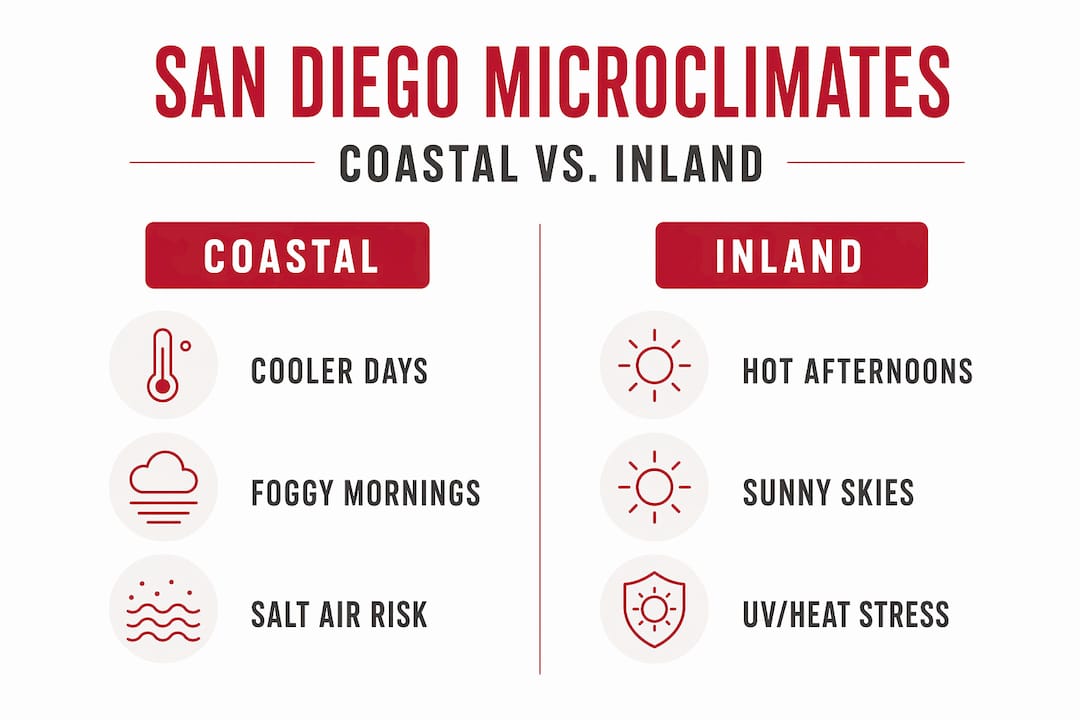
The practical lifestyle difference between a coastal and inland microclimate in San Diego is bigger than most buyers expect. Take a typical spring morning. At Pacific Beach, the sky is gray, the air is cool and damp, and you might not see direct sunlight until noon. That same morning in Mission Valley or Rancho Bernardo, residents are already in shorts and sunglasses.
This contrast shows up directly in how you use your home. Coastal residents run their heaters more in the morning and rarely need air conditioning. Inland residents often flip that equation entirely, with heavy afternoon AC use in summer months driving up energy bills. The marine layer timing also affects how much natural light enters your home, which shapes everything from your mood to your lighting costs.
Other lifestyle factors shaped by local climate conditions include:
-
Outdoor living: Coastal homeowners may lose several usable outdoor mornings per week to fog and chill from May through July.
-
Garden and landscaping: Salt air limits plant selection near the water. Inland areas support a wider range of flora but demand more irrigation.
-
Humidity and comfort: Coastal humidity, while moderate, can make a cool 62°F feel colder than an inland 72°F with dry air.
-
Window and ventilation habits: Sea breeze patterns influence how you naturally ventilate your home and whether cross-ventilation is an asset or a liability.
Pro Tip: Visit any home you are serious about at least twice. Go once in the morning during May or June to experience the marine layer at its strongest, and once in the afternoon on a warm day to gauge heat and wind. Those two visits will tell you more about the actual living experience than any listing description.
Understanding how San Diego’s climate for home buyers plays out daily helps you decide whether a cooler, foggier coastal lifestyle or a sunnier, warmer inland setting actually fits your preferences.

Microclimate effects on building durability and home values
Here is where understanding real estate microclimate factors gets financially meaningful. Your home is a physical structure exposed to whatever climate zone it sits in, every single day. Think of the local microclimate as a continuous building envelope stress test. Each zone produces a distinct pattern of wear.
Coastal salt air is the most aggressive. Salt particles in the marine layer accelerate corrosion on metal components including gutters, fasteners, HVAC equipment, and window frames. Persistent moisture also promotes algae and mold growth on roofing, siding, and decks. These are not one-time repairs. They are recurring maintenance expenses that compound over years.
Inland climates bring their own challenges. Intense UV radiation and heat cycles degrade roofing materials faster, causing premature cracking and wear on asphalt shingles, wood fencing, and exterior paint. Temperature swings between night and day also stress building materials through repeated expansion and contraction.
| Microclimate zone | Primary stress factors | Common maintenance concerns |
|---|---|---|
| Coastal (0-3 miles from ocean) | Salt air, moisture, moderate UV | Metal corrosion, mold, algae on roof |
| Mid-coastal transition | Occasional marine layer, moderate temp | Balanced wear, periodic fog-related moisture |
| Inland valleys | High UV, heat, dry air | Roof material aging, paint fading, wood drying |
| Canyon and mountain areas | Wind, temperature swings, fire risk | Structural stress, ember intrusion, vegetation |
These real estate microclimate factors directly influence property pricing. Comfortable microclimates attract higher buyer demand, which supports stronger home prices. Buyers also factor in perceived risk. Homes in areas prone to heat extremes or fire-adjacent microclimates face tighter insurance markets, which affects both desirability and resale value.
Pro Tip: When budgeting for a coastal home, add 10 to 15 percent to your annual maintenance estimate for salt air and moisture-related upkeep. It is real, and it catches buyers off guard every year.
If you are considering building or substantially renovating, owner-builder construction financing can be structured to account for climate-specific material choices from the start, which is far less expensive than retrofitting later.
Using microclimate knowledge to make smarter property decisions
Understanding how microclimates shape home life is one thing. Turning that knowledge into better real estate decisions is another. Here is a practical framework for applying microclimate thinking to your search:
-
Map your tolerance first. Decide honestly whether you prefer cooler and overcast or warm and sunny. Neither is objectively better, but the mismatch between expectation and reality is one of the most common sources of buyer regret in San Diego.
-
Research neighborhood fog frequency. Ask local residents or your agent how often mornings are overcast in a target neighborhood from May through August. The answer can shift your sense of a property dramatically.
-
Factor energy costs into your budget. Homes in hotter inland microclimates often carry higher summer utility bills. Get 12 months of utility data from the seller before closing.
-
Check sun exposure at the property level. A home on the shaded north side of a canyon behaves very differently from one on the sun-facing south slope, even within the same neighborhood.
-
Look at what materials were used and how they are aging. Rust stains on stucco, faded paint on south-facing walls, or algae streaks on a roof all tell you something real about how a particular microclimate is treating that specific structure.
-
Ask about emerging developments. Microclimate modeling tools are increasingly used in urban planning to predict ventilation, shading, and temperature patterns in new neighborhoods, which can affect long-term livability as San Diego continues to grow.
-
Consider climate change trajectory. The marine layer pattern may shift as regional temperatures change, potentially reducing fog frequency at the coast and intensifying heat inland. This is a long-term risk factor worth acknowledging in any 10-plus-year investment.
The importance of microclimate in property decisions comes down to this: you are not just buying a structure. You are buying into a specific outdoor environment that will shape how you feel at home, what you spend to live there, and what the next buyer will think when your time comes to sell.
My take on microclimate: the most underestimated factor in San Diego real estate
I have worked with hundreds of buyers in San Diego over more than 15 years, and the conversations that stick with me are the ones where microclimate surprised people. Not pleasantly.
I have seen buyers fall in love with a home during a sunny October afternoon showing, close escrow in November, and then call me in June genuinely frustrated that their backyard is socked in with fog until noon every day. They did not do anything wrong, exactly. They just did not know to look.
What I have learned is that microclimate is not a secondary detail. For many buyers, it should outweigh granite countertops, an extra bathroom, or a slightly larger square footage. You can renovate a kitchen. You cannot renovate your neighborhood’s weather.
My honest take: buyers tend to overcorrect toward cosmetics and underthink livability. The home that checks every interior box but puts you in a microclimate that does not match your lifestyle will wear on you. Fast. And when you go to sell, buyers in that zone will run the same math you should have run before you bought.
The practical advice I give every client is simple. Visit the home in the early morning during spring. Drive through the neighborhood on a hot August afternoon. Talk to a neighbor or two about what September feels like. That kind of due diligence takes a few extra hours and can save years of regret.
Microclimate is where local knowledge pays for itself. It is not something you find in a Zestimate.
— Stu
Find the right San Diego home for your climate preferences

At Stuharveyestates, microclimate awareness is built into every buyer consultation. Stu Harvey draws on more than 15 years of real estate experience while helping clients evaluate properties and the local conditions that affect daily life. Whether you are drawn to the coastal living of Del Mar or prefer the sunnier skies further inland, the right match starts with understanding exactly what your daily environment will feel like. Browse San Diego home listings across diverse microclimate zones, or reach out directly to the Stuharveyestates team for a personalized consultation. With experience from 250+ personal career transactions, Stu helps buyers identify questions to explore before choosing a property.
FAQ
What does microclimate mean in San Diego real estate?
In San Diego real estate, a microclimate refers to the localized weather conditions, including temperature, fog, humidity, and wind, that vary significantly across small geographic areas. These conditions directly affect home comfort, energy costs, and property values.
How does the marine layer affect San Diego home buyers?
The marine layer creates coastal fog that keeps neighborhoods near the ocean cooler and cloudier, especially in spring and early summer, while inland areas clear much sooner. Buyers should visit coastal homes in the morning during May and June to experience this firsthand before committing.
Do microclimates affect home maintenance costs in San Diego?
Yes. Coastal salt air accelerates corrosion and promotes mold growth, while inland UV and heat cycles degrade roofing and exterior finishes faster. These maintenance cost differences are real and recurring, so buyers should factor them into their long-term budget.
Do microclimates influence San Diego property values?
Absolutely. Comfortable microclimates support higher home prices because lifestyle appeal and lower utility costs drive buyer demand. Climate risk factors such as extreme heat or fire exposure can reduce both demand and insurability in affected zones.
How can I evaluate a home’s microclimate before buying?
Visit the property at multiple times of day and in different seasons, particularly early morning during late spring. Ask for 12 months of utility bills, observe how materials on the exterior are aging, and talk to neighbors about seasonal conditions. These steps reveal what no listing photo can show.