
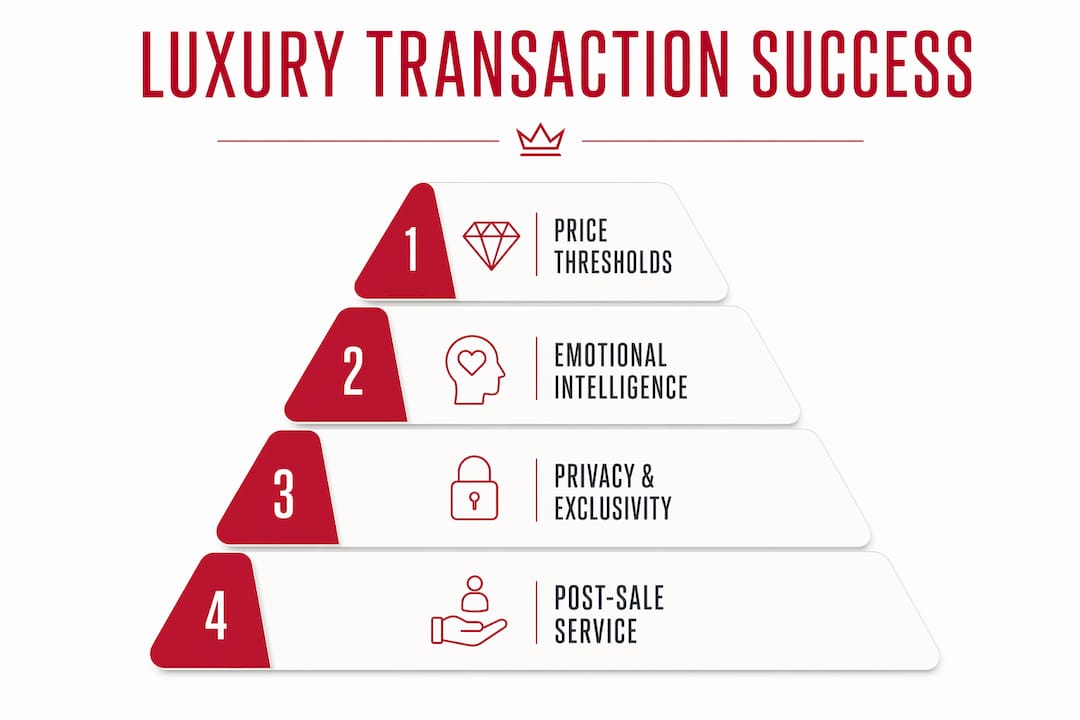
A successful luxury real estate transaction is defined as a confidential, client-centered process that delivers measurable value through craftsmanship, privacy, and personalized service. Price is a threshold, not the finish line. The real benchmark is whether the buyer and seller both walk away feeling their experience matched the caliber of the asset. Understanding what is a successful luxury transaction defined requires looking at market segmentation, emotional intelligence, and post-sale care as equally important factors.
What is a successful luxury transaction defined by in real estate?
Luxury real estate operates on market-specific price percentiles, not a single national number. Entry-level luxury starts at the top 10% of a given market, high-end luxury sits in the top 5% at roughly $2 million nationally, and ultraluxury begins near $5.5 million in the top 1%. These thresholds shift dramatically by geography.
In La Jolla or Rancho Santa Fe, a $2 million property may sit at the lower end of the luxury spectrum. In a mid-tier Midwest market, that same price point is firmly ultraluxury. The table below illustrates how these tiers translate across different markets.
| Market | Entry-Level Luxury (Top 10%) | High-End Luxury (Top 5%) | Ultraluxury (Top 1%) |
|---|---|---|---|
| National average | ~$800K | ~$2M | ~$5.5M |
| La Jolla, CA | ~$2.5M | ~$5M | ~$12M+ |
| Rancho Santa Fe, CA | ~$3M | ~$6M | ~$15M+ |
| Mid-tier U.S. market | ~$500K | ~$1.2M | ~$3M |
Price thresholds matter because they set the baseline expectation for service, privacy, and process quality. A buyer crossing into the top 1% expects a fundamentally different experience than someone purchasing a standard home. That expectation gap is where most transactions either succeed or fail.
Pro Tip: When evaluating a market, always anchor your luxury definition to local percentiles, not national averages. A $2 million budget means something very different in San Diego than in suburban Ohio.
What client expectations actually define a successful luxury purchase?
The definition of luxury transaction success shifts the moment you look at what buyers actually value. 89% of top-tier luxury clients rate craftsmanship and product quality as their primary value driver. Only 16% cite exclusivity as the main factor. That gap tells you something critical: buyers want substance, not status symbols.
The successful luxury purchase criteria that matter most to clients include:
- Craftsmanship and material quality in the property itself, from finishes to structural integrity
- Privacy protocols throughout the transaction, including how offers are communicated and who has access to personal financial information
- Proactive contingency management so clients never feel blindsided by inspection results, title issues, or financing delays
- Personalized communication pacing that matches the client's preference, not a standard checklist timeline
- Concierge-level access to vetted professionals including attorneys, architects, and interior designers
Luxury clients expect proactive management of every contingency and a service experience that anticipates needs before they are voiced. That anticipatory quality separates a good transaction from a great one.
Pro Tip: During negotiation phases, acknowledge the emotional weight of the decision before presenting counter-offers. Buyers who feel heard are far less likely to walk away over minor price gaps.
How do negotiation and emotional intelligence shape luxury transaction success?
Luxury deals are identity-driven. A buyer purchasing a $10 million estate in La Jolla is not just acquiring square footage. Luxury advisors succeed when they understand that buyers seek an enhanced lifestyle and identity, not a commodity. That psychological layer changes everything about how negotiation must be handled.
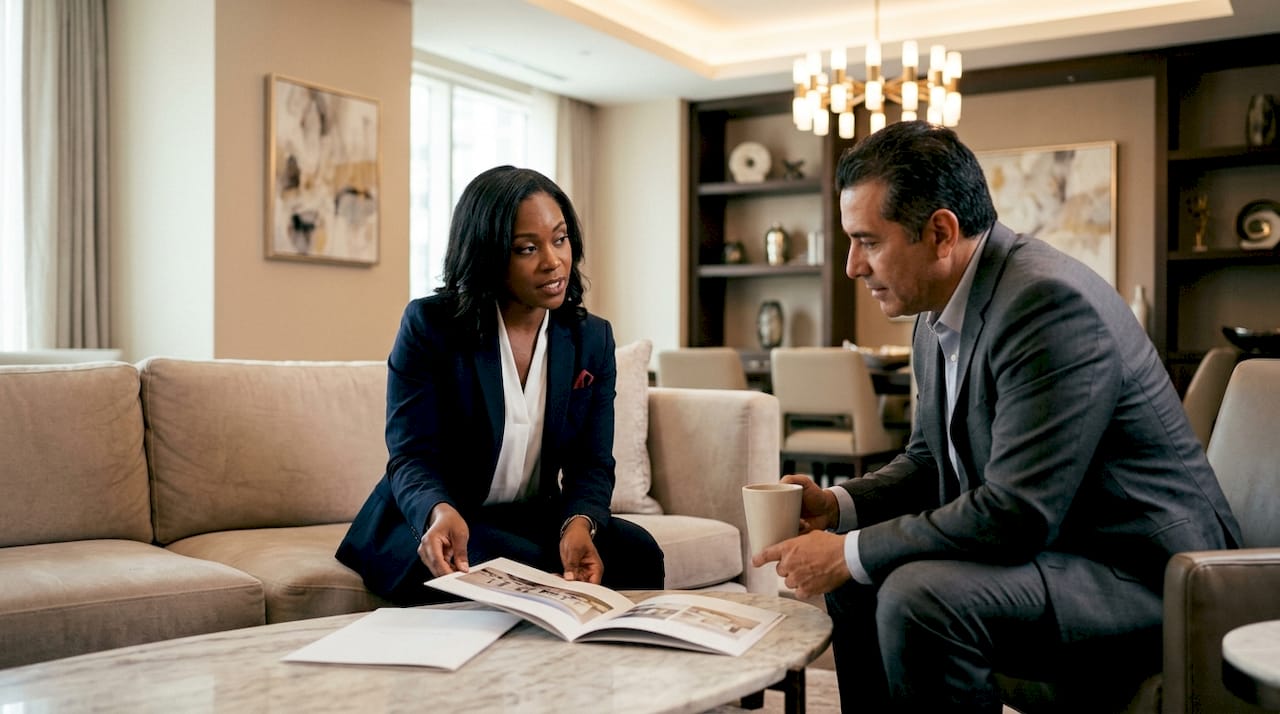
The advisor's role in luxury transactions extends well beyond presenting offers. Advisors act as "emotional thermometers," monitoring both parties' emotional states and knowing precisely when to pause negotiations before ego injury collapses a deal. A seller who feels disrespected by a lowball offer will not simply counter. They will disengage entirely.
Luxury negotiation periods can last three months or more due to complexity involving tax structuring, estate planning, and multi-party legal reviews. That timeline is normal and healthy. A listing sitting beyond 180 days, however, signals failed positioning rather than a patient market. The distinction matters because misreading the timeline leads to price reductions that damage perceived value.
Experienced advisors also know when silence is a tactic. Pausing communication for 24 to 48 hours after a tense counter-offer allows emotional temperature to drop. That pause often produces more movement than any additional negotiation language.
Why do privacy and exclusivity define luxury transaction success?
True luxury relies on rarity, restricted access, and handmade craftsmanship. Access is relationship-earned, not purchased through marketing spend. This is the core distinction between a premium product and a genuinely luxury one. Most branded "luxury" marketing sells aspiration. True luxury sells access.
In real estate, off-market and private transactions represent the highest expression of this principle. A seller who never lists publicly, whose property transfers through a network of trusted advisors, has achieved the ultimate luxury transaction benchmark. No public days on market. No open houses. No exposure to unqualified buyers.
Privacy protocols like holding companies shield buyer identities during purchase, preventing public records from exposing high-net-worth individuals to security risks or unwanted attention. This is standard practice at the ultraluxury tier, not an optional add-on. Buyers spending $5 million or more expect their advisor to know this without being asked.
The relationship-driven nature of luxury access also means that the best properties rarely reach public listing platforms. Buyers who rely solely on public searches miss a significant portion of the true luxury inventory. Access comes from the advisor's network, built over years of trust and closed transactions. Stuharveyestates has built exactly that kind of network across Southern California's most competitive markets, including San Diego luxury real estate corridors where off-market activity is especially high.
How does post-sale service complete the definition of a successful luxury sale?
The transaction does not end at closing. Nearly half of luxury buyers, 49%, want full-service transition management to achieve a stress-free ownership experience after purchase. That demand reveals a service gap that most advisors leave unfilled.
Successful brokers extend their role beyond closing by connecting buyers with property management teams, security consultants, and wealth management professionals. This is not upselling. It is completing the transaction. A buyer who moves into a $7 million home and immediately struggles to find a reliable property manager does not feel successful, regardless of the price they paid.
Post-sale concierge connections also drive referrals. Clients who receive ongoing support after closing are far more likely to return for their next purchase and recommend their advisor to peers. In luxury markets, word-of-mouth within high-net-worth networks is the most valuable marketing channel available.
Pro Tip: Build your post-sale resource list before closing, not after. Presenting a curated list of vetted property managers, security firms, and estate attorneys at the final walkthrough signals that your service extends beyond the commission check.
The 2026 luxury market report from Stuharveyestates outlines how post-sale service expectations have grown alongside rising price points across Southern California markets.
Key Takeaways
A successful luxury transaction requires price-threshold awareness, emotional intelligence, privacy protocols, and post-sale concierge service working together as a single client experience.
| Point | Details |
|---|---|
| Price thresholds set the baseline | Ultraluxury begins near $5.5M nationally, but local percentiles vary significantly by market. |
| Craftsmanship outranks exclusivity | 89% of luxury buyers prioritize quality over status, so substance must lead every presentation. |
| Emotional intelligence closes deals | Advisors who manage negotiation pauses and ego dynamics prevent deal collapse at critical moments. |
| Privacy is a non-negotiable standard | Holding companies and off-market access protect buyer identity and define true luxury service. |
| Post-sale care drives retention | 49% of luxury buyers expect full-service transition support, making post-closing concierge a success factor. |
What I've learned about defining success in luxury real estate
Most people assume a successful luxury transaction means a high sale price and a fast close. After more than 15 years and over $1.2 billion in closed volume, I can tell you that is rarely what clients remember.
What clients remember is how they felt during the process. Did their advisor anticipate problems before they became crises? Did they feel their privacy was protected at every step? Did someone pick up the phone on a Sunday when the inspection report raised a concern? Those moments define success far more than the final number on the contract.
The biggest mistake I see in luxury real estate is advisors who treat price as the primary success metric. Price is a threshold. Experience is the product. A client who paid $8 million and felt anxious, exposed, or ignored throughout the process does not feel successful. A client who paid $6 million and felt guided, protected, and genuinely cared for absolutely does.
Tailoring service to each client's personal definition of luxury is the hardest and most important skill in this business. Some clients want daily updates. Others want silence until there is something worth saying. Reading that preference correctly, and adjusting without being asked, is what separates advisors who build lasting practices from those who chase transactions.
— Stu
How Stuharveyestates delivers successful luxury transactions in Southern California
Stuharveyestates brings over 15 years of expertise and more than 250 closed luxury transactions to every client engagement in markets like La Jolla, Rancho Santa Fe, and greater San Diego.
The team manages privacy protocols, negotiation pacing, and post-sale transition connections as standard practice, not premium add-ons. Buyers gain access to off-market listings and curated market data that public searches simply do not reach. Whether you are buying or selling at the top tier of the Southern California market, the process should feel as refined as the property itself. Browse available luxury listings or connect directly with the buyer advisory team to start with a conversation built around your goals.
FAQ
What is the definition of a luxury transaction in real estate?
A luxury real estate transaction is defined by market-specific price percentiles, with entry-level luxury at the top 10%, high-end luxury at the top 5% (around $2 million nationally), and ultraluxury at the top 1% (near $5.5 million). Beyond price, success requires privacy, personalized service, and proactive transaction management.
What do luxury buyers prioritize most during a purchase?
89% of top-tier luxury buyers rate craftsmanship and quality as their primary value driver, far above exclusivity. Buyers also expect proactive contingency management and privacy protocols throughout the transaction.
How long do luxury real estate negotiations typically take?
Luxury negotiations commonly span three months or more due to complexity involving tax structuring, estate planning, and multi-party legal reviews. A listing exceeding 180 days on market signals failed positioning, not a patient buyer pool.
Why does privacy matter so much in luxury transactions?
High-net-worth buyers use privacy tools like holding companies to prevent public records from exposing their identity and creating security risks. Off-market transactions represent the highest standard of privacy in luxury real estate.
What role does post-sale service play in luxury transaction success?
Nearly 49% of luxury buyers want full-service transition management after closing, including connections to property management, security, and wealth advisory teams. Brokers who provide this level of ongoing support see significantly higher client retention and referral rates.