
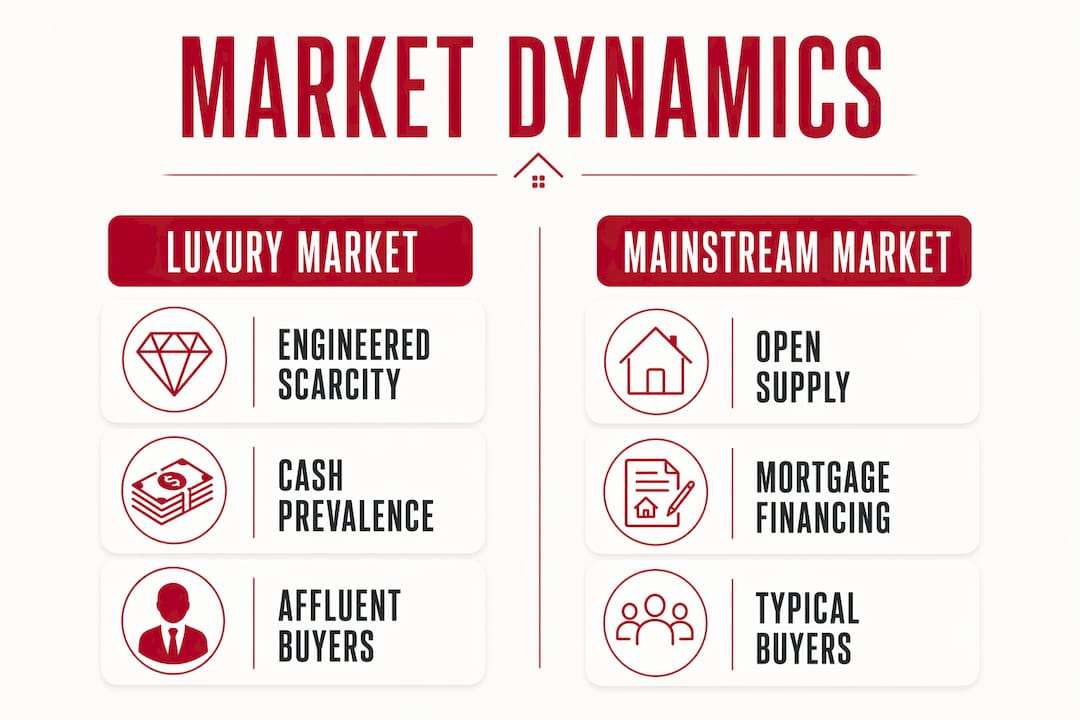
Luxury neighborhoods are defined by a separate set of market rules because exclusivity, controlled supply, and affluent buyer behavior operate independently of mainstream real estate cycles. Understanding why luxury neighborhoods have different market rules is not just academic. It directly affects how you price, negotiate, and time transactions in places like La Jolla, Rancho Santa Fe, or Newport Beach. Luxury home prices rose 4.7% in the past year, more than three times the broader market increase. That gap exists because luxury real estate is engineered, blending finance, branding, and psychological exclusivity rather than following conventional supply and demand cycles.
Why luxury neighborhoods have different market rules: engineered scarcity
Engineered scarcity is the single most powerful force behind high-end property market rules. Developers and brokers deliberately limit supply and control visibility to maintain pricing power. This is not a side effect of geography. It is a core business strategy built into how luxury neighborhoods are planned and marketed.
Zoning laws, height restrictions, and environmental protections all serve as structural tools that preserve scarcity. In Naples, Florida, height restrictions preserve exclusivity by preventing the dense development that erodes premium character in other markets. In Barton Creek, Texas, watershed protections and impervious cover limits restrict redevelopment intensity in ways that protect values more effectively than school districts or amenities alone.
The contrast with mainstream markets is stark. A suburban neighborhood can absorb new construction quickly, softening prices through added inventory. A luxury enclave with strict zoning cannot. Every new restriction that blocks a developer from adding units is a price floor for existing owners.
| Factor | Luxury neighborhoods | Mainstream markets |
|---|---|---|
| Supply control | Zoning, height limits, environmental rules | Fewer regulatory barriers |
| New construction impact | Minimal, often blocked | Significant price softening |
| Inventory turnover | Low, owners hold longer | Higher, driven by life events |
| Price stability | High, supported by scarcity | Moderate, sensitive to supply |
Pro Tip: When evaluating a luxury property, pull the local zoning code and check for height limits or environmental overlays before making an offer. Those regulations are the invisible price floor protecting your investment.
How does buyer behavior shape luxury market dynamics?
Affluent buyers do not behave like typical homebuyers, and that difference reshapes the entire market. 38% of luxury agents report that aging in place is now a primary driver of supply compression. Wealthy owners hold their homes longer, which means fewer properties ever reach the open market.
Generational shifts are adding another layer of complexity to market dynamics in affluent areas. The upper-middle-class share of U.S. households grew 210% since 1979, rising from 10% to 31%. That expansion creates intense competition for entry-level luxury homes, pushing prices upward even when broader market conditions are flat.
Buyer motivation has also changed in ways that affect how properties are valued and held. The 2026 Coldwell Banker Global Luxury Trend Report identifies a clear shift toward purposeful investment, where buyers select properties for legacy, lifestyle integration, and long-term financial planning rather than status alone. That mindset produces longer holding periods and lower turnover, which tightens inventory further.
Key buyer behavior trends shaping luxury markets in 2026:
- Aging in place extends ownership timelines, reducing available supply in established neighborhoods.
- Purposeful investment priorities mean buyers hold properties through market corrections rather than selling.
- Wellness and lifestyle features now rank alongside location in purchase decisions.
- Generational wealth transfers are bringing younger buyers into luxury segments earlier than prior generations.
- Emotional attachment to trophy properties creates resistance to listing, even at peak valuations.
These behaviors collectively produce a market where inventory stays tight regardless of broader economic conditions. That is what makes luxury neighborhoods structurally different from standard residential markets.
How do financing and economic factors differ in luxury real estate?
Cash is king in luxury real estate, and that fact alone separates high-end property market rules from everything else. A large share of luxury transactions close without a mortgage, which means interest rate movements that dominate mainstream market headlines have far less influence on luxury pricing.

AI-driven equity liquidity events add roughly $198,000 in upfront cash for buyers entering the entry-level luxury segment near $3 million, particularly in markets like the Bay Area. That hidden cash infusion offsets broader market corrections and keeps prices elevated even when mortgage rates rise. Buyers and sellers who do not account for this dynamic misread the market entirely.
| Financing factor | Luxury market | Broader market |
|---|---|---|
| Cash purchase prevalence | High | Low |
| Interest rate sensitivity | Low | High |
| Down payment size | Often 30–50%+ | Typically 10–20% |
| Equity liquidity influence | Significant | Minimal |
| Correction resilience | Strong | Moderate to weak |
The practical implication for investors is that luxury markets do not correct the same way mainstream markets do. When rates rise, mainstream buyers get priced out and demand falls. In luxury segments, cash buyers absorb the shock and prices hold. Understanding this distinction is the difference between a well-timed entry and a costly miscalculation.
Pro Tip: Before investing in a luxury sub-market, research the local share of cash transactions. A neighborhood where more than half of sales close in cash is far more insulated from rate-driven corrections than one dependent on jumbo mortgage financing.
What makes luxury neighborhoods unique in terms of location and perception?
Location in luxury real estate is not just about geography. It is about what that geography cannot be replicated. Waterfront scarcity, mountain views, and coastal preservation laws create natural barriers that no developer can engineer around. Those barriers are permanent, and permanence is what buyers in affluent areas pay for.
The halo effect from high-profile transactions is a real and measurable force. When a billionaire buys in a sub-market, local pricing standards reset upward. Neighboring owners hold their properties longer, waiting for the new benchmark to validate their own valuations. Inventory shrinks, and the cycle reinforces itself.
San Diego luxury markets like La Jolla and Coronado demonstrate this dynamic clearly. Coastal preservation rules limit what can be built along the waterfront. Every restriction that blocks new supply is a structural advantage for existing owners. Buyers who understand La Jolla's zoning constraints recognize that the premium they pay today is protected by the same regulations that prevented oversupply yesterday.
Controlled visibility also plays a role that most buyers overlook. Many luxury properties in markets like Rancho Santa Fe or The Hollywood Hills never appear on public listing platforms. They trade through private networks, which compresses the visible supply even further. That off-market activity is not a quirk. It is a deliberate feature of how these neighborhoods maintain their exclusivity and pricing power.
Key Takeaways
Luxury neighborhoods follow fundamentally different market rules because engineered scarcity, cash-dominant financing, and lifestyle-driven buyer behavior create structural price floors that mainstream markets simply do not have.
| Point | Details |
|---|---|
| Engineered scarcity drives value | Zoning, height limits, and environmental rules restrict supply and protect pricing power. |
| Buyer behavior tightens inventory | Aging in place and purposeful investment extend holding periods, reducing available listings. |
| Cash dominance buffers corrections | High cash purchase rates insulate luxury markets from interest rate-driven price drops. |
| Location barriers are permanent | Waterfront scarcity and preservation laws create advantages no new development can erase. |
| Halo transactions reset benchmarks | High-profile sales raise local price standards and incentivize owners to hold longer. |
What I've learned after 250+ luxury transactions
After more than 15 years and over $1.2 billion in luxury sales across Southern California, the pattern I see most often is buyers treating luxury neighborhoods like scaled-up versions of mainstream markets. They apply the same logic, the same timing instincts, and the same negotiation tactics. That approach consistently costs them money.
The most undervalued insight in this market is regulatory depth. Buyers focus on the view, the finishes, and the square footage. The buyers who build real wealth focus on what the zoning code prevents from being built next door. In Barton Creek, in La Jolla, in Rancho Santa Fe, the regulations are the asset. The house is just the vehicle.
I have also watched buyers dismiss off-market opportunities because the property was not publicly listed. That instinct is backwards. In luxury markets, the absence of a public listing often signals that the seller has pricing power and knows it. The best luxury portfolio strategies I have seen all involve cultivating access to inventory before it becomes visible to the broader market.
The one mistake sellers make most often is pricing against the last comparable sale without accounting for the halo effect of a recent high-profile transaction nearby. If a significant sale closed two streets over, your property's floor just moved. Price accordingly.
— Stu Harvey
Stu Harvey Estates: your edge in luxury neighborhood markets
Navigating the distinct rules of luxury real estate requires more than a general understanding of the market. It requires local knowledge, regulatory fluency, and access to inventory that never reaches public platforms.
Stu Harvey Estates brings over 15 years of specialized experience and more than 250 completed luxury transactions across San Diego, Los Angeles, Orange County, and Southern California. Whether you are buying in La Jolla, selling in Rancho Santa Fe, or building a portfolio across multiple affluent markets, the team at Stu Harvey Estates provides the kind of personalized, data-grounded guidance that turns market complexity into clear decisions. Start your luxury home search or connect directly with Stu to discuss your specific goals and the neighborhoods that match them.
FAQ
Why do luxury home prices rise faster than the broader market?
Luxury home prices rose 4.7% in the past year, more than three times the broader market rate. Engineered scarcity, low inventory turnover, and cash-dominant buyers insulate luxury markets from the corrections that affect mainstream real estate.
How does aging in place affect luxury real estate supply?
Wealthy homeowners hold properties longer than typical sellers, which compresses available inventory. 38% of luxury agents identify aging in place as a primary driver of supply tightening in affluent neighborhoods.
Are luxury home buyers less affected by rising interest rates?
Yes. A high share of luxury transactions close in cash, which reduces sensitivity to mortgage rate changes. AI equity liquidity events also add significant upfront cash capacity for buyers near the $3 million entry-level luxury threshold.
What is the halo effect in luxury real estate?
The halo effect occurs when a high-profile transaction resets local pricing standards upward. Billionaire-level purchases incentivize neighboring owners to hold their properties longer, which shrinks inventory and sustains elevated price levels across the sub-market.
What makes a luxury neighborhood's value more durable than a standard neighborhood?
Zoning restrictions, environmental protections, and natural barriers like waterfront scarcity create permanent supply limits. Those structural constraints, combined with purposeful investment priorities among affluent buyers, produce price floors that standard neighborhoods cannot replicate.