
Timing a Southern California home sale is the single biggest variable sellers control after price. List during peak demand and you attract multiple offers, shorter days on market, and a final sale price that reflects full market value. List during a slow period and you face longer waits, price reductions, and buyers who know they have leverage. Recent data from Realtor.com and Zillow confirms what experienced agents in La Jolla, San Diego, and Los Angeles have observed for years: the calendar matters as much as the condition of the home.
Why timing affects Southern California home sales more than most markets
Southern California real estate does not behave like a single market. It is a collection of distinct submarkets, from the coastal luxury corridors of La Jolla and Del Mar to the inland communities of Rancho Santa Fe and the dense urban core of Los Angeles. Each responds to seasonal buyer demand differently, but all share one pattern: buyer activity concentrates in spring and early summer, and that concentration creates a measurable advantage for sellers who list at the right moment.
Seasonal buyer demand drives the core timing effect. When more buyers are actively searching, competing offers emerge faster, and sellers gain negotiating power they simply do not have in october or january. The impact shows up directly in median days on market for the Los Angeles metro, where monthly figures tracked through FRED reveal clear seasonal troughs during spring and peaks during late fall and winter.

Mortgage rate stability during spring 2026 has reinforced this pattern. When rates hold steady, buyers who have been waiting on the sidelines commit. That commitment concentrates demand into a narrow window, which is exactly the window sellers want to target.
Pro Tip: Track the Realtor.com median days on market for your specific metro before setting a listing date. A drop in DOM from the prior month signals rising buyer demand and is your clearest indicator that the window is opening.
How spring creates the strongest seller conditions
Spring is the strongest selling season in Southern California for three compounding reasons. Families want to close before the school year ends. Tax refunds give buyers additional down payment funds. And longer daylight hours mean more showings per day, which accelerates the timeline from listing to offer.
Realtor.com’s 2026 analysis identifies the week of april 12–18 as the national “Goldilocks” window, when homes receive 16.7% more views and sell about 9 days faster, with a 1.3% price premium. That 9-day reduction in time on market is not a minor convenience. It means fewer carrying costs, less disruption from showings, and a stronger negotiating position at the table.
Does the listing date actually change your sale price?
The answer is yes, and the dollar amounts are specific. Zillow’s 2025 Best Time to List report shows that homes listed in late may nationally sell for a 1.7% premium, roughly $6,000 above comparable homes listed at other times. That premium exists because late may captures buyers who have been searching since march and are ready to commit before summer travel disrupts their plans.
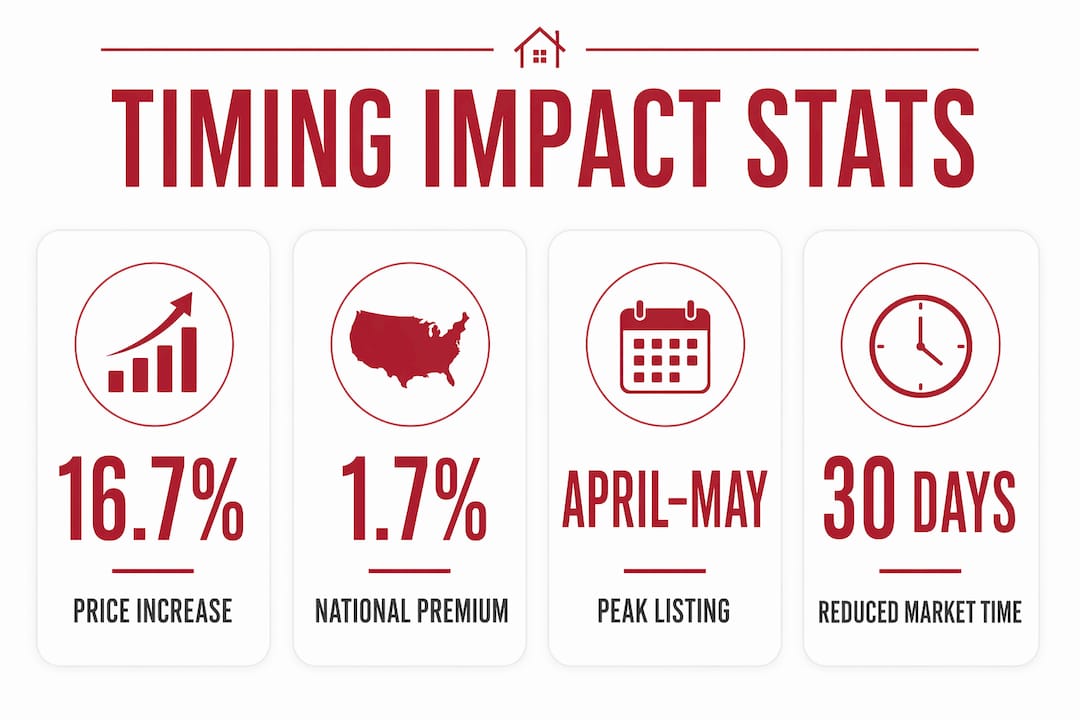
Metro-specific data sharpens this picture considerably. San Jose’s best listing window falls in early february, yielding a 3.1% premium. Baltimore peaks in late june at 2.0%. Los Angeles and San Diego follow patterns closer to the national late may window, but neighborhood-level variation within Southern California is real. A home in coastal Del Mar competes differently than one in the Inland Empire, and the optimal listing week reflects that difference.
The table below shows how price premiums vary across metros relevant to Southern California sellers.
| Metro | Best listing window | Estimated price premium |
|---|---|---|
| National average | Late may | 1.7% (~$6,000) |
| San Jose | Early february | 3.1% |
| Los Angeles | Late april to late may | Near national average |
| San Diego | Mid april to late may | Near national average |
| Baltimore (comparison) | Late june | 2.0% |
Source: Zillow 2025 Best Time to List report
The practical implication is clear. Sellers who treat “spring is best” as a precise enough strategy leave money on the table. The difference between listing in early march and late april in Los Angeles can mean the difference between one offer and four.
Pro Tip: Use Zillow’s metro-specific timing data alongside your agent’s neighborhood comps to identify your exact listing window. Generic seasonal advice is a starting point, not a final answer.
What does median days on market tell you about your timing advantage?
Median days on market (DOM) is the most direct measure of how quickly buyers are absorbing available inventory. When DOM falls, demand is outpacing supply and sellers hold the leverage. When DOM rises, buyers have time to be selective and negotiate down.
Monthly DOM data for the Los Angeles metro shows a consistent seasonal pattern. DOM compresses during march through june, then expands through the fall and winter months. Sellers who list when DOM is already falling ride the momentum of rising buyer urgency. Sellers who list when DOM is expanding fight against a market that is cooling.
The table below illustrates how DOM shifts across seasons in the LA metro.
| Season | Typical DOM trend | Seller leverage |
|---|---|---|
| Spring (march to june) | Falling | High |
| Early summer (july) | Near low | Moderate to high |
| Late summer to fall | Rising | Moderate |
| Winter (november to february) | Near peak | Low |
Source: FRED, Realtor.com LA metro data
Faster DOM also reduces the risk of price cuts. Homes that sit on the market beyond 30 days in Southern California attract lowball offers and the stigma of being “stale.” Listing during peak demand periods reduces price reduction risk by generating early offers before that stigma can form. The first two weeks of a listing are its most powerful. Timing determines how much buyer traffic fills those two weeks.
How do local Southern California submarkets change the timing calculus?
Broad seasonal patterns apply across Southern California, but the hyper-local timing advantage requires submarket-specific knowledge. The San Diego coastal market, including La Jolla and Del Mar, attracts a high proportion of relocation buyers and second-home purchasers. Those buyers operate on different calendars than first-time buyers in the San Fernando Valley or Inland Empire.
Inventory levels by submarket amplify or dampen the timing effect. In areas with chronically tight supply, like Rancho Santa Fe or the Hollywood Hills, a well-prepared home listed in april will attract strong offers regardless of minor timing variations. In higher-inventory submarkets, hitting the exact peak demand window matters more because buyers have alternatives.
Seller preparation is the variable most often underestimated. Realtor.com advises backward planning from the target listing week to align home readiness with market velocity. A home that needs staging, minor repairs, and professional photography requires four to six weeks of preparation. That means a seller targeting a late april listing needs to begin work in early march at the latest.
Key preparation steps to align with your target listing window:
-
Complete all deferred maintenance and cosmetic repairs at least three weeks before listing.
-
Stage the home and schedule professional photography two weeks before the target date.
-
Work with your agent to set a price based on the most recent comparable sales, not comps from six months prior.
-
Plan your own move-out timeline so the home can be shown with maximum flexibility.
-
Monitor local DOM weekly in the two months before your target date to confirm demand is building.
Pro Tip: If your personal timeline does not align with the spring peak, the second-best window in Southern California is late january to early february, when inventory is low and motivated buyers who missed the prior year’s market are actively searching.
The San Diego luxury market adds another layer. Global buyers and investors do not always follow domestic seasonal patterns, which means high-end coastal properties can see strong demand outside the traditional spring window. Understanding your buyer profile is as important as understanding the calendar.
Key Takeaways
Timing a Southern California home sale during peak spring demand directly increases sale price, reduces days on market, and strengthens your negotiating position against buyers.
| Point | Details |
|---|---|
| Spring is the strongest window | Homes listed in april and may sell faster and at higher prices across Southern California metros. |
| Late may adds measurable value | Zillow data shows a 1.7% national price premium for late may listings, roughly $6,000 above off-peak sales. |
| DOM signals your leverage | Falling median days on market in the LA metro from march through june confirms peak buyer demand. |
| Submarket timing varies | San Diego coastal, LA urban, and Inland Empire markets each have distinct optimal listing windows. |
| Preparation must precede the window | Sellers need four to six weeks of preparation to list at peak demand, requiring planning that starts in late winter. |
What matters when timing Southern California home sales
Sellers consistently underestimate how much the calendar affects their outcome. I have seen nearly identical homes in the same neighborhood sell for meaningfully different prices based solely on when they hit the market. The home listed in late april with four competing offers closed above ask. The same floor plan listed in november sat for 45 days and closed below ask. The difference was not the home. It was the timing.
The data from Realtor.com and Zillow confirms what I observe in practice. The week of april 12–18 generating 16.7% more views is not a statistical curiosity. It is the difference between a bidding war and a single offer. Sellers who understand this plan their preparation around it.
The caution I always share is this: do not let the calendar override your readiness. A home listed in the peak week that is not properly prepared, priced, or staged will underperform a well-prepared home listed two weeks later. Timing creates the opportunity. Preparation captures it.
Life events do not always align with market calendars, and that is real. But sellers who have flexibility should treat the spring window as a hard target, not a preference. The financial difference is too significant to treat casually. Working with an agent who tracks Del Mar’s 2026 market conditions or La Jolla’s specific demand cycles gives you the local intelligence to refine the national data into a precise listing date.
— Stu
How Stuharveyestates helps you time your Southern California sale
Stu Harvey brings more than 15 years of real estate experience and 250+ personal career transactions to his work with sellers. Listing decisions should consider current neighborhood data alongside each seller's goals and schedule.
Stu Harvey’s team analyzes median days on market, current inventory levels, and buyer demand patterns specific to your submarket before recommending a listing date. Whether you are selling in La Jolla, Rancho Santa Fe, or the Hollywood Hills, the timing strategy is built around your property and your market. Browse current listings to see how well-timed Southern California properties are positioned, or connect with the team directly to build a sale timeline around your goals.
FAQ
When is the best time to sell a home in Southern California?
The strongest window is late april through late may, when buyer demand peaks and median days on market reach their seasonal low. Realtor.com identifies the week of april 12–18 as the single best national listing week, with homes selling 9 days faster and receiving 16.7% more views.
How much more money can I make by timing my sale correctly?
Zillow’s analysis shows a 1.7% price premium for late may listings nationally, roughly $6,000 on a median-priced home. Metro-specific premiums in Southern California vary, but the pattern of higher prices during peak spring demand holds consistently across LA and San Diego markets.
Does timing matter differently in San Diego versus Los Angeles?
Yes. San Diego’s coastal submarkets attract more relocation and second-home buyers, which can extend strong demand slightly beyond the traditional spring peak. Los Angeles follows the national pattern more closely, with late april to late may representing the strongest window for most neighborhoods.
How far in advance should I start preparing to sell?
Realtor.com advises backward planning from your target listing date. Most homes require four to six weeks of preparation including repairs, staging, and photography. A seller targeting a late april listing should begin the preparation process in early to mid march.
What happens if I miss the spring window?
The second-best window in Southern California is late january to early february, when inventory is at its seasonal low and motivated buyers are actively searching. Avoid listing in october through december unless your personal timeline requires it, as DOM rises and buyer competition falls during those months.