
Yes, California requires a written buyer-broker agreement before a real estate agent can represent you. Civil Code §1670.50, enacted through AB 2992, mandates the contract be signed as soon as practicable but no later than when you submit an offer. It must spell out compensation, the services your agent will provide, when payment is due, and how either side can end the relationship. For individual buyers, the term caps out at three months with no automatic renewal. None of this stops you from negotiating whether the seller covers your agent's fee.
TL;DR:
- The written buyer-broker agreement must be signed before or at the time of submitting an offer and clearly state compensation, services, and termination terms.
- The three standard C.A.R. forms differ in flexibility: BR-11 is revocable and non-exclusive, NAP-11 is non-exclusive with clear compensation, and AAP-11 is exclusive and non-revocable, affecting your obligations.
- Compensation generally functions as a ceiling, with the seller usually responsible for paying the agent unless negotiations or specific requests make you pay directly out of pocket.
- Missing statutory terms or signing the agreement too late can render the contract unenforceable and may lead to license violations for the agent.
- Luxury buyers should explicitly specify off-market access and extended transaction terms in their agreement to avoid disputes in longer, high-end escrows.
Table of Contents
- What The Buyer Broker Agreement California Law Actually Requires
- Which C.A.R. Form Will You Be Asked To Sign?
- Who Actually Pays Your Buyer's Agent
- Your Exit Options If Something Feels Off
- Questions To Ask Before You Sign Anything
- Exceptions Worth Knowing About
- Where To Verify These Rules Yourself
- What Luxury Buyers Should Watch For In Their Representation Agreement
- Reviewing Your Agreement Before You Commit To An Agent
- Sources
What The Buyer Broker Agreement California Law Actually Requires
Civil Code §1670.50 lists four things every agreement must spell out: compensation, the specific services the agent will perform, when that compensation becomes due, and how the contract terminates. These aren't suggestions. Skip one, and the whole agreement can become unenforceable.
"Compensation" means a stated dollar figure or a clear formula. Vague language like "standard commission" doesn't satisfy the statute. "Services to be rendered" needs to name what your agent actually does, whether that's touring homes, drafting offers, negotiating repairs, or coordinating inspections. Vague boilerplate here creates disputes later when a buyer feels underserved.
Timing trips up more people than any other part of the law. The statute says "as soon as practicable" but no later than when you sign an offer, which sounds like it gives agents room to wait. The Department of Real Estate's November 2024 advisory pushes agents toward getting the agreement signed before touring a home, not after. If an agent asks you to sign paperwork mid-showing, that's the DRE's preferred sequence playing out, not a sales tactic.
The term cap applies to individual buyers only, and agreements cannot auto-renew. If your search runs long, you and your agent sign a new agreement. That's a built-in checkpoint that forces a conversation about whether the relationship is still working.
Violate these requirements and the consequences aren't theoretical. An agreement missing required terms, or signed too late, risks being void. For the agent, that can trigger licensing consequences with the DRE, since practicing without a valid signed agreement violates the statute they're licensed under.
Which C.A.R. Form Will You Be Asked To Sign?
Not every buyer-broker agreement locks you in the same way. The California Association of Realtors publishes three standard forms, and the differences between them matter more than most buyers realize before they sign.
- BR-11 (non-exclusive, revocable): You can work with this agent, but you're free to also work with others or cancel at will. This is the lowest-commitment option and often what agents offer for an initial consultation or first showing.
- NAP-11 (non-exclusive with a compensation clause): Similar flexibility to BR-11, but it locks in specific compensation terms. You might see this when an agent wants payment certainty without demanding exclusivity.
- AAP-11 (exclusive, non-revocable): This binds you to that agent for the term of the agreement. If you buy a home during that window, even one you found yourself, you may owe compensation under the terms listed.
Picture two buyers touring the same open house. One signs a BR-11 and decides three weeks later to switch agents. No issue. The other signs an AAP-11, then finds a property through a friend and tries to close without the original agent. That buyer may still owe compensation, because the exclusive form doesn't care who located the property. Reading the form name before you sign, according to C.A.R.'s consumer guidance, tells you exactly how much flexibility you're giving up.
Who Actually Pays Your Buyer's Agent
The compensation figure in your agreement isn't automatically coming out of your pocket. It functions as a ceiling. Think of it as the maximum your broker can collect from any combination of sources, not a bill addressed directly to you.
In practice, three outcomes show up most often:
- You pay your agent directly, out of pocket, per the agreed amount or percentage.
- The seller offers a concession that covers some or all of the buyer-agent fee, often negotiated into the purchase offer itself.
- No concession materializes, and the buyer negotiates a reduced fee or covers the difference.
Since the DRE's 2024 advisory, sellers can no longer be assumed to cover buyer-agent compensation by default. That assumption used to be baked into MLS practices before the industry settlements that led to AB 2992. Now it has to be requested and negotiated, deal by deal.
If out-of-pocket payment isn't realistic for you, say so early. Agents can structure offers that ask the seller to credit the buyer-agent fee as part of the deal, which keeps your cash exposure at closing lower without changing what your agent ultimately earns. Understanding how commission structures actually work post-settlement helps you spot when a number quoted to you doesn't match market norms.
Pro Tip: When drafting your offer, ask your agent to include specific language requesting the seller pay a stated dollar amount toward buyer-agent compensation, rather than leaving it as an open-ended request. Specific numbers get negotiated. Vague requests get ignored.
Your Exit Options If Something Feels Off
A signed agreement isn't permanent, and it isn't immune to correction. Here's what to do if the terms stop working for you or the paperwork looks wrong from the start.
- Check the termination clause first. Every valid agreement under §1670.50 must state how either party ends the relationship. If you signed a revocable form like BR-11, exiting is straightforward. An exclusive AAP-11 requires more care.
- Get any change in writing. If your agent verbally agrees to shorten the term, waive a fee, or adjust services, that promise means nothing until it's signed by both parties. Oral modifications don't alter a written contract.
- Flag missing statutory terms immediately. If your agreement lacks a clear compensation figure, a services description, or a termination clause, it may be void. Raise this with your agent's broker in writing before proceeding further.
- Escalate if the agent won't cooperate. Unresolved disputes, especially around fees or exclusivity you didn't agree to, are grounds to contact the DRE directly or consult a real estate attorney for complex transactions.
An agreement that violates the statute's core requirements isn't just a paperwork problem. It can be unenforceable in a dispute, and for the agent, it can trigger a license law violation.
Questions To Ask Before You Sign Anything
Most buyers sign whatever's placed in front of them because the moment feels transactional, not contractual. Slow down. These questions take five minutes and save headaches later.
Ask directly:
- What exact dollar amount or percentage is my compensation obligation, and is it negotiable?
- What specific services are included, and what costs extra?
- When exactly does compensation become due, at closing or some other trigger?
- How do I terminate this agreement, and is there a fee for doing so?
- Does this agreement auto-renew, or do we need a new signature after three months?
Before signing, run through this checklist:
- Confirm you've received your Section 2079.14 disclosure explaining agency relationships.
- Verify the agreement states a specific compensation number or formula, not vague language.
- Check the term length and confirm there's no auto-renewal buried in the fine print.
- Ask whether the agent is requesting any advance fee, which requires DRE preapproval before collection.
If an agent pressures you to sign before you've toured a single property, or dodges a direct question about the compensation figure, treat that as a red flag. A qualified buyer's agent should welcome these questions, not rush past them. For unusual terms, extended exclusivity periods, or disputes that arise mid-transaction, bringing in a real estate attorney before signing costs far less than untangling a bad contract afterward.
Exceptions Worth Knowing About
The three-month rule and standard timing requirements don't apply uniformly to every buyer. A few carve-outs matter, especially in higher-value transactions.
- Entity buyers are different. If you're purchasing through an LLC, corporation, or trust, the three-month cap doesn't apply. Parties can negotiate longer retainer periods, which shows up often in investment purchases and estate planning acquisitions.
- Advance fees need DRE sign-off. If a broker asks you to pay a fee upfront, separate from standard compensation, that broker needs a letter of no objection from the DRE before collecting it. Ask to see it if this comes up.
- Dual agency requires explicit consent. If your agent also represents the seller, C.A.R. forms require documented consent from both sides. This isn't automatic and should be discussed openly.
- Virtual tours complicate timing. The DRE's guidance around touring versus offer timing assumes in-person showings. If you're touring virtually, document exactly when you received disclosures and when the agreement was signed, since the timeline can get murky in a dispute.
Where To Verify These Rules Yourself
Don't take secondhand summaries as the final word. The statute, the regulator's guidance, and the standard forms are all publicly available, and checking them directly takes minutes.
- Read the statutory text at Civil Code §1670.50 for the exact required terms and the three-month limit language.
- Review the DRE's licensee advisory for practical clarification on timing, touring, and advance fee rules.
- Check C.A.R.'s consumer Q&A for plain-language explanations of the BR-11, NAP-11, and AAP-11 forms.
- For disputes or unusual arrangements, a real estate attorney can review your specific agreement rather than relying on general guidance.
Before your next walkthrough, it's also worth reviewing a pre-closing checklist so negotiated terms, whether they're seller concessions or repair credits, actually show up before you sign off.
What Luxury Buyers Should Watch For In Their Representation Agreement
Standard agreements cover the legal minimum. Luxury transactions demand more precision, and that's where most buyers get shortchanged without realizing it.
Off-market access is the first thing worth writing into your agreement explicitly. If your agent has relationships that surface listings before they hit the open market, that service should be named in the contract, not implied. The same goes for vendor introductions: architects, contractors, escrow officers who specialize in high-value closings. Vague "concierge service" language in a contract means nothing if a dispute arises later.
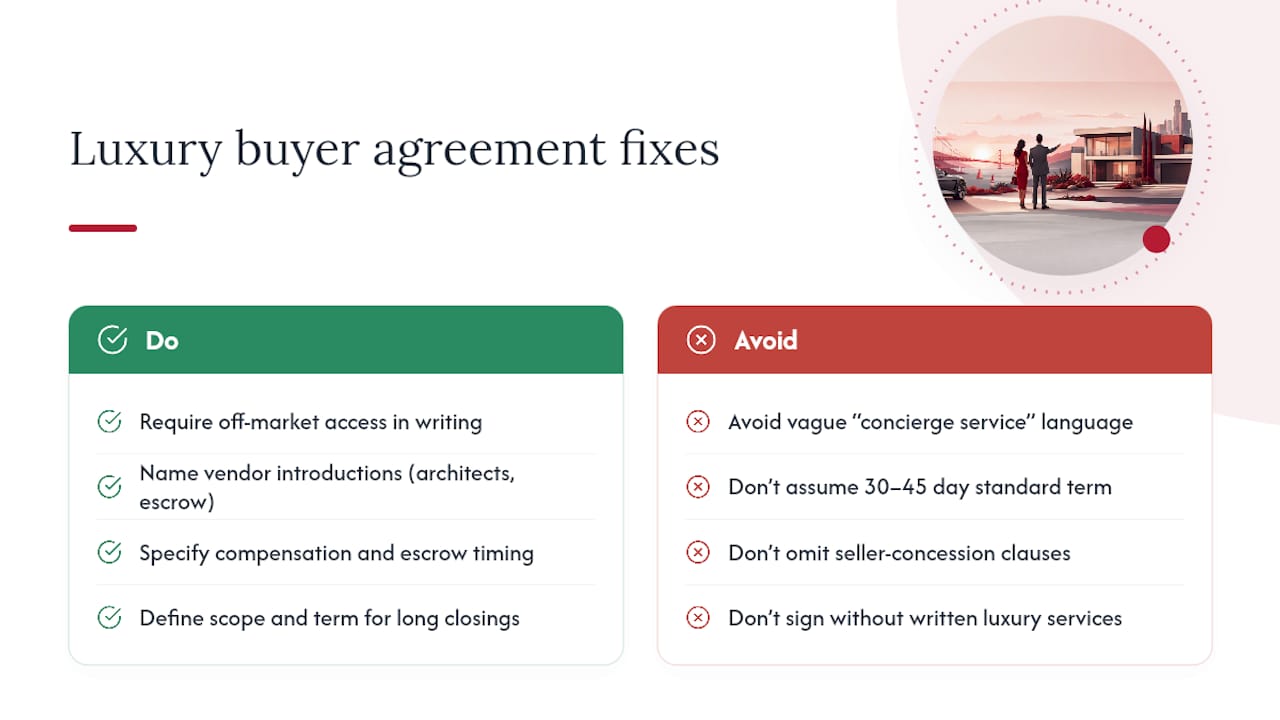
Compensation and timing also behave differently at the high end. Luxury escrows often run longer than standard 30 to 45 day closings, particularly with custom financing or extensive inspection periods. If your representation agreement's term doesn't account for that, you could find yourself needing a renewal mid-transaction. Seller concession negotiations get more nuanced too, since sellers of $3 million-plus properties often have more room to negotiate buyer-agent compensation as part of a broader deal structure.
I've found that buyers who insist on explicit scope language before signing end up with fewer disagreements at closing. If you're navigating a search in La Jolla, Rancho Santa Fe, or the Hollywood Hills and want a second set of eyes on a representation agreement before you sign, that conversation is worth having early.
— Stu Harvey
Reviewing Your Agreement Before You Commit To An Agent
A buyer-broker agreement is a negotiation, not a formality, and the terms you accept now shape your leverage for months. These agreements can be reviewed and negotiated with luxury buyers to ensure the compensation figure, service scope, and termination terms reflect their needs before signing.
That review covers agent selection guidance if you're comparing representation options, negotiation of commission structure and seller concessions once you're under contract, and a plain-language read of any contract clause that feels unclear. Every fee discussion happens upfront, with the fiduciary duty that a signed representation agreement is supposed to guarantee. If you're weighing a purchase in La Jolla, Rancho Santa Fe, Newport Beach, or the Hollywood Hills and want your agreement reviewed before you sign, schedule a consultation with Stu Harvey Estates and get a straight answer on what the terms actually mean for your transaction.
Sources
- California Codes: Civil Code — Title 4.1. Buyer-Broker Representation Agreements 1670.50
- Licensee Advisory — California Department of Real Estate: Changes to Buyer Representation
- C.A.R. Buyer Representation Agreements — consumer Q&A and form explanations