
Expect to lose roughly 6% to 9% of your sale price to closing costs and commissions when you sell a home in California, with non-commission fees alone typically running about 2.7% of the sale price. On an $800,000 sale, that translates to a substantial amount in title, escrow, and transfer costs before commissions even enter the picture. City transfer taxes and buyer concessions can push that number considerably higher.
TL;DR:
Non-commission closing costs in California typically amount to about 2.7% of the sale price, but actual fees vary based on region, title tiers, and city taxes.
Seller’s settlement statement line items like owner’s title insurance and transfer taxes are negotiable, especially in high-value markets or specific counties.
Building a personalized net sheet before listing, based on actual title quotes, can prevent sellers from leaving thousands of dollars on the table at closing.
Expect city transfer taxes in Los Angeles and San Francisco to significantly increase costs beyond the statewide baseline, especially on high-value sales.
Sellers should verify local transfer tax rates and obtain real title and escrow quotes early to improve negotiation leverage and accurate planning.
Table of Contents
-
What Fees Actually Show Up on a Seller’s Settlement Statement?
-
Stu Harvey’s Perspective: What Southern California Sellers Miss
What Goes Into Seller Closing Costs in California?
That 2.7% figure isn’t one fee. It’s a stack of smaller charges, and the mix changes depending on where in the state you’re selling. Before you can estimate your actual number, you need to know what inputs to plug in and how much they typically swing the final total.
A rough calculator only needs four numbers: your expected sale price, your remaining mortgage payoff, the commission rate you’ve negotiated with your agent, and an estimate for non-commission costs (title, escrow, transfer tax, prorations). Run those four inputs and you’ll have a workable ballpark within minutes.
Here’s how that plays out across three price points, using the statewide averages of roughly 2.7% for non-commission costs and 5.0% to 5.5% for combined agent commissions:
Those numbers exclude your mortgage payoff and any prorated taxes, HOA transfer fees, or negotiated buyer credits, which is exactly why a spreadsheet estimate and your actual proceeds can differ by tens of thousands of dollars. One sample calculation from Homelight using a median-priced home landed on a different non-commission percentage entirely, largely because it assumed different title tiers and a smaller HOA transfer fee. That variance is the whole reason a broker-prepared net sheet matters more than any online tool. A calculator gives you a planning number; a net sheet, built from your actual title quote and payoff statement, gives you the number you’ll actually see at the closing table.
What Fees Actually Show Up on a Seller’s Settlement Statement?
Every line item on your closing statement falls into one of a handful of categories, and knowing which ones are customary versus negotiable changes how you approach your offer.

Owner’s title insurance is the biggest variable by region. In Southern California, sellers customarily pay for the buyer’s owner’s title policy, while in many Northern California counties the buyer picks up that cost instead. Neither is state law. Both are negotiable in the purchase contract, and title premiums typically run on a tiered schedule tied to the sale price rather than a flat percentage.
Escrow and title service fees cover the neutral third party that holds funds and documents until every condition of the sale is met. These often land in the low thousands of dollars, scaling with property value.
Fast fact: California’s statewide documentary transfer tax is only about $1.10 per $1,000 of value, or 0.11%. But Los Angeles and San Francisco layer on additional city transfer taxes that can multiply that cost several times over on higher-value sales.
Beyond those two big-ticket items, expect:
-
Prorated property taxes, typically calculated against roughly 0.70% of assessed value for the portion of the year you owned the home.
-
Recording fees, often averaging around $244 for standard document filing.
-
HOA transfer fees, common in condo and planned-community sales, ranging from a couple of hundred to over a thousand dollars depending on the association.
-
Buyer incentives or concessions, which sellers agree to as part of negotiation, capped by loan type (conventional loans allow sellers to contribute 3% to 9% of the price toward buyer costs depending on down payment, FHA caps it at 6%, VA loans at 4%).
-
Mortgage payoff and, in rare cases, attorney fees, when a transaction requires legal review outside the standard escrow process.
Can You Build Your Own Seller Net Sheet?
Yes, and it’s worth doing before you sign a listing agreement, not after. A net sheet is simple subtraction done in the right order: sale price, minus commissions, minus closing costs, minus your mortgage payoff, minus any liens or negotiated credits.
Here’s how it works on a $1,200,000 Southern California sale:
-
Start with sale price: $1,200,000
-
Subtract commission (5.5%): $1,200,000 − $66,000 = $1,134,000
-
Subtract non-commission closing costs (2.7%): $1,134,000 − $32,400 = $1,101,600
-
Subtract remaining mortgage payoff (example: $450,000): $1,101,600 − $450,000 = $651,600
-
Subtract any negotiated buyer credits or unpaid HOA dues (example: $8,000): $651,600 − $8,000 = $643,600
| Step | Amount |
|---|---|
| Sale Price | $1,200,000 |
| Commission (5.5%) | −$66,000 |
| Closing Costs (2.7%) | −$32,400 |
| Mortgage Payoff | −$450,000 |
| Credits/Unpaid Dues | −$8,000 |
| Estimated Net Proceeds | $643,600 |
Three things trip up sellers on this math every time: prepayment penalties buried in old loan terms, unpaid HOA dues that surface late in escrow, and holdback amounts your title company sets aside to cover unresolved repair items. None of those show up until you’re deep into the escrow process, so ask your escrow officer to flag them early rather than discovering them at signing.
How Do You Negotiate Down Your Closing Costs?
Most of what lands on your settlement statement is customary, not fixed. That distinction is where your leverage lives.
Start with title insurance. If you’re in a market where sellers traditionally cover the buyer’s owner’s policy, you can still negotiate that responsibility back onto the buyer, especially in a seller’s market. Ask your title company for its tiered pricing schedule up front rather than accepting a flat quoted percentage; premiums step down at certain value thresholds, and knowing where those breaks fall can save real money on a seven-figure sale.
Bring these questions to your agent and title company before you accept an offer:
-
Who customarily pays owner’s title insurance in this county, and can that shift in negotiation?
-
What’s the title company’s tiered rate schedule at our sale price?
-
Are there city-specific transfer taxes beyond the state’s $1.10 per $1,000 baseline?
-
What buyer concessions are being requested, and how do they change my net sheet?
Pro Tip: Get your net sheet itemized with real title quotes, not percentage estimates, at least two weeks before you sign a purchase agreement. Renegotiating a fee after you’ve accepted an offer is far harder than setting terms before you do.
One red flag worth watching: any escrow or title provider unwilling to itemize their fee schedule before you’re under contract. That reluctance usually means the numbers move once you’re locked in.
Stu Harvey’s Perspective: What Southern California Sellers Miss
For California sellers, reviewing an estimated net sheet before listing can clarify expected costs and help guide negotiations.
The sellers who do best request a custom net sheet before they ever list, confirm their city’s specific transfer tax rate (not just the state baseline), and walk into commission negotiations with a clear strategy rather than accepting the first number offered.
That’s especially true in coastal luxury markets like La Jolla or Rancho Santa Fe, where local surcharges on high-value sales and title tiers can shift your bottom line by tens of thousands. If you want a personalized breakdown before you list, request one directly.
An Editorial Take on Why Sellers Get This Number Wrong
The biggest mistake sellers make isn’t underestimating closing costs. It’s treating the statewide average as their number. A 2.7% non-commission figure is a useful anchor, but it assumes typical title tiers, no unusual concessions, and no city-level transfer tax beyond the state baseline. Sell in Los Angeles or San Francisco, and that assumption breaks immediately.
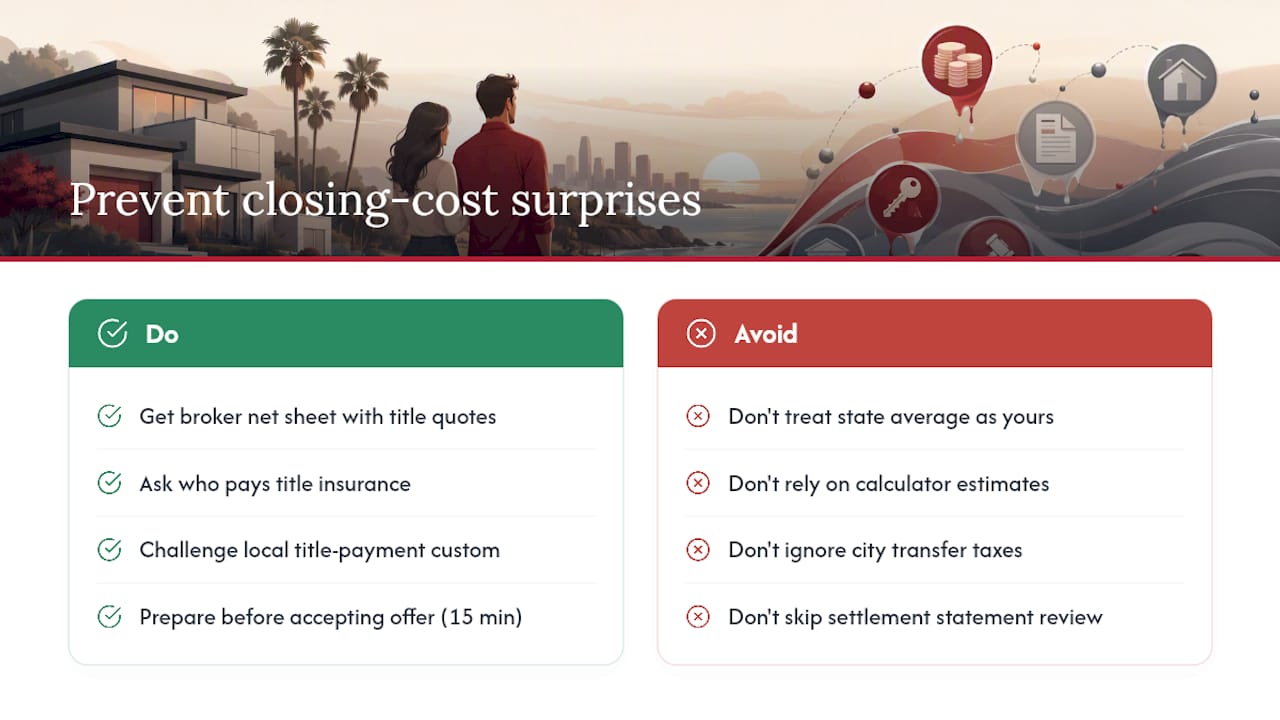
Conventional advice tells sellers to “budget 6% to 9% and move on.” That’s a reasonable planning number, but it skips the part that actually determines your outcome: who customarily pays title insurance in your county, and whether that custom is worth challenging in negotiation. Most sellers never ask.
If there’s one priority I’d push above all others, it’s this: get a broker-prepared net sheet with real title quotes before you accept an offer, not after. The gap between a calculator estimate and a real settlement statement is where sellers lose the most money, and it’s entirely preventable with fifteen minutes of preparation.
— Stu Harvey
How Stu Harvey Estates Builds Your Custom Net Sheet
Generic percentages get you in the ballpark. A custom net sheet, built from your actual mortgage payoff, your county’s title customs, and your city’s specific transfer tax rate, gets you the real number. Stu Harvey Estates prepares that net sheet before you list, not after you’ve already accepted an offer, so you know your true proceeds and can negotiate commission structure and buyer concessions from a position of actual information rather than a guess.

Whether you’re weighing a sale in La Jolla, Newport Beach, or anywhere else across San Diego’s coastal neighborhoods, the same principle applies: your title coordination, commission strategy, and escrow timeline all need to line up before you sign anything. If you’re planning a sale and want a personalized net sheet built around your property and county, reach out through our listings and consultation page to get started.
Where to Verify These Numbers Yourself
Run your own estimate against a California-specific closing cost calculator, and cross-check city transfer tax rates directly with your county recorder’s office before finalizing any net sheet. For a broader breakdown of standard line items, this seller cost overview is a solid second reference. When in doubt on a city-specific surtax, call your title company directly.
Sources
-
Seller’s Closing Cost Calculator for California (2026 Update)
-
What Are The Average Closing Costs in California? - JVM Lending