
Real estate commission is a performance-based fee calculated as a percentage of the home's final sale price, paid only when the transaction closes. Understanding how real estate commission structure works is the difference between leaving money on the table and negotiating from a position of knowledge. The national average total commission sits at approximately 5.7% in 2026, split between the listing agent and the buyer's agent. The August 2024 NAR settlement reshaped who pays what, making commission literacy more valuable than ever for buyers, sellers, and investors alike.
How is real estate commission calculated and who pays it?
Real estate commission is calculated as a percentage of the home's final sale price, not the listing price or appraised value. That distinction matters. If a home lists at $1,200,000 but closes at $1,100,000, the commission applies to $1,100,000. At 5.7%, that's $62,700 divided between both sides of the transaction.
The typical commission range runs from 4% to 8%, with listing agents averaging approximately 2.88% and buyer's agents averaging approximately 2.82% nationally. These figures vary by market, property type, and agent experience. Luxury markets in Southern California, for example, often see negotiated rates that differ from national averages.

Traditionally, sellers pay the total commission, which is deducted from their net proceeds at closing by escrow or an attorney. The commission deduction at closing means sellers never write a check directly. The funds flow from the buyer's purchase price through escrow, with commission carved out before the seller receives their net.
Since the 2024 NAR settlement, buyers now negotiate and pay their own agent's fee through a signed buyer-broker agreement before home tours begin. Sellers are no longer obligated to cover the buyer's agent fee, though many still offer it as a concession to attract competitive offers.
Key facts about who pays commission:
- Sellers traditionally pay total commission from sale proceeds at closing.
- Buyers must now sign a written buyer-broker agreement specifying agent fees before touring homes.
- Buyers may pay their agent directly in cash at closing, adding to their closing costs.
- Sellers can offer to pay the buyer's agent fee as a concession to make their listing more attractive.
- Closing costs for buyers who pay their agent directly typically range from 2% to 5% of the purchase price.
Pro Tip: If you're a seller, offering to cover the buyer's agent fee as a concession can widen your buyer pool significantly, especially in slower markets.
How is the commission split between agents and brokerages?
The commission split is a four-step process, and most buyers and sellers never see the full picture. Understanding it clarifies why the percentage quoted at signing is not what any individual agent takes home.
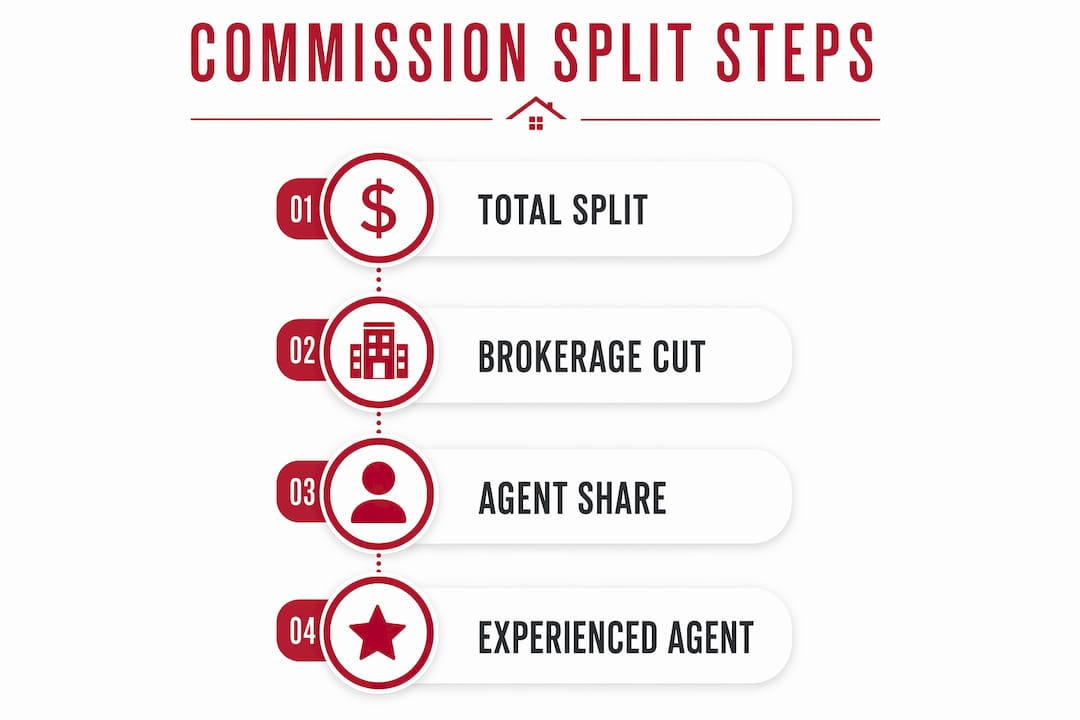
Step one: The total commission is divided between the listing brokerage and the buyer's brokerage. At 5.7%, each side typically receives roughly half.
Step two: Each brokerage keeps a portion to cover overhead, office costs, marketing, and administrative support before paying its agent. Brokerages typically retain 20% to 50% of the agent's share, depending on the brokerage model and the agent's agreement.
Step three: The remaining amount goes to the individual agent. A newer agent on a 50/50 split with their brokerage might net roughly 1.44% of the sale price from a 5.7% total commission. A top-producing agent on a 90/10 split keeps far more.
Step four: Experienced agents often negotiate better splits or pay a flat desk fee to keep 100% of their commission. Experienced agents negotiate better splits or move to desk-fee models as their volume grows.
Here is how the math looks on a $1,000,000 sale at 5.7% total commission:
| Party | Percentage | Dollar Amount |
|---|---|---|
| Total commission | 5.70% | $57,000 |
| Listing brokerage share | 2.88% | $28,800 |
| Buyer's brokerage share | 2.82% | $28,200 |
| Listing agent (70/30 split) | ~2.02% | ~$20,160 |
| Buyer's agent (70/30 split) | ~1.97% | ~$19,740 |
Agents earn commission only upon successful closing. If a transaction falls through, agents generally receive nothing, with rare exceptions written into specific contracts. This performance-based structure means agents are financially motivated to close deals.
Pro Tip: Ask any agent you interview what their brokerage split is. An agent keeping 90% of their commission has more financial flexibility to negotiate their rate with you than one on a 50/50 split.
What types of listing agreements affect commission obligations?
The listing agreement you sign as a seller directly determines your commission obligations. Three main types exist, and each carries different risks and incentives.
Exclusive right to sell is the most common agreement. It guarantees the listing brokerage earns a commission regardless of who finds the buyer, including the seller themselves. Agents strongly prefer this structure because it protects their investment of time and marketing dollars. Exclusive right to sell agreements give agents the highest motivation to market aggressively.
Exclusive agency agreements pay commission only if the agent brings the buyer. If the seller finds a buyer independently, no commission is owed. Agents accept these less frequently because their effort is not fully protected.
Open listings allow the seller to work with multiple brokers simultaneously. Only the agent who produces the buyer earns a commission. This arrangement gives sellers flexibility but typically results in less dedicated marketing effort from any single agent.
Key considerations when choosing a listing agreement:
- Exclusive right to sell maximizes agent effort and marketing investment.
- Exclusive agency reduces commission risk if you have a buyer in mind but limits agent motivation.
- Open listings suit sellers with strong buyer networks but may result in minimal agent support.
- Always review the commission rate, duration, and termination clauses before signing.
- Negotiate the agreement terms before listing, not after you receive an offer.
How did the 2024 NAR settlement change commission rules?
The August 17, 2024 NAR settlement is the most significant structural change to real estate commissions in decades. It rewired how buyer's agent fees are disclosed, negotiated, and paid.
Before the settlement, buyer's agent compensation was listed on the Multiple Listing Service (MLS), and sellers routinely offered a set percentage to attract buyer's agents. That practice ended. Post-settlement, buyer agent fees are no longer advertised on MLS listings. Buyers now negotiate their agent's fee directly through a written buyer-broker agreement signed before any home tours.
The practical effects for buyers and sellers:
- Buyers must agree to their agent's fee in writing before touring properties.
- Sellers are not required to offer buyer's agent compensation, though many still do.
- Sellers who offer to pay the buyer's agent fee list it as a concession in the purchase contract, not on the MLS.
- Buyers who pay their agent directly must budget for that cost as part of their cash-to-close.
- Commission negotiation is now more transparent and deal-specific than at any point in recent history.
The NAR settlement effective August 2024 shifted financial responsibility and negotiating power simultaneously. Buyers who understand this change can negotiate their representation fee before committing to an agent. Sellers who understand it can use buyer's agent concessions as a competitive tool in their listing strategy.
How can buyers and sellers negotiate real estate commissions?
Commission is fully negotiable. No law sets a fixed rate, and no industry standard requires any specific percentage. That fact alone gives buyers and sellers more leverage than most realize.
For sellers, the negotiation happens at listing. High-value properties, strong market conditions, and a seller's willingness to list exclusively all create leverage for a lower commission rate. An agent who closes $50,000,000 in volume annually has more flexibility on rate than one closing $5,000,000. Understanding agent and broker splits helps sellers identify where room exists.
For buyers, the negotiation happens before signing a buyer-broker agreement. Buyers should ask for a written breakdown of the agent's fee, what services it covers, and whether the seller's concession will offset it. A dedicated luxury buyer agent can often structure agreements that align their compensation with your actual purchase outcome.
Practical negotiation tips:
- Compare multiple agents before signing any agreement.
- Ask each agent directly: "Is your commission rate negotiable?"
- In slower markets, sellers have more room to negotiate rates down.
- Buyers can request a credit if the seller's concession exceeds the agreed buyer-agent fee.
- Review the benefits of buyer representation before agreeing to any fee structure.
Pro Tip: Dual agency, where one agent represents both buyer and seller, often reduces the total commission. However, it also limits how strongly either party is advocated for. Weigh the savings against the reduced representation carefully.
Key Takeaways
Real estate commission is a negotiated, performance-based percentage of the sale price, split four ways between listing and buyer agents and their brokerages, with the 2024 NAR settlement making buyer-side fees a direct negotiation between buyers and their agents.
| Point | Details |
|---|---|
| National average commission | The 2026 average total commission is approximately 5.7%, split between listing and buyer's agents. |
| Four-way commission split | Total commission divides between two brokerages, then each brokerage splits with its agent based on experience and contract terms. |
| 2024 NAR settlement impact | Buyers must now sign written fee agreements before home tours; sellers are no longer required to pay buyer's agent fees. |
| Commission is negotiable | No fixed rate exists; market conditions, property value, and agent volume all create room to negotiate. |
| Listing agreement type matters | Exclusive right to sell maximizes agent effort; exclusive agency and open listings reduce seller commission risk but may reduce agent motivation. |
What I've learned after $1.2 billion in transactions
Most buyers and sellers walk into commission conversations with the wrong mental model. They treat the percentage as a fixed cost, like a tax, rather than a negotiated service fee. That framing costs them money.
After more than 15 years and over 250 luxury transactions across La Jolla, Newport Beach, and the Hollywood Hills, I've seen commission structure become a deal-structuring tool in the hands of informed clients. A seller who understands the four-way split can have a real conversation with their agent about where flexibility exists. A buyer who reads their buyer-broker agreement before signing can negotiate terms that actually reflect the service they're receiving.
The 2024 NAR settlement changed the mechanics, but it also created an opportunity. Buyers who previously assumed their agent was "free" now have to confront the real cost of representation. That transparency is good. It forces both sides to have honest conversations about value, service, and fees before a single offer is written.
My advice: treat commission the same way you treat any other line item in a real estate transaction. Ask questions, compare options, and negotiate based on facts. The agents worth working with will welcome that conversation, not avoid it.
— Stu Harvey
How Stu Harvey Estates approaches commission and deal structure
Stu Harvey Estates brings over 15 years of experience and more than $1.2 billion in closed transactions to every client conversation, including the ones about fees.

Commission structure is one of the first topics covered with every buyer and seller at Stu Harvey Estates. Whether you're selling a $3,000,000 home in Rancho Santa Fe or buying in Newport Beach, understanding your fee obligations before you sign anything is non-negotiable. Stu Harvey works with clients to clarify payment responsibilities, structure buyer concessions effectively, and negotiate agreements that reflect real market conditions. For buyers and sellers ready to move forward with full clarity on costs, explore current listings or connect directly through Stu Harvey Estates for a personalized consultation.
FAQ
What is the average real estate commission in 2026?
The national average total commission is approximately 5.7% of the home's sale price, with listing agents averaging 2.88% and buyer's agents averaging 2.82%.
Who pays the buyer's agent commission after the 2024 NAR settlement?
Buyers are now directly responsible for their agent's fee through a signed buyer-broker agreement. Sellers may still offer to pay the buyer's agent fee as a concession in the purchase contract.
Is real estate commission negotiable?
Yes. Commission rates are fully negotiable and no fixed standard exists. Market conditions, property value, and agent experience all influence what rate an agent will accept.
What happens to commission if a sale falls through?
Agents generally receive no commission if a transaction does not close. Commission is a performance-based fee tied to successful title transfer, with limited exceptions written into specific contracts.
What is dual agency and how does it affect commission?
Dual agency occurs when one agent represents both the buyer and the seller. It typically reduces the total commission paid, but it also limits how strongly either party is represented in negotiations.