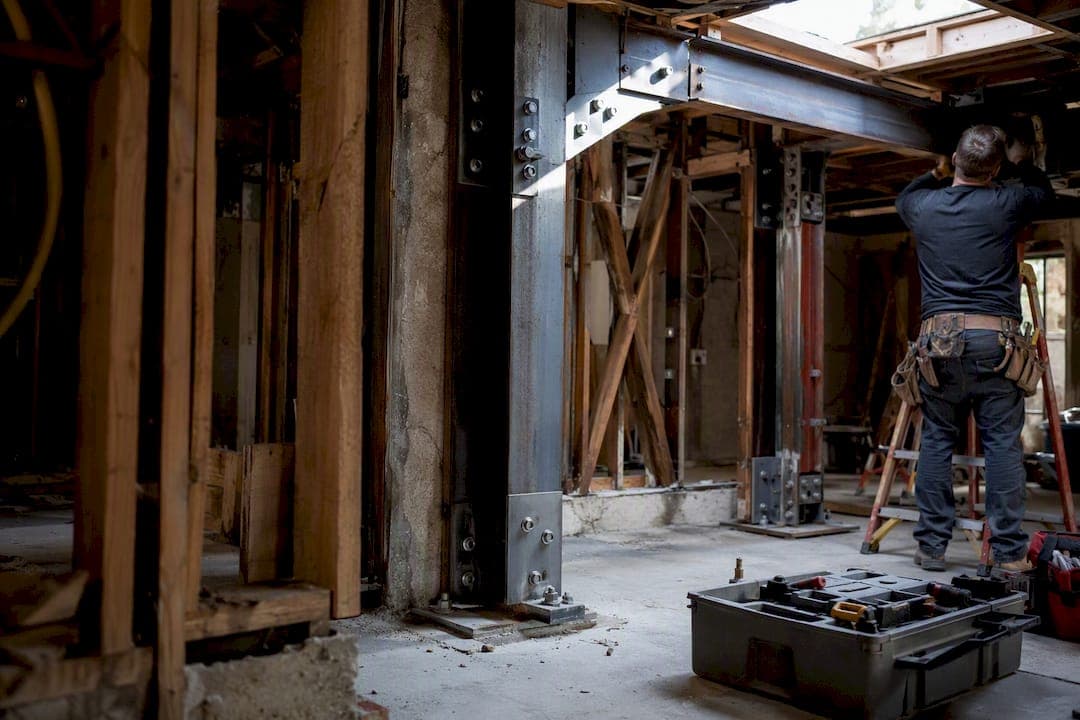
If your Los Angeles building went up before 1978, has a wood frame, stands two or more stories, and has an open-front or tuck-under parking area on the ground floor, it almost certainly falls under the city mandatory soft-story retrofit program, unless it holds three or fewer residential units. The requirement comes from Ordinance No. 183893, and it's not optional once your building has been flagged. Your first move isn't calling a contractor. It's checking the LADBS Soft-Story Retrofit Program database to see if you've received an Order to Comply, then lining up a California-licensed structural or civil engineer if you have.
A few things worth knowing right away:
- The program affects thousands of buildings citywide, so you're far from alone in dealing with this.
- Compliance runs on a fixed clock: 2 years for plans, 3.5 years for a permit, 7 years for finished construction.
- Buildings altered after 1978, or missing clear permit history, still need a professional look even if they seem borderline.
Key Takeaways
Compliance with the Los Angeles soft-story ordinance requires verifying your Order to Comply, hiring a licensed engineer early, and documenting every step for buyers and lenders.
| Point | Details |
|---|---|
| Confirm your scope | Check LADBS's database to see if your pre-1978 wood-frame building has an active Order to Comply. |
| Track your deadlines | Plan for the 2-year, 3.5-year, and 7-year milestones starting from your order date, not from today. |
| Hire the right professional | Use a California-licensed structural or civil engineer who works with FEMA P-807, IEBC A4, or ASCE 41. |
| Plan for tenants early | File a Tenant Habitability Plan and contact LAHD before construction disrupts occupied units. |
| Document for resale value | Keep permits, inspection records, and engineer reports; they matter to future buyers and lenders. |
Table of Contents
- Soft Story Retrofit Los Angeles: Which Buildings Qualify
- Soft Story Ordinance Los Angeles: Compliance Deadlines Explained
- Engineering Standards Behind Soft-Story Retrofit Design
- How to Retrofit Soft Story Buildings: A Step-by-Step Path
- Cost of Retrofit Los Angeles: Budgeting and Funding Help
- Tenant Habitability Plan and Cost Recovery Explained
- How to Verify Your Building and Reach LADBS
- What Selling or Refinancing Owners Should Know
- Post-Retrofit Maintenance for Long-Term Structural Integrity
- The Real Cost of Ignoring Your Order to Comply
- Work With a Local Expert When Compliance Meets Market Timing
- Editorial Perspective: What This Compliance Handbook Gets Right
- Frequently Asked Questions
- Sources
Soft Story Retrofit Los Angeles: Which Buildings Qualify
The ordinance targets a narrow but common building type: wood-frame construction permitted before 1978, two or more stories, with a ground floor that's structurally weaker than the floors above because of open parking, carports, or tuck-under garages. Three-unit-or-fewer residential buildings are exempt outright, which trips up a lot of owners of small courtyard apartments who assume they're covered when they are not.
Edge cases are where things get messy:
- Mixed-use buildings with ground-floor retail and open parking on one side often still qualify, even if the retail space looks solid.
- Buildings altered after 1978 sometimes had structural upgrades that changed their status, but only a documented engineering review confirms that.
- Buildings with incomplete permit records require a records pull from LADBS before anyone can say definitively whether they're in scope.
Pro Tip: Don't rely on a real estate listing or a prior owner's word that a building was "already retrofitted." Ask for the final permit sign-off document. If it doesn't exist, treat the building as unverified.
An official Order to Comply is what actually starts your clock, not a general sense that your building might qualify.
Soft Story Ordinance Los Angeles: Compliance Deadlines Explained
Once LADBS issues an Order to Comply, three deadlines govern everything that follows, and missing any of them creates real enforcement exposure.
- 2 years from the order date to submit retrofit plans or proof the building is exempt.
- 3.5 years to obtain a building permit for the retrofit work.
- 7 years to complete construction and pass final inspection.
LADBS assigns these dates based on when your building was identified and prioritized within the program's compliance framework, and roughly 13,500 buildings are moving through these same milestones citywide. Owners who wait until year six to start engineering work routinely run out of runway, because plan check alone can take months.
Treat the 2-year mark as your real deadline, not the 7-year one. Everything downstream, engineer selection, design, plan check, permitting, depends on starting the paperwork early.
Engineering Standards Behind Soft-Story Retrofit Design
LADBS accepts three technical frameworks for retrofit design, and your engineer will typically pick one based on your building's configuration and budget.
- FEMA P-807 offers a weak-story retrofit methodology built specifically for wood-frame buildings with open first stories, focused on reducing collapse risk rather than achieving a full seismic upgrade.
- IEBC Chapter A4 provides prescriptive retrofit provisions many engineers use for straightforward configurations.
- ASCE 41 sets performance-based criteria for buildings where a more customized structural analysis is warranted.
Only a California-licensed structural or civil engineer can perform the evaluation, prepare calculations and drawings, and conduct required structural observation once construction starts. This isn't a general contractor's call to make.
Plan-check rejections tend to cluster around the same issues: incomplete load-path documentation, missing foundation anchorage details, and skipped diaphragm or collector upgrades, according to regional guidance from ABAG. Engineers who reference FEMA P-807 or ASCE 41 explicitly, using the same language LADBS reviewers expect, tend to move through plan check with fewer rounds of comments.
Pro Tip: Ask your engineer for a pre-submittal checklist before you pay for full drawings. Catching a missing anchorage detail on paper costs a lot less than catching it after a plan-check rejection.
How to Retrofit Soft Story Buildings: A Step-by-Step Path
Getting from an Order to Comply to a finished, signed-off retrofit follows a fairly predictable sequence, even though every building's specifics differ.
- Verify the order and pull records. Confirm your Order to Comply date and gather existing permit history and drawings.
- Hire a licensed structural or civil engineer. They evaluate the building and determine which standard, FEMA P-807, IEBC A4, or ASCE 41, fits your situation.
- Prepare a Tenant Habitability Plan and financing plan. Do this in parallel with design, not after.
- Submit plans to LADBS and respond to plan-check comments. Budget time for at least one round of revisions.
- Get permits, hire a contractor, and schedule inspections. Structural observation by your engineer is required at specific construction stages.
- Finish work, file documentation, and get LADBS final approval. This closes out your Order to Comply.
A few practical notes as you move through this:
- Engineer selection is the step most owners rush, and it's the one that determines how smoothly everything else goes.
- Tenant Habitability Plans need to be filed before construction disrupts access, not scrambled together mid-project.
Cost of Retrofit Los Angeles: Budgeting and Funding Help
Retrofit costs vary widely because they depend on the scope of structural work, not just square footage. A building needing only wall-line strengthening costs far less than one requiring new foundation anchorage, upgraded diaphragms, and difficult site access for equipment.
Cost drivers worth planning around:
- Number of ground-floor openings that need new shear walls or moment frames.
- Foundation condition and whether new anchorage is required.
- Unit count and whether work can proceed with tenants in place versus requiring temporary relocation.
- Site access constraints, alley-loaded buildings and tight urban lots cost more to work in.
The EMR grant program (Earthquake Multi-Unit Retrofit) offers assistance to qualifying multi-unit buildings, though eligibility and funding availability change, so check current LADBS program pages directly rather than relying on secondhand summaries. Beyond grants, some owners pursue conventional rehab loans or lines of credit; if you're weighing financing structures more broadly, this guide to financing investment property covers loan options relevant to owners carrying rental units through a retrofit.
Pro Tip: Get at least two engineering-scope estimates before assuming your retrofit will be "expensive." Scope, not square footage, drives the number.
Tenant Habitability Plan and Cost Recovery Explained
The Los Angeles Housing Department (LAHD) oversees Tenant Habitability Plans for soft-story retrofits and administers a cost-recovery process that lets owners pass through a portion of eligible retrofit expenses. Call LAHD's tenant habitability and cost-recovery line at (866) 557-RENT to start that conversation before construction begins, not after.
To reduce tenant disruption:
- Phase work where possible so occupied units aren't left without access to entries or parking for extended stretches.
- Give tenants written notice well ahead of any temporary relocation requirement.
- Document existing conditions with photos before work starts, which helps with both habitability compliance and any disputes later.
For cost recovery, keep organized records: engineering invoices, permit fees, contractor payment applications, and LAHD correspondence. Owners managing occupied buildings sometimes find that clear, early tenant communication does more to keep a project on schedule than any amount of legal paperwork after the fact.
How to Verify Your Building and Reach LADBS
Search your address in the LADBS Soft-Story Retrofit Program database to check your Order to Comply date and priority tier. If your address isn't listed but you suspect it should be, or you need official records, call the LADBS Custodian of Records at (213) 482-6770.
For permit submissions and tracking, use LADBS's PermitLA portal alongside ePlanLA for electronic plan check. Both systems require your engineer's coordination, so loop them in before you create login credentials.
What Selling or Refinancing Owners Should Know
Fifteen years of watching Southern California's luxury and multi-unit markets has taught me that buyers and lenders both treat an unresolved Order to Comply as a red flag, often a bigger one than the retrofit cost itself. A building with completed, documented retrofit work sells faster and appraises cleaner than one with an open compliance file, even in strong markets like La Jolla or the Hollywood Hills.
If you're planning to sell or refinance in the next few years, get ahead of your Order to Comply now. Buyers' agents and lenders both flag unresolved retrofit status during due diligence, and a completed file with engineer sign-off removes that friction entirely.
Work with a licensed engineer, keep every permit and inspection record, and treat that documentation as part of your property's value, not just a compliance formality.
Post-Retrofit Maintenance for Long-Term Structural Integrity
A completed retrofit isn't a "set it and forget it" fix. The strengthened wall lines, new shear panels, foundation anchorage, or moment frames your engineer designed need periodic attention to keep performing as intended over decades of use.
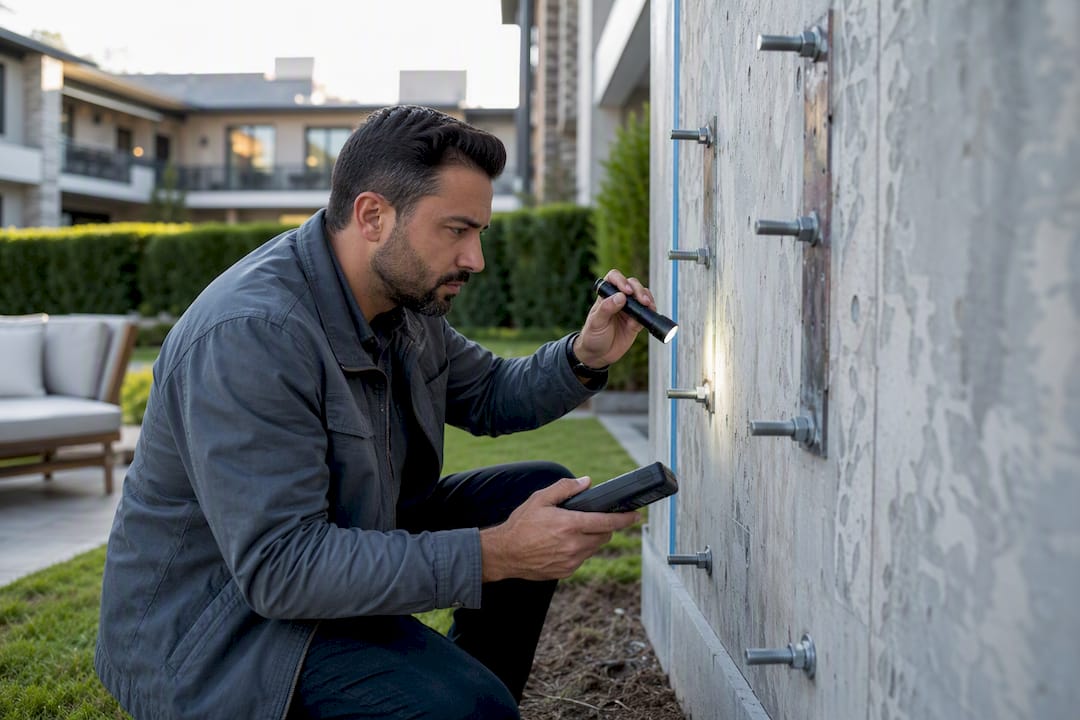
Have a structural engineer inspect visible retrofit elements every few years, particularly after any major moisture intrusion, since wood-frame connections and steel hardware are vulnerable to corrosion and rot if water gets in. Check that no one has cut into or modified retrofit elements during later renovations, tenants adding storage, contractors running new utility lines, or owners altering parking configurations can unknowingly compromise a shear wall or anchor bolt.
Keep your final LADBS inspection records and engineer's structural observation reports in a permanent file, not just for your own reference but because future buyers, lenders, and insurers will ask for them. A retrofit without documentation is, from a due-diligence standpoint, almost as uncertain as no retrofit at all.
If your building sits in a flood-prone or coastal-adjacent area, pay extra attention to corrosion at metal connectors and anchor bolts. Salt air and moisture accelerate the exact failure modes the retrofit was designed to prevent. Annual visual checks by building maintenance staff, paired with a professional structural review every five to seven years, is a reasonable baseline for most retrofitted soft-story buildings.
The Real Cost of Ignoring Your Order to Comply
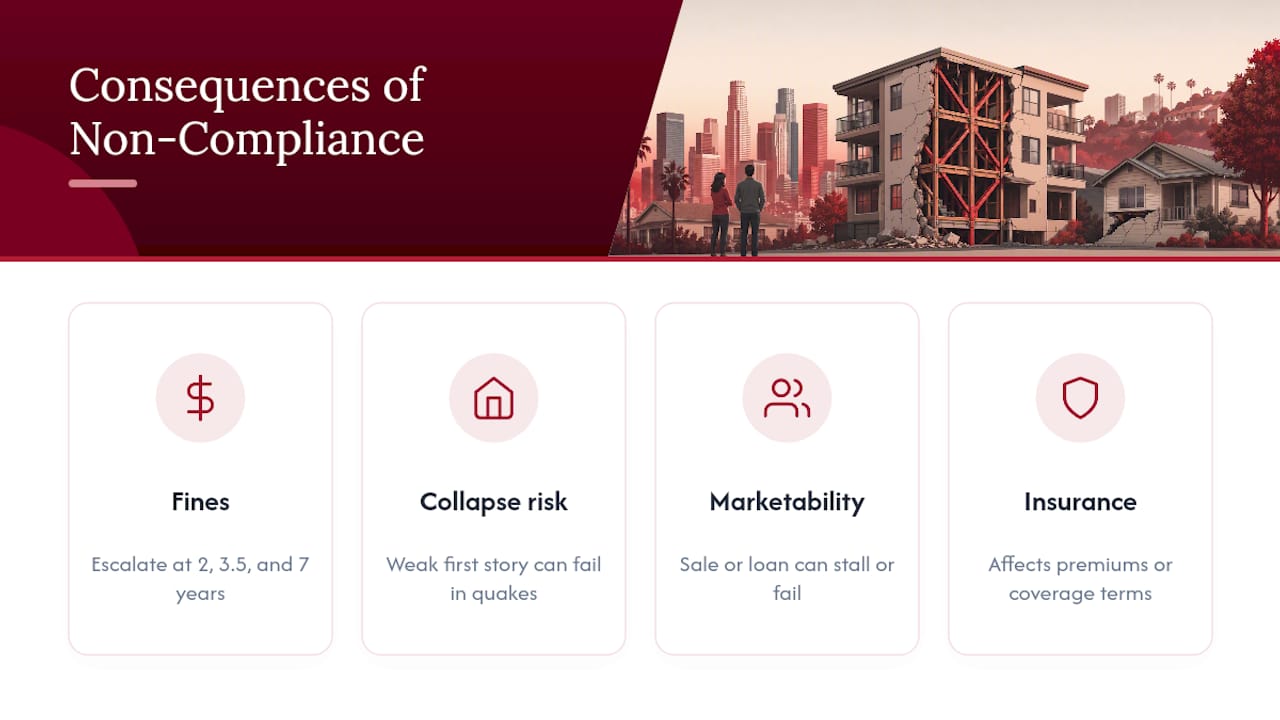
Missing retrofit deadlines carries consequences well beyond a late notice. LADBS can issue escalating fines for owners who blow past the 2, 3.5, or 7-year milestones, and unresolved orders can also complicate property tax records and title work.
The safety stakes are the bigger issue. Soft-story buildings with open ground floors are specifically vulnerable during earthquakes because the weak first story can collapse under the weight of the floors above, the exact failure mode that drove the 1994 Northridge earthquake losses and prompted this ordinance in the first place. An unretrofitted building isn't just out of compliance; it's carrying real collapse risk for every tenant and every neighbor on the block.
There's also a market consequence that doesn't show up in any fine schedule. Buyers, appraisers, and lenders increasingly ask about soft-story status during due diligence on multi-unit LA properties, and an unresolved Order to Comply can stall or kill a sale outright. Insurance carriers have also grown more attentive to seismic retrofit status when underwriting multi-unit properties, which can affect premiums or coverage terms for owners who delay.
None of this improves by waiting. Every year a compliant retrofit gets pushed back is a year of accumulating fine exposure, insurance uncertainty, and reduced marketability, stacked on top of the same construction costs you'll eventually pay anyway.
Work With a Local Expert When Compliance Meets Market Timing
A completed soft-story retrofit, backed by clean LADBS documentation, is one of the more overlooked value drivers in Los Angeles's multi-unit and mixed-use property market. If you're weighing whether to finish your retrofit before listing, refinancing, or acquiring a building that's mid-compliance, Stu Harvey Estates can walk you through how retrofit status affects pricing, buyer interest, and lender comfort across Los Angeles, Orange County, and the broader Southern California luxury market. Browse current listings and market data to see how comparable properties with completed retrofits are performing before you decide on timing.
Editorial Perspective: What This Compliance Handbook Gets Right
Most soft-story coverage online treats this as a pure engineering problem: hire an engineer, submit plans, get a permit. That framing misses half the picture. The deadlines matter, but so does what happens to a building's marketability and financing options while compliance drags on.
Conventional advice tends to underweight the tenant habitability piece, treating it as a footnote when it's often the thing that actually determines project timeline and cost. Owners who engage LAHD early and communicate with tenants before construction starts consistently move faster than owners who treat habitability planning as an afterthought.
My honest read: prioritize the engineer conversation and the tenant conversation in the same week, not sequentially. Everything else, financing, permits, contractor selection, flows more smoothly once those two relationships are established. Document every step. Buyers and lenders reward that paper trail more than they reward the retrofit itself.
Frequently Asked Questions
How do I know if my building needs a soft-story retrofit in Los Angeles? Search your address in the LADBS database. If your building is pre-1978, wood-frame, two or more stories, and has open-front or tuck-under parking, it likely qualifies unless it has three or fewer units.
What happens if I miss a compliance deadline? LADBS can issue escalating fines, and an unresolved Order to Comply can complicate title work, financing, and any future sale of the property.
Who is qualified to design a soft-story retrofit? Only a California-licensed structural or civil engineer can perform the evaluation, prepare drawings and calculations, and conduct required structural observation during construction.
Does the EMR grant cover the full cost of retrofit? No. The EMR grant program assists qualifying multi-unit buildings, but eligibility and coverage amounts vary, so check current LADBS program pages for specifics.
Do I need a Tenant Habitability Plan if my building is vacant? If units are occupied during construction, a Tenant Habitability Plan is required, and LAHD administers that process along with cost-recovery options for eligible retrofit expenses.
Sources
- Soft-Story Retrofit Program | LADBS
- Ordinance No. 183893 — City of Los Angeles (ordinance text)
- ABAG soft-story report (regional guidance)