
An adjustable-rate mortgage (ARM) is a home loan whose interest rate can change after an initial fixed period, which means your monthly payment may rise or fall depending on market conditions. According to the Consumer Financial Protection Bureau, many ARMs start with a lower introductory rate than comparable fixed-rate loans, but payments are likely to rise once the loan begins adjusting. For buyers, that trade-off is the whole story: you get lower payments upfront, but future affordability depends on how rates move and how well the loan's caps protect you.
Both the CFPB and HUD publish consumer guides that explain ARM mechanics and required disclosures. Understanding what an adjustable rate mortgage means for buyers starts with one practical question: can you still afford the payment if rates climb to the loan's maximum allowed level?
Pro Tip: Before comparing introductory rates, ask your lender for the loan's periodic cap, lifetime cap, and adjustment frequency. Those three numbers tell you far more about your real risk than the teaser rate does.
- Your rate and payment are fixed for the initial period, then reset periodically.
- The reset is tied to a published market index plus a fixed lender margin, not solely to the lender's discretion.
- Caps limit how much the rate can move at each adjustment and over the loan's life.
Key Takeaways
An ARM can save buyers real money in the short term, but the fully indexed rate and cap structure determine whether it stays affordable over time.
| Point | Details |
|---|---|
| Check caps before the rate | Review the initial, periodic, and lifetime caps to understand your worst-case payment. |
| Qualify at the fully indexed rate | Confirm you can afford index + margin, not just the introductory rate. |
| Match the ARM term to your timeline | Choose an initial fixed period that covers how long you plan to keep the home. |
| Use the CFPB notice window | You receive a 7–8 month advance estimate before the first adjusted payment — use it to shop refinancing. |
| Get cap language in writing | Confirm the index name, margin, and all three caps are in the signed Note before closing. |
Ready to evaluate mortgage options for a Southern California home? The Stu Harvey Estates buyer team can walk you through ARM offers alongside fixed-rate alternatives and help you run the stress-test worksheet on any loan you're considering. Browse current listings to see what's available in La Jolla, Newport Beach, and across the region.

Table of Contents
- How an ARM actually works: fixed period, index, and rate resets
- Common ARM types buyers encounter and how to read the numbers
- Rate caps, payment protections, and notices you should watch for
- How your payment can change: a simple worked example
- Benefits, disadvantages, and the main risks an ARM introduces
- Who should consider an ARM, and who should avoid one
- Questions to ask your lender before signing an ARM
- Strategies to limit ARM risk and your options if rates move against you
- Quick glossary of ARM terms you'll see in your loan documents
- A buyer agent's perspective on when ARMs make sense
- Sources
How an ARM actually works: fixed period, index, and rate resets
Three moving parts drive every ARM: the initial fixed-rate period, the index plus margin formula, and the adjustment frequency. Once you understand those, any ARM offer becomes readable.

The initial fixed period is the stretch of time when your rate does not change at all. A 5/1 ARM holds the rate steady for several years; a 7/1 ARM holds it for a longer initial period. The CFPB CHARM booklet explains the X/Y notation directly: the first number is the length of the initial fixed period in years, and the second number is how often the rate can change after that. In a 5/1 ARM, the "1" means the rate can adjust periodically after the fixed period. In a 5/6m ARM, the "6m" means it can adjust more frequently, for example, every half year.
The fully indexed rate is what your rate resets to at each adjustment. The formula is straightforward:
The index is a market benchmark your lender cannot control. Common U.S. indices today include the Secured Overnight Financing Rate (SOFR) and the Constant Maturity Treasury (CMT). LIBOR, which was widely used for decades, was phased out; federal rules now require lenders to use SOFR or other approved benchmarks for new ARMs. The margin is a fixed percentage your lender adds on top of the index and it stays constant for the life of the loan.
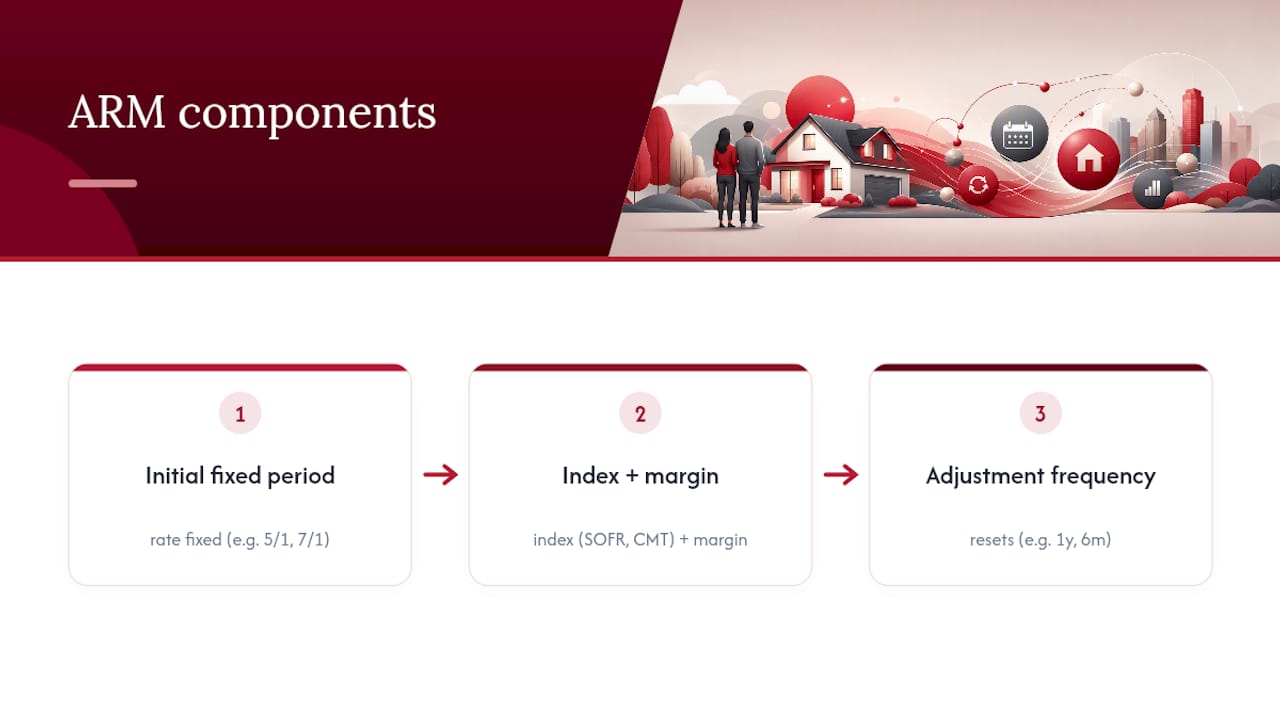
Adjustment frequency determines how often that calculation runs after the initial period ends. Once the first adjustment hits, your servicer is required to give you advance notice before your payment changes, which is covered in detail in the caps and protections section below.
Common ARM types buyers encounter and how to read the numbers
Most buyers see a handful of ARM products in the market. The differences come down to how long the initial rate holds and how often it resets afterward.
A few notes on less common variants:
- Interest-only ARMs let you pay only interest for a set period, which lowers early payments dramatically but means no equity builds until principal payments begin. They appear more often in jumbo and luxury loan products.
- Hybrid ARMs combine a longer fixed period with a variable tail, giving buyers more predictability before the first reset. The 10/1 ARM is essentially a hybrid product.
For buyers in Southern California's luxury market, the 7/1 and 10/1 structures tend to appear most often on high-balance and jumbo loans, where the rate differential versus a 30-year fixed can be meaningful on a large principal balance.
Rate caps, payment protections, and notices you should watch for
Caps are the contractual limits that prevent your rate from moving without bound. There are three types, and every ARM has all three.
- Initial adjustment cap: limits how much the rate can change at the very first reset. Commonly a few percentage points.
- Periodic cap: limits how much the rate can move at each subsequent adjustment. Typically a small percentage.
- Lifetime cap: the maximum the rate can ever rise above the initial rate. Usually several percentage points.
That is still a large payment increase, which is why stress-testing matters.
Payment caps are a separate concept. Some ARMs cap the dollar amount your payment can increase rather than the rate itself. This sounds protective, but it can cause negative amortization: if your payment cap holds your payment below the interest owed, the unpaid interest gets added to your loan balance. Check your disclosures carefully for any negative amortization language.
The AIR table (Adjustable Interest Rate table) in your loan disclosures shows the minimum and maximum rates possible, along with example payment scenarios. Review it before signing.
On notice timing: CFPB servicing rules require your servicer to give you at least 60 days' notice before a payment change caused by a rate adjustment, and a 7–8 month advance estimate before your first adjusted payment. That window exists so you can budget, shop for refinancing, or build reserves before the new payment kicks in.
Checklist item for closing day: Locate the "Adjustable Interest Rate" section in your Note and confirm the index name, margin, and all three cap numbers are exactly what your lender quoted. Any discrepancy is worth stopping the closing to resolve.
How your payment can change: a simple worked example
Payments are principal and interest only, rounded, on a 30-year amortization. Taxes, insurance, and HOA are excluded.

A modest rise in the index can add a moderate increase to monthly payments. A sharp rise in the index can cause a large increase in monthly payments. That gap is why the CFPB stresses testing your budget against the cap structure, not just the introductory rate. To adapt this to your numbers, substitute your loan amount and your quoted margin, then look up the current SOFR rate and add your margin to get the fully indexed rate. Apply the cap to find the worst-case first-adjustment rate.
Benefits, disadvantages, and the main risks an ARM introduces
The core trade-off: a lower initial rate and payment now, in exchange for payment uncertainty later.
Advantages:
- Lower initial monthly payment frees up cash for other priorities.
- If you sell or refinance before the first reset, you may never pay the higher rate.
- If market rates fall, your rate can adjust downward too.
- On large loan balances, even a 0.5% rate difference translates to meaningful monthly savings.
Disadvantages:
- Payment volatility makes long-term budgeting harder.
- Refinancing is not guaranteed: if your home's value drops or your credit changes, you may not qualify.
- Caps still allow large increases. A 5% lifetime cap on a 6% start rate means a potential 11% rate.
- Negative amortization risk on payment-capped products can increase your loan balance over time.
The single biggest buyer-side risk is this: you qualify for the ARM at the introductory rate, rates rise to the allowed cap, and you can no longer afford the payment and cannot refinance. NerdWallet's guidance specifically warns buyers to budget for possible payment increases after adjustment, not just the teaser rate.
Pro Tip: Match your ARM's initial fixed period to how long you realistically plan to keep the home. If you're buying a starter home in San Diego with a five-year plan to upsize, a 5/1 ARM aligns well. If your timeline is uncertain, the extra rate certainty of a 7/1 or 10/1 is worth the slightly higher initial rate.
Who should consider an ARM, and who should avoid one
ARMs tend to work well for:
- Buyers with a clear, short ownership horizon (selling or relocating within the fixed period).
- Buyers expecting a significant income increase before the first reset.
- Investors or buyers prioritizing initial cash flow on a property they plan to refinance or sell.
- Buyers in high-cost markets where the rate differential on a large loan produces real monthly savings.
ARMs are a poor fit for:
- Buyers on fixed incomes or tight budgets who cannot absorb a payment increase.
- Long-term owners who plan to stay well past the initial fixed period without a refinance plan.
- Buyers who would not qualify for the loan at the fully indexed rate.
NAR guidance frames the ARM recommendation around three factors: ownership timing, income and credit stability, and a clear understanding of the cap structure and refinance timing. All three need to check out before an ARM makes sense.
Before choosing an ARM, run through this personal-finance checklist:
- Do you have at least three to six months of reserves beyond your down payment?
- Is your debt-to-income ratio manageable at the fully indexed rate, not just the start rate?
- Do you have a realistic refinance path (stable income, equity cushion, good credit)?
- Is your ownership horizon shorter than or equal to the initial fixed period?
The CFPB recommends that buyers qualify at the fully indexed rate and stress-test the maximum payment increase before committing. If the worst-case payment would strain your budget, a fixed-rate mortgage is the safer choice regardless of the initial rate savings.
Questions to ask your lender before signing an ARM
Compare ARM offers using three numbers: the fully indexed rate, the cap structure, and the adjustment frequency. Everything else is secondary.
Here is a numbered checklist to bring to your lender:
- What index does this ARM use? (SOFR, CMT, or other — confirm it is a published, verifiable benchmark.)
- What is the margin? (This is fixed for the life of the loan and should be stated in writing.)
- What is the initial fixed period?
- How often does the rate adjust after the fixed period ends? (Annually, every six months?)
- What are the three caps? (Initial adjustment cap, periodic cap, lifetime cap.)
- Is there a payment cap, and can this loan negatively amortize?
- Are there prepayment penalties or refinancing restrictions?
- When will I receive the first rate-change notice, and how far in advance?
On your Loan Estimate, the ARM details appear in the "Projected Payments" section and in the separate ARM disclosure. The AIR table shows minimum and maximum possible rates and corresponding payment examples. Cross-check every number on the AIR table against what your lender quoted verbally.
For a quick stress-test: take your loan amount, apply the fully indexed rate (index + margin), and calculate the payment on a standard amortization calculator. Then apply the lifetime cap rate and calculate again. The difference between those two payments is your maximum exposure.
Pro Tip: Ask the lender to confirm the index source in writing, specifically the publication name and where you can look it up yourself. A lender who cannot name the index source clearly is a red flag.
For buyers working through luxury property financing, the margin negotiation on jumbo ARMs is often more flexible than on conforming loans. Push back on the margin, not just the initial rate.
Strategies to limit ARM risk and your options if rates move against you
The most reliable risk-management move is to start planning for the reset before you close, not after you receive the notice.
Before the reset:
- Track your servicer's notice window. Under CFPB rules, you should receive a 7–8 month advance estimate before your first adjusted payment. Use that window to get refinancing quotes.
- When the notice arrives, verify the index value and effective date yourself using a published source, then recalculate the new rate using your margin and cap structure. Do not assume the servicer's math is correct.
- Build reserves specifically for the payment increase scenario. Even if you plan to refinance, a delayed closing or a market shift can push the timeline.
Structural alternatives to reduce risk:
- Choose a longer initial fixed period (7/1 or 10/1 instead of 5/1) to extend your certainty window.
- Consider a fixed-rate mortgage if your ownership horizon is genuinely uncertain. The rate premium for certainty is often smaller than buyers expect, particularly on shorter loan terms.
- For buyers with cross-border or international purchase considerations, fixed vs. variable mortgage comparisons follow similar principles across markets, though U.S.-specific cap rules and CFPB protections apply only domestically.
Pro Tip: If you are within 12 months of your first reset and rates have risen, start the refinancing process early. Lenders take 30–60 days to close a refinance, and you want to lock a new rate before your ARM adjusts, not after.
Reviewing ARM documents at closing with a real estate attorney is worth the cost on any loan where the cap structure or index language is complex. An attorney can flag negative amortization clauses or unusual index definitions that a buyer might miss.
Quick glossary of ARM terms you'll see in your loan documents
- Index: The market benchmark (SOFR, CMT) your lender uses to calculate rate resets. Published publicly and outside the lender's control.
- Margin: The fixed percentage your lender adds to the index. Set at origination and does not change.
- Fully indexed rate: Index + margin. The rate your loan resets to at each adjustment, subject to caps.
- Initial rate: The fixed rate that applies during the initial period before any adjustments occur.
- Adjustment period: How often the rate can change after the initial fixed period ends (annually, every six months).
- Periodic cap: The maximum the rate can move at any single adjustment after the first one. Typically a small percentage.
- Initial adjustment cap: The maximum the rate can move at the very first reset. Often 2% or 5%.
- Lifetime cap: The maximum total increase over the loan's starting rate. Commonly 5% or 6%.
- Payment cap: A limit on how much your dollar payment can increase per period, separate from the rate cap.
- Negative amortization: When a payment cap holds your payment below the interest owed, and the shortfall is added to your loan balance, increasing what you owe.
- AIR table: The Adjustable Interest Rate table in your loan disclosures, showing minimum and maximum rates and example payment scenarios across the loan's life.
A buyer agent's perspective on when ARMs make sense
The bottom line from a buyer agent's standpoint: an ARM is a planning tool, not a gamble, but only when the buyer has a clear exit strategy and has stress-tested the worst case.
Most clients who benefit from an ARM share one trait: they have a defined timeline. A buyer relocating to La Jolla for a five-year corporate assignment, or an investor purchasing in Newport Beach with a plan to refinance once equity builds, can use the initial rate savings productively. The ARM aligns with their actual holding period, and the caps provide a known ceiling on exposure.
The red flags that stop a recommendation: a buyer who is already stretching to qualify at the introductory rate, no meaningful reserves beyond the down payment, or an ownership horizon that is genuinely open-ended. In those cases, the initial rate savings rarely justify the payment risk. A fixed-rate loan with a predictable payment is the more defensible choice, even if it costs more upfront.
One thing worth confirming before signing: verify that the margin is written into the Note itself, not just quoted verbally. Margins on jumbo ARMs in particular can vary between lenders, and the difference of even half a percentage point compounds significantly on a $1M+ loan balance.
Sources
These are the primary sources to verify ARM rules, required disclosures, and consumer protections:
- What is the difference between a fixed-rate and adjustable-rate mortgage (ARM) loan? | Consumer Financial Protection Bureau
- Adjustable-Rate Mortgages (CFPB CHARM booklet)
- Adjustable-Rate Mortgage: How an ARM Works, Who It’s For - NerdWallet
- When to Suggest an Adjustable Rate Mortgage to Home Buyers | NAR
This article is general information, not a substitute for advice from a qualified financial advisor. Consult a qualified financial professional about your own circumstances before acting on anything here.