
Whether you need flood insurance in San Diego right now depends on two things: your mortgage lender and your FEMA flood zone. If your address sits in a Special Flood Hazard Area and you have a federally backed loan, coverage is mandatory. Check your parcel on the FEMA Map Service Center, confirm the requirement with your lender, and get quotes now. The City of San Diego's flood maps change on March 3, 2026, and that shift will move some properties into new zones overnight.
TL;DR:
- Flood insurance is mandatory for properties in Special Flood Hazard Areas with a federally backed mortgage, but not for Zone X or outright ownership.
- The March 3, 2026, FEMA map updates will reclassify some properties into flood zones, potentially triggering new insurance requirements with fast-build premium discounts.
- NFIP caps coverage at $250,000 for buildings and $100,000 for contents, prompting high-value homes to seek private policies with higher limits and loss-of-use coverage.
- Map revisions offer a one-year premium discount and a waived 30-day waiting period if insurance is purchased due to the new flood maps.
- Confirm zone status early using FEMA maps and quotes, and consider challenging designated zones with a LOMA or LOMR if your property’s topography or elevation data support it.
Table of Contents
- Do I need flood insurance in San Diego?
- NFIP limits versus private flood policies: which fits your property?
- How the March 3, 2026 FEMA map update changes things locally
- How to buy flood insurance in San Diego
- Can you challenge your flood zone designation?
- What to document and which endorsements matter
- How flood risk shapes San Diego luxury transactions
- Let Stu Harvey Estates handle the flood-risk homework on your next move
- Where to check your status and get a quote today
- Sources
Do I need flood insurance in San Diego?
The trigger is simple: a federally backed mortgage on a property inside a Special Flood Hazard Area (any zone starting with A or V) makes flood insurance mandatory, not optional. Lenders require it before closing and confirm it annually. Pay off the mortgage or own the home outright, and the legal requirement disappears, though the water doesn't care about your loan status.
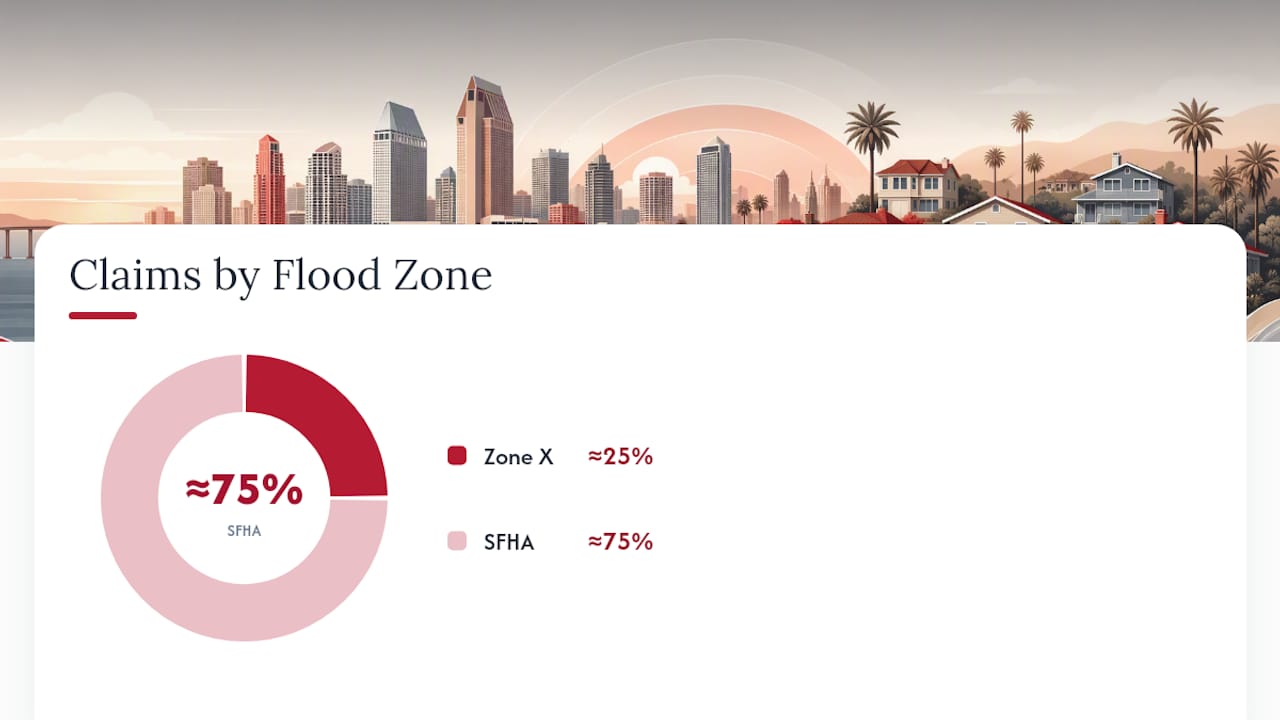
Zone X properties, the moderate to low risk designation covering most of San Diego's inland neighborhoods, carry no such mandate. That doesn't mean no risk. Roughly 1 in 4 flood insurance claims come from moderate to low risk zones, which tells you Zone X is a risk category, not a guarantee.
San Diego participates in the National Flood Insurance Program through the county's Community Rating System standing, and that participation carries a real perk: eligible policyholders automatically receive a 15% discount on NFIP premiums. A few things to keep in mind before you assume you're covered:
- Standard homeowners insurance excludes flood damage entirely, no matter your zone.
- Lenders check flood zone status at closing and again whenever maps update.
- Zone X homeowners can still buy flood coverage voluntarily, often at lower premiums than SFHA properties.
- Renters have no flood obligation tied to a mortgage, but landlord policies won't cover their belongings either.
NFIP limits versus private flood policies: which fits your property?
The National Flood Insurance Program caps residential building coverage at $250,000, with contents coverage up to $100,000. For a starter home in Linda Vista, that ceiling might cover a full rebuild. For a $3 million property in Point Loma or La Jolla Shores, it covers a fraction of the structure and none of the temporary housing costs while repairs happen.
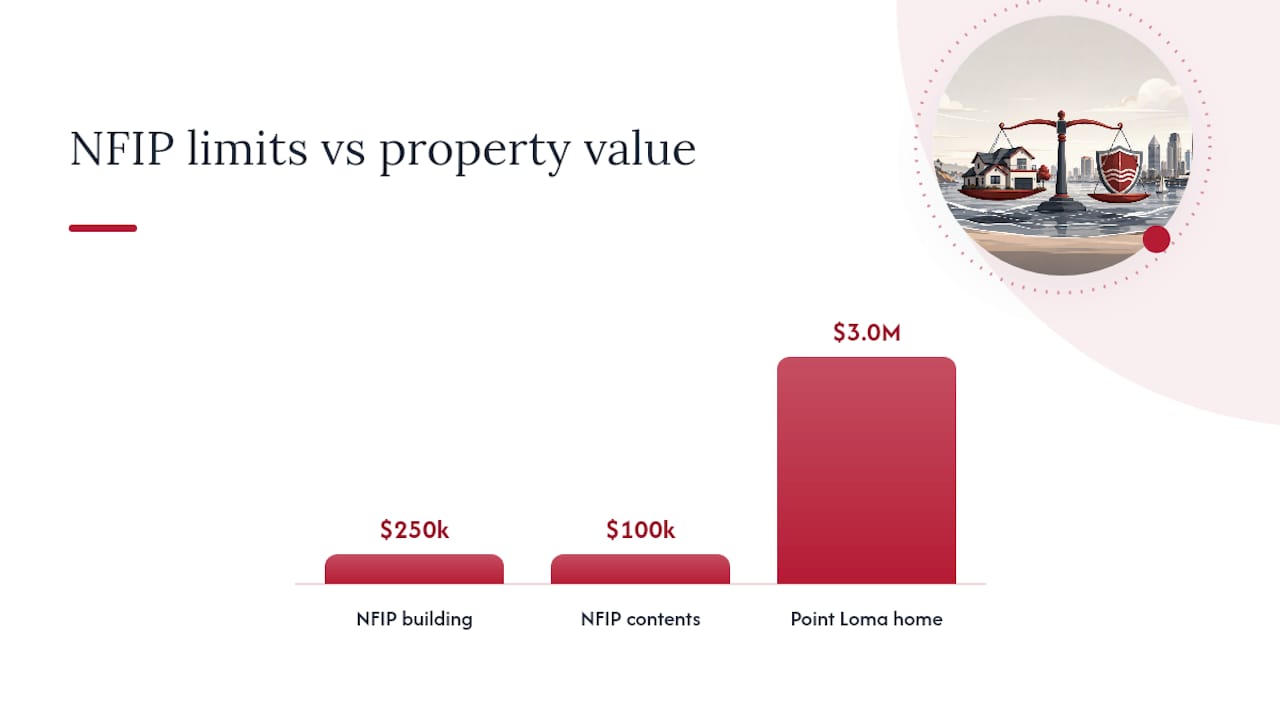
Statistic to remember: NFIP's $250,000 building cap hasn't kept pace with San Diego construction costs, which is why higher-value coastal homes increasingly look to the private market for the gap.
Private flood insurance fills that space with a few real advantages:
- Higher coverage limits that match actual rebuild costs on expensive properties
- Loss-of-use coverage, which pays for temporary housing during repairs (NFIP doesn't offer this)
- Broader endorsements for detached structures, landscaping, and pool equipment
- Faster underwriting in some cases, though carrier appetite varies by flood history
The tradeoff cuts both ways. Properties with repetitive loss history or unusual elevation profiles sometimes can't find private appetite at any price, leaving NFIP as the only realistic option. Private carriers tend to compete hardest for well-elevated homes with clean claims records, exactly the properties that need the coverage least urgently. Get quotes from both markets before deciding. A broker who sells NFIP policies can usually run a private quote alongside it in the same conversation.
How the March 3, 2026 FEMA map update changes things locally
San Diego's Physical Map Revision takes effect March 3, 2026, and it reclassifies coastal and valley parcels the city has flagged for updated hydrology and coastal flood modeling. If your property moves into a Special Flood Hazard Area under the new maps, your lender will likely require flood insurance going forward, even if you've owned the home flood insurance free for years.
There's a real cushion built into this transition, though. Two provisions specifically protect newly mapped homeowners:
- A newly mapped discount that reduces premiums for the first 12 months after the change takes effect
- A waiver of the standard 30-day waiting period when you buy insurance specifically because of the map revision, meaning coverage can start the next business day instead of a month out
That second point matters more than it sounds. Most flood policies won't pay a claim until 30 days after purchase, which is exactly why insurers hate letting people buy coverage as the storm arrives. The map change waiver exists so newly mapped homeowners aren't left exposed during the gap between reclassification and normal underwriting timelines.
Check your specific parcel against the updated maps through the FEMA Map Service Center or the city's PMR notices, and don't wait until escrow to find out your zone changed.
How to buy flood insurance in San Diego
Getting covered is a short process if you have the right documents ready. Here's the order that saves the most time:
- Confirm your zone. Look up your address on the FEMA Map Service Center or run it through the FloodSmart quote tool to see current and post-PMR designations side by side.
- Pull two sets of quotes. Get an NFIP quote through FloodSmart or a participating agent, then get a private quote from a broker who writes flood policies. Compare limits, loss-of-use coverage, and total premium, not just the sticker price.
- Gather your paperwork. Have your property address, mortgage information, and an elevation certificate ready if one exists for your home; it can lower your premium significantly in borderline zones.
- Understand your waiting period. Standard purchases carry a 30 day wait before coverage activates. If you're buying because of the March 2026 map change, that wait is waived and coverage starts the next business day.
Pro Tip: Buy before the rainy season starts, not during the first storm warning. Photograph your property's current condition, foundation, and any prior water staining before you bind the policy. It removes ambiguity if you ever need to prove pre-existing condition during a claim.
Can you challenge your flood zone designation?
If you believe your parcel was mapped incorrectly, two tools exist to fix it. A Letter of Map Amendment (LOMA) applies when your structure sits on naturally high ground within a mapped flood zone. A Letter of Map Revision (LOMR), or LOMR-F for fill-based changes, applies when the ground was physically raised or the flood data itself needs updating.
Both require real documentation:
- A certified elevation certificate showing your lowest adjacent grade
- A licensed surveyor's certification of ground elevation
- Supporting engineering data in more complex cases
Submit a complete package and FEMA typically processes it in about 60 days. A successful LOMA or LOMR can remove the mandatory purchase requirement entirely, which matters if you're mid escrow and a lender just flagged the loan.
What to document and which endorsements matter
Photograph and video every room, plus your foundation and exterior, before any flood event happens. Keep receipts for temporary repairs; NFIP reimburses documented emergency work up to policy limits.
Renters need their own coverage. A landlord's building policy never extends to a tenant's furniture or belongings, so a contents-only NFIP or private policy is the only real protection for renters in flood-prone units.
- Ask your agent about mold remediation endorsements; standard NFIP policies handle mold caused by flooding only under specific conditions.
- Review water damage caps in any existing homeowners policy; don't assume flood related water damage is covered without explicit language.
- Consider additional living expense coverage if your carrier offers it, since NFIP does not include it.
Pro Tip: After any flood event, call a property inspection service before you start cleanup. Services like Vanguard Home Watch document structural condition immediately, which strengthens your claim and speeds the adjuster's review.
How flood risk shapes San Diego luxury transactions
Flood zone status now shows up on nearly every buyer checklist we run for coastal and valley properties. A property that moves into a Special Flood Hazard Area under the 2026 map revision can stall a closing if the lender flags it late, so we verify zone status and insurance quotes early, alongside title and escrow. For deeper context on how coastal permitting and property features intersect with these decisions, our post on coastal development permits walks through the transaction side in more detail.
— Stu Harvey
Let Stu Harvey Estates handle the flood-risk homework on your next move
A local agent who checks zone status and insurance implications before they become a closing day surprise can provide valuable assistance to buyers and sellers. We coordinate directly with title, escrow, and local insurance contacts so a map reclassification or a lender's last minute flood requirement never derails your timeline.
If you're actively searching neighborhoods with coastal exposure, flood zone considerations should be part of your property search, not an afterthought once you're in contract. Ready to start looking at homes with someone who already knows which streets sit in a Special Flood Hazard Area? Visit our San Diego Home Buying Guide to start the conversation, or browse current listings to see what's available now.
Where to check your status and get a quote today
Bookmark these before you need them under time pressure:
- FEMA's National Flood Insurance Program for coverage limits and program basics
- FEMA Map Service Center for address-level flood zone panels
- FloodSmart's provider directory to find an agent and run a quote
- City of San Diego's PMR page for the March 2026 map change details and local notices
- San Diego County's flood program page for county-level NFIP participation information
Save the links, share them with your agent or escrow officer, and check your specific address again once the March 2026 revision takes effect. Zones change; your habit of checking shouldn't.
This article is general information, not a substitute for advice from a qualified financial advisor. Consult a qualified financial professional about your own circumstances before acting on anything here.
Sources
- Flood Insurance — FEMA
- Physical Map Revision (PMR) — City of San Diego
- FEMA's National Flood Insurance Program (NFIP) — San Diego County Department of Public Works
- FEMA Map Service Center — Flood map PDF (San Diego panel example)
- Find a flood insurance provider — FloodSmart / NFIP