
Yes, Airbnb is legal in Los Angeles, but only under narrow conditions. Skip any one of those steps and the City now has better tools than ever to find you.
TL;DR:
- Registering as a home-sharing host requires proof of primary residence, notarized landlord authorization if renting, and must be done within city limits, excluding unincorporated county areas.
- Unhosted stays are limited to 120 nights annually, requiring an extended permit, which involves a clean hosting history and no nuisance citations, whereas hosted stays have no night limit.
- Hosts must display their registration number on all listings, keep accurate booking logs, and renew annually to avoid illegal advertising and potential suspension or revocation.
- Short-term rental income is subject to about 14% Transient Occupancy Tax, which platforms may collect automatically, but hosts must verify this and file directly if necessary.
- Enforcement is heavily data-driven post-2026, with platforms obliged to share host and listing data, making compliance efforts, record-keeping, and addressing citations crucial for ongoing legality.
Table of Contents
- What Does the Home-Sharing Ordinance Actually Do?
- Who Actually Qualifies to Register?
- How Do You Register for Home-Sharing in Los Angeles?
- Hosted vs. Unhosted Stays: How the 120-Night Cap Works
- What Taxes Do You Owe on Short-Term Rental Income?
- How Aggressively Does LA Enforce These Rules Now?
- City of Los Angeles or LA County: Which Rules Apply to You?
- Your Compliance Checklist Before You List
- What Happens Legally If You Don't Comply?
- How Does the City Actually Investigate Complaints?
- Does Your Homeowner's Insurance Cover Short-Term Guests?
- Do Emergency Orders Still Affect Hosting Rules Today?
- Applying for Your Home-Sharing Permit, Start to Finish
- Where to Go for Official Answers
- Why the Real Risk in 2026 Isn't the Fine, It's Getting Flagged at All
- Sources
What Does the Home-Sharing Ordinance Actually Do?
The Home-Sharing Ordinance exists for one reason: keeping Los Angeles housing stock in the hands of renters and owners, not investors running de facto hotels. City Planning built the Home-Sharing program around that goal, and the Los Angeles Housing Department has said explicitly that the primary-residence rule and rent-stabilized exclusions exist specifically to block commercial conversion of housing units into short-term inventory.
The ordinance covers every parcel within the City of Los Angeles proper. That distinction matters because Los Angeles County is enormous, and unincorporated pockets like East LA or Marina del Rey answer to a different set of rules entirely, which we'll get to later.
Inside city limits, the Administrative Guidelines that implement the ordinance spell out what's banned outright: advertising a listing before you're registered, converting a unit into a standalone short-term rental business, exceeding occupancy limits tied to bedroom count, and generating noise complaints that pile up into a nuisance pattern. Under Los Angeles Municipal Code Section 12.22 A.32, hosting platforms carry real responsibility here too. Airbnb, Vrbo, and similar sites are expected to display registration numbers, remove noncompliant listings when the City flags them, and, increasingly, hand over host data when compelled.
None of this means Los Angeles is hostile to short-term rentals. It means the City drew a specific lane: homeowners and renters supplementing income from the place they actually live, not landlords running unlicensed micro-hotels across a portfolio of units.
Who Actually Qualifies to Register?
Before you spend an afternoon on the portal, figure out whether you're even eligible. The primary residence rule is the gatekeeper for everything else, and it trips up more applicants than any other requirement.
A primary residence is the home you live in for the majority of the year, and the City wants proof: a driver's license, voter registration, utility bills, or a tax return showing that address. If you own a second home in Malibu and live full time in the Valley, only the Valley property can carry an HSR.
Tenants can register too, but only with permission. City Planning and Airbnb both require a notarized landlord authorization affidavit before a renter can list a unit for home-sharing. Get this notarized before you start the application; it's the single most common delay point for tenant hosts.
Accessory Dwelling Units carry their own wrinkle. ADUs built or permitted after 2017 generally cannot be used for home-sharing under current guidance, though a pre-2017 exception exists for units that were legally established before the ADU rules tightened. If you're weighing whether a converted guest house on your property qualifies, it's worth reading through how ADUs differ from guest houses under California law before you invest in furnishing it for guests.
Rent-stabilized units under the Rent Stabilization Ordinance (RSO) are excluded from home-sharing almost entirely, and any unit removed from the rental market through the Ellis Act carries its own separate restrictions. If your building has gone through a soft-story retrofit, double check whether that triggered any RSO status changes that affect your eligibility.
How Do You Register for Home-Sharing in Los Angeles?
Registration happens entirely online through the City Planning Home-Sharing portal, and the process is faster than most permit applications you'll deal with as a property owner.
You'll need three categories of documents ready before you start: government-issued photo ID, proof of primary residence (a utility bill and one other document showing the address), and, if you're a tenant, that notarized landlord affidavit mentioned above. Homeowners skip the affidavit step entirely.
The standard HSR carries a modest annual registration fee, and renewal happens yearly, not automatically. Mark your calendar, because a lapsed registration means your listing becomes illegal to advertise the moment the old one expires, even mid-booking-season.
Once approved, you'll receive a Home-Sharing Registration Number. That number has to appear on every single listing, on every platform, every time. If you update your address, change ownership structure, or need to correct an error on file, the portal has a modification workflow. Don't just create a second listing and hope the old one disappears. Duplicate or outdated registrations are one of the easier things for the City to flag during a compliance sweep.
Pro Tip: Screenshot your confirmation page and save the PDF receipt the moment you register. City servers occasionally lag during renewal season, and a saved confirmation is your proof of timely filing if there's ever a dispute.
Hosted vs. Unhosted Stays: How the 120-Night Cap Works
Los Angeles draws a hard line between hosted and unhosted stays, and the difference changes how many nights you can legally rent.
A hosted stay means you're physically present in the residence while guests occupy a room or portion of the home. Hosted stays face no annual night limit under the ordinance. An unhosted stay means the entire home is rented out and you're elsewhere. Those nights count toward a 120-night annual cap, a figure that replaced an earlier 180-night proposal floated during the ordinance's drafting process.
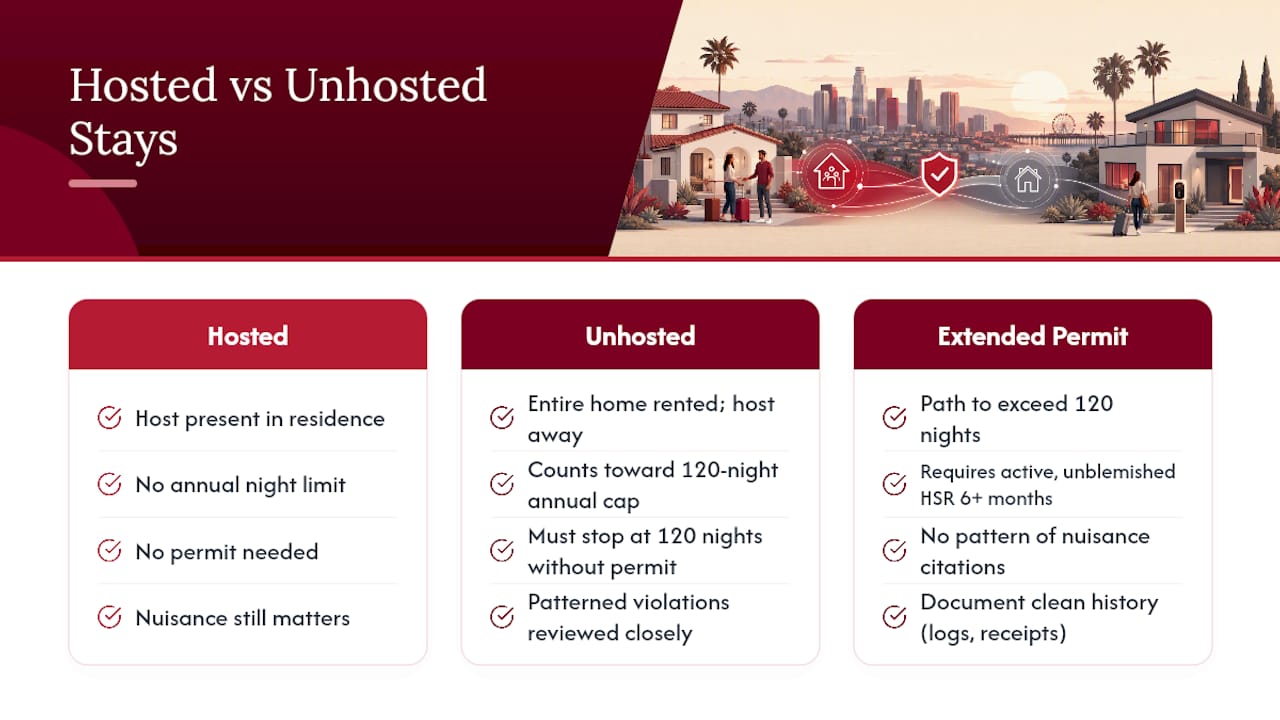
If you want to exceed 120 unhosted nights, you need an Extended Home-Sharing permit. Qualifying isn't automatic. City Planning generally requires that you've held an active, unblemished HSR for at least six months, that you have no pattern of nuisance citations, and that you can document a clean hosting history through booking logs and prior renewal receipts.
Nuisance violations are the fastest way to torpedo an extended permit application. A single noise complaint probably won't sink you, but a documented pattern, especially anything tied to City enforcement action, gets reviewed closely and can disqualify an otherwise strong application. Keep your guest communications professional and your house rules visible; both matter more than most hosts assume when this file lands on a reviewer's desk.
What Taxes Do You Owe on Short-Term Rental Income?
Every stay of 30 days or fewer in the City of Los Angeles owes Transient Occupancy Tax at a rate the Office of Finance sets and publishes, commonly cited around 14%. That's separate from any income tax you owe the state or federal government on rental earnings.
Here's where hosts get tripped up: some platforms collect and remit TOT automatically on your behalf, and some don't, depending on jurisdiction agreements that shift over time. Airbnb has historically collected and remitted TOT directly in the City of Los Angeles, but you're still on the hook to confirm this is happening for your specific listing rather than assuming it. If your platform doesn't collect it, you must register directly with the Office of Finance, obtain a Transient Occupancy Registration Certificate, and file monthly TOT returns yourself.
Unincorporated Los Angeles County runs a parallel but distinct system through the County Treasurer and Tax Collector. If your property sits outside city limits, your TOT registration and remittance path is different from a City host's, even though the tax concept is similar. Mixing up which agency to file with is a common and entirely avoidable mistake.
Keep clean monthly records regardless of who remits. If a platform's remittance ever gets contested or delayed, your own documentation of nights booked and tax collected is what protects you.
How Aggressively Does LA Enforce These Rules Now?
Enforcement in 2026 looks nothing like it did five years ago, and the reason has a name: Senate Bill 346. Effective January 1, 2026, SB 346 lets California municipalities compel short-term rental platforms to hand over host and listing data directly. Los Angeles City Planning has already outlined updated fine structures that assume this new visibility into who's actually hosting.
Practically, this means the days of quietly running an unregistered listing and hoping nobody notices are largely over. The City no longer has to rely solely on neighbor complaints or manual listing sweeps; it can cross-reference platform data against its own registration database and spot mismatches automatically.

Penalties escalate with the violation. Advertising without a valid HSR draws civil fines that increase for repeat violations, and the City can pursue daily penalties for a listing that stays up after a cease notice. Persistent noncompliance can lead to registration suspension or outright revocation, at which point re-registering becomes far harder.
The City also runs administrative enforcement programs, generally referred to internally under names like ACE (Administrative Citation Enforcement), that allow code enforcement to issue citations without a full court proceeding, speeding up the timeline between a complaint and a consequence.
Your best defense is boring compliance: display your HSR number on every listing, keep your unhosted-night count under the cap, respond promptly to any City correspondence, and don't let a small citation go unaddressed. Once SB 346 data-sharing agreements are fully active, the gap between "unregistered" and "flagged" shrinks to almost nothing.
City of Los Angeles or LA County: Which Rules Apply to You?
The single biggest jurisdictional mistake hosts make is assuming "Los Angeles" means one rulebook. It doesn't.
If your property sits inside the incorporated City of Los Angeles, City Planning's Home-Sharing Ordinance governs you, and you register through their portal. If your property sits in an unincorporated area, the County Treasurer and Tax Collector's Short-Term Rental program governs you instead, with its own registration certificate and its own fee schedule.
There's a genuinely useful carve-out here: unincorporated coastal zones in Los Angeles County are currently not subject to the County's short-term rental registration requirement. That's a real exception, not a loophole, but it's narrow and location-specific, so don't assume it applies just because you're near the coast.
The cleanest way to confirm which rulebook applies to your address is the City's ZIMAS parcel mapping tool, which shows zoning, jurisdiction, and RSO status for any parcel in the city. If your street sits near a boundary line between city and county territory, run your exact address through ZIMAS before you file anything. Guessing wrong here wastes an application fee and weeks of processing time.
Your Compliance Checklist Before You List
Before your first booking goes live, work through this sequence. Skipping steps out of order is the most common reason applications bounce back.
- Gather your government-issued photo ID and two forms of primary-residence proof (utility bill, tax return, or voter registration).
- If you're a tenant, get the landlord authorization affidavit notarized before you touch the application.
- Register on the City Planning Home-Sharing portal and, separately, with the Office of Finance for TOT within 30 days of your first confirmed booking.
- Post your HSR number on every listing across every platform you use, no exceptions.
- Start a written booking log the day you register, tracking hosted versus unhosted nights.
- Install working smoke detectors, keep a fire extinguisher accessible, and confirm emergency exits are unobstructed, standards the City's adopted Administrative Guidelines treat as baseline compliance.
Pro Tip: Save digital copies of every registration confirmation, renewal receipt, and TOT filing the moment you get them, and keep a running dated log of hosted nights. If you ever apply for an Extended Home-Sharing permit, this exact paper trail is what a reviewer wants to see, and scrambling to reconstruct six months of history after the fact is a preventable headache.
What Happens Legally If You Don't Comply?
Fines are the visible penalty, but they're not the worst outcome. Registration suspension strips your right to list at all, and revocation goes further, potentially barring you from re-registering that property for a defined period. For an owner counting on rental income to cover a mortgage, that's a far bigger financial hit than any single citation.
Repeated or willful violations, especially advertising without an HSR after a formal cease notice, can escalate into City-initiated legal action, including injunctive relief that forces an immediate shutdown of the listing regardless of existing bookings. That's disruptive in a way a fine simply isn't; guests get canceled, refunds get demanded, and your platform reviews take the hit.
There's also a reputational layer that doesn't show up in any ordinance text. Platforms track host compliance history, and a pattern of City enforcement actions against your account can affect your standing on the platform itself, independent of any City penalty. A suspended HSR paired with a damaged Superhost or Guest Favorite status is a combination that takes far longer to recover from than the citation that caused it.
The practical lesson: treat a first warning letter or citation as a hard stop, not a cost of doing business. Address it immediately, document your response, and confirm resolution in writing before you accept another booking.
How Does the City Actually Investigate Complaints?
Enforcement typically starts one of two ways: a neighbor complaint or a data mismatch surfaced through platform reporting under SB 346. Either path routes to City Planning's code enforcement division.
A complaint, usually about noise, parking, trash, or a suspected unregistered listing, triggers a review of the property's HSR status against the address on file. If there's no active registration, or if the listing's registration number doesn't match what's posted, the City issues a notice of violation with a response deadline, generally giving the host a window to correct the issue before penalties escalate.
Inspections aren't routine walkthroughs the way a building permit inspection might be. Most enforcement here is document and record based rather than a physical site visit, checking registration status, occupancy claims, and night counts against submitted logs. Physical inspections do happen in cases involving safety complaints or repeated nuisance citations, where code enforcement has cause to verify conditions directly.
If you receive a notice, respond in writing within the stated deadline and include your HSR number, your booking log, and any documentation contradicting the complaint if you believe it's inaccurate. Silence is the worst response; it reads as noncompliance even when the underlying issue might be resolvable with a five-minute email.
Does Your Homeowner's Insurance Cover Short-Term Guests?
Most standard homeowner's policies exclude commercial activity, and short-term rental hosting falls squarely into that category the moment you accept paying guests, even occasionally. Relying on your existing policy without checking is one of the most common and costly assumptions hosts make.
Talk to your insurer directly before you list. Many carriers offer a short-term rental endorsement or rider that extends liability and property coverage specifically for hosting activity, often at a modest premium increase over your base policy. Some platforms also offer host protection programs, but these typically supplement rather than replace proper insurance and often carry exclusions worth reading closely, particularly around liability caps and property damage limits.
If you're renting out a unit inside a multi-family building or a property with an ADU, confirm with your insurer whether that structure needs its own separate coverage. A policy that covers your main residence doesn't automatically extend to a converted guest unit generating rental income.
At minimum, carry liability coverage sufficient to handle a guest injury claim, and keep documentation of your policy's short-term rental endorsement alongside your HSR paperwork. If the City or a platform ever asks for proof of adequate coverage during a dispute, you want that answer ready in under five minutes, not buried in a filing cabinet.
Do Emergency Orders Still Affect Hosting Rules Today?
Los Angeles temporarily restricted short-term rentals during the COVID-19 public health emergency, limiting bookings to essential workers and people in housing crisis for a stretch in 2020. Those emergency restrictions have been lifted, and the Home-Sharing Ordinance operates under its normal rules today.
That said, the emergency period left a lasting mark on how the City thinks about short-term rentals during future crises. Los Angeles retains authority to reissue emergency restrictions on short-term rentals during a declared local emergency, whether that's a public health crisis, a wildfire evacuation event, or another disaster scenario where housing stock needs to prioritize displaced residents over vacation guests.
Practically, this means hosts should treat any local emergency declaration as a trigger to check City Planning's Home-Sharing page immediately rather than assuming normal operations continue by default. Historically, these restrictions have come with short notice and immediate effect, leaving little room for hosts who weren't paying attention.
If you're hosting during fire season, which in Los Angeles increasingly stretches well beyond the traditional autumn window, build a contingency plan for canceled bookings tied to evacuation zones. It's a smaller compliance issue than registration or taxes, but it's the one most hosts forget to plan for until they're already dealing with a canceled reservation and an anxious guest.
Applying for Your Home-Sharing Permit, Start to Finish
Walking through the actual application sequence removes most of the anxiety around this process, since it's genuinely more straightforward than most City permitting.
Step one: Confirm eligibility. Verify your property is inside city limits, confirm it's your primary residence, and check that it isn't excluded under RSO or Ellis Act status.
Step two: Assemble documents. You need photo ID, two forms of residency proof, and, if you're a tenant, the notarized landlord affidavit.
Step three: Submit through the Home-Sharing portal. The online form walks you through document upload and collects your basic property information.
Step four: Pay the registration fee. Processing typically completes within a few weeks, though timelines can extend during high-demand renewal periods.
Step five: Receive your HSR number and post it immediately on every active or planned listing across every platform.
Step six: Register separately with the Office of Finance for TOT purposes if your platform doesn't handle collection and remittance automatically.
Step seven: Calendar your renewal date one year out, and start your booking log on day one so you're building extended-permit eligibility from the start, even if you don't need it yet.
If you're setting up an ADU specifically for short-term use, review ADU-specific short-term rental setup guidance before finalizing your registration, since accessory unit rules intersect with home-sharing eligibility in ways that trip up otherwise straightforward applications.
Where to Go for Official Answers
For registration itself, start at the City Planning Home-Sharing portal and read the Administrative Guidelines PDF in full before you apply. For tax questions, the Office of Finance's TOT requirements page covers registration and monthly filing steps. If your property sits outside city limits, the County Treasurer and Tax Collector's short-term rental page is your correct starting point instead.
Platform-side guidance, including document checklists, lives on the Airbnb Help Center's Los Angeles page. For anything involving RSO status, Ellis Act history, or a complicated ownership structure, talk to a real estate attorney or tax advisor before you file. The rules are clear on paper, but edge cases around older buildings and multi-unit properties genuinely benefit from professional review.
Why the Real Risk in 2026 Isn't the Fine, It's Getting Flagged at All
Most hosting advice still treats compliance as a paperwork exercise you handle once and forget. That thinking is already outdated. SB 346 changed the actual risk calculus: the City doesn't need a neighbor complaint anymore to find you, it needs a data mismatch, and platforms are now required to provide exactly that.
The conventional advice, register once, post your number, move on, misses that extended-permit eligibility and clean citation history are becoming the real competitive advantage for hosts who want to run unhosted stays past 120 nights. A host with eighteen months of clean booking logs and zero nuisance citations is in a fundamentally different position than one applying cold.
If you're serious about this as income rather than a side project, prioritize the boring stuff first: notarize your affidavit before you need it, log every night from day one, and treat your first citation, if it ever comes, as a full stop rather than a cost to absorb. The hosts who get flagged in this new enforcement environment are almost never the ones who read the ordinance. They're the ones who assumed nobody was checking.
— Stu Harvey
This article is general information, not a substitute for advice from a qualified lawyer. Consult a qualified legal professional about your own circumstances before acting on anything here.
Sources
- Home-Sharing | Los Angeles City Planning
- Transient Occupancy Tax requirements — City of Los Angeles Office of Finance
- Short-Term Rentals - Los Angeles County Treasurer and Tax Collector
- Los Angeles, CA - Airbnb Help Center