
Moving from New York to San Diego at the luxury level starts with one decision: hire a concierge broker who can get you into off-market inventory before it ever touches the MLS. Without that access, you're bidding against everyone else on a shrinking public pool while the best trophy properties change hands quietly through broker networks.
Four neighborhoods dominate the shortlist for New Yorkers making this move:
- La Jolla — coastal prestige with walkable village life and ocean views, closest analog to Manhattan's density
- Rancho Santa Fe — gated estates, multi-acre lots, and the privacy of a compound rather than a lot line
- Del Mar — beachfront exclusivity with a smaller, tighter inventory pool
- Coronado — island-style living, a slower pace, and a strong sense of enclosure
The right next move is a confidential consultation with Stu Harvey Estates before you set foot on a single showing.
Key Takeaways
A concierge luxury broker with off-market access, specialty inspection relationships, and integrated tax counsel reduces both the cost and the risk of a New York to San Diego luxury relocation.
| Point | Details |
|---|---|
| Hire for off-market access first | A meaningful share of San Diego's trophy inventory never reaches the MLS, so broker network depth outweighs marketing reach. |
| Match neighborhood to lifestyle | La Jolla suits walkability, Rancho Santa Fe suits acreage and privacy, Del Mar and Coronado suit beachfront and island living. |
| Insist on specialty inspections | Hillside stability, seismic integrity, pool systems, and wine cellar controls require inspectors beyond a standard home inspection. |
| Engage tax counsel before the offer | LLC and trust structures for privacy and estate planning work best when settled before contract terms are written. |
| Choose Stu Harvey Estates for scale and access | 15-plus years, $1.2 billion-plus in sales, and 250-plus transactions back the off-market network and concierge coordination this move requires. |
Table of Contents
- Who Is Stu Harvey Estates and What Do They Bring to the Table?
- Which San Diego Neighborhood Fits Your New York Lifestyle?
- How Does the Buying Process Work for Out-of-State Buyers?
- What Inspections Do Luxury Coastal Homes in San Diego Require?
- Should You Buy Through an LLC or Trust?
- What Does Full Concierge Relocation Support Actually Include?
- What Does a Full Concierge Relocation Actually Cost?
- How Long Does the Full Relocation Take From First Call to Move-In?
- How Do You Choose the Right Broker for This Move?
- What Are the Common Pitfalls in a Cross-Country Luxury Move?
- What Should You Know About Daily Life in San Diego?
- Why a Concierge Approach Beats the Conventional Moving Playbook
- Ready to Start Your Confidential San Diego Search?
- Sources
Who Is Stu Harvey Estates and What Do They Bring to the Table?
Stu Harvey has closed more than $1.2 billion in luxury sales over 15-plus years, spanning 250-plus transactions across San Diego's premier coastal markets as a Senior Agent with The Oppenheim Group. That volume matters for a New York buyer because it means direct relationships with the listing agents who control unpublished inventory in La Jolla, Rancho Santa Fe, Del Mar, and Coronado.
The firm's concierge model extends past the transaction itself:
- Coordination with tax counsel and estate advisors on ownership structuring before you make an offer
- Introductions to lenders and title teams experienced with high-value, remote closings
- A curated library of neighborhood profiles and buyer checklists for deeper research ahead of a visit
Pro Tip: Ask any broker you're vetting for a specific count of off-market deals they closed in the past 24 months, not just total sales volume. Volume can come from public listings alone; off-market access is the differentiator that actually matters for a confidential relocation.
Which San Diego Neighborhood Fits Your New York Lifestyle?
New Yorkers tend to sort into one of three camps: people who want walkability and street life, people who want acreage and complete separation from neighbors, and people who want water at the front door. San Diego's top four enclaves map cleanly onto those instincts.
- La Jolla rewards buyers who miss the energy of a real neighborhood, restaurants, galleries, and a coastline within walking distance, without giving up ocean views.
- Rancho Santa Fe suits families who want horse property, multi-acre privacy, and a covenant-protected community feel closer to Connecticut horse country than to a beach town.
- Del Mar attracts buyers chasing beachfront exclusivity in a compact footprint. Inventory here is thin, and homes in this tier trade on micro-market drivers like ocean orientation and architectural pedigree more than square footage alone.
- Coronado delivers an island rhythm, quieter streets, a historic core, and a commute across the bridge that filters out casual traffic.
For remote buyers, the smart sequence is a virtual-first review of three or four finalists, then a single concentrated trip for in-person walkthroughs, timed once financing and privacy planning are already settled.
How Does the Buying Process Work for Out-of-State Buyers?
Buying in San Diego from New York follows a sequence with clear decision points, and a concierge broker manages the coordination at every stage.
- Preparation. Your broker builds a tailored search brief, confirms financing strategy (jumbo pre-approval versus a cash position), and sets a privacy plan for how your identity is protected during the search.
- Sourcing and vetting. This stage blends MLS listings with off-market intelligence, since a meaningful share of San Diego's trophy inventory never reaches public listing services and only surfaces through broker-to-broker channels.
- Offer and negotiation. Trophy assets often call for an escalation strategy, tight inspection windows, and privacy clauses that keep the buyer's name off public records until close.
- Closing. Escrow, remote notarization, and coordination with your counsel bring the deal home.
Remote tools make the distance workable. Virtual tours, drone footage, and interactive floor plans let you narrow a list without six cross-country trips, but they only work when paired with:
- A lender fluent in interstate, high-value transactions
- An escrow and title team accustomed to remote signings for seven and eight-figure deals
- A broker willing to run preliminary inspections on your behalf before you ever board a plane
Most New York buyers complete the entire process, from first call to key handoff, in a span of a few months once financing is confirmed, though trophy assets with off-market negotiation can move faster when a broker already has the relationship in place. The luxury home buying checklist is worth reviewing before your first call so you arrive with a clear brief rather than a vague wish list.
What Inspections Do Luxury Coastal Homes in San Diego Require?
Luxury finishes hide problems that standard inspections miss. A home with imported stone counters and a temperature-controlled wine room can still sit on an unstable hillside or run HVAC systems nobody has serviced in years.
The inspections worth insisting on:
- Hillside and coastal bluff stability assessments, critical for La Jolla and Del Mar properties built on or near coastal cliffs
- Seismic and structural evaluations specific to California's building codes
- Pool, spa, and water feature system inspections
- Wine cellar and environmental control system checks
- Roofing, major mechanical, and HVAC system reviews
Specialized inspections are advisable for luxury homes precisely because standard walkthroughs miss the systems that cost the most to fix. Stu Harvey Estates coordinates these inspections in phases, pairing each specialist with a contractor estimate so you know the true cost of any issue before it affects your offer, an approach detailed in the firm's due diligence guide for luxury investment property.
Should You Buy Through an LLC or Trust?
Privacy and estate planning drive most ownership decisions at this price point, and the right structure depends entirely on your broader financial picture. This is counsel territory, not brokerage territory, but you should walk into that conversation informed.
Common approaches include:
- A property-specific California LLC that keeps your name off the public deed
- A trust structure that folds the property into a broader estate plan
- Multi-entity arrangements, sometimes a California LLC owned by an out-of-state holding entity or trust, used by sophisticated buyers for layered privacy and estate alignment
Each option carries real trade-offs on reassessment exposure, transfer obligations, and ongoing filing requirements. Engaging tax and estate counsel before you write an offer preserves your options; trying to restructure ownership after closing is far more expensive and sometimes impossible. Stu Harvey Estates routinely loops in California-licensed tax and estate counsel early in the process so the ownership vehicle is settled before contract terms are finalized, not after.
What Does Full Concierge Relocation Support Actually Include?
A genuine concierge relocation service goes well past showings and paperwork. It manages the entire operational load of moving your life three thousand miles.
That typically covers:
- Confidential property sourcing that keeps your search off public radar
- Vendor management for inspectors, pool and landscape contractors, and security installers
- Temporary housing arrangements while your permanent purchase closes
- Introductions to schools, private clubs, and neighborhood contacts
- Logistics coordination for movers, art handlers, and specialty transport
Confidentiality gets preserved through private showings scheduled around your travel, non-disclosure agreements with vendors where needed, and a search process that never puts your name on a public offer sheet until you're ready. Pro Tip: Ask your broker who handles landscape and hardscape assessment before close. A firm like Modern Yardz, which specializes in luxury landscape design across San Diego, can flag drainage or hillside planting issues a general contractor would miss entirely. Full details on what a relocation package typically includes are worth reviewing before your first consultation.
What Does a Full Concierge Relocation Actually Cost?
Three cost categories drive the total: brokerage fees, the physical move, and the professional services that surround the purchase.
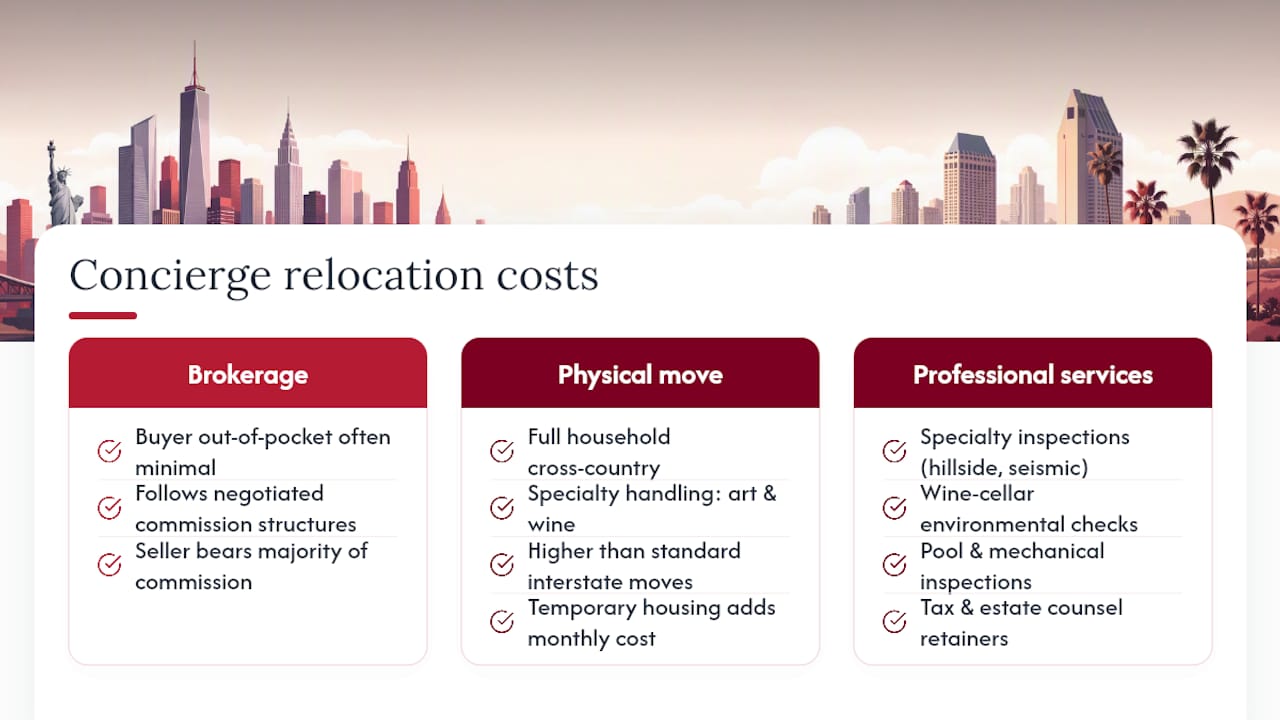
Brokerage compensation on the buy side typically follows standard commission structures negotiated with the listing side, so your out-of-pocket brokerage cost as a buyer is often minimal compared to what a seller pays. Where costs concentrate is everywhere else. A cross-country move of a full household, including art, wine collections, and specialty furnishings, runs meaningfully higher than a standard interstate move because of the specialized handling those items require. Temporary housing during a search or a gap between close dates adds a monthly cost on top of that.
Specialty inspections stack up fast at this tier: hillside stability assessments, seismic reviews, pool and mechanical inspections, and wine cellar environmental checks each carry their own fee, often totaling several thousand dollars combined before you factor in any repair estimates that surface.
Then there's the professional services layer. Tax and estate counsel fees for structuring an LLC or trust ownership vehicle vary by complexity, and if you're also selling a New York property in parallel, you're paying legal and brokerage costs on both coasts simultaneously.
The honest answer for a buyer at this level is that the purchase price itself is rarely the surprise. It's the accumulation of inspection fees, moving logistics, temporary housing, and counsel retainers that catches New York buyers off guard when nobody mapped the full cost picture up front. A concierge broker who itemizes these categories before you start touring homes saves you from discovering them one invoice at a time.
How Long Does the Full Relocation Take From First Call to Move-In?
Plan for a process that unfolds in four broad phases, typically spanning three to six months depending on how quickly the right property surfaces.
Weeks one through two cover the preparation phase: your search brief, financing pre-approval, and privacy plan get finalized. This is also when you should have your first conversation with tax counsel about ownership structure, since that decision shapes how offers get written.
Weeks two through eight cover active sourcing. Your broker runs both MLS and off-market channels in parallel, and you review shortlisted properties virtually before committing to an in-person trip. Most New York buyers make one to two dedicated visits during this window.
Weeks six through twelve cover offer, negotiation, and inspections. Once you're under contract, phased specialty inspections typically run two to four weeks, with contractor estimates following close behind any issues found.
Weeks ten through fourteen cover closing: escrow, remote notarization coordination, and final counsel review of the ownership vehicle. Escrow itself on a cash or well-financed luxury deal typically closes within a month from contract acceptance.
Layer a household move and, if applicable, a simultaneous New York sale onto that timeline, and the realistic window from first serious call to keys in hand runs closer to four to six months for most HNW buyers managing both sides of the transaction.
How Do You Choose the Right Broker for This Move?
The questions that separate a genuine concierge operation from a broker who simply handles high-value listings come down to access, network depth, and process discipline.
Ask directly: How many off-market transactions has this broker closed in the target neighborhoods in the past two years? A broker without a real answer is relying on the same public inventory you could search yourself. Ask who they use for specialty inspections, and whether those relationships are established enough to get you priority scheduling rather than a two-week wait. Ask how they structure confidentiality during a search, specifically what happens if your name needs to stay off a preliminary offer.
Also probe their advisor network. Do they have existing relationships with California tax and estate counsel, or will you be starting that search from zero mid-transaction? Do they coordinate directly with lenders experienced in jumbo, interstate financing, or do they hand you a generic referral list?
Finally, ask about their process for a simultaneous sale if you're also listing a New York property. Coordinating two closings across two legal jurisdictions requires a broker who has actually managed that sequencing before, not one improvising it for the first time on your deal.
What Are the Common Pitfalls in a Cross-Country Luxury Move?
The biggest risk isn't the property. It's the assumption that a cross-state luxury purchase works like a standard local transaction with a longer flight attached.
Buyers who skip specialty inspections because a home "shows perfectly" routinely discover hillside erosion, outdated seismic retrofitting, or a wine cellar HVAC system nearing failure after close, when the cost of fixing it is entirely theirs. Buyers who wait to contact tax counsel until after signing a purchase agreement often find their preferred ownership structure is no longer clean to implement, forcing a workaround that costs more than doing it right from the start.
Relying solely on public listings is another quiet failure point. Since off-market inventory moves through broker relationships rather than open listings, a buyer working without a well-connected broker simply never sees a large slice of what's actually available at the trophy tier.
Financing timelines trip up out-of-state buyers too. A lender unfamiliar with jumbo, interstate transactions can add weeks to a closing that a specialized lender would clear in days. And privacy leaks happen more often through careless showing logistics than through public records: a poorly managed in-person tour can expose a buyer's identity to neighbors or press well before a deal closes.
What Should You Know About Daily Life in San Diego?
The lifestyle shift from Manhattan to San Diego is real, and it extends past weather. Private schooling options cluster around La Jolla and Rancho Santa Fe, with several institutions offering the kind of college placement rigor New York families expect from their current schools. Waitlists at the most sought-after schools run long, so families relocating mid-year should start that conversation before the home search, not after.

Club culture replaces some of what New York offers through professional and social networks. The La Jolla Beach & Tennis Club, the San Diego Yacht Club in Coronado, and several private golf clubs in Rancho Santa Fe function as the social infrastructure where deals get discussed and friendships form, much like a Manhattan private club, just with more marine layer and fewer elevators.
Cultural amenities exist but at a different scale than New York's. The La Jolla Playhouse, the Museum of Contemporary Art San Diego, and a strong farm-to-table dining scene fill the gap, though buyers accustomed to Lincoln Center or a five-borough gallery circuit should expect a quieter, more spread-out cultural calendar. The trade is space and climate for density, and most New York transplants describe the adjustment as fast, usually within the first season of living here full-time.
Why a Concierge Approach Beats the Conventional Moving Playbook
Most advice aimed at relocating buyers treats this like a logistics problem: pack the house, hire a mover, close on a place you found on a listing site. That framework badly undersells what a New York to San Diego move at this level actually requires.
The conventional wisdom that "any good local agent can handle a luxury deal" falls apart the moment off-market inventory enters the picture. A public-listings-only search means you're competing for a shrinking pool while the real trophy assets change hands quietly. The other overrated idea is that remote tools alone solve the distance problem. Virtual tours are useful, but they're worthless without a lender who moves fast on jumbo interstate financing and a broker who can get you priority access to inspectors instead of a two-week wait.
What actually matters, in order: secure a broker with a real off-market track record first, lock your ownership structure conversation with counsel before you write an offer, and treat specialty inspections as non-optional regardless of how polished the home looks. Skip any of those three, and the "easy" version of this move gets expensive fast.
— Stu Harvey
Ready to Start Your Confidential San Diego Search?
Most relocation guides hand you a moving checklist and a rental truck comparison. That's not the problem you're solving. Stu Harvey Estates gives New York buyers something a generic mover or a general-practice agent cannot: direct entry into San Diego's off-market trophy inventory, plus the counsel and inspection network to close on it without surprises.

A confidential consultation starts with a market briefing tailored to your target neighborhoods, whether that's La Jolla, Rancho Santa Fe, Del Mar, or Coronado. Browse the neighborhoods guide to see current inventory, or review an active listing like 527 N Park Ave to get a sense of what's currently available at this tier. Reach out directly to schedule a confidential briefing and get a tailored search brief built before you book your next trip west.
Sources
- California tax counsel resources — CALTAX
- How to buy a home in San Diego from out of state: step-by-step guide — Coastal Connect Realty