
A non-QM jumbo loan is a high-balance mortgage that uses alternative underwriting to qualify borrowers who exceed the FHFA conforming limit but can't show sufficient W-2 or tax-return income. It typically fits self-employed professionals, real estate investors, and asset-rich buyers with unconventional income. The tradeoff is more flexible documentation, but a higher rate than a standard conventional jumbo.
TL;DR:
- Non-QM jumbo loans typically come with a rate premium of 0.5 to 2 percentage points above conventional jumbos, especially for borrowers with lower credit scores or minimal reserves.
- They are primarily used by self-employed, real estate investors, and asset-rich buyers whose income documents may undervalue actual earnings or are difficult to verify.
- Matching the right program—such as bank statement, DSCR, asset depletion, or 1099—is crucial to avoid extra costs and to align with specific borrower circumstances.
- Processing times generally range from 30 to 45 days, with longer timelines possible for properties requiring multiple appraisals or complex underwriting.
- Future regulatory changes could further limit conforming loan limits, potentially increasing demand for non-QM jumbo financing in high-cost markets like Southern California.
Table of Contents
- What Makes a Loan Non-QM Jumbo Instead of Conventional Jumbo
- Who Actually Uses This Financing
- Bank Statement, DSCR, Asset Depletion, and 1099 Programs Explained
- What It Costs: Credit, Down Payment, Reserves, and Rate
- Choosing a Lender and Building Your Application Packet
- The Tradeoffs and When a Different Path Makes More Sense
- How Stu Harvey Helps Buyers Navigate Complex Financing
- What Happens From Application to Closing
- Regulatory Shifts Worth Watching
- An Editorial Take on Non-QM Jumbo Lending in Southern California
- Sources
What Makes a Loan Non-QM Jumbo Instead of Conventional Jumbo
A loan becomes "jumbo" the moment it crosses the FHFA conforming loan limit, which sits at $832,750 for most U.S. counties in 2026. High-cost areas like San Diego, Los Angeles, and Orange County often carry higher local limits, so a loan that's jumbo in Ohio might still be conforming in coastal Southern California. You can check exact county figures on our breakdown of jumbo loan limits for 2026.
"Non-QM" is the second, separate layer. It refers to loans that fall outside the Qualified Mortgage rule the CFPB built to protect borrowers from loans they can't realistically repay. QM loans cap debt-to-income ratios, require documented income through tax returns and pay stubs, and limit certain loan features. Non-QM lenders still verify a borrower's ability to repay, just through different evidence.
A loan can be:
- Conforming and QM (the most common combination)
- Jumbo and QM (high balance, but still documented the traditional way)
- Jumbo and non-QM (high balance, alternative income documentation)
- Conforming and non-QM (less common, usually for credit-event or self-employed borrowers who want a smaller loan)
The CFPB's ability-to-pay rule is why non-QM programs exist at all. Lenders still have to prove a borrower can repay the loan. They just get to use bank deposits, rental income, or asset balances instead of a tax return to do it.
Who Actually Uses This Financing
Non-QM jumbo loans cluster around a few recognizable borrower types, and if you don't fit one of these profiles, you probably don't need this path.
- Self-employed business owners whose tax returns show heavy write-offs that shrink taxable income well below what they actually earn.
- 1099 contractors and consultants paid through multiple clients with no single W-2 to anchor a debt-to-income calculation.
- Real estate investors buying a property where the rental income, not the borrower's personal income, should drive the underwriting decision.
- Retirees and asset-rich buyers who hold substantial investment or retirement accounts but show little monthly income on paper.
Another: an investor is acquiring a cash-flowing short-term rental in a coastal market and wants the property's income, not personal tax documents, to carry the file.
Pro Tip: If your tax returns actually reflect your real income and you're not buying for cash flow, get a conventional jumbo quote first. Non-QM only wins when your paperwork undersells your finances.
Bank Statement, DSCR, Asset Depletion, and 1099 Programs Explained
Each non-QM jumbo program solves a different documentation problem, and matching your situation to the right one saves time and money.
-
Bank statement loans calculate qualifying income from 12 to 24 months of business or personal bank deposits. Lenders apply an expense factor, often 50%, against gross deposits to estimate real income, though the exact factor varies by program and industry. A borrower depositing $50,000 monthly might qualify on roughly $25,000 in usable income after that adjustment.
-
DSCR loans (debt service coverage ratio) qualify the property, not the person. Lenders divide the property's rental income by its total housing payment. A ratio of 1.0 means rent exactly covers the mortgage; many programs accept ratios as low as 0.75, though pricing improves as the ratio climbs toward 1.25 or higher. Investors chasing luxury short-term rentals or high-value multifamily properties gravitate here because personal income never enters the equation; learn more about the role of pools in luxury real estate value as an amenity investors consider. Our luxury investment property financing guide walks through how DSCR math plays out on higher-value acquisitions.
-
Asset depletion loans convert liquid assets, brokerage accounts, retirement funds, into a monthly income figure by dividing the balance over an amortization schedule, commonly 84 to 120 months. A $3 million portfolio spread over 10 years produces roughly $25,000 in monthly qualifying income before any adjustments.
-
1099 and profit-and-loss (P&L) programs let a CPA-prepared P&L statement or a year or two of 1099 forms substitute for full tax returns. Some lenders blend approaches, combining a P&L with bank statement deposits when neither method alone tells the full story.
Program maximums vary widely by lender, but jumbo non-QM balances commonly run well into the multi-million-dollar range for well-qualified files, according to industry program guides.
What It Costs: Credit, Down Payment, Reserves, and Rate
Pricing on non-QM jumbo loans scales more aggressively with credit score than conventional pricing does. A 760 credit score and a 680 credit score can produce a meaningfully different rate quote on the same loan amount, since non-QM lenders lean harder on credit as a risk signal when income documentation is already unconventional.
- Down payment: typically 10% to 25% of the purchase price, with the lower end reserved for the strongest files and DSCR ratios.
- Reserves: most programs want 6 to 12 months of PITIA (principal, interest, taxes, insurance, and association dues) sitting liquid after closing.
- Rate premium: expect roughly 0.5 to 2 percentage points above a comparable conventional jumbo rate, according to industry pricing data.
- Appraisal and closing: budget about a month and a half from application to funding for most non-QM jumbo files, possibly longer if additional appraisals are needed, longer if the property needs a second appraisal review.
Non-QM jumbo loans are frequently held in lender portfolios rather than sold on the secondary market, which is part of why rate premiums vary so much from one lender to the next, per reporting on jumbo loan funding.
The rate gap narrows for borrowers with strong credit, low leverage, and reserves well beyond the minimum. It widens for thin files, low DSCR ratios, or first-time investors with no landlord history.
Choosing a Lender and Building Your Application Packet
Not every non-QM lender underwrites the same file the same way, which makes lender selection almost as important as the loan program itself.
- Gather your documents first: 12 to 24 months of bank statements, current asset statements, a CPA-prepared P&L if self-employed, any available tax transcripts, and signed leases for DSCR properties.
- Confirm licensing through NMLS Consumer Access before sharing financial documents with any originator.
- Ask about portfolio capacity. Lenders funding from their own balance sheet, rather than packaging loans for outside investors, tend to offer steadier pricing and more flexible credit overlays on complex files.
- Compare program breadth. A lender who only offers bank statement loans can't pivot you to DSCR if your file changes mid-process.
- Watch for red flags: vague rate quotes, reluctance to disclose reserve requirements upfront, or program limits that shift between conversations.
Pro Tip: Ask every lender the same three questions, minimum credit score for your program, exact reserve requirement, and whether the loan will be held in portfolio or sold. The answers reveal more about pricing stability than any advertised rate.
Negotiation still has room even in non-QM: rate locks, appraisal timing, and seller-paid closing credits are all fair game once you have a signed pre-approval in hand.
The Tradeoffs and When a Different Path Makes More Sense
Non-QM jumbo financing costs more over the life of the loan and ties up more cash in reserves. That's the real price of flexible documentation, and it's worth weighing against the opportunity cost of losing a property you can't finance any other way.
- Refinance later: if your tax returns catch up to your actual income within a year or two, refinancing into a conventional jumbo can recover much of that rate premium.
- Stay conforming instead: a larger down payment can sometimes pull your loan amount back under the local FHFA limit entirely.
- Consider a piggyback structure or bridge financing if timing, not documentation, is the real obstacle.
- Talk to your tax advisor before you talk to your lender. Reducing taxable income saves on taxes but can shrink your borrowing power, and that tradeoff deserves a real conversation before you file next year's return.
How Stu Harvey Helps Buyers Navigate Complex Financing
Complex files close faster with the right lender relationships already in place. A knowledgeable real estate professional's network across Southern California includes lenders comfortable underwriting bank statement, DSCR, and asset depletion files, the kind of financing that a listing agent unfamiliar with non-QM structures can accidentally stall. When a buyer's income doesn't fit a conventional box, that lender relationship often determines whether a $3 million offer actually closes.
What Happens From Application to Closing
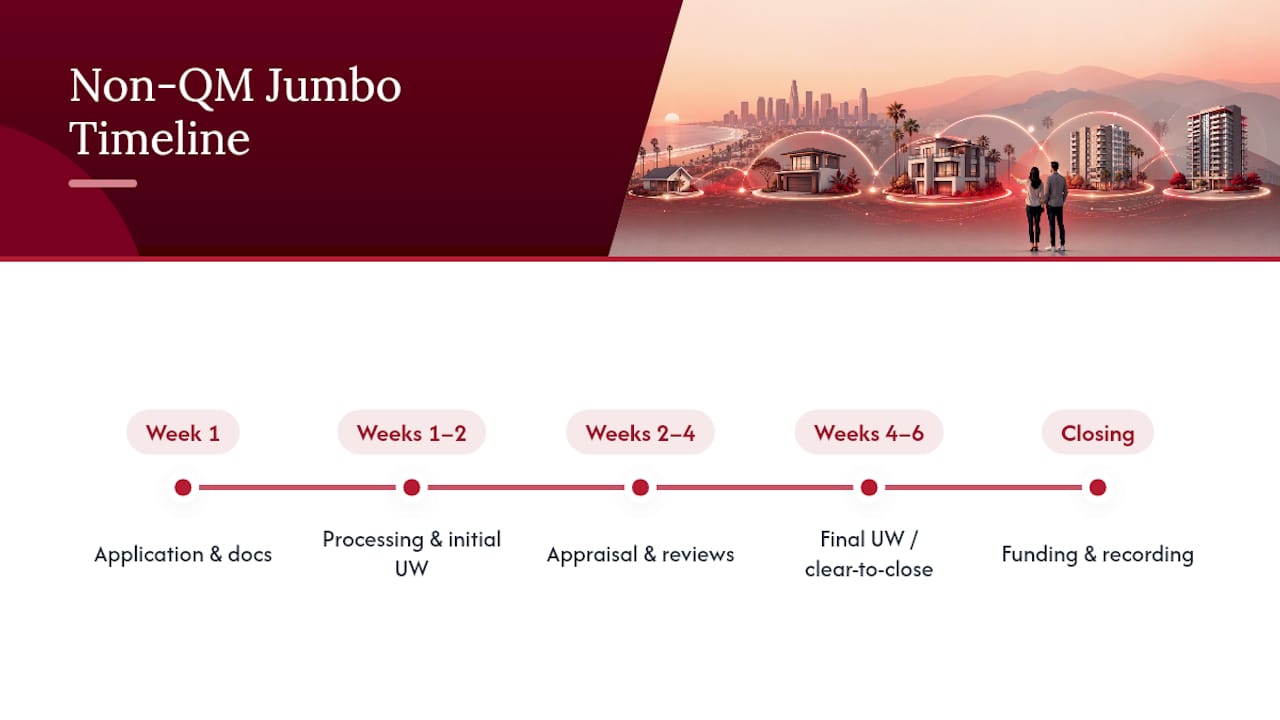
Non-QM jumbo timelines run longer than conforming loans because underwriters spend more time validating alternative income evidence, not less.
Week 1: Application and documentation. You submit bank statements, asset statements, or P&Ls alongside a standard loan application. This stage moves faster when your packet is complete on day one instead of trickling in.
Weeks 1 to 2: Processing and initial underwriting. The lender orders the appraisal, verifies assets, and runs your income calculation, whether that's a bank statement deposit average or a DSCR ratio. Expect a request for clarifying documents here almost every time.
Weeks 2 to 4: Appraisal and underwriting conditions. Jumbo properties, especially luxury homes with unique features or limited comparable sales, sometimes need a second appraisal opinion. This is the stage most likely to stretch the timeline past the original estimate.
Weeks 4 to 6: Final underwriting and clear to close. Once conditions are satisfied, the file goes to final underwriting for a clear-to-close decision. Reserve verification usually happens again right before this stage, since account balances can shift over a multi-week process.
Closing: funding and recording typically follow within days of clear-to-close. Total time from application to keys in hand commonly runs 30 to 45 days, longer for unusual properties or files needing multiple appraisal reviews.
Regulatory Shifts Worth Watching
The CFPB's ability-to-pay framework has stayed the anchor for QM status for over a decade, and non-QM lending exists precisely because that framework doesn't fit every legitimate borrower. Any future tightening of QM's debt-to-income caps or documentation standards would likely push more borrowers, not fewer, toward non-QM programs rather than shrinking the market.
Conforming loan limits also move annually with home price data, and each increase from the FHFA quietly shrinks the pool of loans that need non-QM jumbo treatment in lower-cost markets, while high-cost Southern California counties stay largely unaffected. Watch for state-level licensing changes too. Non-QM lenders operate under varying state oversight, and a lender licensed and verifiable through NMLS Consumer Access today should stay that way through your entire loan term, but it's worth a second check before you sign anything.
An Editorial Take on Non-QM Jumbo Lending in Southern California
The conventional advice on non-QM jumbo loans treats it like a last resort for borrowers who "can't qualify" any other way. That framing misses the point entirely. For a lot of self-employed buyers and investors in this market, non-QM isn't a fallback, it's the more accurate way to underwrite someone whose tax strategy and actual cash flow have almost nothing to do with each other.
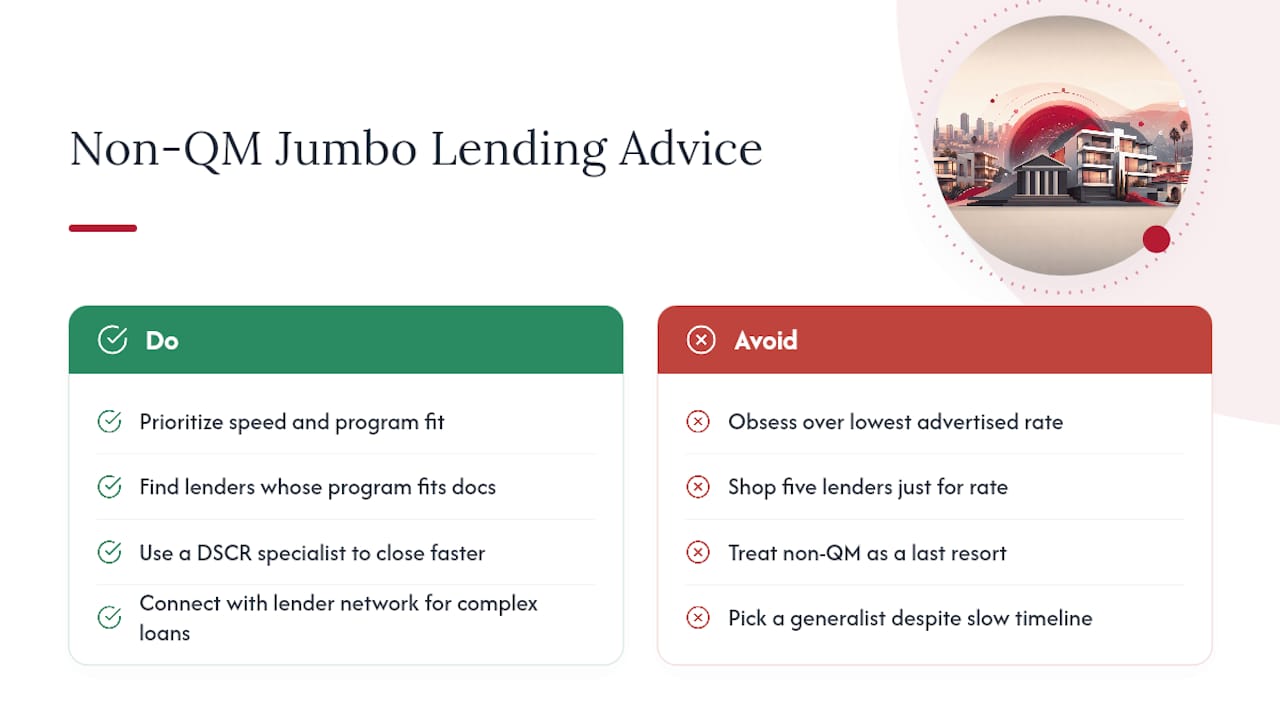
Where most guidance falls short is rate obsession. Shopping five lenders for the lowest advertised rate on a non-QM file wastes time that should go toward finding a lender whose program box actually fits your specific documentation. A DSCR specialist who closes in three weeks beats a generalist quoting a slightly better rate but taking six weeks to figure out your file doesn't fit their standard underwriting.
Prioritize speed and program fit first. Rate is real, but it's the second question, not the first.
— Stu Harvey
Ready to put this financing knowledge to work on an actual property? Browse a current luxury home search to see what's available across Southern California, and connect with a lender network built for exactly this kind of complex, high-balance financing.
This article is general information, not a substitute for advice from a qualified financial advisor. Consult a qualified financial professional about your own circumstances before acting on anything here.
Sources
- FHFA — Conforming loan limits
- CFPB — What is a Qualified Mortgage?
- The Mortgage Reports — jumbo loan funding and program notes