
A 1031 exchange lets a U.S. investor defer federal capital gains tax by swapping investment real estate for like-kind property, but the tax break only holds if you meet two absolute deadlines: identify replacement property within 45 days and close within 180. Miss either one, or acquire property that fails the like-kind test, and the IRS treats the sale as fully taxable, reportable on Form 8824.
TL;DR:
- The 45-day identification and 180-day closing deadlines for a 1031 exchange are absolute, with no exceptions except in disaster declarations.
- Proper property identification must be submitted in writing to a party involved in the exchange, using specific rules like the three-property, 200%, or 95% method.
- Like-kind real estate includes various real properties used for investment or business, but primary residences, inventory, and foreign properties do not qualify.
- Strategies such as simultaneous, deferred, reverse, or DST exchanges fit different investor needs, with deferred exchanges being most common and DSTs offering a passive option.
- Receiving cash or non-like-kind value (boot) triggers taxable gain, and involving relatives or related parties complicates the deferral unless strict holding requirements are met.
Table of Contents
- What Are the 1031 Exchange Rules Under Federal Law?
- How Strict Are the 45-Day and 180-Day Deadlines?
- What Property Qualifies as Like-Kind Real Estate?
- Simultaneous, Deferred, Reverse, or DST: Which Structure Fits?
- What Happens Tax-Wise If You Receive Cash or Extra Value (Boot)?
- Can You Exchange Property With a Relative or Business Partner?
- What's the Step-by-Step Compliance Checklist?
- Stu Harvey Estates: What California Investors Should Watch For
- Where to Verify These Rules Yourself
- Why the Deadline Panic Misses the Real Risk
- Sources
What Are the 1031 Exchange Rules Under Federal Law?
The legal foundation sits in 26 U.S.C. § 1031, which allows an investor to defer recognition of gain when exchanging real property held for productive use in a trade or business, or for investment, for other real property of like kind. That deferral is not a tax break Congress designed as a loophole. It's a deliberate policy choice: if you're rolling equity from one investment property into another without pulling cash out, the theory goes, you haven't really realized a gain yet.
Since the Tax Cuts and Jobs Act took effect for exchanges completed after December 31, 2017, Section 1031 applies exclusively to real property. Personal property exchanges, once common for equipment, vehicles, and franchise rights, no longer qualify at all. The IRS defines real property broadly under current regulations, covering land, buildings, and permanently affixed structural components, but the boundary matters because misclassifying an asset can unravel an otherwise clean exchange.
Eligible taxpayers include individuals, partnerships, LLCs, corporations, and trusts, as long as the underlying property meets the holding requirement. What's excluded is just as important: primary residences, property held primarily for sale (inventory, like a fix-and-flip project), stocks, bonds, partnership interests, and most other securities. The IRS's own guidance on like-kind exchanges confirms that gain deferred under Section 1031 is deferred, not forgiven. That distinction drives every other rule in this guide.
How Strict Are the 45-Day and 180-Day Deadlines?
There's no flexibility here, and that surprises people who assume tax rules always have some wiggle room. You have exactly 45 calendar days from the closing of your relinquished property to identify replacement property in writing, and exactly 180 calendar days (or the due date of your tax return, including extensions, if earlier) to close on it. Both clocks start on the same day, the day title transfers on the property you sold, and they run concurrently, not sequentially.
Statistic Callout: The 45-day and 180-day windows are absolute under 26 U.S.C. § 1031, with the only recognized exception being extensions granted for presidentially declared disasters. There's no case-by-case leniency for a slow lender or a delayed inspection.
Identification has to be delivered in writing to a party involved in the exchange, typically your qualified intermediary, not just mentioned to your real estate agent or attorney over the phone. Verbal identification, or identification that only reaches your own counsel, generally doesn't satisfy the requirement.
Three identification methods govern how many properties you can name:
- Three-property rule: Identify up to three properties of any value; you can close on any or all of them.
- 200% rule: Identify more than three properties, as long as their combined fair market value doesn't exceed 200% of what you sold.
- 95% rule: Identify any number of properties regardless of value, but you must actually acquire at least 95% of their total identified value.
Most investors use the three-property rule because it's the simplest to document cleanly.
What Property Qualifies as Like-Kind Real Estate?
Like-kind for real estate is a nature-and-character test, not a "must look similar" test. A rental duplex can exchange for raw vacant land, an office building can exchange for an apartment complex, and a triple-net retail property can exchange for a multifamily building. All U.S. real property is generally considered like-kind to other U.S. real property held for investment or business use.
A few edge cases trip people up:
- Leaseholds with a long remaining term including renewal options are treated as real property eligible for exchange.
- Cooperative housing interests can qualify in certain structures, but the analysis is fact-specific and worth confirming with counsel before you rely on it.
- Incidental personal property, such as furnishings included with a rental sale, is generally disregarded if its value stays within a small percentage of the total transaction, under 2020 regulations that tightened the definition of real property.
What doesn't qualify: primary residences, fix-and-sell inventory, and foreign real estate. A property in Mexico or Portugal cannot exchange for one in California. The IRS treats U.S. real property and foreign real property as separate classes entirely, and that line has no exceptions.
Simultaneous, Deferred, Reverse, or DST: Which Structure Fits?
Four structures cover almost every real-world exchange:
- Simultaneous exchange. The sale of the relinquished property and the purchase of the replacement property close on the same day. Rare today, mostly because coordinating two closings simultaneously is logistically brutal.
- Deferred exchange. The most common structure. A qualified intermediary holds the sale proceeds so you never take constructive receipt of the cash, which is what preserves the deferral while you shop for replacement property inside the 45/180 window.
- Reverse exchange. You acquire the replacement property first, using an exchange accommodation titleholder to "park" title, then sell the relinquished property within 180 days. Useful in competitive markets where waiting to sell first risks losing the property you want.
- Delaware Statutory Trust (DST). A passive, fractional ownership vehicle often used as a backup replacement option when direct property identification looks risky against the 45-day clock, according to the National Association of Realtors.
Pro Tip: If you're nervous about finding a suitable replacement property in time, identify a DST alongside your primary target on day one. It costs nothing to name it and gives you a fallback if your first choice falls through in escrow.
Each structure trades convenience for control. A deferred exchange with a qualified intermediary is straightforward but requires disciplined timing. A DST hands off management entirely, which some investors want and others find frustrating if they like being hands-on with their properties.
What Happens Tax-Wise If You Receive Cash or Extra Value (Boot)?
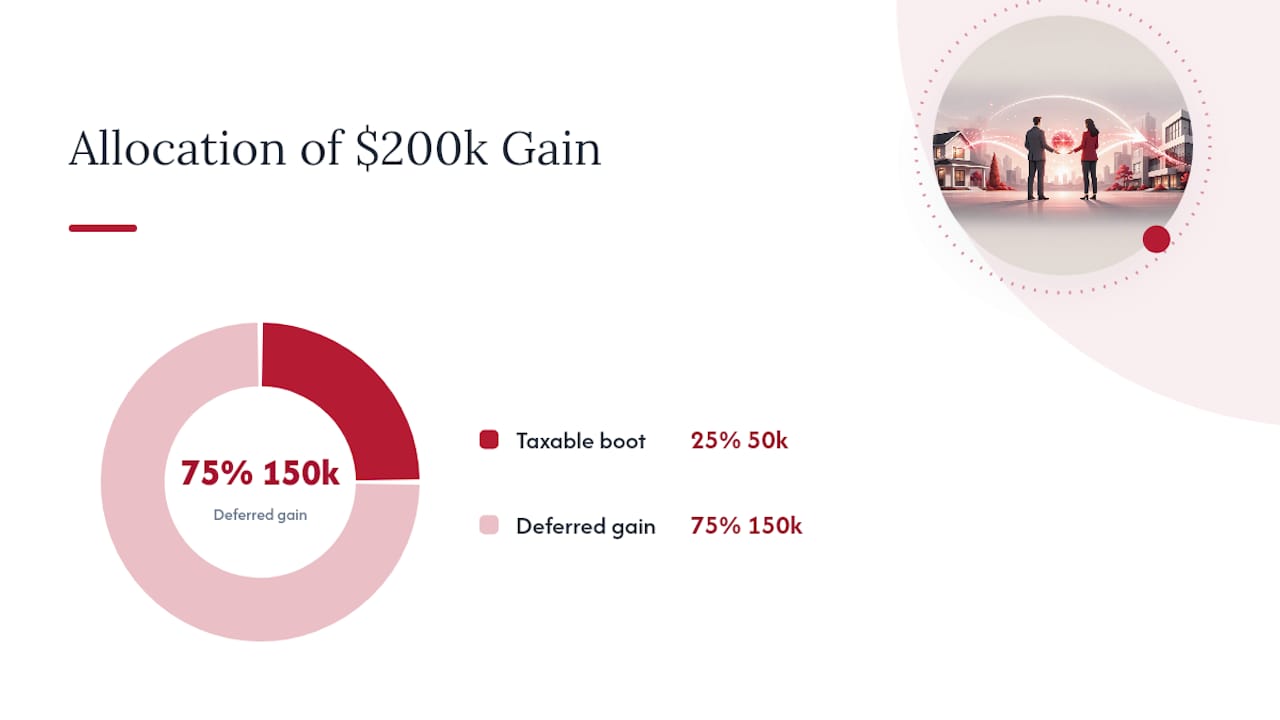
Boot is any value you receive in the exchange that isn't like-kind real property, cash, debt relief, or non-qualifying property mixed into the deal. The IRS fact sheet on like-kind exchanges makes clear that boot triggers gain recognition up to the amount of boot received, even if the rest of the exchange qualifies for deferral.
Your basis in the new property carries over from the old one, adjusted for any boot recognized and any additional cash you put in, which is explained in detail in US Rental Owners: Tax on a Sale, Forms, and a Detroit Cash Option. That carryover is exactly why "deferred" doesn't mean "gone." Sell the replacement property outright someday without another exchange, and the original deferred gain comes due along with whatever appreciation happened since.
Statistic Callout: Say you sell a property with a $200,000 gain and buy a replacement worth $50,000 less, taking that $50,000 difference out in cash. That $50,000 is boot, taxable immediately, while the remaining $150,000 stays deferred. According to Thomson Reuters tax guidance, several states also apply their own clawback provisions that recapture deferred gain differently than federal rules do, so state tax exposure needs separate analysis.
Can You Exchange Property With a Relative or Business Partner?
Section 1031(f) restricts exchanges between related parties, generally family members and entities under common control, with a two-year holding requirement that follows the exchange. Both parties typically must hold their respective properties for at least two years after the exchange, or the deferred gain gets recaptured retroactively.
The IRS scrutinizes related-party exchanges closely because they're a common vehicle for basis-shifting schemes designed to cash out appreciated property without triggering tax. Red flags include a related party disposing of the received property shortly after the exchange, or structures that look designed purely to shift basis rather than facilitate a genuine investment transaction.
If a related party is involved anywhere in your exchange, whether as buyer, seller, or intermediary, loop in a real estate attorney before you sign anything. The American Bar Association's overview treats this as one of the areas where DIY exchanges most often go wrong.
What's the Step-by-Step Compliance Checklist?
- Engage a qualified intermediary before you close on the relinquished property. Once you touch the sale proceeds, the exchange is dead.
- Deliver written identification within 45 days, to your QI or another party to the exchange, following the three-property, 200%, or 95% rule.
- Close on the replacement property within 180 days, tracking any boot received and how it affects your basis.
- File Form 8824 with your tax return for the year of the exchange, disclosing dates, property descriptions, and adjusted basis calculations, per the IRS's Form 8824 instructions.
- Keep every closing statement, identification letter, and QI agreement in one file. If the IRS questions the exchange years later, you'll need to reconstruct the timeline fast.
Pro Tip: Loop in your CPA before you list the relinquished property, not after you've accepted an offer. Basis tracking and boot calculations are far easier to plan for in advance than to fix retroactively.
Stu Harvey Estates: What California Investors Should Watch For
A seasoned luxury real estate agent has closed hundreds of transactions across Southern California, with career sales volume in the billions. That volume includes a number of 1031 exchanges involving high-value coastal properties in Southern California.
California generally conforms to federal 1031 treatment, but the state has specific reporting requirements when California property is exchanged into an out-of-state replacement, and clawback provisions can apply down the line. In luxury transactions, the bigger practical risk is usually escrow coordination: high loan payoffs, private lender timing, and QI custody transfers all have to line up inside that 180-day window, which leaves very little room for the kind of delays that don't matter in a lower-dollar deal.
Where to Verify These Rules Yourself
Don't take any secondhand summary, including this one, as the final word on your specific situation. Start with 26 U.S.C. § 1031 for the statutory text itself, then read the IRS's own like-kind exchange guidance for plain-language explanation.
For the mechanics of filing, the Form 8824 instructions spell out exactly what the IRS expects on your return. The American Bar Association's exchange overview covers structural nuance well, and Thomson Reuters' tax guidance is a solid summary for state conformity questions. Treat the statute as the rule, the IRS pages as the practical explanation, and the filing instructions as your checklist.
Why the Deadline Panic Misses the Real Risk
Most articles on this topic obsess over the 45 and 180-day clocks, and for good reason, they're unforgiving. But the bigger risk I see in practice isn't the calendar. It's investors who treat a 1031 exchange as a pure tax play and skip the underwriting on the replacement property itself.
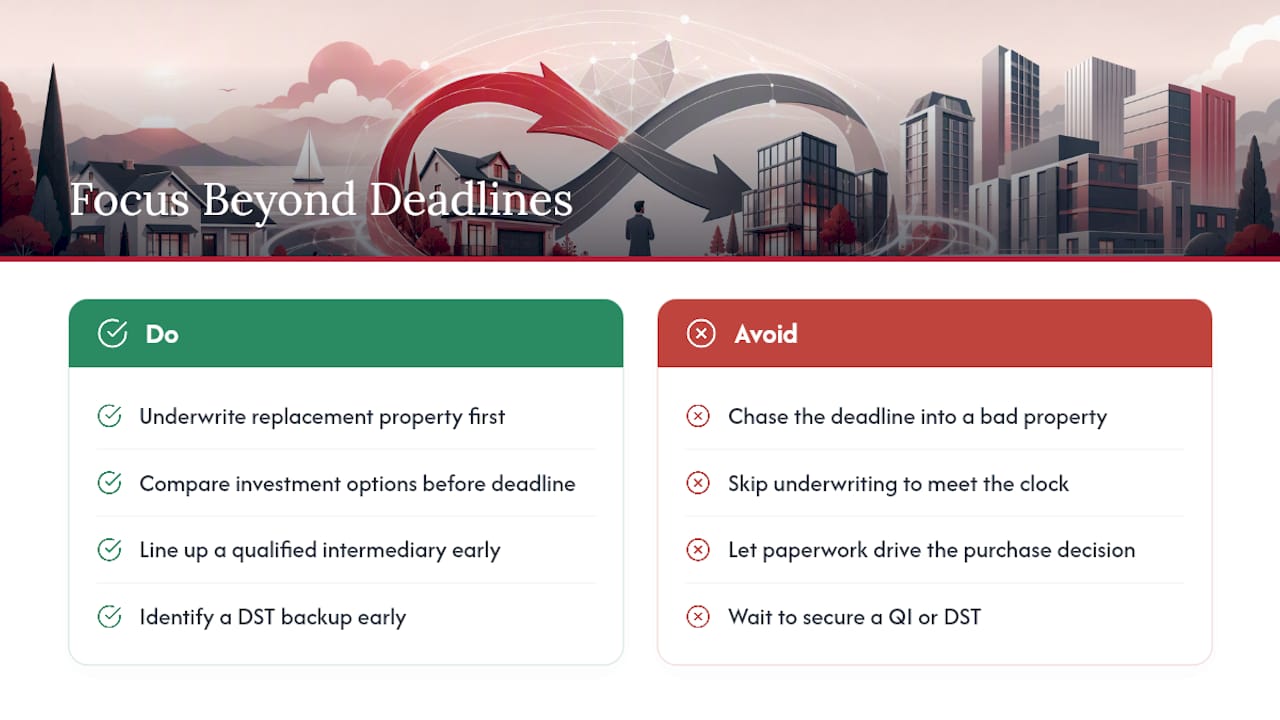
I've watched clients chase a deadline into a property they wouldn't have bought under normal circumstances, just to avoid a tax bill. That's backwards. A property that's a mediocre long-term hold doesn't become a good investment because it saved you money on gains you'd have paid anyway eventually, since the tax is deferred, not eliminated.
If you're weighing a luxury investment property against a straight residential purchase, do that analysis before you're under deadline pressure. Line up your qualified intermediary and identify a DST as backup early. The paperwork matters, but it should never be the reason you buy the wrong property.
— Stu Harvey
If you're identifying replacement property against a 45-day clock right now, browse current San Diego and Southern California listings or connect with Stu Harvey's team to coordinate the search, escrow timing, and closing logistics that make a 1031 exchange work under real deadline pressure.
This article is general information, not a substitute for advice from a qualified financial advisor. Consult a qualified financial professional about your own circumstances before acting on anything here.
Sources
- 26 U.S.C. § 1031 - Exchange of real property held for productive use or investment
- Like-kind exchanges - Real estate tax tips (IRS)
- Exchanges Under Code Section 1031 (American Bar Association)
- 1031 exchange rules: Overview and FAQ | Thomson Reuters