
A discretionary luxury home purchase is a real estate transaction where an affluent buyer acquires a high-end property based on strategic preference, investment goals, and lifestyle choice rather than immediate necessity. This category of buying sits at the intersection of wealth management and personal vision. Unlike a conventional home purchase driven by shelter needs or life-stage pressures, the discretionary luxury buyer controls the timing, terms, and purpose of the acquisition. Understanding what is discretionary luxury home purchase means recognizing that the decision is always optional, always deliberate, and almost always tied to a larger financial picture. Stu Harvey Estates works exclusively in this space across Southern California markets including La Jolla, Newport Beach, and the Hollywood Hills.
What is a discretionary luxury home purchase?
A discretionary luxury home purchase is defined as the voluntary acquisition of a premium property by a buyer who has the financial means to proceed without urgency. The industry term for this category is "discretionary real estate acquisition," and it stands apart from necessity-driven buying in three clear ways: the buyer chooses when to act, why to act, and at what price point to engage.
Luxury real estate is defined by price percentiles rather than a fixed dollar amount. Entry-level luxury generally begins at the top 10% of homes by price in a given regional market. That threshold shifts dramatically by geography. A $2 million home qualifies as luxury in most of San Diego. In Beverly Hills, it barely clears the starting line.
The discretionary element adds another layer. These buyers are not rate-sensitive in the way traditional buyers are. Approximately 35% of luxury home purchases in 2026 are all-cash transactions. That figure tells you something important: a large share of this market operates entirely outside the mortgage system, which means interest rate cycles have limited influence on their decision to buy.
How discretionary spending shapes luxury home purchases today
The luxury real estate market is recalibrating. Buyers who once chased square footage and trophy amenities are now focused on long-term value, tax positioning, and estate planning. 96% of luxury home agents report that buyers are using cash purchases to hedge against market volatility, shifting toward what the industry calls "smart luxury." That shift is not cosmetic. It reflects a fundamental change in how high-net-worth individuals think about real estate as an asset class.

Renovation behavior confirms this trend. The top 10% of luxury renovation projects increased in cost by 7% to $150,000 or more in 2025. Buyers are spending more on targeted, high-impact upgrades rather than wholesale lifestyle overhauls. That pattern signals confidence in the underlying asset even when broader consumer sentiment is cautious.
Key patterns defining discretionary luxury spending in 2026:
- All-cash dominance: Buyers use cash to sidestep rate volatility and close faster with fewer contingencies.
- Tax and estate alignment: Acquisitions are structured around wealth transfer goals, not just personal use.
- Selective renovation: Spending focuses on architectural integrity and systems upgrades rather than flashy additions.
- Patience as strategy: Discretionary buyers wait for the right property rather than settling under market pressure.
Pro Tip: If you are evaluating a luxury property as part of a broader estate plan, consult a tax attorney before making an offer. The structure of the acquisition, whether personal, through an LLC, or via a trust, can significantly affect your long-term tax position.
What defines luxury real estate in 2026?
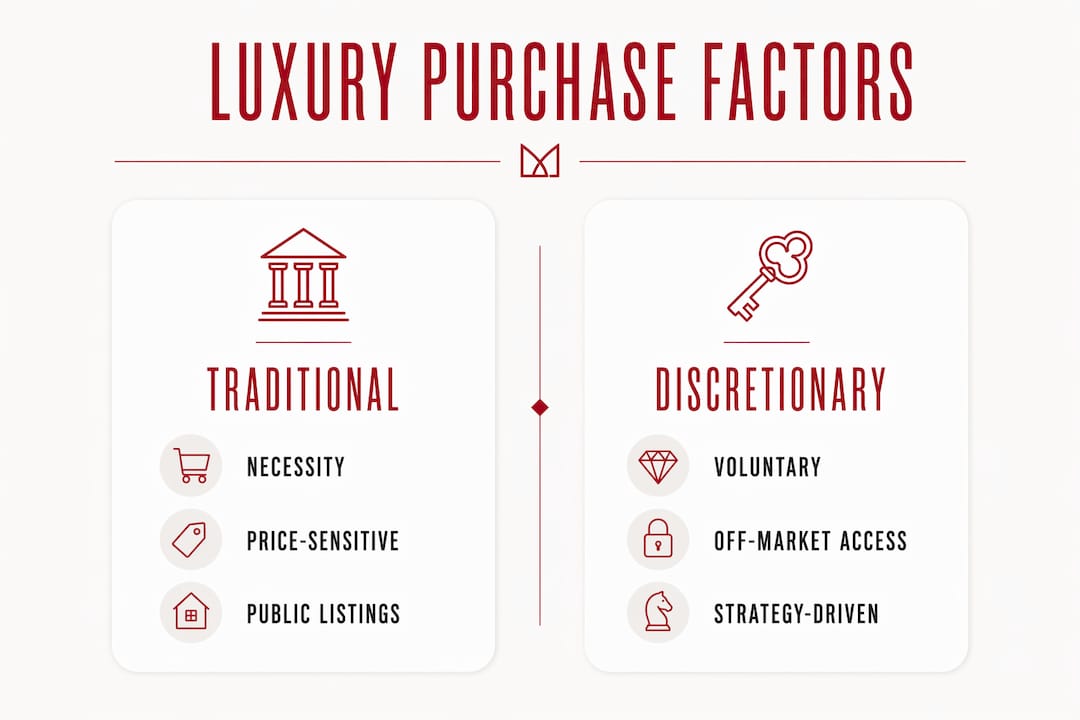
Luxury real estate is not a fixed category. Luxury is a relative market concept that varies by region, shaped by local economic engines, price percentiles, and lifestyle amenities. A property that qualifies as ultra-luxury in Phoenix may be considered mid-tier in Malibu.
The most useful framework divides the market into tiers based on price percentile and buyer profile:
| Tier | Price Range (Regional) | Buyer Profile |
|---|---|---|
| Entry luxury | Top 10% by local price | Move-up buyers, first-time luxury buyers |
| Mid luxury | Top 5% by local price | Established professionals, portfolio builders |
| Ultra luxury | Top 1% by local price | Ultra-high-net-worth, multi-property buyers |
| Trophy | Off-market, bespoke | Institutional wealth, privacy-first buyers |
What has changed most sharply in 2026 is the definition of desirability. Size and visible opulence no longer drive purchase decisions at the top of the market. Luxury buyers now prioritize privacy, control, and off-market timing over visible scale or square footage. A 6,000-square-foot compound with no public listing history and a gated, private setting outranks a 10,000-square-foot showpiece on a busy street.
Architectural integrity has replaced square footage as the primary quality signal. Buyers at the ultra-luxury level want properties that reflect genuine craftsmanship, not developer-grade finishes dressed up with high-end appliances. They also want control over information. The fewer people who know a property changed hands, the better.
"True luxury is increasingly about living exceptionally without exposure. Privacy, control over information, and off-market timing define the modern luxury experience."
Lower-tax regions attract ultra-luxury buyers specifically because lighter acquisition costs allow more capital to flow into the property itself. This geographic preference is a direct expression of discretionary thinking. The buyer is not moving for a job. The buyer is moving because the financial structure of ownership is more favorable.
How do discretionary luxury purchases differ from traditional home buying?
Traditional home buying is driven by need. A growing family needs more space. A job relocation requires a new primary residence. A lease expiration creates urgency. Discretionary luxury buying operates on none of those pressures.
The differences show up in every phase of the transaction:
| Factor | Traditional purchase | Discretionary luxury purchase |
|---|---|---|
| Motivation | Necessity or life event | Strategy, lifestyle, or investment |
| Financing | Mortgage-dependent | Frequently all-cash |
| Timeline | Urgency-driven | Buyer-controlled |
| Listing access | Public MLS | Off-market and private networks |
| Decision criteria | Price, schools, commute | Privacy, architecture, asset value |
Ultra-wealthy buyers use luxury real estate as a cornerstone asset for hedging wealth independent of market swings, typically purchasing multiple properties through all-cash strategies. This is portfolio thinking, not home buying in the traditional sense. The property is simultaneously a residence, a store of value, and a tax planning vehicle.
Off-market access is the defining operational difference. Discretionary luxury acquisitions frequently occur through private networks that emphasize relationship-driven transactions rather than public listings. A buyer who insists on searching only the public MLS will miss a significant portion of the best available inventory at the top of the market.
Pro Tip: Ask any agent you interview what percentage of their transactions in the past 12 months involved off-market properties. A specialist in discretionary luxury buying will have a meaningful answer. A generalist will not.
Strategic considerations for buying a discretionary luxury home
Buying a luxury property without a clear strategy is how buyers overpay and underperform. The following framework applies whether you are acquiring a primary residence, a second home, or an investment property.
Identify genuine luxury versus marketing hype
Not every property marketed as "luxury" qualifies. Evaluate the actual price percentile for the specific submarket, not the county or metro average. A $1.5 million home in Rancho Santa Fe competes in a very different tier than a $1.5 million home in Chula Vista. Look at land value, architectural provenance, and the quality of systems, not just surface finishes.
Align the purchase with tax and estate goals
Tax and regional costs directly influence luxury purchase strategies. Before selecting a property, determine whether the acquisition belongs in your personal name, a family trust, or an LLC. Each structure carries different implications for property tax reassessment, capital gains treatment, and estate transfer. A luxury property repositioning strategy built around tax efficiency can add meaningful value over a 10-year hold.
Access off-market inventory
The best discretionary luxury properties rarely appear on public listing platforms. Build relationships with agents who maintain active off-market networks in your target markets. Read the 2026 buyer's guide to off-market listings to understand how private sales work and what access requires.
Choose the right agent
The agent you select determines the inventory you see, the terms you negotiate, and the discretion maintained throughout the process. Criteria for evaluating a luxury buyer's agent:
- Verified transaction volume above $100 million in the relevant submarket
- Demonstrated access to off-market and pocket listings
- Experience structuring complex, multi-party closings
- A network of tax, legal, and estate planning professionals
- A track record of protecting buyer privacy throughout the transaction
Specialized agents in luxury real estate operate differently from residential generalists. The difference shows up in access, negotiation, and the quality of advice you receive before you ever make an offer.
Key Takeaways
A discretionary luxury home purchase succeeds when the buyer combines clear investment intent, off-market access, and a tax-aligned acquisition structure before making any offer.
| Point | Details |
|---|---|
| Definition is clear | A discretionary luxury purchase is voluntary, strategy-driven, and not tied to immediate necessity. |
| Cash dominates the market | Roughly 35% of luxury transactions in 2026 are all-cash, insulating buyers from rate volatility. |
| Luxury is regional | Entry luxury begins at the top 10% by local price, making submarket knowledge non-negotiable. |
| Off-market access matters | The best properties trade through private networks, not public listing platforms. |
| Tax structure shapes value | How you hold the property affects long-term returns as much as the purchase price itself. |
What I've learned about discretionary luxury buying after 250+ transactions
After more than 15 years and over $1.2 billion in luxury real estate sales across Southern California, the pattern I see most often is this: buyers who treat a luxury property purely as a lifestyle purchase leave money on the table. Buyers who treat it purely as a financial instrument miss properties that would have genuinely served them.
The best outcomes come from buyers who hold both goals simultaneously. They want a property that fits their life and builds their wealth. Those two things are not in conflict, but they require different questions during the evaluation process.
The shift toward "smart luxury" is real, and I have watched it accelerate over the past two years. Buyers who once led with aesthetics now open with questions about tax basis, HOA structure, and resale liquidity. That is a healthy development. It means the market is maturing.
The caution I offer most often is this: do not let the pursuit of discretion become an excuse for skipping due diligence. Off-market does not mean off-scrutiny. Some of the most problematic transactions I have seen involved buyers who moved quickly on a private deal because they trusted the relationship. Trust the relationship and verify everything independently.
The buyers who build lasting wealth through real estate are the ones who build a luxury portfolio with patience, clear criteria, and the right team around them.
— Stu Harvey
Stu Harvey Estates: curated listings for serious luxury buyers
Stu Harvey Estates serves buyers who know what they want and need an agent with the access and experience to find it.
Whether you are searching for a primary residence in La Jolla, a second home in Newport Beach, or a portfolio addition in the Hollywood Hills, Stu Harvey brings over 15 years of specialized expertise and a private network built through more than 250 closed luxury transactions. Browse current luxury listings across San Diego, Los Angeles, and Orange County, including properties that never reach the public market. Every search begins with a direct conversation about your goals, your timeline, and the acquisition structure that serves you best.
FAQ
What is a discretionary luxury home purchase?
A discretionary luxury home purchase is a voluntary acquisition of a premium property by a buyer who has the financial means to act without urgency, driven by investment strategy, lifestyle preference, or wealth management goals rather than necessity.
How much does a luxury home cost to qualify as luxury?
Luxury real estate is defined by price percentile rather than a fixed number. Entry-level luxury generally begins at the top 10% of homes by price in a given regional market, which means the threshold varies significantly by location.
Why do luxury buyers prefer all-cash transactions?
All-cash purchases insulate buyers from interest rate volatility and allow faster, cleaner closings. Roughly 35% of luxury home purchases in 2026 are all-cash, reflecting a broader shift toward using real estate as a wealth-hedging tool.
What is an off-market luxury property?
An off-market property is one sold through private networks without a public listing. Many discretionary luxury buyers prefer this approach because it protects their privacy and gives them access to inventory that never appears on public platforms.
How do I find a qualified luxury buyer's agent?
Look for an agent with verified transaction volume in your target submarket, demonstrated access to off-market inventory, and experience with complex closings. Specialized luxury agents operate differently from residential generalists and deliver measurably better access and outcomes.