
Escrow is the secure, step-by-step system that guarantees you receive payment only after every agreed condition is met and property ownership transfers legally. As a seller, you hand your deed to a neutral third party, not to the buyer directly, and that party releases it only when verified funds are in hand. That single mechanism is what separates a protected sale from a handshake deal gone wrong.
Here is what the escrow closing process delivers for you as a seller:
- Fraud protection: The escrow holder holds the buyer's earnest money deposit, signed documents, and lender funds in a separate account until all conditions are satisfied.
- Secure net proceeds: Your mortgage payoff, liens, and closing costs are settled before the remaining balance is wired to you, usually the same day or the next business day.
- Legal title transfer: The deed is recorded with the county only after funding is confirmed, making the transfer official and public.
- Contingency enforcement: Inspections, appraisals, and financing approvals all clear through escrow before you give up possession.
One clarification worth making early: the escrow you deal with as a seller is the transactional closing escrow, a neutral third party managing funds and documents during the sale. It is not the same as a mortgage escrow account, which is the buyer's monthly fund for taxes and insurance. The two are entirely separate, and only the closing escrow is your concern.
Table of Contents
- How the escrow closing process works for sellers from day one
- Step-by-step timeline of the escrow closing process
- What to expect on closing day
- Seller closing costs and how to manage them
- How the escrow officer's neutral role protects you from fraud
- Stu Harvey Estates guides Southern California sellers through every stage of escrow
- Key Takeaways
How the escrow closing process works for sellers from day one
Escrow opens the moment a fully executed purchase agreement and the buyer's earnest money are delivered to the escrow holder. The escrow officer assigns the file a number, confirms the terms, and begins a checklist of everything that must happen before closing. Your agent typically handles the delivery, but you should confirm it happened and note your escrow number for every future call.
From that point, your responsibilities as a seller are more active than most people expect:
- Sign escrow instructions promptly. These written instructions are the escrow officer's legal authority to act. Without your signature, nothing moves.
- Provide complete disclosures. Property condition reports, lead paint disclosures, HOA documents, and any known material defects must be delivered on time.
- Supply your mortgage payoff statement. Your lender issues this figure, and the escrow officer needs it to calculate your net proceeds accurately.
- Respond to repair requests in writing. Any agreed credits or repairs must be documented through escrow so both sides have a clear record.
- Grant property access. Inspectors, appraisers, and the buyer's final walkthrough all require your cooperation on scheduling.
- Review every document before signing. Errors in the settlement statement or escrow instructions can cost you money if caught late.
Pro Tip: Keep a dedicated folder, physical or digital, for every escrow document you receive. Escrow officers work on tight deadlines, and a seller who can produce a requested document in minutes rather than days keeps the closing on schedule.
Communication is the part sellers most often underestimate. Your escrow officer is a neutral facilitator, not your advocate, so they will not chase you for missing items. Staying in regular contact with both your agent and the escrow officer is how you catch problems before they become delays.

Step-by-step timeline of the escrow closing process
A financed sale typically runs 30–45 days from accepted offer to closing. Cash deals can close faster. The exact length depends on the buyer's lender, the complexity of title issues, and how quickly both sides respond to requests. For California sellers, timing in the Southern California market can also affect how competitive your closing window needs to be.
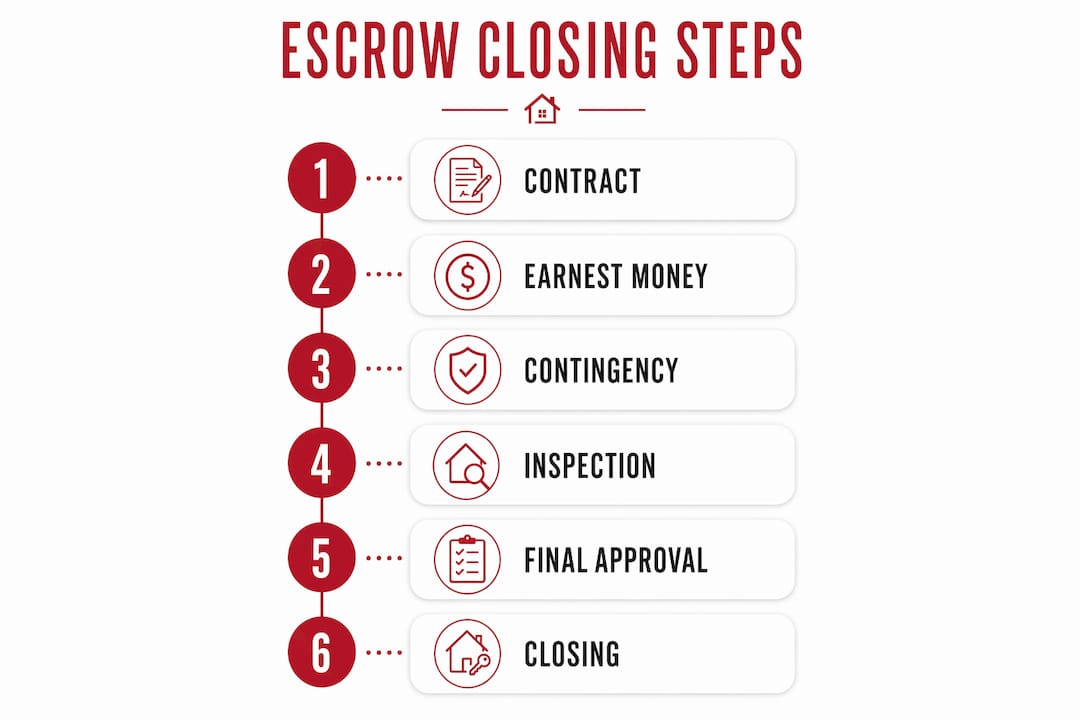
| Stage | What happens | Typical timing |
|---|---|---|
| Escrow opens | Signed contract and earnest money delivered; file opened; instructions drafted | — |
| Title search | Public records reviewed for liens, judgments, and ownership gaps | — |
| Seller disclosures delivered | Property condition reports, HOA docs, and required disclosures submitted | — |
| Inspections and appraisal | Buyer's inspector and lender's appraiser visit the property | — |
| Contingency clearance | Inspection, appraisal, and financing contingencies removed one by one | 30–45 days |
| Repair completion | Any agreed repairs finished; receipts provided to escrow | Before final walkthrough |
| Final walkthrough | Buyer confirms property condition matches contract terms | before closing |
| Document signing | Seller signs grant deed, settlement statement, and other closing docs | Closing day or just before |
| Funding | Buyer's lender wires loan funds; buyer sends remaining balance | Closing day |
| Recording | Deed and mortgage recorded with the county recorder | Closing day |
| Disbursement | Mortgage payoff, liens, and costs settled; net proceeds wired to seller | Same day or next business day |
Watch the contingency deadlines closely. Missed deadlines are where sales most often stall, and the escrow officer will not remind you of dates that are written into the purchase agreement rather than the escrow instructions.
What to expect on closing day
Closing day is mostly paperwork and confirmation, but the details matter. Sellers sign the grant deed and the settlement statement, among other documents, and the escrow officer coordinates the final sequence of funding and recording.
Here is what you should be ready for:
- Government-issued ID. Every signing requires it, no exceptions.
- Grant deed review. Confirm your name, the buyer's name, and the legal property description are all correct before you sign.
- Settlement statement review. This document lists every debit and credit in the transaction. Verify your mortgage payoff figure, commission amounts, escrow fees, and any prorations for property taxes.
- Repair receipts. If you agreed to repairs during escrow, bring documentation. The escrow officer may need proof before releasing funds.
- Key handover. Keys, garage openers, and any access codes transfer to the buyer only after the escrow officer confirms funding is complete.
- Wire confirmation. Your net proceeds typically arrive by wire the same day or the next business day after recording. Confirm your bank details with the escrow officer well before closing day.
Signing can happen at the escrow office, a title company, an attorney's office, or remotely with a notary, depending on your state. In California, most closings run through a licensed escrow company or title company. If anything on the settlement statement looks unfamiliar, ask before you sign. Correcting an error after recording is far more complicated than catching it at the table.
Seller closing costs and how to manage them

Your net proceeds are what remains after the escrow officer settles every charge against your sale. Seller closing costs typically include agent commissions, your existing mortgage payoff, escrow fees, prorated property taxes, transfer taxes, and any outstanding liens. All of these are deducted from the sale price before you see a dollar.
A few practical ways to stay on top of costs:
- Request a preliminary net sheet early. Before escrow even opens, ask your agent to estimate your net proceeds based on the offer price and expected costs. It will not be exact, but it prevents surprises.
- Read the settlement statement line by line. Every charge should match what was agreed in the purchase contract or disclosed in the escrow instructions. Question anything that does not.
- Negotiate who pays which fees upfront. Escrow fees, transfer taxes, and home warranty costs are often negotiable in the purchase agreement. What you agree to in the contract is what shows up on the settlement statement.
- Clear liens before closing. If a title search surfaces an old lien or judgment, work with your escrow officer to resolve it quickly. Unresolved liens can delay or kill a closing.
- Keep receipts for agreed repairs. Credits or repairs negotiated during escrow affect your final numbers. Document everything so the settlement statement reflects the actual agreement.
The settlement statement is your financial record of the entire transaction. Keep a copy after closing. You will need it for tax purposes, particularly for calculating capital gains on the sale.
How the escrow officer's neutral role protects you from fraud
The escrow officer is not on your side. They are not on the buyer's side either. That neutrality is precisely what makes escrow work. Per California Department of Real Estate guidance, the escrow officer acts only on written, signed instructions from both parties. They cannot release funds, record the deed, or take any action unless both sides have authorized it in writing.
That structure protects you in concrete ways. The escrow holder secures the buyer's earnest money and lender funds in a separate account, so you are never relying on the buyer's promise alone. The title search surfaces any claims against the property before you transfer ownership. If a lien appears, it gets paid from your proceeds at disbursement rather than becoming the buyer's problem after the fact. And the deed is not recorded until funding is confirmed, so you cannot lose your property without receiving payment.
A common misconception is that escrow only benefits buyers. Sellers rely on it just as much, because it confirms the buyer's funds are real and conditions are met before the title changes hands.
Pro Tip: When choosing an escrow company, look for one licensed in your state with a track record in your property type. In California, escrow companies are licensed by the Department of Financial Protection and Innovation. A reputable provider with experience in home closing procedures will flag issues before they become closing delays.
One more distinction worth knowing: the closing escrow described throughout this article is entirely separate from a mortgage escrow account. The mortgage escrow is the buyer's ongoing account for paying property taxes and homeowners insurance after closing. As a seller, it has no bearing on your transaction.
Stu Harvey Estates guides Southern California sellers through every stage of escrow
Selling a luxury home in San Diego, Los Angeles, Orange County, or anywhere across Southern California means navigating an escrow process where the stakes are high and the details are unforgiving. Stu Harvey Estates offers sellers something most agents cannot: more than 15 years of experience, over 250 closed luxury transactions, and a sales volume exceeding $1.2 billion, all focused on markets like La Jolla, Rancho Santa Fe, Newport Beach, and the Hollywood Hills.

The difference with Stu Harvey is that you get direct access to a Senior Agent at The Oppenheim Group who knows exactly which escrow issues surface in Southern California transactions and how to resolve them before they cost you time or money. From reviewing your settlement statement to coordinating with escrow officers on your behalf, the guidance is specific to your property and your timeline, not generic advice that applies to any seller anywhere. If you are preparing to sell and want to know what your home is worth and what your net proceeds will look like, explore current listings or reach out directly to start with a clear picture of your position.
Key Takeaways
The escrow closing process protects sellers by holding all funds and documents with a neutral third party until every contractual condition is met and payment is fully secured.
| Point | Details |
|---|---|
| Escrow opens at contract signing | The process starts when the signed purchase agreement and earnest money reach the escrow holder. |
| Typical timeline is several weeks | Financed sales usually take several weeks; cash deals close faster depending on contingencies. |
| Seller signs grant deed and settlement statement | These are the two most critical closing documents; review every line before signing. |
| Closing costs reduce your net proceeds | Commissions, mortgage payoff, escrow fees, and liens are all deducted before disbursement. |
| Stu Harvey Estates guides sellers through closing | With extensive experience and a significant sales volume, Stu Harvey Estates provides hands-on escrow guidance for Southern California sellers. |