A private road maintenance agreement is a written, recorded contract that spells out who pays for road repairs, who manages the work, and what happens in an emergency. Without one, you're relying on state statute or informal handshake deals, both of which tend to fall apart the moment a neighbor refuses to pay for a $40,000 repave. If you own property on a private road, or you're buying one, the next move is simple: find any existing recorded agreement, pull a municipal sample as a starting point if none exists, and get a local real estate attorney to review it before you sign anything.
TL;DR:
- A private road maintenance agreement is essential for roads serving multiple owners to specify payment responsibilities, management roles, and emergency procedures.
- Recording the agreement with the county makes it binding on future landowners and lenders, preventing disputes over obligations and enforcement.
- Owners typically choose cost-sharing methods based on parcel frontage, usage, or equal division, each affecting fairness and annual costs.
- An emergency repair clause with a dollar cap allows immediate action without a formal vote but requires post-incident documentation and notification.
- Local legal review remains crucial to ensure compliance with regional laws, easement scope, and lender requirements, avoiding costly disputes or overlooked liabilities.
Table of Contents
- What a Private Road Maintenance Agreement Covers and When You Need One
- Core Elements Every Private Roadway Upkeep Contract Should Include
- How Cost-Sharing Formulas and Funding Typically Work
- Recording the Agreement and Making It Stick
- Emergency Repairs and Who Can Act Without a Vote
- State Statutes and Lender Rules Buyers and Sellers Need to Check
- Templates and a Quick Drafting Checklist
- Why Local Legal Review Still Matters Before You Sign
- A Broker's Take on Private Road Due Diligence
- Let Stu Harvey Estates Handle the Fine Print
- Sources
- FAQ
What a Private Road Maintenance Agreement Covers and When You Need One
A private road maintenance agreement governs any road that isn't dedicated to and accepted by a city or county, which means shared driveways, gated subdivisions, and rural lanes serving three or four homes. You need a recorded agreement whenever more than one owner depends on the same private roadway and no municipality is on the hook for plowing, grading, or repairs.
Relying on statute alone works only until a dispute arises, because most state laws set default rules rather than specific dollar amounts or maintenance schedules. Easement ownership matters here too: the parcel that holds the easement often carries different legal obligations than a neighbor who simply benefits from using the road.
- Shared driveways serving two or more separately owned lots
- Private subdivision or ranch roads with no public dedication
- Any right-of-way where usage, not deed language, determines who should pay
Core Elements Every Private Roadway Upkeep Contract Should Include
A solid agreement reads less like a handshake and more like a small corporation's bylaws. Start with recitals and a legal description, often attached as Exhibit A, that identifies the road and every parcel it serves. Name the Participating Owners specifically, and define what counts as a "parcel" so future subdivisions don't create loopholes.
Most agreements appoint a Road Commission Agent or Road Manager who collects dues, hires contractors, and calls emergency repairs. The agreement should spell out how that person is elected, removed, and what spending they can approve without a vote. Separate maintenance from capital improvements, since a pothole patch and a full repave deserve different voting thresholds.
- Recitals and Exhibit A legal description of the road and parcels
- Defined roles for the Road Manager, including election and removal procedures
- Voting rules that distinguish routine maintenance from capital projects
- Cost-sharing formula, prepayment terms, a dedicated bank account, and annual budget reporting
- A perpetual term, an amendment process, and language stating the agreement runs with the land
Pro Tip: Insist on annual financial reporting in the agreement itself. A Road Manager who never has to show a ledger is the single biggest source of private road disputes.
How Cost-Sharing Formulas and Funding Typically Work
Owners generally choose one of three allocation methods, and the choice affects fairness as much as it affects your annual bill.
- Equal share divides costs evenly per parcel, which is simple but can feel unfair if one owner drives a gravel road daily hauling equipment while another visits twice a year.
- Frontage or pro-rata allocation ties costs to how much road frontage or linear footage each parcel touches, which tends to track more closely with actual wear.
- Usage-based formulas, sometimes weighted by vehicle trips or improved-parcel counts, work well for roads serving a mix of residential lots and working farms.
Beyond the formula, the agreement needs an annual budget, a reserve fund for emergencies, and a clear invoicing schedule, often collected annually or split into quarterly installments. Delinquency provisions matter just as much: most agreements charge interest on late payments, allow the association to recover attorneys' fees, and, in persistent cases, place a lien on the delinquent parcel that can lead to foreclosure.
Recording the Agreement and Making It Stick
An unrecorded agreement is a gentleman's promise. Recording it with the county recorder or Register of Deeds, along with language stating it "runs with the land," is what binds future buyers, heirs, and lenders to the same obligations you agreed to. Skip this step and a new owner can plausibly argue they never signed anything and owe nothing.
Standard enforcement provisions give the agreement teeth: liens against unpaid assessments, recovery of attorneys' fees, and, where necessary, foreclosure on the delinquent parcel's interest in the easement.
- Record the executed agreement with the county recorder or town clerk
- Attach the legal description so title searches surface it automatically
- Include lien and foreclosure language tied to unpaid assessments
When there's no agreement at all, California Civil Code § 845 steps in as a backstop, requiring easement owners to keep the right-of-way in repair and splitting costs proportionate to use. That statute is useful protection, but as BPE Law notes, disputes without a written contract often land in court simply to determine what "proportionate use" even means for that specific road.
Emergency Repairs and Who Can Act Without a Vote
Storms don't wait for a homeowners meeting. Most agreements define an emergency narrowly, things like a collapsed culvert, washout, or downed tree blocking the only access route, and give the Road Manager authority to authorize immediate repairs up to a stated dollar cap without a formal vote.
That cap protects owners from a manager who spends freely, while still letting urgent work start the same day. After the repair, the manager typically must notify all owners in writing and document the cost against the emergency fund.
- Define "emergency" narrowly: blocked access, structural failure, safety hazard
- Set a specific dollar cap the manager can authorize alone
- Require written notice to all owners within a set number of days
- Outline how the emergency fund gets replenished through the next assessment cycle
State Statutes and Lender Rules Buyers and Sellers Need to Check
State law fills gaps differently depending on where the property sits. In California, Civil Code § 845 requires easement owners to share maintenance costs proportionate to use when no agreement exists, and it even addresses snow removal specifically. In Wisconsin, statute 710.20) requires anyone who benefits from an access easement to contribute to reasonable maintenance costs, using similar proportional logic but different procedural mechanics. Pennsylvania and Virginia have no comparable statewide statute forcing private road maintenance agreements, which means enforceability there depends almost entirely on what's actually recorded.
Underwriting adds another layer. FHA, VA, USDA, and Fannie Mae loans can require evidence of legal access and a maintenance plan before closing, so talk to your lender early rather than during the appraisal week.
- Request copies of any recorded agreement during due diligence, not after the offer is accepted
- Ask for the last two years of maintenance budgets and assessment history
- Confirm with your lender whether the loan program requires a documented maintenance plan
Templates and a Quick Drafting Checklist
You don't need to start from a blank page. The Town of Los Altos Hills publishes a sample private road maintenance agreement with recitals, a Road Commission Agent role, cost allocation language, and recording instructions built in. Dexter Township, Michigan offers a comparable sample with lien remedies spelled out, and Boulder, Utah has published similar templates for rural road associations.
Whatever template you start with, adapt it for your state's statute, then record the final version.
| Checklist item | Why it matters |
|---|---|
| Legal description / Exhibit A | Identifies the road and bound parcels precisely |
| Named Road Manager role | Assigns clear authority and accountability |
| Cost allocation formula | Prevents disputes over who owes what |
| Bank account and annual budget | Creates financial transparency |
| Emergency repair clause with cap | Balances speed and oversight |
| Amendment and recording language | Ensures the agreement binds future owners |
Why Local Legal Review Still Matters Before You Sign
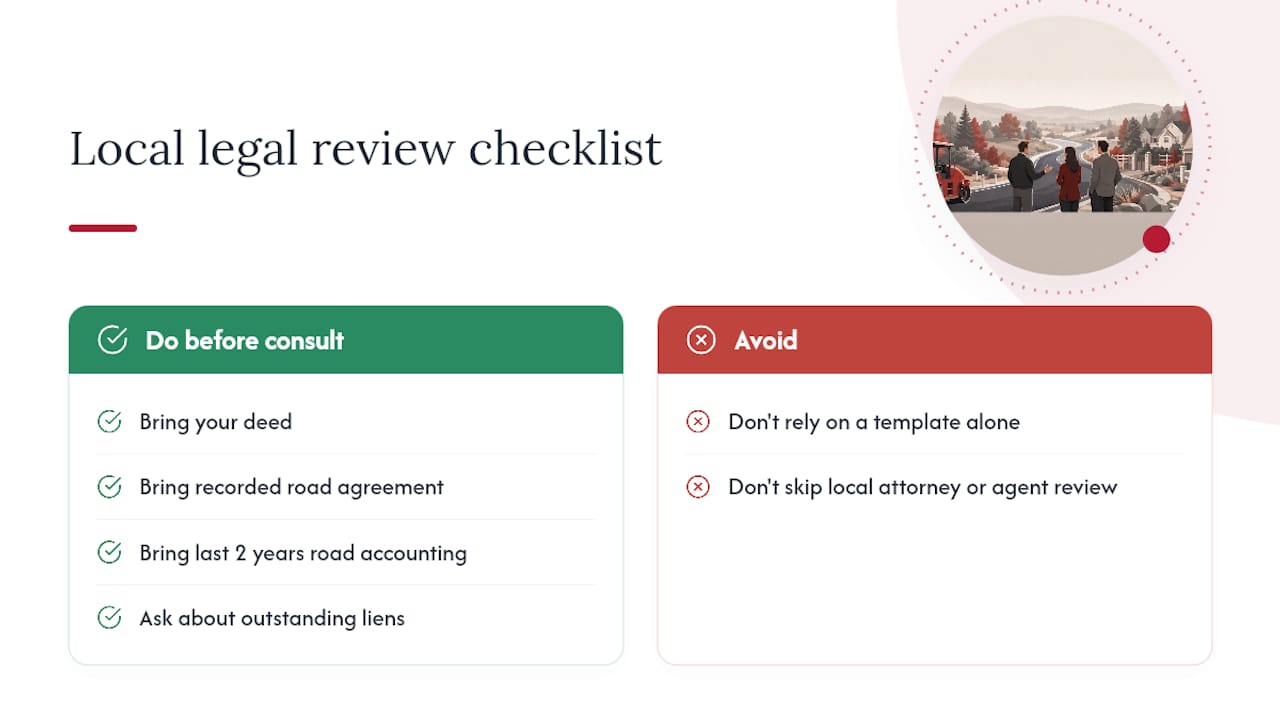
Municipal ordinances, easement scope, and lender rules vary enough by county that a template alone won't catch every local wrinkle. A real estate attorney or an agent familiar with the area will check recorded instruments, outstanding liens, past assessment history, and whether the agreement's language actually runs with the land. Similar local nuance shows up in zoning too, which is why understanding rules like the Baseline Hillside Ordinance in Los Angeles matters before any hillside purchase. Before your consult, gather your deed, any recorded road agreement, and the last couple years of road accounting statements.
A Broker's Take on Private Road Due Diligence
In high-value Southern California markets, an unrecorded road agreement can quietly shave value off a listing during escrow. Before closing, I want three things confirmed: a recorded document, a current budget with recent assessments, and proof the emergency fund isn't sitting at zero.
— Stu Harvey
Let Stu Harvey Estates Handle the Fine Print
Stu Harvey Estates reviews private road agreements as a standard part of buyer and seller due diligence, not an afterthought tacked on after you're already in contract. That matters in coastal and hillside communities across La Jolla, Rancho Santa Fe, and Orange County, where shared roads are common and a poorly drafted agreement can quietly cost a buyer thousands a year.

If you're buying, our buyer's team can pull recorded agreements and estimate the likely annual road-cost impact before you write an offer. If you're selling a property on a private road, our seller's team helps you document maintenance history so it doesn't become a last-minute negotiation point. Curious what your property is worth with these factors accounted for? Request a home valuation and let's talk specifics.
This article is general information, not a substitute for advice from a qualified lawyer. Consult a qualified legal professional about your own circumstances before acting on anything here.
Sources
- California Civil Code - CIV § 845 | FindLaw
- Understanding Private Road Maintenance | BPE Law
- Private Road Maintenance Agreement (Town of Los Altos Hills)
FAQ
Does California require a private road maintenance agreement?
California doesn't mandate a written agreement, but Civil Code § 845 requires easement owners to maintain the road and share costs proportionate to use when no agreement exists.
Is a private road maintenance agreement required in Pennsylvania?
Pennsylvania has no statewide statute forcing owners to create one, so enforceability depends almost entirely on whether owners have a recorded agreement in place.
What are Fannie Mae's guidelines for private road maintenance?
Fannie Mae underwriting can require evidence of legal, permanent access and a maintenance plan for private roads before approving a loan, so buyers should confirm requirements with their lender early in the process.
Does Virginia require a private road maintenance agreement?
Virginia doesn't have a statewide mandate either, which puts the weight on a clear, recorded agreement between owners rather than a default statutory formula.
Where can I find a private road maintenance agreement template?
Municipal samples from towns like Los Altos Hills and townships like Dexter, Michigan offer free, adaptable starting points that cover recitals, cost sharing, and recording language.