
A corporate relocation real estate service is a specialized B2B coordination framework that manages home sales and purchases for employees transferring to a new location on behalf of their employer. Rather than leaving employees to navigate the open market alone, corporations route these transactions through a relocation management company (RMC), which assigns vetted agents at both the origin and destination. The result is a structured, policy-driven process that looks nothing like a typical residential sale.
These services typically apply to mid-to-senior management transfers at organizations with more than 500 employees. Financial arrangements vary: some companies use direct billing, others issue lump-sum reimbursements, and many combine both. The scope usually covers home sale programs, destination property searches, temporary housing, mortgage assistance, and tax gross-ups to offset the employee's tax liability on relocation benefits.
Core components of a corporate relocation real estate service include:
- Home sale programs such as Guaranteed Buyout (GBO) and Buyer Value Option (BVO)
- Destination home search coordinated by an RMC-assigned agent in the new market
- Temporary and corporate housing during the transition period
- Closing and settlement management handled through the RMC's network
- Tax gross-up provisions to cover the employee's tax exposure on employer-paid benefits
What makes a relocation real estate agent different from a standard agent?
The gap between a relocation agent and a general residential agent is wider than most employees expect. A relocation agent operates inside a corporate policy framework, which means their fiduciary duties, compensation structure, and service sequence are all shaped by RMC network agreements, not just state license law.
Per 2026 standards from Sirva's Master Referral Policy, agents in preferred broker networks must meet strict criteria:
- Full-time real estate experience
- Experience specifically handling corporate relocations
- A minimum number of closed transactions and corporate referrals
- Completion of brokerage-sponsored relocation training
Beyond the numbers, relocation agents hold credentials like the Certified Relocation Professional (CRP) designation, which signals fluency in GBO and BVO programs, corporate contract structures, and the compliance requirements that come with employer-funded moves. They also maintain strict confidentiality on employee salary data and move details, a practice that simply does not exist in standard residential transactions.
The financial complexity alone separates these agents from the general market. Understanding how a GBO converts a home sale into a B2B transaction, or how tax gross-ups interact with closing costs, requires training that most residential agents never receive.
How does the corporate relocation process actually work?
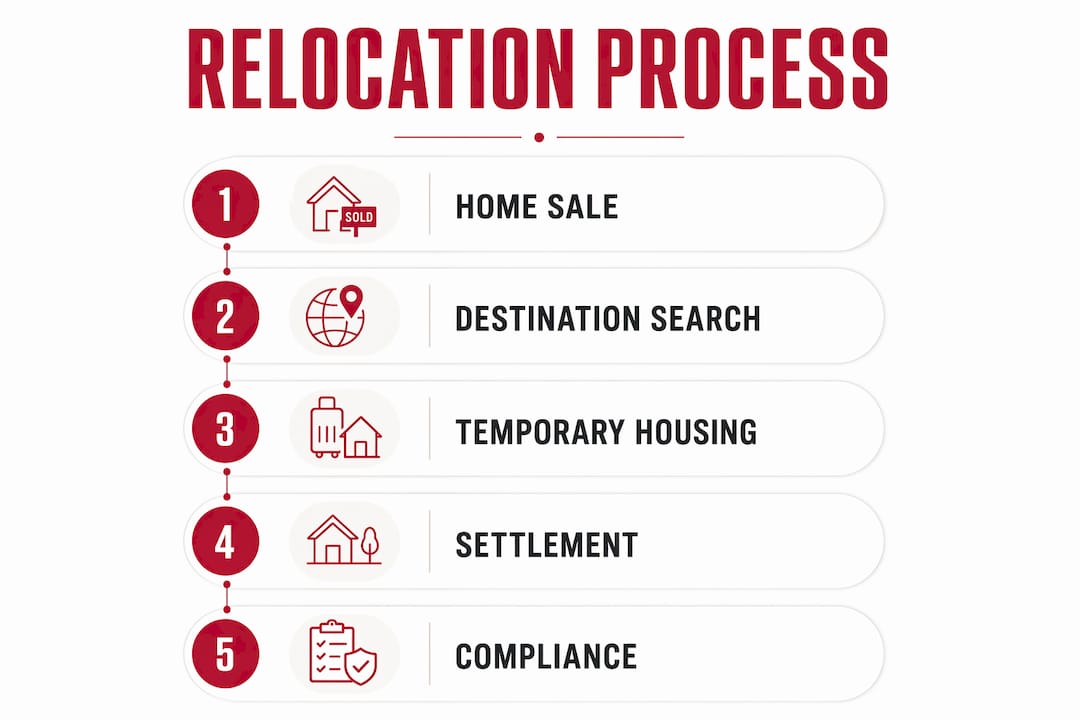
The process follows a predictable sequence, though the specifics depend on the company's relocation policy tier. Here is how a full-service corporate relocation typically unfolds:
Stage 1: Pre-move counseling The employee receives a transfer offer and connects with the corporate HR team or directly with the RMC. A relocation counselor reviews the policy, explains available programs, and begins coordinating service providers.
Stage 2: Origin home sale The RMC assigns a network agent to the employee's current market. Two main programs govern the sale:
- Buyer Value Option (BVO): The employee markets the home and finds a buyer. The RMC steps in as an intermediary purchaser, buying the home from the employee and reselling it to the outside buyer. This structure keeps closing costs off the employee's taxable income.
- Guaranteed Buyout (GBO): If the employee cannot find a buyer within a set period, the RMC purchases the home directly, converting the transaction into a B2B deal. This eliminates market risk for the employee and provides the corporation with predictable costs.
Stage 3: Destination home search A destination-market agent, also assigned through the RMC's network, guides the employee through property search, offer strategy, and closing. Many corporate programs include mortgage assistance through employer-selected lenders.
Stage 4: Temporary housing Full-service RMCs coordinate short-term rentals or corporate-furnished housing for employees who close on their new home before their old one sells, or who need time to search without pressure.

Stage 5: Settlement and compliance Closing procedures are managed through the RMC's settlement arm, which consolidates costs and maintains compliance with corporate policy. Tax gross-ups are calculated and applied at this stage to cover the employee's liability on employer-paid benefits.
Why working with a preferred relocation agent benefits everyone
Corporations that route moves through vetted preferred agents see fewer costly exceptions. An exception in relocation terms is any request that falls outside the standard policy, and they add up fast. RMCs reduce these overruns by deploying agents who already understand local market pricing, corporate contract details, and the compliance requirements baked into the policy.
For the employee, the difference is felt immediately. A preferred agent knows the destination neighborhoods, can move quickly on tight corporate timelines, and handles the administrative load that would otherwise fall on someone who is simultaneously starting a new job. Career mobility research shows that smooth home transitions directly support employee productivity post-move, which is why corporations treat relocation quality as a talent retention tool, not just a logistics expense.
Sirva's Preferred Broker Network agents bring expertise in market pricing, real estate contract details, and local legal customs. That combination reduces the time an employee spends distracted by housing uncertainty during the critical first weeks in a new role.
For HR teams, preferred agents also reduce administrative burden. They report directly to the RMC, handle documentation, and operate within the corporate compliance framework without requiring hand-holding from internal staff.
Who pays, and how do the fees work?
Most corporate relocation real estate costs are paid by the corporation, not the employee. The specific structure depends on the company's policy tier, but the most common arrangements are:
- Direct billing: The RMC invoices the corporation for all real estate services, and the employee pays nothing out of pocket.
- Lump-sum reimbursement: The corporation provides a fixed cash allowance and the employee selects providers independently. This approach offers flexibility but removes access to GBO and BVO programs.
- Incentive programs: Some policies include a home sale incentive, rewarding employees who sell quickly and at or above the appraised value.
Tax gross-ups are a critical piece of the financial picture. When an employer pays for relocation benefits, those payments are often treated as taxable income for the employee. A tax gross-up is an additional payment the corporation makes to cover that tax liability, so the employee does not take a financial hit for accepting the transfer.
The cost advantage over a traditional home sale is real. In a standard sale, the employee absorbs agent commissions, closing costs, and any capital loss. In a GBO program, those costs flow through the RMC as a business expense, which changes the tax treatment entirely and protects the employee's net proceeds.
How to choose and work with a corporate relocation real estate service
Start with your company's relocation policy. Most mid-to-large employers with structured programs have already contracted an RMC, and that RMC maintains a preferred broker network. Your first call is to HR or the mobility team, not to an agent you found online.
When evaluating agents, look for these markers:
- CRP designation or equivalent relocation-specific certification
- Documented experience with BVO and GBO programs
- Active membership in the Employee Relocation Council (ERC) network
- Local market depth in both your origin and destination markets
- Clear communication protocols with the RMC and HR team
For employees on a lump-sum policy without RMC support, the process is more open but also more exposed. In that case, finding an agent who specializes in corporate moves and understands relocation timelines is worth prioritizing over an agent with the highest sales volume in the general market.
Pro Tip: Ask any prospective relocation agent directly how many corporate referrals they closed in the past 12 months. Per Sirva's 2026 standards, the benchmark is at least 6 corporate referrals annually. An agent who cannot answer that question specifically has likely not worked inside a corporate relocation framework before.
Smooth communication among the employee, HR, RMC, and agents is the single biggest variable in whether a relocation stays on schedule. Full-service RMCs act as a single point of contact for all parties, which removes the coordination gaps that cause delays. If your company's program does not include that layer, assign one internal contact to own the process.

Understanding how a relocation buyer consultation works before the move begins also helps employees set realistic expectations on timelines, offer strategies, and what the corporate policy actually covers versus what comes out of pocket.
For employees navigating a job relocation home sale, understanding the difference between a GBO and a BVO upfront prevents surprises at closing.
Stu Harvey's perspective on luxury corporate relocations
Corporate relocations at the luxury level carry a different set of pressures. Stu Harvey, Senior Agent with The Oppenheim Group and the principal of Stu Harvey Estates, brings over 15 years of experience and more than $1.2 billion in sales volume to this specific challenge. His work across La Jolla, Rancho Santa Fe, Newport Beach, and the Hollywood Hills puts him squarely in the markets where senior executives and high-earning transferees land.
The core challenge in luxury corporate relocation is that the timelines are corporate but the properties are not. A $4 million home in Newport Beach does not move on the same schedule as a median-priced suburban property, and a relocation agent who does not understand that market's pricing dynamics, off-market inventory, and negotiation customs will cost the client time and money. Stu's approach combines current market data with deep local knowledge, which is exactly what a transferee needs when they are making a major purchase decision under deadline pressure.
Specialized agents for luxury homes understand that the due diligence process, the offer structure, and the closing timeline all differ materially from standard residential transactions. For corporate clients placing executives in Southern California markets, that expertise is not optional.
Pro Tip: For luxury corporate relocations, ask your RMC or HR team whether their preferred broker network includes agents with verified transaction history in the specific submarket where the employee is buying. A generalist with high volume in a different price tier is the wrong fit for a $3M+ purchase in La Jolla or Rancho Santa Fe.
Stu Harvey Estates works with corporate clients and transferees who need a trusted, experienced partner for high-value moves in Southern California. The combination of modern technology, transparent communication, and genuine local expertise is what separates a smooth luxury relocation from a costly, stressful one.
Ready to start your corporate relocation home search?

Whether you are an HR team placing a senior executive in Southern California or an employee navigating a luxury relocation on your own, Stu Harvey Estates offers the market knowledge and transactional experience to get it right. With over 250 successful luxury transactions and $1.2 billion in sales volume, Stu Harvey brings the depth that high-stakes corporate moves demand.
Search available listings in La Jolla, Newport Beach, Rancho Santa Fe, and across Southern California, or reach out directly to discuss your relocation needs.
Key Takeaways
Corporate relocation real estate services are structured B2B frameworks managed through RMCs and vetted agents, designed to protect employees and corporations from the financial and logistical risks of unmanaged home sales and purchases.
| Point | Details |
|---|---|
| RMC-driven structure | Corporations route transactions through a relocation management company, not directly through open-market agents. |
| Agent qualification standards | Preferred agents must meet benchmarks including 2 years of relocation experience and at least 6 corporate referrals annually. |
| GBO and BVO programs | These programs convert home sales into B2B transactions, reducing employee tax exposure and corporate financial risk. |
| Corporation covers most costs | Direct billing and tax gross-ups mean employees typically pay little to nothing out of pocket under a full-policy program. |
| Luxury moves need market-specific agents | Senior executive relocations in high-value markets require agents with verified experience in that specific price tier and submarket. |