
Southern California coastal markets outperform most U.S. housing markets for three structural reasons that compound over time: the coastline cannot be replicated, the buyer pool is unusually wealthy and rate-insensitive, and regulatory barriers make new supply nearly impossible to add at scale. A recent Orange County Register analysis found the six-county Southern California median sits roughly 122% above the national median — a gap that reflects permanent geography, not a temporary sentiment spike.
The core drivers, in order of durability:
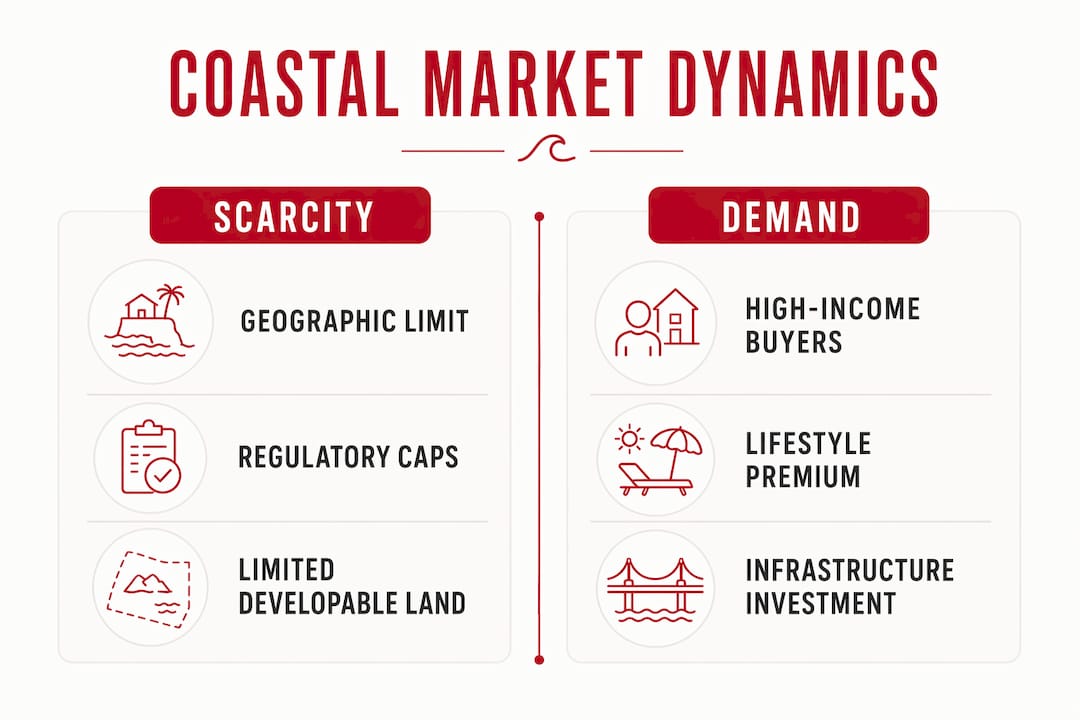
- Structural scarcity: Ocean to the west, mountains and protected lands inland — no room to expand the supply of coastal parcels.
- Demand composition: A buyer mix of high-income residents, second-home purchasers, equity-funded relocators, and retirees who are less sensitive to mortgage rate moves than typical buyers.
- Capital inflows: Persistent flows from Bay Area, New York, and international buyers who treat coastal Southern California as a long-duration store of value.
- Amenity premium: Climate, walkability, blue-space access, and school quality create a lifestyle floor that sustains demand across economic cycles.
For investors, the first thing to underwrite is location-specific scarcity, not the macro rate environment. The coastal premium behaves differently from national housing headlines, and understanding why is the foundation of any defensible acquisition thesis here.
Table of Contents
- 1. How Southern California's macroeconomy drives coastal demand
- 2. Why new coastal supply is structurally impossible to add
- 3. Who buys coastal properties and why the amenity premium holds
- 4. The performance evidence: price premiums, appreciation, and resilience
- 5. Principal risks coastal investors need to price in
- 6. Tactical takeaways for investors and analysts
- 7. How coastal micro-markets behave in practice
- Key Takeaways
- The coastal premium is misread more often than it is understood
- Stu Harvey Estates helps investors source and underwrite coastal opportunities
- Useful sources and further reading
1. How Southern California's macroeconomy drives coastal demand
The region's economic scale is the starting point. The Southern California Association of Governments (SCAG) region encompasses one of the largest metropolitan economies in the world, anchored by healthcare, technology, entertainment, international trade through the ports of Los Angeles and Long Beach, and a growing life sciences cluster in San Diego. That industry mix matters because it concentrates high-earning jobs within commuting or lifestyle distance of the coast.
County-level medians in mid-2026 show coastal counties — Orange, San Diego, and Ventura — posting year-over-year gains while many inland counties are flat or declining. The divergence is not accidental. Coastal counties hold a disproportionate share of the region's high-wage employment, which creates a durable income floor under property demand. When a tech or biotech professional earns a San Diego or Irvine salary, the coastal premium is a smaller share of their budget than it would be for a median-income household.
Capital flows reinforce the income base. Equity-funded buyers from the Bay Area and Los Angeles, along with international buyers drawn to San Diego and Orange County, treat coastal Southern California as a long-duration asset. These buyers are not primarily rate-driven. They are positioning for lifestyle and wealth preservation, which is why coastal assets tend to compress rather than collapse during national softening periods. Replacement cost dynamics add another floor: construction inflation and high local permitting and insurance costs make replacing coastal assets expensive, supporting real-value stability even when transaction volumes slow.
2. Why new coastal supply is structurally impossible to add
Geography is the most durable investment thesis in coastal real estate. Coastal Orange County is bounded by the Pacific Ocean to the west, the Santa Ana Mountains to the east, and the built-out metro areas of greater Los Angeles and San Diego to the north and south. San Diego faces the same hard limits, compounded by military installations, tribal lands, and protected open space that consume large portions of the county's developable land. There is no outward expansion available.

Regulation compounds the geographic constraint. The California Coastal Commission holds permitting authority over development within the coastal zone, and its mandate is preservation, not growth. CEQA (the California Environmental Quality Act) adds a parallel review layer that can extend timelines by years and expose projects to litigation from any party with standing. Local design review, height limits, parking requirements, and historic district overlays stack on top. The result is a permitting environment where a single coastal infill project can take five to ten years from entitlement to certificate of occupancy.
The replacement cycle is slow by design. When a teardown occurs, it replaces one unit with one unit — not a hundred. High construction costs on coastal parcels, driven by soil conditions, salt-air specifications, and insurance requirements, mean that even when a developer clears every regulatory hurdle, the economics rarely pencil for anything other than a premium single-family home or small boutique project. Coastal supply is finite in a way that inland markets simply are not.
Key regulatory and geographic constraints that investors should map at the submarket level:
- California Coastal Commission jurisdiction: Applies to the coastal zone, typically extending 1,000 yards inland from the mean high-tide line, with broader reach in sensitive areas.
- CEQA review: Mandatory environmental review for any project that could have a significant effect on the environment — applies to most coastal development proposals.
- Local height and density limits: Many coastal cities cap building heights at two or three stories and impose low floor-area ratios that prevent densification.
- Design review and historic districts: Laguna Beach, for example, maintains an active design review process that can delay or modify projects significantly.
- Bluff and setback requirements: Coastal Commission and local ordinances require setbacks from bluff edges that reduce buildable area on many of the most desirable parcels.
Pro Tip: When screening coastal submarkets for scarcity intensity, look for small peninsulas, bluff-top neighborhoods, and historic districts where regulatory and geographic constraints overlap. Dana Point, Laguna Beach, and La Jolla's Bird Rock and Windansea neighborhoods are examples where multiple constraint layers converge — these tend to show the strongest long-term price floors.
3. Who buys coastal properties and why the amenity premium holds
The buyer pool in coastal Southern California is structurally different from most U.S. markets, and that difference is what makes demand resilient across rate cycles. Primary residents with high local incomes compete alongside second-home buyers from colder or more congested metros, equity-funded relocators from the Bay Area and New York, retirees seeking climate and walkability, and remote professionals who decoupled from office geography after 2020.
The amenity premium — what researchers sometimes call the "blue-space" effect — reflects the measurable willingness to pay for ocean proximity, outdoor lifestyle access, and year-round temperate climate. Buyers in this pool are not primarily optimizing for yield. They are buying long-duration lifestyle value, which makes their demand less elastic to short-term rate moves. When mortgage rates rise, these buyers often wait rather than exit the market entirely. Waiting buyers become buying buyers when the right property appears, which is why coastal lifestyle markets have attracted sustained in-migration even during periods of national housing softening.
Buyers who want to live near the Pacific Ocean, in a specific school district, in a specific walkable community, do not evaporate when rates move. They wait. And waiting buyers become buying buyers when the right property appears.
Infrastructure investment reinforces the amenity premium over time. The Dana Point Harbor renovation and ongoing improvements along the San Clemente coastal corridor are concrete examples of community-level capital that deepens desirability and supports resale depth. Walkable retail, dining, and harbor access are not amenities that can be replicated inland — they are location-specific, and their improvement compounds the premium already embedded in the land.
For investors focused on San Diego's luxury buyer profile, the demand composition is particularly concentrated: high-income professionals in biotech, defense technology, and healthcare, alongside a growing cohort of retirees and second-home buyers from higher-cost metros who find San Diego's price points accessible relative to their origin markets.

4. The performance evidence: price premiums, appreciation, and resilience
The substantial premium of the Southern California six-county median over the national median is the headline number, but the more instructive data is at the submarket level. San Diego coastal submarkets — La Jolla, Del Mar, and Encinitas — have shown continued year-over-year strength even during periods of national softening, with local medians holding or advancing while repeat-sales indices in other markets flatten.
One important interpretive note: medians can rise even when individual home appreciation is flat, because mix effects push the median upward when fewer entry-level transactions close. Investors should read median figures alongside repeat-sales indices — such as the S&P CoreLogic Case-Shiller Los Angeles index — to distinguish genuine appreciation from compositional shifts. Both signals matter, but they answer different questions.
The comparison below uses the dimensions most relevant to coastal versus inland underwriting:
| Dimension | Coastal Southern California | Inland Southern California |
|---|---|---|
| Scarcity / developable land | Severely constrained (ocean, mountains, protected lands) | Moderate to high availability; active master-planned development |
| Demand composition | High-income residents, second-home buyers, cash/equity buyers, retirees | More rate-sensitive primary buyers; fewer second-home purchasers |
| Income and wage base | Concentrated high-wage employment (tech, biotech, entertainment, trade) | Broader income distribution; lower median household incomes |
| Capital inflows | Bay Area, LA, international equity migration; institutional interest | Primarily local and regional buyer pools |
| Regulatory constraints | California Coastal Commission, CEQA, local design review, bluff setbacks | Standard CEQA; fewer coastal-specific overlays |
| Historical performance | Long-term outperformance vs. national median; faster recovery from downturns | More correlated with national rate cycles; slower recovery in oversupply periods |
| Rental yield differential | Lower gross yields but stronger rent floors and lower vacancy in premium tiers | Higher gross yields in some submarkets; more vacancy sensitivity to economic cycles |
| Climate and physical risk | Sea-level rise, bluff erosion, salt-air maintenance, seismic exposure | Wildfire exposure in some areas; heat events; less coastal physical risk |
For rental investors, Pacific Beach and comparable coastal nodes illustrate the yield trade-off clearly: gross yields are lower than inland peers, but vacancy rates are structurally tighter and rent floors are supported by the same scarcity dynamics that underpin sale prices. The net yield picture, adjusted for vacancy and rent growth, often closes the gap with inland alternatives.
5. Principal risks coastal investors need to price in
Coastal Southern California is not a risk-free market. The same scarcity that supports prices also concentrates exposure to a specific set of physical and regulatory risks that inland markets largely avoid.
Physical and climate exposure is the most discussed risk, and it is real. Bluff erosion is an active process in Del Mar, Solana Beach, and parts of San Clemente, where properties within certain setback distances face genuine long-term uncertainty. Sea-level rise projections from the California Coastal Commission inform local planning documents, and some parcels in low-lying coastal areas carry flood insurance requirements that add meaningfully to carrying costs. Salt-air maintenance costs are higher than inland equivalents. Seismic risk is a baseline condition across Southern California, with coastal areas generally no more exposed than inland ones, but the combination of seismic and coastal physical risks means that insurance underwriting is more complex and more expensive.
The buyers who have historically underperformed in this market are those who bought at market peaks with maximum leverage and needed to sell within three to five years.
Affordability and demand thinning is a subtler risk. At the top of the price range, the buyer pool is genuinely thin. A $5 million coastal property in Laguna Beach competes for a small universe of qualified buyers, which means days-on-market can extend significantly in a softening environment. Investors who need liquidity within a short window face real execution risk.
Insurance and carrying costs have risen materially. Several major insurers have reduced their California coastal exposure, pushing buyers toward the California FAIR Plan or surplus-line carriers at higher premiums. Combined with elevated HOA fees, Mello-Roos obligations in some communities, and the maintenance premium of coastal construction, net yields can compress faster than gross yield figures suggest.
Policy and regulatory risk is ongoing. Changes to Coastal Commission permitting standards, local zoning overlays, or state tax policy (including potential modifications to Proposition 13 treatment for investment properties) could affect investor returns. The regulatory environment that creates scarcity also creates uncertainty — the same body that limits supply can limit what you do with an existing asset.
Where inland markets face deeper rate sensitivity and oversupply risk, coastal markets face concentration and physical risks. Neither profile is universally better; they require different underwriting frameworks.
6. Tactical takeaways for investors and analysts
Coastal Southern California rewards a specific kind of investor: patient, well-capitalized, and focused on location-specific fundamentals rather than macro rate timing. The acquisition, financing, and hold strategies that work here differ from what works in rate-sensitive inland markets.
Acquisition priorities:
- Lead with location-specific scarcity analysis: street and block matter more than zip code. A property two blocks from the water in a constrained neighborhood is a fundamentally different asset from one a mile inland in the same city.
- Assess neighborhood-level demand drivers: school district quality, walkability scores, harbor or beach access points, and proximity to walkable retail and dining.
- Review title for coastal zone permits, Coastal Commission conditions of approval, and any prior variance or nonconforming use designations — these affect what future owners can do with the property.
- Price insurance and maintenance costs before making an offer, not after. Coastal construction premiums and insurance market conditions in 2026 make this a material underwriting variable.
Financing and underwriting:
- Expect a higher cash-buyer share in the competitive tier. In premium coastal segments, cash transactions and equity-funded buyers represent a meaningful portion of closed deals, which compresses the negotiating advantage of rate-sensitive buyers.
- Build conservative carry assumptions: elevated insurance, potential HOA and Mello-Roos, and coastal maintenance capex should all be modeled at current market rates, not historical averages.
- Use a Southern California luxury market analysis framework that accounts for the thin comparable set in premium tiers — standard automated valuation models underperform in markets where fewer than a dozen comparable sales close per year.
Hold and exit strategy:
- A 5–10+ year time horizon is not a preference in this market — it is a structural requirement for capturing the appreciation cycle and avoiding forced selling in a thin liquidity window.
- Value-add returns in coastal markets are non-linear. Exterior and outdoor improvements — enlarged outdoor living areas, improved ocean sight lines, envelope upgrades — tend to generate outsized returns compared with interior cosmetic work. The buyer paying a coastal premium is buying the outdoor experience first.
- Plan exit timing around inventory cycles. Coastal markets have distinct seasonal patterns, and listing into a period of compressed inventory typically produces better outcomes than listing into a supply surge.
Pro Tip: When sizing offers in a market with limited comparable liquidity, anchor to replacement cost rather than the last comparable sale. In constrained coastal submarkets, the cost to replicate a property — land, permitting, construction at coastal specifications — often sets a more defensible floor than a thin comp set.
7. How coastal micro-markets behave in practice
Stu Harvey has closed over 250 luxury transactions across San Diego, Orange County, and Los Angeles, with total sales volume exceeding $1.2 billion. That transaction history produces a ground-level view of how coastal micro-markets actually behave — one that national data cannot fully capture.
The patterns that repeat across submarkets: cash-funded buyers who have been watching a specific neighborhood for months move quickly when the right property appears, often before a listing reaches full market exposure. Teardowns in constrained coastal nodes — a 1960s ranch on a bluff-top lot in La Jolla or a dated bungalow in Laguna Beach — get replaced by custom homes priced at two to three times the teardown acquisition cost, which resets the comparable base for the entire block. Renovation paybacks are concentrated in outdoor and envelope improvements: a well-executed outdoor living addition in a coastal San Diego property consistently outperforms a kitchen remodel in terms of resale premium.
Coastal Southern California is not a market you time. It is a market you qualify for — with the right time horizon, the right carry capacity, and a clear-eyed view of what you are actually buying.
In San Diego specifically, submarkets like La Jolla and Del Mar show the most acute scarcity dynamics: inventory in the premium tier regularly sits below one month of supply, and negotiation dynamics shift accordingly. Sellers in these markets rarely need to discount; buyers who hesitate lose properties to cash offers. In Orange County, Dana Point and Laguna Beach show comparable supply tightness, with the added tailwind of the harbor renovation and ongoing community investment.
Stu Harvey Estates supports investment clients through the full sourcing and underwriting process: identifying off-market and pre-market opportunities, providing neighborhood-level comp analysis, and managing the transaction from offer through close with concierge-level support. For investors who want a detailed coastal neighborhood comparison before committing to a submarket, that analysis is part of the standard advisory process.
Key Takeaways
Southern California coastal markets outperform because structural scarcity, a rate-insensitive buyer mix, and persistent capital inflows create a premium that national housing cycles cannot fully erode.
| Point | Details |
|---|---|
| Scarcity is structural, not cyclical | Geography and regulation permanently cap coastal supply, supporting long-term price floors. |
| Buyer mix reduces rate sensitivity | Cash buyers and equity-funded relocators dominate premium coastal tiers, insulating them from mortgage rate swings. |
| The median premium is real | Southern California's six-county median is approximately 122% higher than the national median, per Orange County Register analysis as of early 2026. |
| Physical and insurance risks are material | Bluff erosion, sea-level exposure, and rising insurance costs must be underwritten conservatively before acquisition. |
| Stu Harvey Estates | Provides location-first sourcing, neighborhood comp analysis, and concierge transaction support for coastal investors. |
The coastal premium is misread more often than it is understood
Most investors who approach Southern California coastal markets for the first time make the same mistake: they benchmark against national cap rates or compare gross yields to inland alternatives and conclude the coastal premium is not justified. That framing misses the point entirely.
The coastal premium is not a yield play. It is a scarcity play with a lifestyle floor. The buyers competing for these assets are not running discounted cash flow models on rental income — they are pricing long-duration optionality: the right to live in, use, or sell a genuinely irreplaceable asset in one of the most desirable climates in the world. When you understand that, the approximately 122% premium over the national median, documented by Orange County Register analysis as of early 2026, stops looking like irrational exuberance and starts looking like a rational response to a permanently constrained supply curve.
What I tell investors consistently: the question is not whether the coastal premium is justified in the abstract. The question is whether your time horizon, carry capacity, and risk tolerance are calibrated to capture it. A five-year hold with maximum leverage in a thin liquidity tier is a different bet than a ten-year hold with conservative financing in a neighborhood where inventory has averaged under two months of supply for a decade. The market is not the risk. The mismatch between the asset's characteristics and the investor's assumptions is the risk.
If you are evaluating a coastal Southern California position and want a frank conversation about where the real value sits and where the real exposure is, reach out directly for a tailored market analysis.
Stu Harvey Estates helps investors source and underwrite coastal opportunities
Identifying a defensible coastal position in Southern California requires more than a Zillow search and a national market report. The 122% median premium over the national median, documented by Orange County Register analysis as of early 2026, reflects real scarcity. Capturing it requires knowing which submarkets have the tightest supply, which neighborhoods are mid-renovation cycle, and which properties are priced at replacement cost versus above it.

Stu Harvey Estates provides investors with the specific intelligence that makes the difference at acquisition: off-market and pre-market sourcing across San Diego, Orange County, and Los Angeles; neighborhood-level comp analysis that accounts for the thin comparable sets in premium coastal tiers; and full concierge transaction support from offer through close. With over $1.2 billion in completed transactions and 250+ luxury closings, the advisory process is built around the fundamentals that actually drive coastal value, not national headlines.
Ready to identify your next coastal position? Browse current coastal listings or contact Stu Harvey directly to request a neighborhood comp pack and a frank conversation about where the opportunity sits in today's market.
Useful sources and further reading
The analysis in this article draws on the following primary and secondary sources. Analysts who want to go deeper into the underlying data should consult these directly.
- Orange County Register / Attom data analysis: Source for the 122% Southern California median premium over the national median. Useful for regional price benchmarking.
- SCAG 2025 Southern California Economic Update: Regional GDP, employment, and housing production data by county. The authoritative source for macro economic context across the six-county SCAG region.
- Living in Coastal OC — Coastal Orange County Investment Analysis: Qualitative analysis of supply structure, buyer composition, and Coastal Commission constraints in Orange County coastal markets.
- Lands Culture — San Diego Coastal Property Values: Local reporting on San Diego submarket resilience, planning constraints, and replacement cost dynamics.
- Matt Mayo Mortgage — SoCal Summer 2026 Market Update: County-level median data and analysis of median versus repeat-sales index behavior in coastal versus inland markets.
- Renishaw — Coastal Property Long-Term Value: Industry commentary on structural scarcity advantages and replacement cost dynamics in coastal markets.
- Dana Point Harbor Renovation Update: Local infrastructure investment reporting relevant to community-level amenity premium analysis.
For the underlying comp packs, submarket-level median data, and current inventory analysis for specific coastal nodes in San Diego and Orange County, contact Stu Harvey Estates directly. National indices and county medians provide context; parcel-level analysis is where acquisition decisions get made.