
Budgeting for luxury home ownership is defined as the full financial planning process that accounts for every cost of acquiring and maintaining an upscale property, not just the purchase price. Most buyers focus on the mortgage and miss the carrying costs that follow. Property taxes, maintenance reserves, insurance, utilities, and lifestyle expenses can add tens of thousands of dollars per year to the real cost of ownership. Buyers who treat luxury real estate budgeting as a purchase-day calculation, rather than a long-term financial model, consistently overspend. The 28% rule, which caps housing costs at 28% of gross monthly income, is a starting point, but it was never designed for the complexity of high-end property ownership.
What are the typical costs of luxury home ownership beyond the purchase price?
The purchase price of a luxury home is the smallest part of the financial commitment. Annual carrying costs for a $2.5M luxury home can run 15–30% above mortgage payments, including property taxes, insurance, maintenance, and utilities. That means owners should plan for $78,000 to $139,000 in non-mortgage carrying costs per year, on top of mortgage payments.
Maintenance reserves
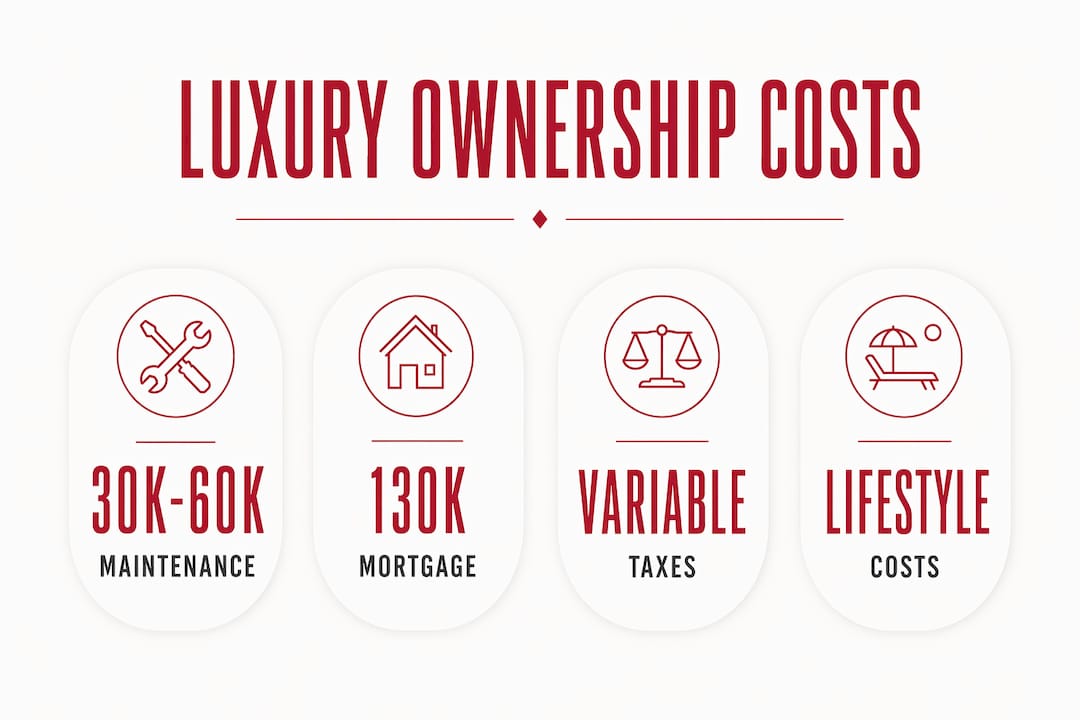
Experts recommend budgeting 1–1.5% of a home's value annually for maintenance, rising to 1.5–2% for older homes or those with deferred upkeep. On a $3M property, that is $30,000 to $60,000 per year, before any major capital project. Capital improvements such as kitchen remodels or roof replacements add another layer. A $3M home's capital improvements can total $200,000 to $600,000 over a decade, or $20,000 to $60,000 per year when amortized across a 7–10 year hold period.

Property taxes and insurance
Property tax escalation varies sharply by state. California caps annual increases at 2%, while some states allow escalation up to 10% annually. Buyers in high-appreciation markets must model these increases over a 10-year horizon, not just year one. Homeowners insurance for luxury properties carries its own complexity, particularly in catastrophe zones like coastal Southern California, where wildfire and flood risk push premiums well above standard rates.
Lifestyle and operational costs
Luxury home operating costs include utilities, landscaping, pool service, security, and staffing. These expenses scale non-linearly with home size. Doubling a home's square footage typically more than doubles operational costs because of systems complexity and staffing requirements. A $2M luxury home in Atlanta, for example, costs $51,000 to $130,000 annually beyond the mortgage for these line items alone.
| Cost Category | Typical Annual Range (on a $2.5M–$3M home) |
|---|---|
| Maintenance reserve | $30,000–$60,000 |
| Property taxes | $25,000–$60,000+ |
| Homeowners insurance | $8,000–$25,000 |
| Utilities and landscaping | $12,000–$30,000 |
| HOA fees | $5,000–$30,000 |
| Capital improvements (amortized) | $20,000–$60,000 |
Pro Tip: Add up every category in the table above before you make an offer. If the total annual carrying cost exceeds your comfort threshold, recalibrate the purchase price, not the budget categories.
How can buyers strategically finance and budget a luxury home purchase?
Luxury home financing goes well beyond a standard 30-year fixed mortgage. Financing luxury homes blends multiple credit products, including jumbo mortgages, securities-backed lines of credit (SBLOCs), and asset-depletion loans, each requiring a different risk and liquidity assessment. Choosing the wrong structure can cost hundreds of thousands of dollars in after-tax wealth over a decade.
Understanding your financing options
- Jumbo mortgages cover loan amounts above the conforming loan limit and are the most common tool for luxury buyers. They typically require a 20–30% down payment and strong credit.
- SBLOCs let buyers borrow against an investment portfolio without liquidating assets. They are often chosen for perceived prestige, but SBLOCs may lack the tax advantages of a jumbo mortgage for primary residences valued under approximately $3M.
- Asset-depletion loans allow lenders to count liquid assets as qualifying income, which benefits buyers with high net worth but irregular income.
Leverage can favor buyers when portfolio growth outpaces borrowing rates. However, financing choice should be based on after-tax net worth impact, not on which option sounds most sophisticated. Cash, mortgage, and SBLOC paths each carry different tax treatments and liquidity risks that must be modeled carefully.
Building a capital reserve fund
Every luxury buyer should establish a dedicated capital reserve fund before closing. This is a separate account, not part of your emergency fund, set aside specifically for major property expenses. A practical starting point is to fund it with one year of projected maintenance and capital improvement costs at closing, then replenish it monthly. This prevents the common trap of funding a roof replacement or HVAC overhaul from operating cash flow.
Pro Tip: Work with a CPA who specializes in real estate before selecting a financing structure. The after-tax cost difference between a jumbo mortgage and an SBLOC on a $3M purchase can exceed $40,000 in the first year alone.
For a detailed breakdown of loan types available to luxury buyers, the 2026 luxury loan guide at Stu Harvey Estates covers current lending standards and qualification criteria.
What are the most common mistakes in luxury home budgeting?
The most expensive mistake luxury buyers make is treating the mortgage payment as the budget. Non-mortgage carrying costs routinely surprise first-time luxury owners because no one line item feels large enough to flag during the purchase process. The cumulative effect, however, is significant.
- Underestimating maintenance reserves. Buyers who skip the 1–1.5% annual reserve rule face large, unplanned repair bills within the first three years of ownership.
- Ignoring property tax escalation. A 10% annual tax increase on a $3M property adds $3,000 to $6,000 per year to carrying costs, compounding over time.
- Overlooking lifestyle operational expenses. Staffing, security, and pool service costs scale non-linearly with property size and catch buyers off guard.
- Delaying capital improvement planning. Buyers who do not amortize future remodels and system replacements into their annual budget face cash flow crises when those projects arrive.
- Overrelying on the 28% income rule. The 28% rule covers mortgage principal and interest only. It does not account for taxes, insurance, maintenance, or lifestyle costs that define the real cost of luxury home ownership.
Buyers who underestimate operational lifestyle costs for luxury properties consistently find that those costs scale faster than expected. The complexity of systems and staffing in a large home creates compounding expenses that a simple income-to-mortgage ratio never captures.
Pro Tip: Build a 10–15% contingency buffer into your annual budget and review it every six months. Costs change, and a budget that was accurate at closing may be outdated within 18 months.
Understanding why luxury neighborhoods have different market rules also helps buyers anticipate cost structures that vary significantly by location, HOA governance, and local tax policy.
How do you build a comprehensive luxury home ownership budget?
A complete luxury home budget requires gathering real numbers, not estimates, before you make an offer. The process takes time, but it prevents the financial strain that follows an underprepared purchase.
- Request actual cost data. Ask the seller's agent for 12 months of utility bills, HOA statements, and any maintenance records. These are the most accurate baseline figures available.
- Get insurance quotes before closing. Luxury home insurance premiums vary widely by location, construction type, and coverage level. Obtain at least two quotes and factor in catastrophe zone surcharges.
- Categorize every expense. Separate your budget into six buckets: mortgage, property taxes, insurance, maintenance, utilities and lifestyle, and capital improvements. Never combine categories.
- Amortize capital projects. Identify every major system in the home, including roof, HVAC, plumbing, and appliances, and estimate its remaining useful life. Divide the replacement cost by the years remaining to get an annual reserve figure.
- Model tax escalation. Use your state's maximum annual property tax increase rate and apply it forward for 10 years. This gives you a realistic picture of future carrying costs.
- Add a contingency buffer. Apply a 10–15% buffer to your total annual budget to absorb unexpected costs without disrupting cash flow.
| Budget Category | Annual Cost Example ($3M Home) | Notes |
|---|---|---|
| Mortgage (30-year, 20% down) | $130,000–$155,000 | Varies with rate and structure |
| Property taxes | $30,000–$60,000 | State-dependent escalation |
| Homeowners insurance | $10,000–$25,000 | Higher in catastrophe zones |
| Maintenance reserve | $30,000–$45,000 | 1–1.5% of home value |
| Utilities and lifestyle | $15,000–$35,000 | Scales with home size |
| Capital improvements (amortized) | $20,000–$60,000 | 7–10 year project horizon |
| Total annual estimate | $235,000–$380,000 | Before contingency buffer |
Pro Tip: Use a spreadsheet with monthly and annual views. A budget you can only see annually hides the months where cash flow gets tight. Monthly visibility lets you adjust before a shortfall becomes a problem.
For buyers building a long-term ownership strategy, the Stu Harvey Estates guide on building a luxury real estate portfolio covers financial modeling approaches that extend well beyond the initial purchase.
What I've learned about luxury home budgets after 250+ transactions
After working through more than 250 luxury transactions across San Diego, Los Angeles, and Orange County, the pattern I see most often is buyers who budget for the home they want to buy, not the home they are actually buying. Those are two very different numbers.
The purchase price is the easy part. What surprises buyers, even sophisticated ones, is how quickly the operational costs of a large, complex property compound. A 7,000-square-foot estate in La Jolla or Rancho Santa Fe does not cost twice as much to run as a 3,500-square-foot home. It costs three to four times as much, because the systems, the staffing, and the maintenance cycles all multiply together.
The second thing I tell every buyer is to finalize their finish specifications before they commit to a budget. Early alignment of design and finishing specifications is the single most effective way to control costs in a custom or heavily renovated luxury home. Custom millwork, smart home systems, and high-end lighting are the categories where budgets blow past projections most often. Locking those decisions early removes the largest source of cost overruns.
The emotional side of luxury buying is real, and it affects financial decisions. I have watched buyers add $500,000 in upgrades during escrow because the excitement of ownership overrides the discipline of the budget. The buyers who come out ahead are the ones who treat their budget as a fixed constraint, not a starting point for negotiation with themselves.
— Stu Harvey
How Stu Harvey Estates helps you buy with financial clarity
Stu Harvey Estates brings more than 15 years of luxury real estate expertise and over $1.2 billion in sales volume to every client relationship. That experience translates directly into budget conversations that go beyond the listing price.
When you work with Stu Harvey Estates, you get a clear picture of the full cost of ownership before you make an offer, not after. The team helps buyers align their budget with the right property by combining deep local knowledge of markets like La Jolla, Newport Beach, and The Hollywood Hills with transparent financial guidance. Browse current luxury property listings to see what is available across Southern California, or explore the San Diego neighborhoods guide to match your budget with the right location.
Key takeaways
Budgeting for luxury home ownership requires modeling all six cost categories, not just the mortgage, to avoid financial strain and protect long-term wealth.
| Point | Details |
|---|---|
| Total carrying costs exceed mortgage | Non-mortgage costs on a $2.5M home can add $78,000–$139,000 per year. |
| Maintenance reserve is non-negotiable | Set aside 1–1.5% of home value annually; more for older properties. |
| Financing structure affects after-tax wealth | Model jumbo, SBLOC, and cash options before choosing; tax treatment differs significantly. |
| Operational costs scale non-linearly | Doubling home size typically more than doubles running costs due to systems and staffing. |
| Build a contingency buffer | Add 10–15% to your total annual budget and review it every six months. |
FAQ
What does budgeting for luxury home ownership actually include?
Budgeting for luxury home ownership includes mortgage payments, property taxes, homeowners insurance, maintenance reserves, utilities, lifestyle expenses, and amortized capital improvements. Non-mortgage carrying costs alone can total $78,000 to $139,000 per year on a $2.5M home.
How much should I set aside for maintenance on a luxury home?
Budget 1–1.5% of the home's value annually for routine maintenance, rising to 1.5–2% for older or deferred-maintenance properties. On a $3M home, that is $30,000 to $60,000 per year before any major capital project.
What financing options are available for luxury home buyers?
Luxury buyers typically use jumbo mortgages, SBLOCs, or asset-depletion loans. Each carries different tax implications and liquidity risks, so the best choice depends on after-tax net worth impact, not perceived prestige.
How do property taxes affect long-term luxury home budgets?
Property tax escalation rates vary by state, from 2% annually in California to up to 10% in other states. Modeling this escalation over a 10-year horizon is necessary for accurate long-term financial planning.
What is the biggest budgeting mistake luxury home buyers make?
The most common mistake is treating the mortgage payment as the full budget. Operational lifestyle costs, maintenance reserves, and capital improvements consistently exceed buyer expectations, especially as home size and complexity increase.