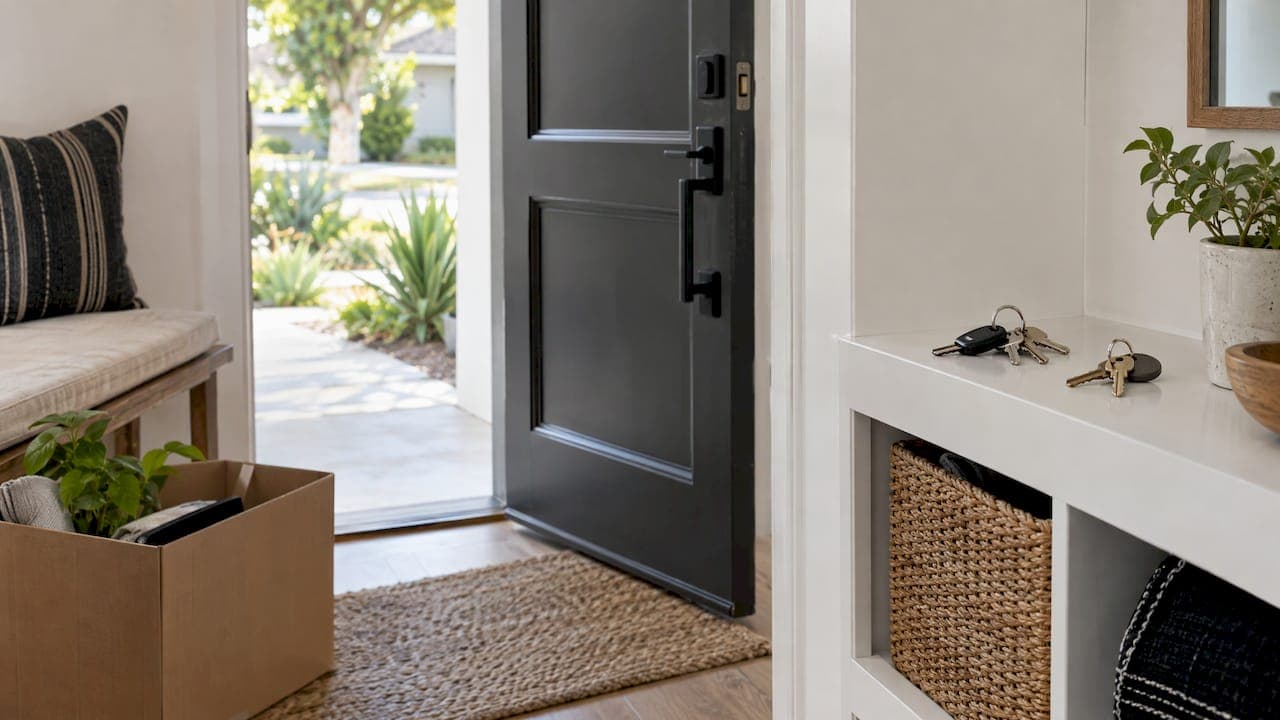
You can buy and sell a San Diego home at the same time, but you have to choose a sequence on purpose. You can sell first, buy first, or line up both closings. Each has a different cost and a different risk. The right pick depends on your equity, your income, your tolerance for two housing payments and how fast homes move in the specific neighborhoods on both sides of your move.
This guide walks through the three sequences, the contract tools that connect them (contingencies and rent-backs), the financing that covers the gap, and the local data that should shape your timing.
TL;DR
- Selling first gives you cash and a cleaner debt-to-income picture, but you may need temporary housing and a second move.
- Buying first makes your offer stronger in a fast market, but you may carry two homes until the old one closes.
- Coordinating both closings is the tidiest result on paper, yet a delay on one side can put the other at risk, so keep a Plan B.
- San Diego is not one market: September 2026 detached-home data shows 10 median days on market in one coastal area and 43 in another.
- Before you offer, know your realistic net proceeds. Our home valuation page is the starting point for the sale side.
Table of Contents
- Is it hard to sell and buy at the same time?
- The three sequences compared
- How contingencies and rent-backs connect the two deals
- Financing the gap
- Coordinating escrows and closing dates
- Why San Diego timing is local
- Your pre-offer checklist
- Where we can help
- FAQ
- Sources
Is it hard to sell and buy at the same time?
It is tricky rather than impossible. You are running two mortgage processes, two escrows and two sets of deadlines, and a slip in one can push the other. Chase's guidance says the closing of the old home followed shortly by the new one is the ideal when feasible, because sale proceeds can then fund the purchase. The catch is that a delay in the first closing can jeopardize the second.
That is why the question is less "can I do both?" and more "which risk am I best positioned to absorb?" Some owners can absorb a few weeks in a rental. Others have enough equity or income to carry two properties for a while. Knowing which one you are decides the sequence.
The three sequences compared
Rocket Mortgage's guide frames the options as buy first, sell first, or coordinate both closings, with the choice depending on finances, local market conditions, housing options and tolerance for overlapping costs. Here is how those trade-offs look side by side.
| Sequence | Main advantage | Main risk | Best when |
|---|---|---|---|
| Sell first | Cash in hand and less debt-to-income pressure | Temporary housing, storage, a second move | You can be flexible on where you live for a while |
| Buy first | A stronger offer, no wait to find the right home | Carrying two homes until the old one sells | You qualify comfortably with both payments |
| Coordinate closings | Minimal overlap in cost and housing | One delay can cascade into the other | Both transactions are straightforward and timelines align |
Selling first
SoFi reported in May 2025 that selling first can supply down-payment funds and ease debt-to-income pressure, though it may require temporary housing unless the buyer agrees to a rent-back. You also shop with certainty: you know your proceeds, so you know your budget.
The cost is time pressure on the buying side. In a quick-moving neighborhood, you may need to move fast once you are mobile. If you plan to rent in between, think through storage, a second move and, if you have children or pets, how long a short-term arrangement is realistic.
Buying first
In a competitive market, buying before selling may be the only way to secure the home you want, but it risks the cost of two homes until the old one sells. Lenders will count both payments when you qualify, so confirm your preapproval reflects that reality, not just the new home on its own.
Buying first works best when your offer needs to be clean. That is where a bridge loan or a home-sale contingency enters the conversation, covered below.
Coordinating both closings
Aim for the same day, or close to it, but do not rely on it. Fidelity's guidance says to try to negotiate same-day closings and still have a Plan B, since mortgage, inspection or walkthrough problems can cause delays. Your Plan B might be a rent-back on the sale, a short-term rental, or a pre-arranged storage unit.

How contingencies and rent-backs connect the two deals
The contract is where the sequencing gets built. Two contingency types matter most, and the National Association of REALTORS® consumer guide explains them:
- Home-sale contingency: gives you time to sell your current home before you close on the new one.
- Home-close contingency: gives you time to close the sale of your current home, once it is under contract, before you close on the new one.
The same guide notes that a seller who accepts a contingent offer may keep showing the property, and if an acceptable offer without contingencies arrives, the first buyer typically has a right of first refusal. It also says contingencies need clear timelines. If one is not met within the specified time, buyer or seller can cancel without penalty, provided both are acting in good faith.
The practical read: a contingent offer is weaker than a clean one, and in a fast neighborhood sellers may pass on it. If you are on the other side of a contingent deal, our guide on contingent versus pending status shows how to spot a shaky sale.
Rent-backs
A rent-back lets you stay in your old home after closing, if the buyer agrees. The NAR guide says rental compensation and the final move-out date should be negotiated specifically, so put both in writing. A rent-back is often the cleanest answer when your sale closes a bit before your purchase does, since it replaces a scramble for temporary housing with a few extra days or weeks at home. The buyer's lender and insurer may have views on occupancy after closing, so raise it early with your agent and your escrow officer.
Protect your deposit
Deadlines are not decoration. NAR warns that buyers can lose earnest money by waiving contingencies prematurely, missing contract deadlines or walking away for reasons the agreement does not protect. If your purchase depends on your sale, do not remove a contingency until the thing it protects you from is resolved, and have your agent calendar every date in both contracts.
Financing the gap
Bridge loans
A bridge loan is short-term financing that lets you tap the equity in your current home before it sells. NAR explains that this can cover costs on both sides and let you make an offer without a home-sale contingency. Qualification considers your equity, income, credit and overall financial profile, and you still have to manage two homes during the transition.
On cost and length, one lender's 2024 guide says bridge loans commonly run six months to a year and generally carry higher rates than traditional mortgages, so you may be paying both your mortgage and the bridge loan. If you want to see how a lender describes eligibility, duration and rates for this product, read about California bridge loans and compare against your own lender's terms.
One regulatory detail worth knowing: the CFPB's appraisal guide treats bridge loans of 12 months or less used to acquire a new principal dwelling as exempt from the specific higher-priced-mortgage appraisal rule. That applies to that defined category only, not to every bridge loan and every appraisal requirement. Ask your lender what applies to your loan.

Home equity lines
A home equity line of credit is the other common route. Note that the CFPB's integrated disclosure rule covers most closed-end consumer mortgages but excludes HELOCs and reverse mortgages, so the paperwork and timing you get with a HELOC differ from a standard purchase loan. Lenders often want a line in place before you list, so raise it early. This is general information, not tax or legal advice. Talk to your lender and a CPA about your own situation.
Coordinating escrows and closing dates
You will have two escrows, and each has its own clock. The California Department of Real Estate explains that escrow holds documents and funds with a neutral third party until written conditions are met, and advises reviewing estimated closing statements, preliminary title reports and time-sensitive documents while staying in touch with your lender.
Two more points to build into your calendar:
- The three-day rule. The CFPB says the lender generally must make sure you receive the Closing Disclosure no later than three business days before mortgage consummation. Consummation is legally distinct from settlement and depends on state law, so a same-day closing on paper is really two separate events.
- Sale proceeds arrive after recording. If your down payment depends on the sale, ask both escrow officers how and when funds will be available, and what happens if either date moves.
If escrow terms are new to you, our explainers on how escrow closing works for sellers and the difference between title and escrow cover who does what.
Why San Diego timing is local
A single "San Diego market" does not exist. The Greater San Diego Association of REALTORS® publishes neighborhood-level reports, and the September 2026 detached-home figures show how different the pace can be:
| Area (detached homes, Sept. 2026) | Median sale price | Median days on market | Months of supply | Share of original list price |
|---|---|---|---|---|
| Pacific Beach / Mission Beach | $2,142,500 | 10 | 3.4 | 100.7% |
| Ocean Beach | $2,125,000 | 43 | 1.9 | 97.8% |
| Point Loma | $1,995,000 | 28 | 2.7 | 97.8% |
| El Cajon | $817,500 | 21 | 2.2 | 100.7% |
What this means for a double move:
- Fast areas (10 days). If you are buying in a place where homes sell in about ten days at or above list, a contingent offer will struggle. Selling first or arranging bridge financing becomes more attractive.
- Slower areas (43 days). If you are selling there, expect a longer runway and build in a longer rent-back or a financing cushion in case your sale takes more time than planned.
- Different ends of the move. Selling in Ocean Beach while buying in Pacific Beach means the two ends of your move may run at very different speeds. Plan around the slower sale and the faster purchase.
These are snapshots for a single month and a single property type, not forecasts. Check the current report for your exact ZIP code before you commit to a sequence. For more on how neighborhoods differ, see our coastal neighborhood comparison, and for the reasons microclimates affect value, what microclimate means in San Diego real estate.
Your pre-offer checklist
Before you write an offer or set a list price, Rocket Mortgage suggests confirming preapproval, your current mortgage obligations, cash needs, realistic net sale proceeds, financing deadlines, appraisal and inspection dates, possession dates, and what happens if either closing changes. For pricing, it points to recent comparable sales, listing times, price reductions and offer activity in both locations, with proceeds estimated after mortgage payoff and selling expenses.
Turned into steps:
- Get preapproved with both homes in mind. Ask the lender to show your qualification with and without the sale.
- Estimate net proceeds, not list price. Subtract your loan payoff and selling costs. Our breakdown of what San Diego sellers actually net uses worked examples at several price points.
- Pick your sequence and a fallback. Write down what you will do if the sale closes late, and what you will do if the purchase closes late.
- Line up the contract terms. Decide whether you need a contingency, a rent-back, or a longer or shorter escrow, and what you can afford to offer in exchange.
- Calendar every deadline in both contracts. Inspection, appraisal, loan, contingency removal and possession dates should sit on one page.
- Keep cash for the overlap. Moving costs, storage and a short rental can add up even when everything goes right.
Where we can help
We work with San Diego buyers and sellers on exactly this kind of two-sided move. On the sale side, you can start with a home valuation to get a grounded view of price and likely proceeds. Our selling and buying pages explain how we approach each side, and we can help you compare communities and time the two ends of your move together. Commissions are negotiable, and we are glad to talk through how that works.
FAQ
Should I sell my San Diego home before I buy?
It depends on your finances and the neighborhood you are buying in. Selling first gives you cash and a clear budget, but you may need temporary housing. Buying first gives you more choice but can mean carrying two homes. A lender and an agent can model both against your numbers.
Can I make an offer that depends on selling my house?
Yes, through a home-sale or home-close contingency, which gives you time to sell or close on your current home. According to NAR, the seller may keep marketing the property and the first buyer typically has a right of first refusal if a clean offer arrives. In fast-selling neighborhoods, these offers can be less competitive.
What is a rent-back and how does it work?
A rent-back lets you stay in your old home after closing if the buyer agrees. Rent and the final move-out date should be negotiated and written into the agreement. It is a common way to bridge a gap between two closings.
How long does a bridge loan last?
One lender's published guide says bridge loans commonly run six months to one year and generally cost more than traditional mortgages. Terms vary by lender, so ask for the full payment picture, including both mortgages. Your lender can tell you whether you qualify.
Is it a good time to buy in San Diego?
That depends on the neighborhood and your goals, since September 2026 data shows large differences in price and speed between areas. Review the current local report for your target ZIP code and talk to a lender about your budget. We are happy to help you compare areas on our buying page.
Sources
- Selling and Buying a Home at the Same Time, Chase
- How to buy a house while selling yours, Rocket Mortgage
- Should You Buy a New Home Before Selling Your Old One? U.S. News
- How to Buy and Sell a House at the Same Time, SoFi
- How to buy and sell a house at the same time, Fidelity
- Consumer Guide: Real Estate Sales Contract Contingencies, NAR
- Consumer Guide: Escrow and Earnest Money, NAR
- Buying and Selling a Home at the Same Time: How Bridge Loans Can Help, NAR
- How to Buy and Sell a Home at the Same Time, New American Funding
- TILA-RESPA Integrated Disclosure rule compliance guide, CFPB
- TILA Higher-Priced Mortgage Appraisal Implementation Guide, CFPB
- Surviving the Real Estate Escrow Process in California, California DRE
- 92109 Pacific Beach, Mission Beach, SDAR market data
- 92107 Ocean Beach, SDAR market data
- 92106 Point Loma, SDAR market data
- 92021 El Cajon, SDAR market data