
San Diego home sellers typically pay between 6% and 10% of their sale price in total closing costs, according to NerdWallet's national breakdown, with California-specific factors often pushing that figure toward the higher end. Real estate commission remains the single largest expense, followed by county documentary transfer tax, escrow and title fees, and prorated obligations like property taxes and HOA dues. The worked examples below turn those percentages into actual dollar figures so you can see what lands in your pocket after escrow closes.
TL;DR:
- Seller closing costs in San Diego typically range from 6% to 10% of the sale price, with the maximum often due to higher California-specific fees.
- Real estate commissions, now more negotiable post-2024, usually account for 4.5% to 6%, but can be adjusted based on market conditions and negotiation; buyer-agent compensation is now disclosed separately.
- County transfer taxes are fixed and calculated per $1,000 of sale price, but city-layered taxes can increase the total amount depending on the property location.
- Largest deductions besides the sale price include mortgage payoff, which depends on remaining balance, and prorated property taxes; these can significantly lower net proceeds.
- Buyers often request repair credits or price reductions after inspections, which directly reduce net proceeds and should be factored into net calculations before listing.
Table of Contents
- What Are Typical Seller Closing Costs in San Diego?
- How Each Seller Closing Cost Works in San Diego
- San Diego Net Proceeds Examples: What You Actually Take Home
- How Can San Diego Sellers Reduce Closing Costs?
- Do Liens or Judgments Affect Your Closing Costs?
- Who Pays for Repairs the Buyer Requests?
- Are There Special Assessments or District Fees in San Diego?
- Customary Versus Statutory Closing Costs: What's the Difference?
- Who Pays the Escrow Officer's Fee in San Diego?
- How Have Recent Rule Changes Affected San Diego Seller Costs?
- Stu Harvey's Perspective: Closing Costs in San Diego's Luxury and Coastal Markets
- Get a Custom Net Sheet Before You List in San Diego
- Sources
- FAQ
What Are Typical Seller Closing Costs in San Diego?
Before you dig into the details, here's the quick version most sellers want first: a rundown of what you'll likely pay, what's negotiable, and what's fixed by law.
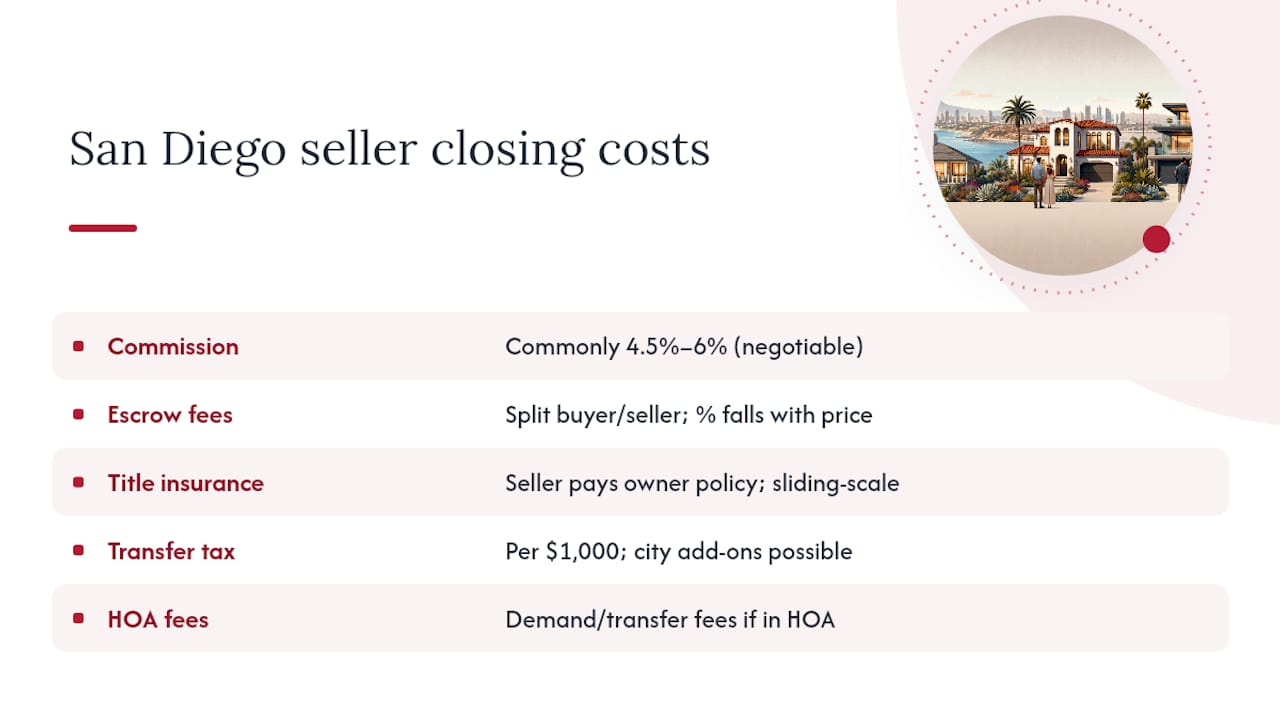
- Real estate commission: Historically 5% to 6% combined, now increasingly split and negotiated separately after the 2024 industry settlement changes. Fully negotiable.
- San Diego County documentary transfer tax: Calculated per $1,000 of sale price and set by county ordinance, though some cities layer on additional tax. Not negotiable.
- Escrow fees: Often split 50/50 between buyer and seller in San Diego County, though this is custom, not law. Negotiable.
- Owner's title insurance: Customarily seller-paid in Southern California. Shoppable between providers.
- Recording fees: Small, flat charges set by the county recorder. Fixed.
- HOA transfer and demand fees: Set by the association, ranging from modest to several hundred dollars. Fixed by the HOA, but timing is manageable.
- Prorated property taxes: Calculated to the day of closing. Not negotiable, but predictable.
Your outstanding mortgage balance isn't technically a "closing cost," but it's the first thing paid out of escrow, and for many sellers it's the biggest deduction on the settlement statement. The CFPB's Your Home Loan Toolkit walks through exactly how payoff and prorations get handled at the closing table.
How Each Seller Closing Cost Works in San Diego
Every line item on your escrow estimate has its own logic, and knowing how each one gets calculated helps you catch errors before they cost you money.
Commission used to follow a near-universal script: the seller paid a total commission, split between their listing agent and the buyer's agent. Post-2024, that structure loosened considerably. Buyer-agent compensation is now negotiated separately and disclosed upfront, which means sellers can choose whether to offer buyer-side compensation at all, offer a lower amount, or negotiate it deal by deal. Total seller-paid commission in San Diego still commonly lands in the 4.5% to 6% range, but the flexibility is real, and it's worth discussing openly with your listing agent rather than assuming a fixed number. Our breakdown of how commission structures work now covers the disclosure mechanics in more depth.
Escrow fees in San Diego County are customarily split evenly between buyer and seller, though nothing in state law requires this. Escrow companies typically charge a base fee plus a percentage of sale price, and that percentage tends to shrink as the price climbs. A $1 million sale doesn't cost twice what a $500,000 sale costs in escrow fees. Get an itemized quote before you sign anything, since escrow fee structures vary by provider even within the same county.
Owner's title insurance is customarily paid by the seller in Southern California, covering the buyer against title defects that predate the sale. Title premiums are calculated as a percentage of sale price on a sliding scale, and while the California Department of Insurance oversees rate filings for title insurers operating in the state, actual premiums still vary by company and by the specific endorsements a transaction requires. Shopping title providers, not just accepting the one escrow suggests, can shave real dollars off this line.
San Diego County's documentary transfer tax is calculated per $1,000 of the sale price, and it applies countywide. Several cities within the county, including the City of San Diego itself, layer on their own additional city transfer tax, so the total rate a seller pays depends on which jurisdiction the property sits in. Because these rates can change and vary by city, always confirm the current combined rate directly with the county recorder or your escrow officer rather than relying on a number from a generic guide.
Recording fees are small, flat charges the county assesses to record the deed and related documents. They rarely move the needle on your bottom line but still show up on the settlement statement.
HOA transfer and demand fees apply if your property sits in a homeowners' association, which is common across San Diego's newer coastal and inland developments. The HOA charges a demand fee to prepare disclosure documents and a transfer fee to process the change in ownership. These fees vary by association and can add up quickly in communities with active management companies, so request the HOA's demand statement early in escrow rather than waiting until the final days.
Mortgage payoff isn't a fee, it's a debt settlement, but it's usually the largest single deduction on your net sheet. Escrow orders a payoff demand from your lender, which includes accrued interest through the closing date, and that full amount comes off the top before you see a dime. If you have a HELOC or second mortgage, both need payoff demands, and both come out of proceeds before you do.
San Diego Net Proceeds Examples: What You Actually Take Home
Numbers make this real. Here's how the math plays out across three representative San Diego price points, using a 5% total commission, a seller-paid owner's title policy, a 50/50 escrow split, and county-only documentary transfer tax with no city add-on.
| Sale Price | Commission (5%) | Escrow & Title (est.) | County Transfer Tax | Total Closing Costs | Net Before Mortgage Payoff |
|---|---|---|---|---|---|
| $600,000 | $30,000 | $4,200 | $660 | $34,860 | $565,140 |
| $1,200,000 | $60,000 | $7,800 | $1,320 | $69,120 | $1,130,880 |
| $2,500,000 | $125,000 | $14,500 | $2,750 | $142,250 | $2,357,750 |
Now apply a mortgage payoff. If the $1,200,000 seller has a remaining loan balance of $650,000, their net drops from $1,130,880 to roughly $480,880 before any prorated property taxes or HOA fees are settled. That gap between "before payoff" and "after payoff" is exactly why sellers with significant mortgage balances need to run their own numbers rather than eyeballing a percentage.
These figures exclude city-level transfer tax, which applies in some San Diego County jurisdictions, and they assume no seller concessions or repair credits negotiated with the buyer. Adjust the escrow and title line for your specific price point since both scale with sale price but not proportionally, and swap in your actual mortgage payoff to see your true net. A request for a full net-proceeds walkthrough from a partner resource offers another useful worked example if you want to cross-check the logic.
How Can San Diego Sellers Reduce Closing Costs?
You have more leverage than most sellers realize, especially since the commission structure loosened up.
- Negotiate your listing commission directly. Ask what services justify the rate, and don't assume the first number quoted is final.
- Decide buyer-agent compensation deal by deal. You can offer it, adjust it, or skip it entirely depending on market conditions and how competitive your listing is.
- Shop at least two escrow and title providers. Request itemized fee sheets, not verbal quotes, and compare line by line.
- Weigh concessions against price cuts. A $10,000 repair credit sometimes closes a deal faster than a $10,000 price reduction, and the tax and cost implications differ.
- Consider cash or as-is offers when speed matters more than maximizing every dollar. These deals often carry lower inspection-related costs but may come with a lower purchase price overall.
Pro Tip: Ask your escrow officer for a preliminary net sheet the week you list, not the week you go into contract. Seeing the real numbers early lets you negotiate from a position of knowledge instead of surprise.
Do Liens or Judgments Affect Your Closing Costs?
Any outstanding lien or judgment against the property has to be paid off or resolved before title can transfer clean, and that obligation comes directly out of your proceeds at closing. This includes obvious items like a second mortgage or HELOC, but also less obvious ones: unpaid contractor liens, HOA assessment liens, tax liens, or a judgment recorded against you personally that attached to the property.
Escrow runs a title search early in the process specifically to surface these. If something unexpected turns up, your escrow officer or a real estate attorney typically needs to get involved to negotiate payoff amounts, especially with contractor liens that sometimes get filed at inflated amounts hoping for a quick settlement. That negotiation itself can add time and occasionally legal fees to your closing costs. A real estate attorney's involvement in closing becomes far more valuable when a title report comes back with surprises rather than a clean record.
The practical lesson: pull your own title report before you list if you suspect any liens exist. Discovering a $40,000 judgment during escrow, with a closing date already promised to a buyer, is a far worse negotiating position than discovering it three months earlier.
Who Pays for Repairs the Buyer Requests?
Repair negotiations after inspection are one of the most common ways a seller's expected net shrinks between contract signing and closing. San Diego buyers routinely request repair credits or price reductions after a home inspection surfaces issues like roof age, foundation cracks, outdated electrical panels, or drainage problems common in the region's clay soil.
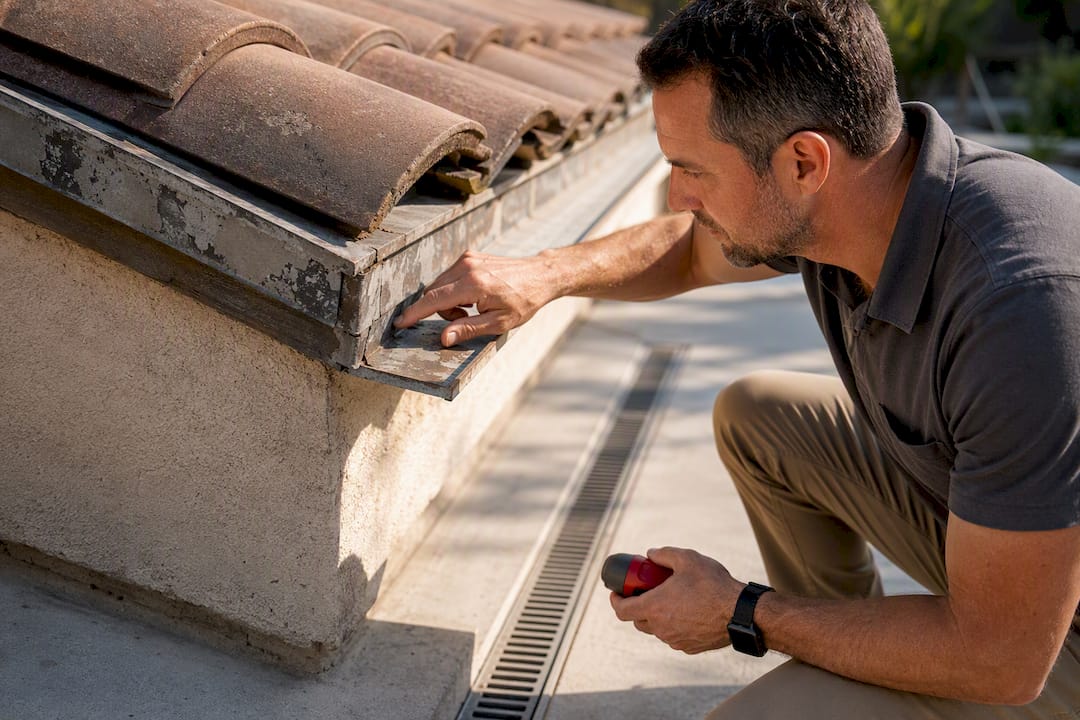
You have three options when this happens: complete the repairs yourself before closing, offer a credit at closing so the buyer handles it after taking possession, or hold firm and risk losing the deal. Credits are far more common than actual completed repairs, since buyers often prefer cash flexibility over trusting a seller's contractor choice. That credit reduces your net proceeds dollar for dollar, the same as any other closing cost, even though it never appears as a line item labeled "repairs."
Older homes, particularly in established neighborhoods like North Park, South Park, or parts of La Jolla, tend to generate longer repair request lists. Getting a pre-listing inspection done before you go on market gives you the chance to fix cheap items yourself and price around bigger ones, rather than negotiating blind after you're already in contract.
Are There Special Assessments or District Fees in San Diego?
Some San Diego neighborhoods carry additional obligations beyond standard property tax, most commonly Mello-Roos special tax assessments tied to Community Facilities Districts that funded infrastructure like schools, roads, or utilities when a development was built. These assessments run with the property and get prorated at closing just like regular property taxes, meaning the seller pays their share through the closing date.
Newer master-planned communities in areas like Otay Ranch, San Elijo Hills, and parts of Carmel Valley are more likely to carry Mello-Roos obligations than older, established neighborhoods. These aren't hidden fees exactly, they show up on your property tax bill, but sellers sometimes forget they exist until escrow calculates the proration and buyers ask pointed questions about the total tax burden they're inheriting.
Separately, some properties fall within a local improvement district or lighting and landscaping district that assesses a smaller annual fee for specific neighborhood infrastructure. These are also prorated at closing. Pull your property tax bill before listing so you know exactly what's on it, and be ready to explain any special assessment to buyers clearly, since an unexplained line item on a tax bill makes buyers nervous and can slow negotiations.
Customary Versus Statutory Closing Costs: What's the Difference?
Statutory costs are set by law and don't move no matter who you negotiate with. San Diego County's documentary transfer tax is statutory. Recording fees are statutory. Prorated property taxes follow a legally defined calculation. None of these are up for discussion.
Customary costs are different. They're set by regional habit, not by law, and habits can be renegotiated. The 50/50 escrow fee split common in San Diego County is customary, not required. The seller-paid owner's title policy is customary in Southern California but isn't universal even within California, let alone nationwide, according to 805title's California closing-cost breakdown. Commission splits, who pays for a home warranty, and who covers a natural hazard disclosure report are all customary rather than statutory.
Understanding which category a fee falls into tells you where you actually have negotiating room. Arguing with your escrow officer about the documentary transfer tax rate wastes everyone's time. Asking your agent whether the customary 50/50 escrow split can shift, or whether you really need to pay for the owner's title policy, is a legitimate conversation worth having before you sign a listing agreement.
Who Pays the Escrow Officer's Fee in San Diego?
San Diego County custom splits the escrow officer's fee evenly between buyer and seller, and that practice has held steady even through the commission-structure changes of the past couple of years. The escrow officer acts as a neutral third party holding funds and documents until every condition of the purchase agreement is satisfied, and both parties benefit from that neutrality, which is the traditional justification for splitting the cost.
Nothing has fundamentally changed about this arrangement recently, but the broader post-2024 shakeup in how agents disclose and negotiate compensation has made sellers more likely to ask questions about every fee on their settlement statement, escrow fees included. That scrutiny is healthy. Escrow companies set their own fee schedules, typically a base charge plus a small percentage of sale price, and those schedules aren't identical across providers even within the same county.
If you want to negotiate the split itself rather than just the amount, that's possible but less common than negotiating commission. Most purchase agreements simply reference "customary" allocation, and unless your agent or attorney flags it specifically, escrow proceeds on the standard 50/50 assumption by default. Reviewing our guide to how the escrow closing process works for sellers before you're deep in a transaction gives you the vocabulary to ask informed questions when your preliminary settlement statement arrives.
How Have Recent Rule Changes Affected San Diego Seller Costs?
The most consequential shift affecting seller closing costs recently isn't a new tax or fee, it's the change in how buyer-agent compensation gets disclosed and negotiated following the 2024 industry settlement. Sellers are no longer locked into a single assumed commission structure, and buyer-agent compensation now requires separate, explicit agreement rather than being baked silently into the listing.
This has made the commission conversation more transparent but also more variable. Some San Diego sellers are negotiating lower total commission percentages than the historical norm. Others are finding that in competitive listing situations, offering strong buyer-agent compensation still helps generate showings and offers, effectively keeping costs similar to before, just now disclosed explicitly rather than assumed.
Interest rate conditions have also shaped the concession landscape. When financing costs run high, buyers lean harder on sellers for rate buydowns or closing-cost credits instead of price reductions, which shows up on your net sheet as a negotiated cost rather than a market-driven one. None of this changes the statutory fees, documentary transfer tax and recording fees stay exactly as county and city ordinances define them, but it means the customary and negotiable side of your closing-cost picture deserves fresh attention rather than assumptions carried over from a few years ago.
Stu Harvey's Perspective: Closing Costs in San Diego's Luxury and Coastal Markets
Fifteen years and more than $1.2 billion in closed transactions has taught me that closing-cost surprises cluster in the same places every time: HOA-governed developments, high fire-hazard zones requiring extra disclosures, and coastal properties with layered title history. In La Jolla and Rancho Santa Fe deals, I've seen targeted negotiation on escrow allocation and title endorsement selection save sellers tens of thousands of dollars that a generic percentage estimate never would have flagged.
Higher price points don't just scale fees proportionally, they often introduce entirely new line items: enhanced title endorsements, more detailed HOA demand statements, and escrow handling that takes longer because there's simply more to verify. If your sale price sits above San Diego's median, don't extrapolate from a friend's net sheet on a smaller home. Request a specialist net sheet built for your exact property and mortgage situation before you list, not after you're already fielding offers.
— Stu Harvey
Get a Custom Net Sheet Before You List in San Diego
A local real estate expert can provide San Diego sellers with a net-proceeds estimate built around actual mortgage balances, HOA fee schedules, and neighborhood micro-market quirks rather than a national average.
That review includes a custom payoff estimate coordinated directly with your lender, a full audit of every escrow and title line item before you commit to a provider, and a negotiation strategy tailored to current San Diego conditions rather than a script from three years ago. Working with a local specialist means someone who has coordinated HOA demand statements in Rancho Santa Fe and navigated coastal disclosure requirements in La Jolla, not someone learning your neighborhood's quirks in real time during your escrow. If you're weighing a sale and want real numbers instead of a rough percentage, start with a property search and consultation request and get your custom seller net sheet built before you commit to a listing date.
Sources
The CFPB's Your Home Loan Toolkit remains the clearest consumer breakdown of escrow, proration, and mortgage payoff mechanics. For title insurance rate context specific to California, the California Department of Insurance oversees rate filings for insurers operating statewide. Confirm your exact combined documentary transfer tax rate directly with the San Diego County Recorder or your city's finance department, since city-level add-ons vary and change over time.
- Closing costs for home sellers (NerdWallet)
- California closing costs — buyer & seller breakdown (805title)
FAQ
How Much Do Sellers Pay in Closing Costs in California?
California sellers typically pay between 6% and 10% of the sale price in total closing costs, with commission as the largest component, according to NerdWallet and California-specific data from 805title.
How Much Are Closing Costs on a $400,000 Home?
Total seller closing costs vary depending on commission rate, escrow and title fees, and county documentary transfer tax, before any mortgage payoff is deducted.
How Much Are Closing Costs on a $500,000 House in California?
At $500,000, sellers can expect roughly $30,000 to $50,000 in total closing costs using the same 6% to 10% range, though the exact figure shifts with negotiated commission and whether city-level transfer tax applies.
Is Commission Still the Biggest Closing Cost for San Diego Sellers?
Yes. Even with post-2024 changes to how buyer-agent compensation is disclosed and negotiated, commission remains the single largest closing-cost line item for most San Diego sellers.