
Capital gains tax on a luxury home sale applies to the profit above your adjusted cost basis, after subtracting any IRS exclusions you qualify for. Under IRS Section 121, single filers can exclude up to $250,000 of gain and married couples filing jointly can exclude up to $500,000. The catch: luxury homes routinely generate gains well above those thresholds. Approximately 13.1 million U.S. homeowners hold capital gains exceeding the federal exclusion limits, and that number skews heavily toward high-value markets like La Jolla, Newport Beach, and the Hollywood Hills. Knowing how to calculate your gain, which rates apply, and which strategies reduce your bill is the difference between a good outcome and an avoidable tax shock.
What is capital gains tax on a luxury home sale?
Capital gains tax on a luxury home sale is a federal (and often state) tax on the profit you earn when you sell a home for more than you paid for it, adjusted for improvements and selling costs. The IRS treats this profit as a capital gain, not ordinary income, which means it qualifies for preferential long-term rates if you held the property for more than one year.
The Section 121 exclusion is the most powerful tool available to homeowners. To qualify, you must have owned the home and used it as your primary residence for at least 24 months out of the last 60 months before the sale. Both the ownership test and the use test must be satisfied. Partial exclusions are available if you fail to meet the full two-year requirement due to a job change, health issue, or other qualifying unforeseen circumstance.
The critical misconception luxury sellers carry into closing is that the exclusion applies to the sale price. It does not. The exclusion applies to the capital gain itself. A home purchased for $1.5 million and sold for $4 million generates a $2.5 million gain before adjustments. A married couple's $500,000 exclusion still leaves $2 million exposed to tax. That exposure demands a plan.

How do you calculate your taxable gain accurately?
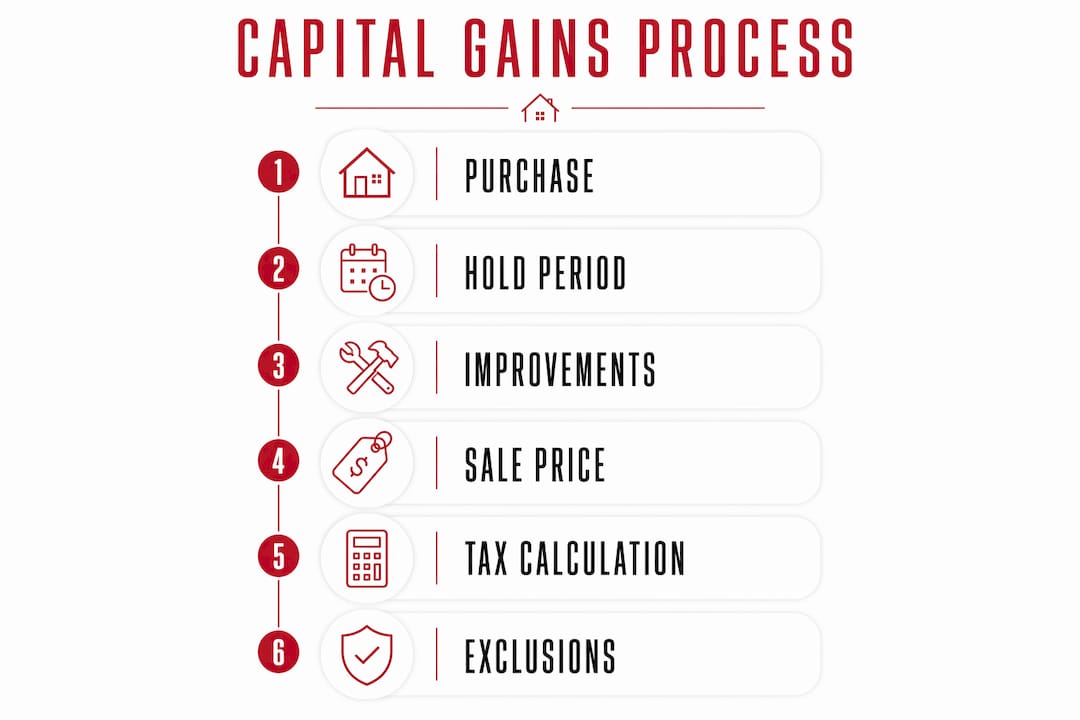
Your taxable gain is the sale price minus your adjusted basis, minus your selling costs, minus any applicable exclusion. Getting each of those numbers right is where most sellers leave money on the table.
Your adjusted basis starts with the original purchase price. You then add the cost of capital improvements made during ownership. The IRS distinguishes capital improvements from repairs. Capital improvements add value, extend the home's useful life, or adapt it to a new use. These include additions, kitchen and bathroom remodels, a new roof, HVAC replacement, and pools. Routine repairs and maintenance do not count. Documenting capital improvements thoroughly is one of the highest-return activities a luxury seller can do before listing.
Selling costs also reduce your taxable gain. Agent commissions, transfer taxes, escrow fees, and title insurance all qualify. On a $4 million sale, a 5% commission alone removes $200,000 from your taxable gain.
- Purchase price: $1,500,000
- Capital improvements: $400,000
- Adjusted basis: $1,900,000
- Sale price: $4,200,000
- Selling costs: $250,000
- Net proceeds: $3,950,000
- Gross gain: $2,050,000
- Section 121 exclusion (married): $500,000
- Taxable gain: $1,550,000
Pro Tip: Keep a dedicated folder, physical or digital, for every capital improvement receipt from the day you close on a luxury property. Contractors' invoices, permits, and architect fees all count. Sellers who reconstruct records years later almost always miss deductions.
What tax rates apply to luxury home capital gains?
Federal long-term capital gains rates fall into three tiers: 0%, 15%, or 20%, based on your taxable income. High-income sellers, the majority of luxury homeowners, pay the 20% federal rate on gains above the top threshold. That rate alone is significant, but it is not the full picture.
The Net Investment Income Tax (NIIT) adds 3.8% on top of the federal rate for sellers whose modified adjusted gross income (MAGI) exceeds $200,000 for single filers or $250,000 for married couples filing jointly. A luxury home sale almost always pushes MAGI above those thresholds in the year of sale. That brings the effective federal rate to 23.8% before state taxes enter the calculation.
State taxes vary dramatically and can reshape your net proceeds. California taxes capital gains as ordinary income, with a top marginal rate of 13.3%. States like Texas, Florida, and Nevada impose no state income tax at all. Combined effective rates for high-income sellers in California can reach approximately 37% on gains above the exclusion.
| Tax component | Rate | Applies when |
|---|---|---|
| Federal long-term capital gains | 20% | High-income sellers |
| Net Investment Income Tax (NIIT) | 3.8% | MAGI above $200K/$250K |
| California state income tax | Up to 13.3% | California residents |
| States with no income tax | 0% | TX, FL, NV, and others |
| Combined top rate (CA example) | ~37% | High earners in California |
Timing a sale to land in a year when your other income is lower can move you into the 15% federal bracket instead of the 20% bracket. That single decision on a $1.5 million taxable gain saves $75,000 in federal tax alone.
Advanced strategies to reduce your capital gains tax liability
Sellers with gains well above the Section 121 exclusion have several legitimate strategies available. Each requires planning before the sale closes, not after.
-
Maximize your adjusted basis. Pull every capital improvement receipt you have. Additions, landscaping upgrades, solar installations, and home automation systems all qualify if they added value. A thorough basis review with a CPA before listing often uncovers tens of thousands in overlooked deductions.
-
Use an installment sale. Rather than receiving the full sale price at closing, you structure the transaction so the buyer pays you over several years. Installment sales spread taxable gain across multiple tax years, which can keep your annual income below the NIIT threshold and potentially below the 20% capital gains bracket.
-
Consider a charitable remainder trust (CRT). A CRT allows you to transfer appreciated property into a trust, which sells the home tax-free. The trust pays you an income stream for a set period, and the remainder goes to a designated charity. This strategy eliminates capital gains tax entirely on the transferred gain, though it requires genuine charitable intent and irrevocable commitment.
-
Reinvest in a Qualified Opportunity Zone (QOZ). Rolling capital gains proceeds into a Qualified Opportunity Zone fund defers the original gain and, if held long enough, can exclude a portion of the new appreciation from tax entirely. This strategy suits sellers who want to redeploy capital into real estate or business investments in designated low-income communities.
-
Engage a tax advisor before you list. The strategies above require structuring decisions made before closing. A CPA or tax attorney specializing in high-net-worth real estate transactions can model each option against your specific income, basis, and charitable goals. Waiting until after the sale eliminates most of your options.
Pro Tip: If you own a luxury real estate portfolio, coordinate the timing of multiple asset sales across different tax years. Staggering gains prevents a single year's income spike from triggering the highest brackets and NIIT simultaneously.
Practical tips for selling luxury real estate with taxes in mind
Selling a luxury home with a strong after-tax outcome requires preparation that starts long before you call your agent.
- Maintain organized records from day one. Every permit, contractor invoice, and design fee belongs in a dedicated file. Recordkeeping for luxury home sales is not just good practice. It is the foundation of your adjusted basis calculation and your first line of defense in an audit.
- Confirm your primary residence status. The Section 121 exclusion requires 24 months of ownership and use within the last 60 months. If you split time between multiple properties, document which one is your primary residence with utility bills, voter registration, and tax filings.
- Time the sale to your income calendar. If you expect a lower-income year due to retirement, a business transition, or reduced investment distributions, that year is your best window. Selling in a high-income year layers your gain on top of already elevated ordinary income.
- Plan for the luxury home selling timeline. Luxury homes typically take 60 to 120 days to close. Sellers who exit within 18 to 36 months of purchase risk unfavorable market timing and price concessions. Holding a luxury property for at least five years generally maximizes both sale price and tax efficiency.
- Work with advisors who know luxury markets. A general real estate agent and a general CPA are not the same as specialists who understand how luxury market cycles, property types, and high-net-worth tax situations interact. The difference in outcome is material.
The most common pitfall is misunderstanding what the Section 121 exclusion actually covers. Sellers who assume the exclusion wipes out most of their tax liability on a $4 million sale are often surprised to find they still owe hundreds of thousands of dollars. Clarity on this point, early in the process, shapes every other decision.
Key Takeaways
Minimizing capital gains tax on a luxury home sale requires accurate basis calculation, strategic timing, and professional guidance applied before the sale closes.
| Point | Details |
|---|---|
| Section 121 exclusion limits | Single filers exclude up to $250,000; married couples exclude up to $500,000 of capital gain. |
| Adjusted basis reduces your tax | Add capital improvements and subtract selling costs to lower your taxable gain before applying exclusions. |
| Combined rates can reach 37% | Federal 20%, NIIT 3.8%, and California state tax up to 13.3% stack for high-income sellers. |
| Advanced strategies require early action | Installment sales, charitable remainder trusts, and opportunity zone investments must be structured before closing. |
| Holding period matters | Luxury homes take 60 to 120 days to sell; holding for 5+ years protects both price and tax position. |
What I've learned from 15 years of luxury home sales
Most luxury sellers come to me with two assumptions that cost them money. The first is that the $500,000 exclusion will cover most of their gain. In markets like La Jolla or Newport Beach, where appreciation over a decade can easily reach $2 million or more, that exclusion is a starting point, not a solution. The second assumption is that tax planning happens after the sale. By then, the options are gone.
What I've seen work consistently is sellers who treat the tax conversation as part of the listing strategy, not an afterthought. They bring their CPA into the room before we set a price. They know their adjusted basis before we discuss timing. They understand whether an installment sale or a trust structure fits their broader financial picture. That preparation translates directly into higher net proceeds.
The shift I'm watching in 2026 is that wealthy sellers are reconsidering capital lock-up risks and prioritizing portfolio liquidity over lifestyle-driven ownership. That means more sellers are entering the market with a financial thesis, not just a desire to move. That's a healthy shift. It means they're asking the right questions earlier. The sellers who struggle are the ones who treat a $4 million home sale like a $400,000 home sale and assume the process will sort itself out.
My advice: get your records in order, get your advisors aligned, and get your tax strategy set before you sign a listing agreement. The planning window is shorter than most people think.
— Stu Harvey
Selling your luxury home with Stu Harvey Estates
Stu Harvey Estates brings more than 15 years of luxury real estate expertise and over $1.2 billion in sales volume to every transaction across San Diego, Los Angeles, Orange County, and Southern California. That depth of experience means understanding not just how to price and market a luxury home, but how timing, documentation, and sale structure affect your after-tax outcome.

Stu Harvey works directly with sellers to coordinate the right advisors, prepare accurate records, and position each property for the strongest possible result. Whether you're selling in Rancho Santa Fe, the Hollywood Hills, or Newport Beach, the process starts with a conversation. Browse current luxury listings or reach out to Stu Harvey Estates to discuss your sale strategy today.
FAQ
What is the IRS exclusion for capital gains on a home sale?
The IRS Section 121 exclusion allows single filers to exclude up to $250,000 of capital gain and married couples filing jointly to exclude up to $500,000. You must have owned and lived in the home as your primary residence for at least 24 months within the last 60 months before the sale.
How does the Net Investment Income Tax affect luxury home sellers?
The NIIT adds 3.8% to your capital gains tax if your modified adjusted gross income exceeds $200,000 as a single filer or $250,000 as a married couple. A luxury home sale almost always pushes income above those thresholds in the year of sale, making the NIIT a near-certain cost for high-value transactions.
What counts as a capital improvement for tax purposes?
Capital improvements include additions, kitchen and bathroom remodels, new roofs, HVAC replacements, pools, and other upgrades that add value or extend the home's useful life. Routine repairs and maintenance do not qualify and cannot be added to your adjusted basis.
Can I defer capital gains tax by reinvesting in another property?
A standard home sale does not qualify for a 1031 like-kind exchange if the property is your primary residence. However, sellers can defer gains by reinvesting proceeds into a Qualified Opportunity Zone fund, or by structuring an installment sale to spread gain recognition across multiple tax years.
How long does it take to sell a luxury home?
Luxury homes typically take 60 to 120 days to close from listing to settlement. Sellers who plan to exit within 18 to 36 months of purchase risk unfavorable market timing. Holding a luxury property for at least five years generally produces better pricing outcomes and a stronger tax position.