
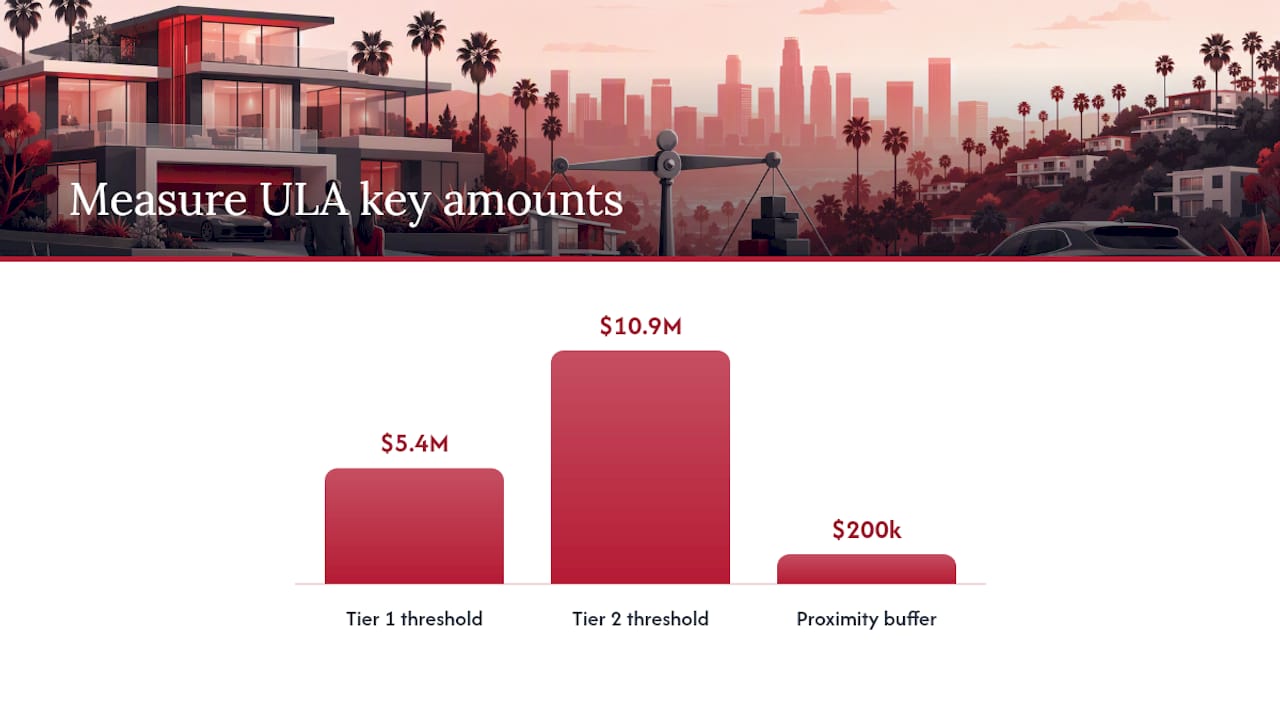
Measure ULA is Los Angeles's transfer tax on high-value real estate. Sales at or above $5,400,000 are taxed at 4%, and sales at or above $10,900,000 are taxed at 5.5%, applied to the entire sale price, not just the amount over the threshold. The tax took effect April 1, 2023, and the thresholds adjust every year.
TL;DR:
- The entire sale price is taxed once a property crosses the threshold, not just the amount above it, making precise pricing critical.
- Properties such as residential, commercial, or entity-controlled transfers in Los Angeles are subject if they meet the price thresholds, but exemptions and city borders limit applicability.
- The tax has generated significantly less revenue than projections, with declines in new construction permitting and owners opting to remodel rather than sell near thresholds.
- Strategies to manage Measure ULA include careful pricing, timing, entity restructuring, and consulting tax counsel to avoid unintended tax liabilities.
- Thresholds are adjusted annually for inflation, and sellers of homes priced within $200,000 of these thresholds should run net-proceeds estimates before listing.
Table of Contents
- Measure ULA Rates and Thresholds: The Real Math Behind the Mansion Tax Los Angeles Sellers Pay
- Which Properties and Transfers Trigger the Los Angeles Mansion Tax
- What the Numbers Show: Revenue Collected vs. Market Fallout
- Smart, Legal Ways to Handle Measure ULA in a Deal
- How the City Collects, Adjusts, and Audits the Tax
- How Stu Harvey Guides Luxury Clients Through Measure ULA
- The Policy Tradeoff Every Stakeholder Should Watch
- Get a Net-Proceeds Estimate Before You List
- Where to Verify These Figures Yourself
- Sources
- FAQ
Measure ULA Rates and Thresholds: The Real Math Behind the Mansion Tax Los Angeles Sellers Pay
The confusion trips up more sellers than it should: Measure ULA is not a marginal tax. Cross a threshold by one dollar, and the entire sale price gets taxed at that tier, not just the sliver above the line. For the fiscal year beginning July 1, 2026, the thresholds sit at $5,400,000 and $10,900,000, adjusted annually for inflation.
Here's what that looks like in dollars:
- A $6,000,000 sale falls in the 4% tier: $6,000,000 × 0.04 = $240,000 owed.
- A $12,000,000 sale hits the top 5.5% tier: $12,000,000 × 0.055 = $660,000 owed.
- A sale at $5,399,000, one thousand dollars under the line, owes nothing under Measure ULA.
That last example is the one that keeps agents and sellers up at night. A single dollar can cost hundreds of thousands. Current thresholds are always verifiable through the City of Los Angeles Office of Finance FAQ, which updates the figures each fiscal year.
Which Properties and Transfers Trigger the Los Angeles Mansion Tax
Measure ULA reaches further than single-family mansions. It applies broadly across property types and, in some cases, to transfers that never touch a traditional sale contract.
- Residential property, including single-family homes, condos, and multi-unit residential buildings sold at or above the threshold.
- Commercial and mixed-use property, such as office buildings, retail centers, and apartment complexes, where the sale price crosses $5,400,000.
- Entity transfers, where ownership of an LLC or corporation holding qualifying real estate changes hands in a way the city treats as a change in property control.
- Certain exempted transactions, including transfers to some government agencies, qualified affordable housing organizations, and specific nonprofit transfers, which can narrow the tax's reach.
- Jurisdictional limits, since Measure ULA only applies inside the City of Los Angeles. Property in incorporated cities like Beverly Hills, Santa Monica, or Culver City falls outside its reach entirely, even when they border L.A. neighborhoods.
Legal analysis from Schorr Law notes the ordinance's full-price application creates real incentive to structure deals carefully, especially near entity transfers, where the city scrutinizes whether a transaction was designed mainly to dodge the tax.
What the Numbers Show: Revenue Collected vs. Market Fallout
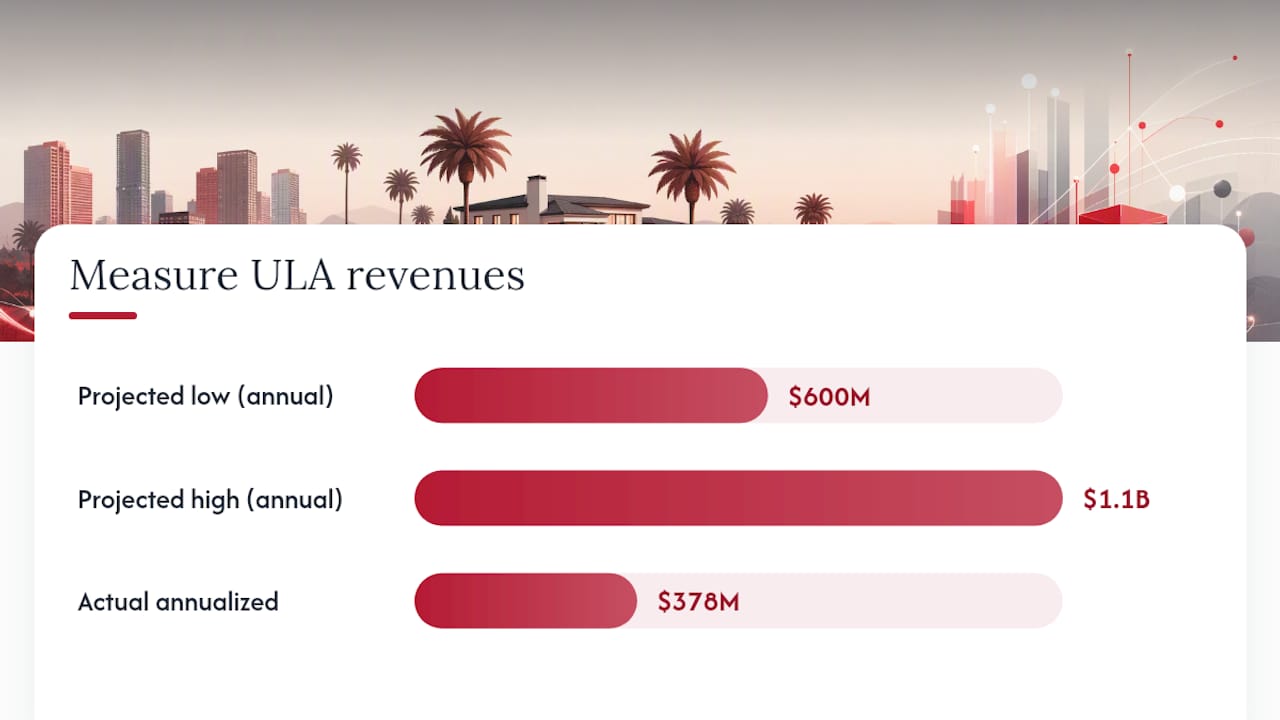
The city projected Measure ULA would bring in $600 million to $1.1 billion a year. Reality has landed well short of that range.
By the numbers: Los Angeles collected roughly $944 million over the tax's first 30 months, according to city reporting summarized by UCLA Anderson, which works out to about $378 million a year, well under even the low end of original estimates.
Where that money comes from surprises a lot of people. Single-family mansions supply a meaningful chunk, but they don't dominate the ledger. Reporting on city data shows offices, retail properties, and apartment buildings account for a large share of total revenue, which complicates the "mansion tax" label the public campaign leaned on.
The construction side tells a starker story. UCLA researchers found that after Measure ULA took effect:
- ADU development in the city dropped by roughly 70% compared with pre-tax baselines.
- Multifamily construction permits fell about 27%.
- Overall construction permits across the city declined close to 40%.
These declines outpaced nearby suburbs that never adopted a similar tax, which is the detail that makes the UCLA Anderson analysis hard to dismiss as noise from rising interest rates alone. Rate hikes explain part of the national slowdown in permits, but the gap between Los Angeles and its neighbors points squarely at the tax itself. Researchers also flagged a lock-in effect: owners near the threshold increasingly choose to remodel or hold rather than sell, which tightens inventory in exactly the price bracket where luxury buyers are shopping.
Smart, Legal Ways to Handle Measure ULA in a Deal
None of this means high-value deals in Los Angeles are stuck. It means the planning has to start earlier than most sellers expect.
- Price negotiations near a threshold should account for who absorbs the tax; buyers and sellers frequently split it or adjust the offer price to land just under $5,400,000 or $10,900,000.
- A 1031 exchange can defer federal and state capital gains tax on investment property, but it does nothing for Measure ULA. The transfer tax applies at the point of sale regardless of exchange status.
- Entity restructuring before a sale can occasionally shift how a transaction is classified, but the city looks hard at substance over form. A restructuring with no business purpose beyond dodging the tax invites an audit and potential penalties.
- Sellers should ask their agent to run a net-proceeds estimate the moment a home is priced anywhere near either threshold, before an offer ever comes in.
Pro Tip: If your home is priced within $200,000 of a threshold, get a written net-proceeds comparison at both the current price and a slightly lower one. Sometimes trimming the ask by a small amount nets more in your pocket than crossing the line does.
Anyone considering a structural workaround, an entity transfer, or a disputed exemption should loop in tax counsel before escrow opens, not after.
How the City Collects, Adjusts, and Audits the Tax
Measure ULA has been in force since April 1, 2023, and the city collects it at closing, alongside the standard Los Angeles real property transfer tax. Escrow officers calculate the amount due based on the recorded sale price and remit it to the Office of Finance as part of closing costs, which shows up on the closing statement next to other line items covered in our guide to Los Angeles closing costs.
The Office of Finance FAQ is the authoritative source for exemption applications, refund requests, and audit procedures. Thresholds reset every July 1 based on inflation indexing, so a price that clears the line this year might not next year. Always confirm current figures directly with the Office of Finance before finalizing a contract.
How Stu Harvey Guides Luxury Clients Through Measure ULA
A knowledgeable agent builds net-proceeds models before a listing goes live, so sellers see the real number, not the headline price. This involves running the math at the actual asking price and at a slightly adjusted one when a home sits close to $5,400,000 or $10,900,000, then explaining what each scenario nets after tax.
For deals with structural complexity, entity ownership or unusual timing, coordination with escrow officers and tax counsel helps avoid issues during the contract process.
The Policy Tradeoff Every Stakeholder Should Watch
Measure ULA funds housing programs but appears to be shrinking the inventory it was meant to help. Watch three things: City Council votes on exemption carve outs, any ballot measure activity, and the next annual revenue report against original projections. For now, owners near the thresholds should plan every deal as if the current rates hold.
— Stu Harvey
Get a Net-Proceeds Estimate Before You List
A specialized luxury real estate service offers modeling of net proceeds at actual and nearby price points before signing anything, avoiding surprises about Measure ULA costs after accepting an offer.
That means seeing the real number on a $5.3 million listing versus a $5.5 million one, or understanding what a $10.9 million sale actually nets after the top-tier rate applies. Stu Harvey Estates coordinates directly with escrow and tax counsel on structure-sensitive deals, so nothing about entity transfers or timing catches you off guard mid-contract. If you're weighing a sale anywhere near either threshold, request a home valuation or start a conversation with the sellers team now, while there's still room to plan the price, not just react to it.
Where to Verify These Figures Yourself
Current thresholds and rates come straight from the Office of Finance FAQ. Revenue allocation is tracked on the LA Housing Department's ULA revenue page. For the deeper research on market effects, read the UCLA Anderson analysis and the Schorr Law ordinance explainer.
Sources
- Assessing Los Angeles Measure ULA: objectives, efficacy, impact, and legal compliance — USC Law for Business
- Real Property Transfer Tax and Measure ULA FAQ — City of Los Angeles Office of Finance
- LA’s Mansion Tax, Intended to Aid Affordable Housing, May Have Backfired — UCLA Anderson Review
- Measure ULA revenue — Los Angeles Housing Department
FAQ
How Does the Mansion Tax Work in LA?
Measure ULA taxes the entire sale price of a property once it crosses $5,400,000, at 4%, or $10,900,000, at 5.5%. It's collected at closing alongside the standard transfer tax, and the Office of Finance handles payment and exemption processing.
Can I Sell My House to My Son for $1?
Selling for a nominal price like $1 doesn't work the way people hope. The city and county still assess transfer taxes based on the property's fair market value in most cases, and an artificially low sale price designed to dodge Measure ULA invites an audit rather than an exemption.
How Do I Avoid the Los Angeles Mansion Tax Legally?
There's no legal way to avoid Measure ULA on a qualifying sale, but pricing just under a threshold, timing a sale carefully, and getting a net-proceeds comparison before listing are the main compliant levers available. A 1031 exchange defers capital gains tax but has no effect on Measure ULA, since the transfer tax applies at the point of sale regardless.
How Much Is the LA Mansion Tax?
For the fiscal year beginning July 1, 2026, it's 4% on sales from $5,400,000 to just under $10,900,000, and 5.5% on sales at $10,900,000 or above. Both rates apply to the full sale price, and thresholds adjust every year.
Does Measure ULA Apply Outside the City of Los Angeles?
No. Measure ULA only applies to property within the City of Los Angeles's boundaries. Neighboring incorporated cities such as Beverly Hills and Santa Monica are not subject to it, even for properties just blocks away.