In Los Angeles, plan for roughly 2% to 5% of the purchase price in buyer-side closing costs, with the city's documentary transfer tax and prepaid tax and insurance escrows, pushing most transactions toward the high end of that range. Sellers typically absorb transfer taxes and settlement costs amounting to several percent of the sale price, including agent commissions. The Loan Estimate and Closing Disclosure your lender issues are the only documents that give you exact numbers.
TL;DR:
- Transfer taxes including city, county, and Measure ULA surtax can significantly raise costs on high-value sales, sometimes exceeding escrow and title fees combined.
- Buyers should compare multiple loan estimates early to negotiate lower origination, underwriting, and processing fees, especially for jumbo and luxury loans.
- In Los Angeles, buyer closing costs generally range from 2% to 5% of the purchase price, with higher absolute costs for luxury properties due to scale and taxes.
- Negotiations on who pays for title policies, escrow, and transfer taxes are flexible and can significantly impact total closing expenses for both parties.
- Early validation of transfer tax exposure, title issues, and insurance costs can prevent costly surprises that threaten the closing timeline, especially on high-value properties.
Table of Contents
- Closing Costs In Los Angeles: The Full Line-Item Breakdown
- Budgeting By Price Point: Three LA Scenarios
- Who Pays What, And How To Negotiate It
- Transfer Taxes And Measure ULA: The LA-Specific Cost Nobody Budgets Enough For
- Cutting Your Closing Costs Without Slowing Down Escrow
- Timing Your Cash: From Loan Estimate To Final Wire
- Stu Harvey's Checklist For Avoiding LA Closing-Cost Surprises
- Why Proactive Closing-Cost Planning Pays Off In Luxury Deals
- Sources
- FAQ
Closing Costs In Los Angeles: The Full Line-Item Breakdown
Every LA closing runs through the same categories, though the dollar amounts swing hard depending on loan size, property type, and how the deal gets negotiated. Here's what actually shows up on a settlement statement.
Lender fees cover origination, underwriting, and any discount points you buy to lower your rate. A cash buyer skips this category entirely, which is one reason all-cash offers close faster and cheaper in LA's competitive luxury segment. On a financed deal, lender charges commonly range in the low thousands of dollars depending on loan size, before points.
Title insurance splits into two policies: an owner's policy that protects your equity and a lender's policy that protects the bank's lien. Southern California custom generally has the seller pay for the owner's title policy while the buyer covers the lender's policy, though this is a negotiable point in the purchase contract, not a fixed rule.
Escrow fees pay the neutral third party handling funds and paperwork through closing. These typically get split evenly between buyer and seller in Los Angeles, unlike some other states where one side customarily absorbs the whole fee.
Recording fees are small (usually under $200) but mandatory. The county charges to officially record the deed and any new mortgage.
Prepaid items catch buyers off guard most often. These include:
- Property tax escrow, often two to six months upfront depending on your closing date relative to the tax calendar
- Homeowners insurance, typically a full year paid at closing
- Prepaid mortgage interest, covering the days between closing and your first payment
- HOA transfer fees, common in condo buildings and gated communities
- Natural hazard disclosure reports, which run $100 to $150 and are standard in LA given wildfire and seismic zoning
None of these fees are set in stone. Title, escrow, and even some lender charges are shoppable, and buyers routinely negotiate who pays what during contract talks.
Budgeting By Price Point: Three LA Scenarios
The 2% to 5% rule that industry calculators use as a baseline holds up in Los Angeles, but the city's own transfer tax and the sheer scale of luxury pricing mean actual dollar figures vary enormously by tier. Loan type matters too: FHA and VA loans carry specific fee caps and funding requirements, while jumbo loans (anything above the conforming limit) often come with higher underwriting fees and larger prepaid interest reserves.
- A $700,000 purchase. Buyer-side closing costs typically range in the lower tens of thousands of dollars for moderately priced homes, with the exact amount depending on loan and local factors. Cash buyers at this price point often see costs closer to $10,000 since they skip lender fees entirely. Sellers on a comparable sale usually net out 6% to 8% of the price in combined commission, transfer tax, and settlement charges.
- A $1.5 million purchase. This is where LA's documentary transfer tax starts to bite harder in absolute dollars. Buyer costs generally run several tens of thousands of dollars, and jumbo financing (standard at this price tier) adds underwriting complexity that can push origination fees higher than a conforming loan would. Sellers should budget for transfer tax plus escrow costs eating into proceeds before commission is even calculated.
- A $6 million luxury sale. Here the math changes shape entirely. Measure ULA's supplemental tax kicks in on top of standard transfer tax, and that single line item can add tens of thousands of dollars to what the seller owes at closing. Buyer-side costs on a multi-million-dollar home, even with strong financing, commonly reach a substantial amount once title insurance premiums (which scale with price) and prepaid tax escrow are factored in.
The pattern across all three tiers: percentage-based fees like transfer tax and title insurance grow linearly with price, but flat fees like recording and escrow admin stay roughly the same in dollar terms. That means the percentage of price you lose to closing costs often shrinks slightly at the very top of the market, even as the absolute dollar figure grows.
Who Pays What, And How To Negotiate It
Southern California custom generally has sellers cover the owner's title policy and buyers cover the lender's policy, but "custom" is not "contract." Everything is negotiable until both parties sign, and the party with more leverage in a given market usually gets their preference written in.
Buyers gain real leverage by comparing Loan Estimates from at least three lenders line by line. Origination charges and "other costs" sections vary more than most buyers expect, and lenders know competing quotes get compared. Once you're near closing, the Closing Disclosure has to match the Loan Estimate closely; if fees jumped without explanation, that's your cue to ask questions before you wire funds.
Practical moves that actually shift dollars:
- Ask sellers for a credit toward closing costs instead of a price reduction. In a softer market, sellers often prefer this because it doesn't affect the comparable sales data on their street.
- Roll smaller costs into your loan amount rather than paying cash at closing, if your loan-to-value ratio has room.
- Split escrow fees according to local custom, but push back if one side tries to shift the whole bill onto you.
- Request an itemized explanation for any fee labeled vaguely as "processing" or "administrative." These are the categories the CFPB has specifically flagged in its junk-fee inquiry.
Pro Tip: Get your Loan Estimate the same week from every lender you're comparing. Rates and fees move daily, and a quote from Monday isn't a fair comparison against one pulled the following Friday.
Transfer Taxes And Measure ULA: The LA-Specific Cost Nobody Budgets Enough For
Los Angeles stacks two layers of transfer tax on top of each other, and this is the single biggest reason LA closing costs run higher than the statewide average. The county levies a standard documentary transfer tax, and the city of Los Angeles adds its own per-$1,000 charge on top of the county rate for any property within city limits.
Then there's Measure ULA. Sales above certain price thresholds trigger a supplemental city tax, and Measure ULA's surtax structure applies specifically to the portion of the sale price above those thresholds, not the entire transaction. This matters enormously for anyone selling in the $5 million-plus range, which covers a meaningful share of listings in the Hollywood Hills, Bel Air, and other premium LA neighborhoods.
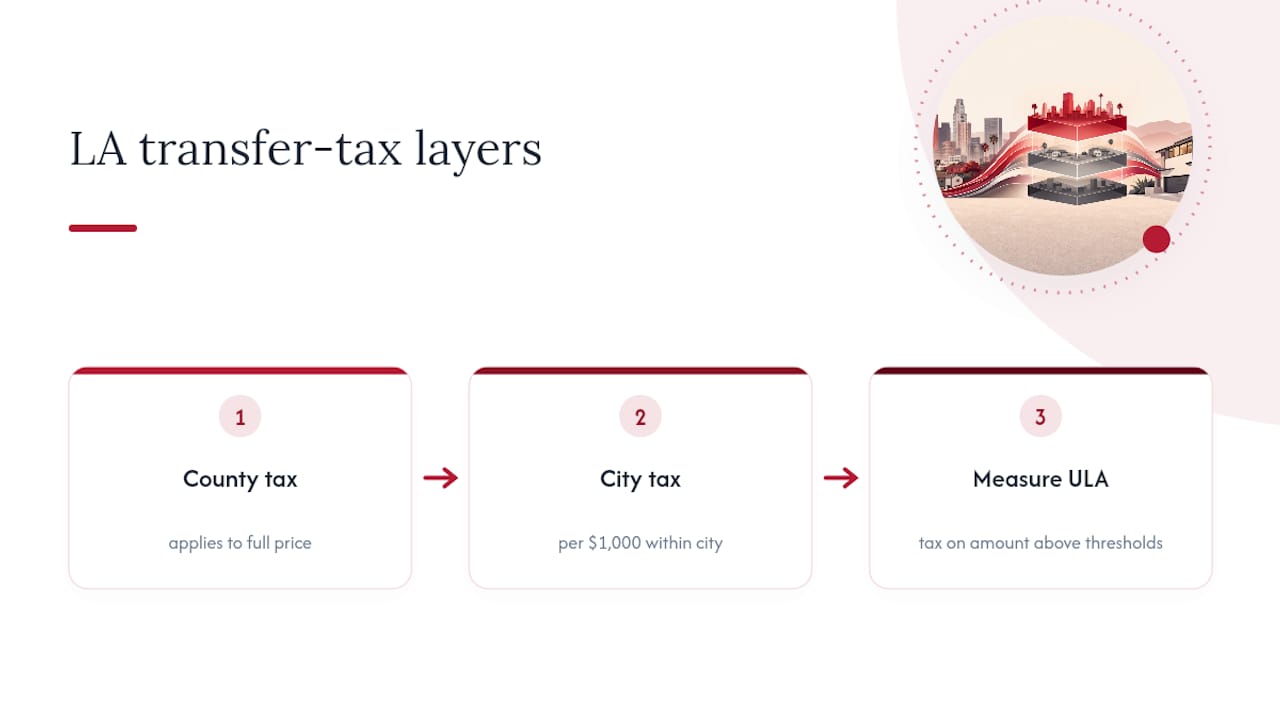
The math that surprises sellers: on a multi-million-dollar sale, combined county transfer tax, city transfer tax, and the Measure ULA surtax can represent one of the largest single line items on the settlement statement, sometimes exceeding the escrow and title fees combined.
Confirm exact exposure directly with LA's Office of Finance or the county recorder before you price a luxury listing or make an offer near a ULA threshold. A detailed look at how these taxes affect net proceeds on high-value sales is worth reviewing if you're selling anywhere near those price bands.
Cutting Your Closing Costs Without Slowing Down Escrow
You don't have to accept whatever the first lender or title company quotes you. A handful of moves, done early, save real money without adding risk to the deal.
- Get Loan Estimates from at least three lenders and compare origination charges, underwriting fees, and points side by side. Shopping multiple lenders is consistently the highest-impact action a buyer can take.
- Ask for seller concessions during negotiation, especially in a market where a property has sat unsold for more than a few weeks. This is realistic leverage, not wishful thinking, once a seller has priced in the likelihood of a price cut anyway.
- Shop title and escrow providers separately from your lender's recommendation. Ask which fees are refundable if the deal falls through and which are sunk costs the moment you pay them.
- Time your homeowners insurance start date carefully. Starting coverage a few days early or late can change your prepaid interest calculation more than buyers expect.
- Consider a lender credit if you're short on cash to close. You'll pay a slightly higher rate in exchange for the lender covering part of your closing costs, which can make sense if you plan to refinance within a few years.
Pro Tip: Ask your escrow officer for a preliminary net sheet the moment you're in contract, not the week before closing. Seeing the numbers early gives you time to negotiate credits while you still have leverage.
Timing Your Cash: From Loan Estimate To Final Wire
Federal rules set the clock here, not local custom. Your lender must send a Loan Estimate within three business days of your application, and the Closing Disclosure has to arrive at least three business days before your scheduled closing.
That three-day Closing Disclosure window matters because it's your real chance to catch fee changes before wiring money. Between those documents, tax and insurance escrow accounts get funded, and this is where Prop 13 reassessment surprises some buyers: your new tax bill, based on the purchase price, can be significantly higher than what the seller was paying, which increases the escrow cushion your lender requires upfront.
Before wiring funds, verify wire instructions by phone using a number you already had on file, never one from an email. Wire fraud targeting real estate closings is common enough that title companies now warn every client in writing. Your escrow officer, not your agent or lender, issues the final settlement statement.
Stu Harvey's Checklist For Avoiding LA Closing-Cost Surprises
Experienced real estate professionals know that the surprises that blow up a closing timeline are almost always things that could have been checked in week one.
- Run a preliminary title search immediately after going into contract, not two weeks before closing
- Confirm exact transfer tax exposure, including whether Measure ULA applies, before finalizing your offer price on anything above the ULA threshold
- Check wildfire and seismic zoning early. Insurance availability and cost in some LA hillside neighborhoods has changed fast, and a policy that was easy to get two years ago may require extra underwriting now
- Review your Loan Estimate line by line with your agent, not just your loan officer
If you're navigating a purchase or sale anywhere in Los Angeles, Orange County, or San Diego, Stu Harvey's buyer team can walk through exactly what your specific price point and property type mean for your closing statement.
Why Proactive Closing-Cost Planning Pays Off In Luxury Deals
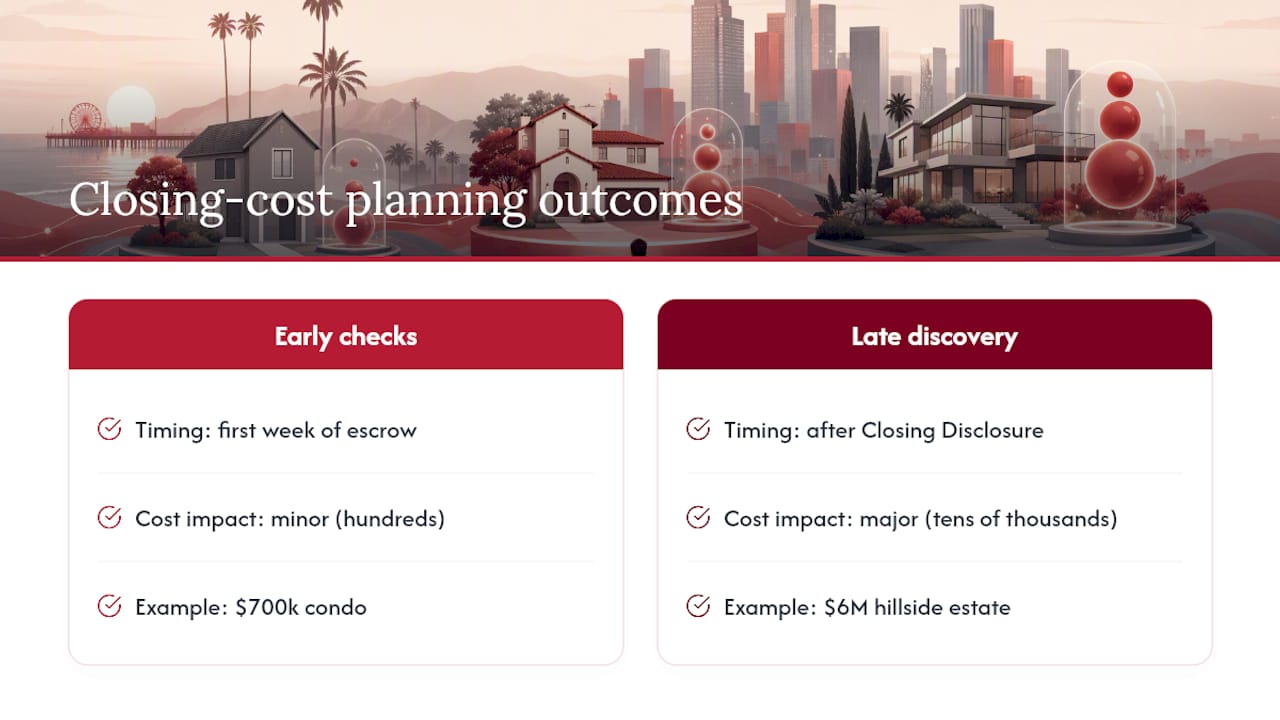
The gap between a smooth luxury closing and a stressful one almost never comes down to the lender or the escrow company. It comes down to how early someone checked the details that actually move money: transfer tax exposure, title chain issues, insurance availability in a fire zone. On a $700,000 condo, a missed detail might cost you a few hundred dollars. On a $6 million hillside estate, the same category of oversight can cost tens of thousands.
That's why I push every client, buyer or seller, to run the transfer-tax and title checks in the first week of escrow rather than the last. Waiting until the Closing Disclosure arrives to discover a Measure ULA surtax you didn't budget for is a solvable problem that becomes unsolvable purely due to timing.
— Stu Harvey
This article is general information, not a substitute for advice from a qualified financial advisor. Consult a qualified financial professional about your own circumstances before acting on anything here.
Sources
- CFPB launches inquiry into junk fees in mortgage closing costs | Consumer Financial Protection Bureau
- Measure ULA | Office of Finance, City of Los Angeles
- Documentary transfer taxes general info | Los Angeles County Registrar-Recorder/County Clerk
- Los Angeles Closing Cost Calculator (2026) | LoanElk
FAQ
How Much Are Closing Costs On A $500,000 House In California?
Buyer-side closing costs typically range in the lower tens of thousands of dollars for moderately priced homes, with Los Angeles transactions usually closer to the higher end of the typical 2% to 5% range due to city transfer tax and prepaid escrow requirements.
How Much Are Closing Costs On A $400,000 House?
Buyer-side closing costs on a $400,000 home generally run $8,000 to $20,000, following the same 2% to 5% range that applies across most California price points.
What Are Typical Closing Costs For A $1 Million Home In California?
Buyer-side closing costs on a million-dollar purchase generally run several tens of thousands of dollars, and in Los Angeles, sellers should factor in the city's documentary transfer tax and potential Measure ULA exposure if the sale price crosses ULA's threshold.
How Much Are Closing Costs On A $300,000 Purchase?
Lower-priced homes usually incur buyer closing costs in the lower tens of thousands of dollars, with cash purchases often coming in near the lower end since lender fees disappear entirely.
Who Typically Pays Closing Costs In Los Angeles, The Buyer Or Seller?
Both sides pay costs, but in different categories: buyers generally cover lender fees and the lender's title policy, while sellers typically cover the owner's title policy, transfer taxes, and commission, though every item is negotiable in the purchase contract.