
Proposition 19 is in effect, and it does two very different things depending on who you are. If you're 55 or older, severely disabled, or lost a home to wildfire or disaster, it lets you carry your old property tax bill to a new home anywhere in California, up to three times. If you're inheriting property from a parent or grandparent, it narrows the old exclusion sharply, often forcing a reassessment unless you move in and the value stays under a $1 million cushion. The rules took effect on February 16, 2021, and April 1, 2021, and they apply differently depending on which side of Prop 19 you're standing on.
TL;DR:
- The portability benefit now allows seniors and disaster victims to transfer their property tax basis anywhere in California up to three times, with strict deadlines and specific purchase timing requirements.
- The inheritance exclusion is limited to principal residences and farms, with a $1 million value cap above the property's base year value, and heirs must move in within one year to preserve the low tax basis.
- Transfers completed before February 16, 2021, or before April 1, 2021, are still evaluated under the old rules, making timing critical for estate planning and tax planning.
- Buying a replacement home before selling the original can trigger full taxes if not timed correctly, especially when the new property's value exceeds the initial home's by more than 105 or 110 percent within the allowable windows.
- Proper claim filing and documentation, including timely main forms and residency proof, are essential to avoid reassessment, and families should seek expert valuation and legal guidance before making big moves.
Table of Contents
- What Proposition 19 Changed and When It Took Effect
- Base Year Value Transfer Rules for Seniors, Disabled Homeowners, and Disaster Victims
- Intergenerational Transfer Exclusion: The $1 Million Cap and Residency Test
- How to Claim Prop 19 Relief: A Step-by-Step Filing Checklist
- Real Numbers: How Portability and the $1 Million Test Actually Work
- A Practitioner's View on Timing, Trusts, and Transaction Strategy
- Common Filing Mistakes County Assessors See Constantly
- What I Tell Clients Navigating Prop 19
- Get Expert Help Navigating Your Prop 19 Transaction
- Where to Verify These Rules Yourself
- Sources
- FAQ
What Proposition 19 Changed and When It Took Effect
California voters approved Proposition 19 in November 2020, and it rewrote two separate corners of the state's property tax rulebook. The measure amended the California Constitution, which means the California State Board of Equalization has no authority to extend deadlines or soften the rules, no matter how sympathetic a claimant's situation is.
The first change expanded who can move their tax base without triggering a full reassessment. Before Prop 19, that portability was limited mostly to same-county or select-county moves. Now homeowners aged 55 and up, people with severe disabilities, and victims of wildfire or another declared disaster can transfer their taxable value to a replacement home anywhere in the state, and they can do it up to three times in their lifetime, according to BOE guidance.
The second change tightened what used to be one of the most generous tax breaks in the state: the parent-child exclusion. Under the prior rules (Proposition 58 and its grandparent-grandchild companion, Proposition 193), a child could inherit a parent's home, rent it out, keep it as a vacation property, and still pay taxes based on the parent's decades-old assessed value. Prop 19 ended that. Now the inherited home only keeps its favorable tax basis if the heir moves in as a primary residence, and even then, only up to a $1 million cushion above the original taxable value.
The dates matter more than most people realize:
- February 16, 2021 is the operative date for the new intergenerational transfer rules. Transfers completed on or before February 15, 2021 are still evaluated under the old Prop 58/193 rules.
- April 1, 2021 is the operative date for the expanded base year value portability rules for seniors, disabled homeowners, and disaster victims.
- Both dates are locked into the state constitution, meaning neither the BOE nor county assessors can grant exceptions based on when escrow closed or when a family "meant" to file.
This is why the framing matters for estate planning. A family that assumed they'd inherit a rental property tax free the way an older relative did in 2015 is often in for a surprise. The Legislative Analyst's Office projected that the narrower inheritance exclusion would raise local property tax revenue over time, even as the portability expansion reduces bills for the seniors and disabled homeowners who use it. Prop 19 was designed as a trade, not a giveaway.
Base Year Value Transfer Rules for Seniors, Disabled Homeowners, and Disaster Victims
This is the part of Prop 19 that homeowners tend to like. If you qualify, you can sell your current home and buy a replacement anywhere in California, keeping the lower taxable value you built up over years or decades instead of resetting to full market value on the new purchase.
Eligibility comes down to three groups: homeowners 55 or older, people with a severe and permanent disability, and owners whose home was destroyed or substantially damaged in a wildfire or governor-declared disaster. In every case, you must have owned and lived in the original property as your principal residence at the time of sale. A rental property or vacation home you own doesn't qualify, even if you're over 55.
The mechanics work like this:
- Sell your original home and either purchase or begin new construction on a replacement within two years of that sale (or in the other order, replacement first, then sale, which we'll get to).
- File the correct claim form with the county assessor: BOE-19-B for age 55 and up, BOE-19-D or BOE-19-DC for severe disability, or BOE-19-V for disaster victims. BOE rules generally require filing within three years of the replacement purchase to lock in the benefit.
- Use the benefit up to three times in your lifetime. That's a meaningful change from the old rules, which typically allowed just one transfer.
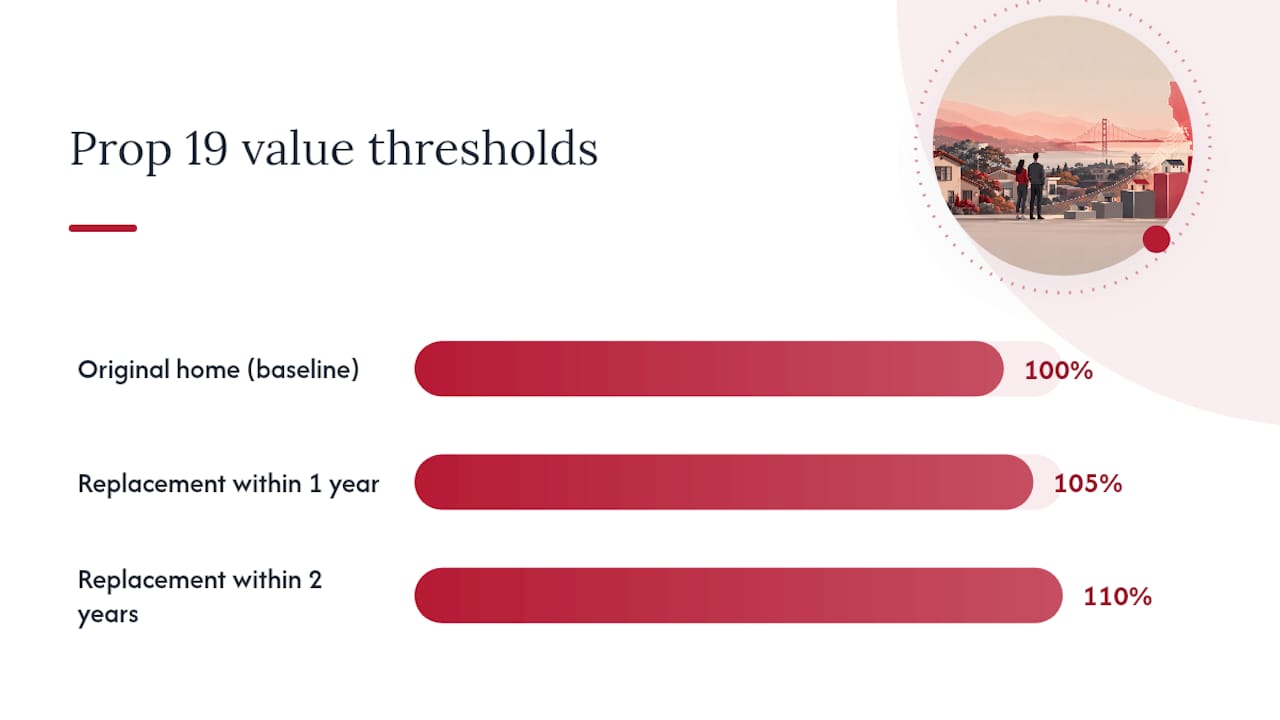
Here's where the math gets specific. If your replacement home costs more than your original one, you don't automatically lose the whole benefit. The BOE fact sheet lays out a sliding scale: if you buy the replacement within the first year after selling, the replacement's market value can exceed your original home's value by up to 105% before you owe tax on the excess. If you buy in the second year, that threshold loosens to 110%. Anything above those thresholds gets added to your transferred taxable value, so you're not getting a completely free upgrade, just a partial one.
Pro Tip: If you're even considering buying before you sell, talk to your assessor's office first. Buy the replacement before the original sells, and you're on the hook for full market-value property taxes on the new home for however long both properties overlap, with no refund for that period. It's one of the costliest and most common timing mistakes in this entire process.
Intergenerational Transfer Exclusion: The $1 Million Cap and Residency Test
This is the part of Prop 19 that catches families off guard, often at the worst possible time, right after losing a parent.
The exclusion for transfers between parents and children, or grandparents and grandchildren when the parents are deceased, now applies only to a family home or a family farm. It's no longer available for investment property, and it comes with a hard residency requirement.
Here's what qualifying actually requires:
- The person inheriting the property must move in and claim it as their principal residence within one year of the transfer.
- They must file for the homeowners' exemption (or the disabled veterans' exemption, if applicable) within that same window to preserve the benefit.
- Only the first $1 million of market value above the property's existing factored base year value is excluded from reassessment. Anything above that gets added to the taxable value. That $1 million figure adjusts every two years for inflation, per BOE guidance.
- If the heir doesn't move in, or moves out later and stops using it as a primary residence, the property gets reassessed at full market value going forward.
Consider what this means in practice. A family farmhouse a parent bought in 1985 for $150,000 might carry a factored base year value of around $350,000 today. If it's now worth $1.2 million on the open market, the $1 million allowance covers the gap between $350,000 and $1.35 million, so the child inherits it at the same low taxable value, assuming they move in and file on time. But if that same home is worth $1.6 million, the $250,000 above the allowance gets added to the taxable base, and the child's tax bill jumps accordingly.
Rentals and vacation homes get hit hardest. A sibling who inherits a share of a beach cottage and keeps it as a second home, rather than moving in, loses the exclusion entirely. The county reassesses it at full market value the moment the transfer records, which can multiply a modest tax bill several times over.
Pro Tip: File BOE-19-P for parent-child transfers or BOE-19-G for grandparent-grandchild transfers as soon as the transfer records. Missing the one-year residency-exemption window is one of the most common reasons an otherwise-eligible family loses this benefit entirely, according to BOE enforcement guidance.
How to Claim Prop 19 Relief: A Step-by-Step Filing Checklist
Every county assessor's office handles intake slightly differently, but the core sequence is consistent statewide. Miss a step, and you're often looking at a full reassessment with no easy path to reverse it.
- Identify your scenario first. Are you transferring your own base year value (portability) or receiving an inherited property (intergenerational exclusion)? The forms and deadlines differ.
- Gather your documents. You'll typically need the recorded deed, proof of prior ownership and occupancy (utility bills, driver's license, tax returns), and, for disability claims, a physician's certification or BOE-19-DC.
- File the correct BOE form with your county assessor, not the state. For portability: BOE-19-B, BOE-19-D, or BOE-19-V. For inheritance: BOE-19-P or BOE-19-G.
- File your homeowners' exemption (BOE-266) or disabled veterans' exemption (BOE-261-G) within one year if you're the transferee on an intergenerational claim. This step gets skipped constantly, and it's costly when it does.
- Confirm your filing window. Portability claims generally need to be filed within three years of the replacement purchase; intergenerational exclusion claims should be filed as soon as possible after the transfer records, per BOE checklist guidance.
- Track processing time. Most counties take several weeks to months to process a claim, and they may request additional documentation before finalizing your assessed value.
- If you miss a window, contact the assessor immediately. Some relief is available for late filing in limited circumstances, but it's never guaranteed, and interest or penalties may already have accrued.
Good recordkeeping habits from the outset, saving deeds, escrow statements, and occupancy proof as you go rather than scrambling later, make this entire process faster and far less stressful when a claim is contested.
Real Numbers: How Portability and the $1 Million Test Actually Work
Abstract rules are easy to nod along to and hard to actually apply. Here's how the math plays out in three common situations.
- Downsizing senior, lower-cost replacement. Say you're 62, your current home has a factored base year value of $400,000, and it sells for $900,000. You buy a smaller replacement for $700,000. Because the replacement costs less than the sale price, your new taxable value stays at $400,000, the same base year value you already had, under the rules described in the BOE fact sheet.
- Moving up, replacement costs more. Same starting point, but this time you buy a replacement for $1,000,000, exceeding your $900,000 sale price. If you buy within the first year, the 105% threshold means anything up to $945,000 is fully covered by your transferred base. The $55,000 above that threshold gets added to your $400,000 base year value, landing your new taxable value around $455,000, still far below the home's full market value.
- Inherited vacation property, no move-in. A parent's factored base year value on a lake house is $250,000. Two adult children inherit it but keep it as a shared vacation rental rather than moving in. Because neither meets the primary residence requirement, the county reassesses the property at its full current market value, say $950,000, on the date of transfer. The $1 million exclusion never comes into play because the residency test wasn't met in the first place.
These are illustrative walkthroughs, not tax-bill calculations. Actual figures depend on your county's tax rate, any local assessments, and the specific timing of your transaction.
A Practitioner's View on Timing, Trusts, and Transaction Strategy
Every family situation involving Prop 19 eventually turns into a timing question, and timing is where deals get expensive if nobody's paying attention.
For seniors weighing whether to sell and downsize, the calculation isn't just "can I afford the new mortgage." It's whether the replacement purchase falls inside the two-year window, whether you're buying before or after your current home closes, and whether the 105%/110% thresholds work in your favor given local market conditions. I've seen clients assume they had more flexibility than they did, only to discover the interim tax exposure from buying before selling added tens of thousands of dollars to a transaction they thought they'd planned carefully.

For families weighing whether to hold an inherited property, gift it, or place it in a trust, the honest answer is that this decision belongs with an estate attorney and a CPA, not a real estate agent. What I can tell you is how the property fits into the current market, what it's actually worth today versus its assessed value, and whether selling now or holding for a move-in scenario makes more financial sense given where prices are headed.
Pro Tip: Before you make any decision about a Prop 19 transfer, get a real, current valuation of the property. Assessed value and market value are often wildly different numbers, and you need both to make an informed call.
Coordinating the sequence, valuation, assessor contact, legal review, and escrow timing, is where most of these transactions either go smoothly or get expensive. That coordination is exactly where Stu Harvey Estates' valuation, selling, and buying services come in.
Common Filing Mistakes County Assessors See Constantly
Assessors process thousands of these claims every year, and the denials tend to cluster around the same handful of errors:
- Filing the homeowners' exemption after the one-year deadline, which converts an otherwise clean intergenerational transfer into a full reassessment.
- Failing to prove actual occupancy, not just intent, when claiming a primary residence for either portability or inheritance purposes.
- Misclassifying a vacation or rental property as a primary residence to try to preserve the old low tax basis.
- Buying a replacement home before selling the original without understanding the interim tax exposure.
Assessors typically request utility bills, voter registration, driver's license address, and sometimes school enrollment records to verify residency. When documentation is thin or contradictory, expect a reassessment notice and a formal appeal process rather than a quiet approval.
What I Tell Clients Navigating Prop 19
The families I work with rarely ask about Prop 19 in the abstract. They ask it while grieving a parent, or while trying to figure out if downsizing actually makes financial sense before rates or prices shift again. My advice is almost always the same: get your valuation and your paperwork in order before you make a decision, not after. A trust attorney and a CPA should be in the conversation early, especially when a $1 million cap or a two-year purchase window is involved. Timing decisions made under pressure are the ones that cost families the most.
— Stu Harvey
Get Expert Help Navigating Your Prop 19 Transaction
Stu Harvey Estates gives you something a spreadsheet and a BOE form can't: a real-time read on what your property is actually worth right now, in a Southern California market that shifts by neighborhood and by month. That matters enormously when a two-year replacement window or a 105% threshold is riding on the sale price you actually get, not the number a generic online estimator guesses at.

If you're weighing a move under the portability rules, or your family is deciding whether to keep, sell, or transfer an inherited home, start with a clear picture of the numbers. Stu Harvey Estates offers home valuation services across San Diego, Los Angeles, Orange County, and the broader Southern California coast, backed by more than 15 years of experience and over $1.2 billion in sales volume. Whether you end up needing buyer representation for a replacement property or seller representation to time your sale correctly against the two-year window, get a current valuation first. Reach out to Stu Harvey Estates and start with that number.
Where to Verify These Rules Yourself
- The BOE's Prop 19 landing page covers eligibility, forms, and the current legal framework directly from the state's tax authority.
- The BOE Prop 19 fact sheet (Pub 801) breaks down filing deadlines, the 105%/110% thresholds, and the $1 million value test in detail.
- The Legislative Analyst's Office ballot analysis explains the fiscal reasoning behind the measure.
- Your county assessor's website will have the specific forms, submission portals, and processing timelines for your jurisdiction.
This article is general information, not a substitute for advice from a qualified financial advisor. Consult a qualified financial professional about your own circumstances before acting on anything here.
Sources
- Proposition 19 - California State Board of Equalization
- Proposition 19 fact sheet (BOE Pub 801)
- Proposition 19 Ballot - Legislative Analyst's Office
FAQ
Is Prop 19 Still in Effect in California?
Yes. Proposition 19 has been in effect since 2021, with intergenerational transfer rules operative February 16, 2021, and base year value portability operative April 1, 2021. Because it's written into the California Constitution, it stays in force unless voters approve another constitutional amendment to change it.
How Do You Avoid Prop 19 Reassessment in California?
You avoid full reassessment on an inherited property by moving in as your primary residence within one year and filing the homeowners' exemption on time, keeping the value increase under the $1 million allowance. For your own move, you avoid reassessment by qualifying for portability as a senior, disabled homeowner, or disaster victim and buying your replacement within the two-year window.
Can You Explain Proposition 19 in Simple Terms?
Prop 19 lets eligible homeowners, those 55 and older, severely disabled, or disaster victims, move their property tax base to a new home anywhere in California. It also narrows the old parent-child inheritance exclusion so that inherited homes only keep their low tax basis if the heir actually lives there, within the $1 million value cushion.
How Many Times Can You Use Prop 19 in California?
Eligible homeowners can use the base year value transfer benefit up to three times in their lifetime, a significant expansion from the single-use limit under the prior rules. The intergenerational exclusion for inherited property isn't a repeatable benefit in the same sense. It applies per qualifying transfer, subject to the residency and value tests.
What Forms Do I Need to File for Prop 19?
The form depends on your situation: BOE-19-B for homeowners 55 and older, BOE-19-D or BOE-19-DC for severe disability claims, BOE-19-V for disaster victims, and BOE-19-P or BOE-19-G for parent-child or grandparent-grandchild transfers. You'll also likely need BOE-266 for the homeowners' exemption, filed with your county assessor's office directly.