
A luxury portfolio diversification strategy is a deliberate allocation framework that adds low-correlation, investment-grade luxury assets — real estate, art, collectibles, and similar holdings — to a traditional stock-and-bond portfolio to reduce overall volatility and preserve wealth across market cycles.
If you manage significant wealth or advise a family office, here are five actions to take now:
-
Audit your current allocation. Identify what percentage of net worth sits in equities, fixed income, and cash versus tangible or alternative assets.
-
Tag lifestyle versus investment-grade assets. A watch you wear is not the same as a watch you bought for provenance and resale. Separate them in your wealth model.
-
Schedule independent valuations. Any luxury holding you count as an investment needs a third-party appraisal on a documented cadence.
-
Explore holding structures. LLCs, trusts, and private funds each carry different tax, estate, and governance implications. Get counsel involved before you acquire.
-
Identify your liquidity buffer. Luxury assets can take months or years to exit. Confirm you have sufficient liquid reserves before committing capital to illiquid holdings.
For Southern California property decisions, Stu Harvey Estates offers market guidance informed by Stu’s 15+ years of real estate experience and 250+ personal career transactions.
Key Takeaways
A luxury portfolio diversification strategy adds low-correlation, investment-grade luxury assets to a traditional portfolio to reduce volatility and preserve wealth, but it only works when governance, structure, and liquidity planning are in place from the start.
| Point | Details |
|---|---|
| Define investment-grade vs. lifestyle | Only assets with provenance, secondary markets, and documented returns belong in your diversification model. |
| Use the core/opportunistic/tactical framework | Illustrative bands: core 60–70%, opportunistic 20–30%, tactical 10–20% of your luxury allocation. |
| Structure before you acquire | LLC, trust, or fund selection determines tax treatment, estate inclusion, and exit mechanics — get counsel involved first. |
| Model net total return, not gross appreciation | Subtract carrying costs, insurance, storage, and transaction fees before comparing luxury returns to traditional assets. |
| Stu Harvey Estates for SoCal real estate | Over 250 personal career transactions and 15+ years of real estate experience inform Stu Harvey’s work with buyers and sellers. |
This article is general information, not a substitute for advice from a qualified financial advisor. Consult a qualified financial professional about your own circumstances before acting on anything here.
Table of Contents
-
Luxury asset categories to consider and how each typically behaves
-
How to build a luxury portfolio diversification strategy step by step
-
Risks, costs, and tax considerations unique to luxury diversification
-
How to measure performance and correlation versus traditional assets
-
A Southern California luxury real estate allocation: a practical example
-
Stu Harvey Estates: your partner for luxury real estate allocation in Southern California
Why diversification matters for wealthy investors
Portfolio diversification reduces risk by holding assets that do not move in lockstep. When one position falls, another may hold steady or rise, smoothing the overall return curve. The mathematical engine behind this is correlation: a coefficient of +1.0 means two assets move identically, while 0 or negative values signal independence or inverse movement.
For HNWIs, this matters more than it might for a retail investor with a simple 60/40 portfolio. A concentrated equity position in a single sector can wipe out years of compounding in one downturn. Adding assets with genuinely low correlation to public markets creates a buffer.
Consider a simple comparison. Blue-chip art and prime real estate in select coastal markets declined far less sharply, and some categories held value. That divergence is exactly what low correlation looks like in practice. Stocks respond to earnings, interest rates, and sentiment. A Basquiat painting or a La Jolla oceanfront estate responds to scarcity, provenance, and global demand from a narrow buyer pool.

Fidelity’s guidance on portfolio construction reinforces this: understanding risk, return, and correlation is the foundation, and periodic rebalancing is the governance mechanism that keeps the strategy honest. Diversification is not a one-time decision. It is an ongoing discipline.
How luxury assets differ from traditional investments
Luxury assets are not simply alternative investments with a prestige label. Their value drivers are structurally different from equities and bonds, and that difference is what makes them useful in a diversification context.
Traditional securities are priced on cash flows, earnings growth, and interest-rate sensitivity. Luxury assets are priced on scarcity, provenance, brand strength, cultural relevance, and the depth of a specialized global buyer pool. A Patek Philippe reference 5711 does not get cheaper because the Fed raises rates. A Malibu compound does not lose half its value because tech stocks correct.
Advisors distinguish investment-grade luxury assets from lifestyle purchases — the former can act as low-correlation diversifiers but require provenance, liquidity planning, and specialist governance. That distinction is the most important judgment call in this entire strategy.
Key attributes that separate luxury assets from traditional holdings:
-
Liquidity profile. Most luxury assets have no public market. Exit depends on finding a specific buyer, often through auction, private sale, or a specialist broker. Timelines range from weeks for a sought-after watch to years for a trophy estate.
-
Valuation complexity. There is no Bloomberg terminal for a 1961 Château Pétrus or a custom superyacht. Valuation requires specialist appraisers and is inherently subjective.
-
Transaction costs. Auction houses charge buyer’s premiums which can be significant. Real estate carries combined commissions and closing costs that are non-trivial. These are not rounding errors.
-
Authentication and provenance risk. Fakes exist in art, watches, wine, and cars. Without documented chain of custody, an asset’s value can collapse entirely.
-
Seasonality. Auction calendars, rental seasons, and buyer travel patterns create demand cycles that affect both price and liquidity timing.
-
Concentration risk. A single trophy property or a single artist’s work can represent a disproportionate share of a portfolio. Diversifying within luxury asset classes is as important as diversifying into them.
-
Storage, insurance, and maintenance. These are real carrying costs that erode net returns and must be modeled explicitly.
The liquidity-versus-return tradeoff is the central tension in luxury investing. Higher illiquidity often accompanies higher potential returns, but it also means you cannot exit cleanly in a market dislocation. A practical liquidity buffer of multiple months of operating expenses in cash or near-cash is recommended before committing to illiquid luxury positions.
Luxury asset categories to consider and how each typically behaves
Understanding the mechanics of each category helps you decide which belong in an investment allocation versus a lifestyle bucket. The Globe and Mail’s analysis of luxury asset diversification is clear: treating lifestyle purchases as consumption avoids inflating return expectations in wealth models.
-
Luxury real estate. Return drivers include location scarcity, rental income, and long-term appreciation in supply-constrained coastal markets. Liquidity is low to moderate depending on price point and market depth. Principal risks: market cycles, carrying costs, and concentration in a single geography. Access routes: direct ownership, LLCs/trusts, private funds, REITs, and fractional platforms. See types of luxury real estate investments for a breakdown of investment-grade versus lifestyle properties.
-
Blue-chip art. Return drivers are artist reputation, provenance, exhibition history, and institutional demand. Liquidity is low; major auction cycles run twice yearly. Authentication risk is high. Access routes: direct purchase, art funds, or fractional platforms like Masterworks. Carrying costs include storage, insurance, and conservation.
-
Collectible cars. Values are driven by rarity, originality, racing provenance, and marque prestige. Liquidity varies widely by model. Storage and maintenance costs are significant. Access routes: direct ownership or specialist collector funds.
-
Vintage watches. Among the more liquid luxury collectibles, with active secondary markets through dealers and auction houses. Return drivers are reference rarity, condition, and box-and-papers completeness. Authentication is critical. Access routes: direct purchase or specialist dealers.
-
Fine wine and spirits. Return drivers include vintage quality, critic scores, and producer reputation. Storage in a bonded warehouse is standard. Liquidity is moderate through specialist brokers and exchanges like Liv-ex. Provenance documentation is non-negotiable.
-
Private aviation and yachts. High carrying costs make pure ownership economically challenging. Family offices that convert these assets into managed charter programs materially change the economics, sometimes turning high carrying costs into partial revenue streams. Access routes: direct ownership, fractional ownership programs, or charter-backed structures.
-
Luxury equities and ETFs. Listed luxury vehicles provide diversified, liquid exposure to the luxury theme whereas physical ownership brings appraisal, storage, insurance, and liquidity frictions. ETFs tracking luxury conglomerates offer daily liquidity and easy reporting, making them useful tactical allocations for family offices that want thematic exposure without operational complexity.
-
Curated private funds and fractional platforms. These pool capital across multiple luxury assets, offering lower minimums and some degree of diversification within a category. Governance and fee transparency vary significantly; manager selection is critical.
The key distinction between listed and physical exposure: luxury ETFs move with equity markets more than physical assets do, which means their correlation benefit is smaller. They are useful for liquidity and tactical positioning, not as a substitute for the genuine low-correlation properties of physical holdings.
How to build a luxury portfolio diversification strategy step by step
The single best starting action is to define your objectives and liquidity constraints before touching any specific asset. Everything else flows from that.
The sequential process
-
Define objectives and constraints. What is the capital’s purpose — wealth preservation, income, appreciation, or estate transfer? What is your time horizon? What liquidity do you need in year one, year three, year ten? These answers determine which asset categories are even eligible.
-
Categorize existing holdings. Separate investment-grade assets (bought for appreciation and resale, with documented provenance and secondary markets) from lifestyle assets (bought for personal use). Only investment-grade holdings belong in your diversification model.
-
Set allocation bands and a liquidity buffer. A commonly used illustrative framework for UHNW luxury portfolios segments holdings into core (60–70%), opportunistic (20–30%), and tactical (10–20%) buckets. These are starting points for advisor conversations, not prescriptive targets. Maintain a separate liquidity buffer outside these bands.
-
Select access structures. Direct ownership, LLCs, trusts, REITs, private funds, and fractional platforms each carry different tax, governance, and liquidity profiles. Match the structure to the asset type and your estate planning goals.
-
Execute due diligence and authentication. Every acquisition needs provenance documentation, independent appraisal, authentication (where applicable), insurance commitment, and a modeled exit scenario before closing.
-
Establish governance and reporting. Assign responsibility for each asset category. Define who approves acquisitions, who manages custody and insurance, and who produces the quarterly performance report.
-
Set rebalancing rules and horizon. Decide in advance what triggers a rebalancing review: a threshold drift from target bands, a major market event, or a fixed calendar date. Luxury assets cannot be rebalanced as quickly as equities, so the rules need to account for illiquidity.
Illustrative allocation ranges
These ranges are illustrative starting points for advisor conversations, not prescriptive targets. Individual circumstances will differ significantly.
| Allocation Tier | Illustrative Range | Typical Asset Types |
|---|---|---|
| Core (stable, lower volatility) | 60–70% of luxury allocation | Prime real estate, blue-chip art, established wine |
| Opportunistic (higher return potential) | 20–30% of luxury allocation | Collectible cars, emerging artists, private funds |
| Tactical (liquid, thematic) | 10–20% of luxury allocation | Luxury ETFs, listed equities, fractional platforms |
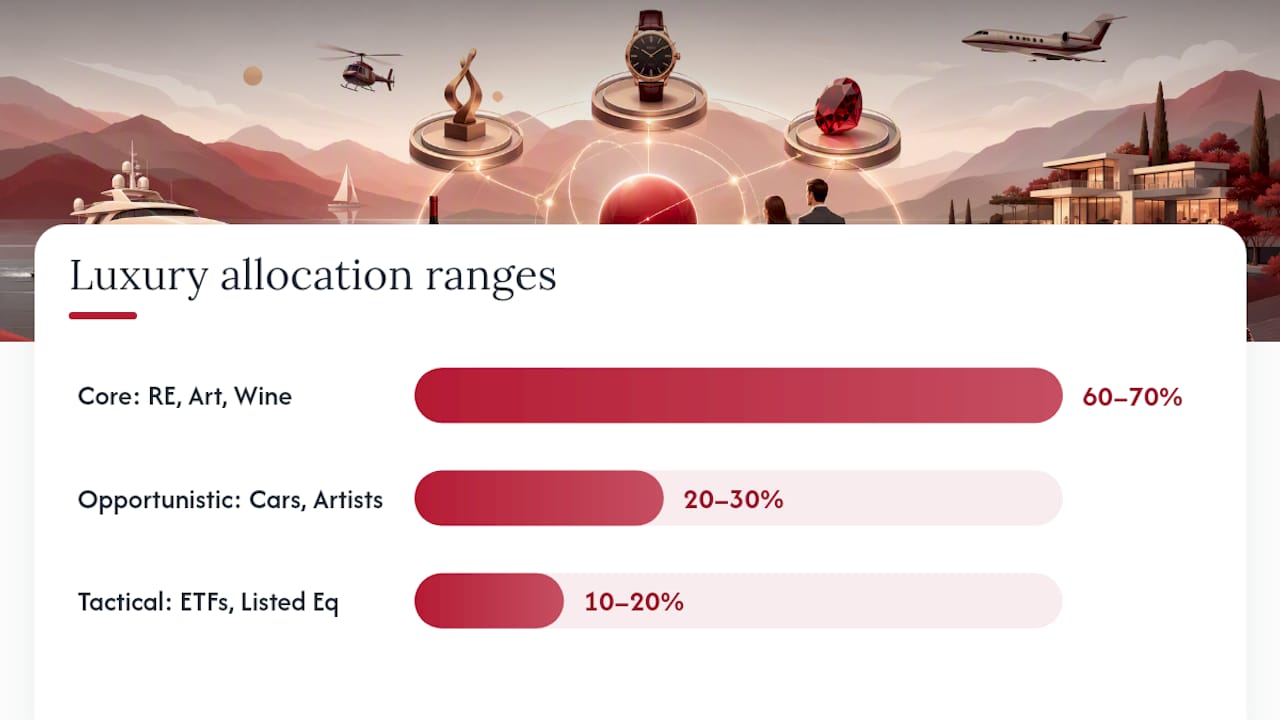
Fidelity’s framework for diversified portfolio construction recommends global diversification and periodic rebalancing as governance pillars — both apply directly to luxury allocations.
Pro Tip: Coordinate estate and tax planning with your acquisition structure before you close, not after. The entity you use to hold a $10M property determines depreciation treatment, estate inclusion, and transfer mechanics. Changing structure post-acquisition is expensive and sometimes impossible without triggering a taxable event.
How to access luxury real estate exposure in the U.S.
The most common structures for HNWIs accessing U.S. luxury real estate are direct ownership via special-purpose LLCs, revocable or irrevocable trusts, private real estate funds, publicly traded REITs, fractional platforms, and 1031 exchanges for capital gains deferral when repositioning existing investment property.
Direct ownership. The simplest structure. You hold title individually or through a single-member LLC. Pros: full control, straightforward financing. Cons: full estate inclusion, personal liability exposure, and no structural separation from other assets.
Special-purpose LLC. The most common structure for investment-grade luxury real estate among HNWIs. The LLC holds title, separating liability and enabling cleaner estate transfers. Multiple members can hold economic interests without co-owning the property directly. Operating agreements govern decision rights and distributions.

Revocable and irrevocable trusts. Revocable trusts offer probate avoidance and privacy without removing the asset from your taxable estate. Irrevocable trusts (including QPRTs and SLATs) can remove the asset from your estate at the cost of control. Trust structures are particularly useful for properties intended to pass to heirs.
Private real estate funds. Pooled vehicles managed by a GP, offering exposure to a portfolio of luxury properties without direct ownership. Useful for family offices seeking diversification within real estate without the operational burden of direct management. Liquidity is limited; lock-up periods of 5–10 years are common.
REITs. Publicly traded REITs offer daily liquidity and exposure to real estate income streams. They do not replicate the low-correlation, scarcity-driven dynamics of direct luxury property ownership, but they are useful for tactical or transitional allocations. Financing luxury investment property through a REIT structure is not the same as owning a specific asset.
Fractional platforms. Emerging platforms allow investors to hold fractional interests in specific luxury properties. Minimums are lower, but governance, liquidity, and secondary market depth vary significantly by platform. Vet the operator carefully.
1031 exchanges. When selling an investment property, a properly executed 1031 exchange defers capital gains tax on the proceeds when reinvested in a like-kind property within IRS-specified timelines. The 45-day identification window and 180-day closing window are strict. Missing either deadline eliminates the deferral. Family offices commonly use 1031 structures when repositioning investment property portfolios.
A brief note on cross-jurisdiction holding companies: U.S.-taxed principals who hold luxury real estate through foreign entities face FIRPTA withholding, FBAR reporting, and potential PFIC complications. U.S. tax counsel is not optional in these structures.
Risks, costs, and tax considerations unique to luxury diversification
The primary risk categories in luxury investing are valuation and authenticity, liquidity, storage and maintenance, insurance, concentration, counterparty and custody, and tax and estate friction. Each one can materially affect net returns, and most are invisible in a simple asset list.
-
Valuation and authenticity risk. Without a documented chain of custody and independent appraisal, you cannot price an asset accurately or defend its value in an estate or dispute. Fakes and misattributions exist across art, wine, watches, and cars.
-
Liquidity risk. A trophy property or a rare painting can take 12–36 months to sell at full value. Forced sales in illiquid markets routinely clear at 20–40% discounts. Model your exit timeline before you acquire, not after.
-
Storage, maintenance, and carrying costs. Specialist custody, insured storage, and transparent fee schedules materially reduce operational risk in physical luxury assets. Note that SIPC protections apply to securities accounts at broker-dealers, not to physical luxury assets — those require separate specialist insurance and custody arrangements.
-
Insurance. Standard homeowner’s or umbrella policies are rarely adequate for investment-grade luxury holdings. Specialist insurers (Chubb, AXA Art, Berkley One) provide agreed-value coverage with provenance-based underwriting. Underinsurance is a common and costly mistake.
-
Concentration risk. A single $15M property in one neighborhood is not a diversified real estate allocation. Spreading exposure across geographies, asset types, and price points within the luxury category reduces single-asset risk.
-
Counterparty and custody risk. Auction houses, dealers, fractional platforms, and fund managers all carry counterparty risk. Vet operators through FINRA BrokerCheck for any registered broker-dealer involved in the transaction.
-
Tax and estate friction. U.S. capital gains on luxury assets held more than one year are taxed at long-term rates (currently 20% for the highest bracket, plus the 3.8% net investment income tax for high earners). Depreciation is available for income-producing real property but not for art, wine, or collectibles. Estate inclusion at fair market value can create liquidity problems for heirs who inherit illiquid assets. Consult tax counsel before structuring any significant acquisition.
-
Transaction costs as a return drag. Auction buyer’s premiums, dealer markups, real estate commissions, fund management fees, and insurance and custody fees are all real costs. Listed luxury vehicles avoid most of these frictions, which is one reason they are useful for tactical allocations.
Due diligence and governance checklist for luxury assets
Successful luxury investing requires documented provenance, third-party valuation, insured storage, a clear exit plan, and formal governance before any capital is committed. The checklist below applies at acquisition and should be revisited on a defined cadence while holding.
-
Provenance and title. Obtain a complete chain of ownership. For real estate: title search and title insurance. For art: exhibition history, auction records, and gallery documentation. For vehicles and watches: factory records and service history.
-
Third-party appraisal. Commission an independent appraisal from a specialist with no economic interest in the transaction. For real estate, use a licensed MAI-designated appraiser. For art, use an appraiser certified by the American Society of Appraisers or the Appraisers Association of America.
-
Authentication. For art, watches, wine, and cars, authentication by a recognized authority is non-negotiable. Catalogue raisonné inclusion, factory certificates, and laboratory analysis (for wine) are standard.
-
Insurance commitment. Secure agreed-value coverage from a specialist insurer before closing. Confirm the policy covers transit, storage, and exhibition or rental use if applicable.
-
Storage and logistics. Identify the custody solution before acquisition. For physical assets: climate-controlled, insured, and access-controlled facilities. For real estate: property management and security protocols.
-
Tax analysis. Model the full tax picture: acquisition taxes, annual property or wealth taxes, income tax on rental or charter revenue, and exit taxes including capital gains and estate inclusion. Get written advice from a U.S. tax attorney or CPA.
-
Exit market validation. Identify the likely exit channel (auction, private sale, broker, secondary platform) and the realistic buyer pool before you buy. An asset with no clear exit is a liability, not an investment.
-
Counterparty vetting. For any registered broker-dealer or financial intermediary involved in the transaction, run a background check through FINRA BrokerCheck. For fund managers and platform operators, review audited financials and regulatory filings.
-
Escrow and fee transparency. Require a full fee schedule in writing before closing. Confirm escrow arrangements for any deposit or earnest money.
-
Ongoing valuation cadence. Schedule independent appraisals at least annually for portfolio reporting and insurance adequacy. For real estate, a formal broker price opinion or appraisal every 12–24 months is standard practice.
Advisor types to engage: art advisors and authenticators, specialist real estate brokers, U.S. tax counsel, specialist insurance brokers, licensed appraisers, and custodial or charter managers for aircraft and yachts. For due diligence on luxury investment property, a step-by-step framework tailored to high-value real estate transactions is available from Stu Harvey Estates.
How to measure performance and correlation versus traditional assets
Measure total return net of all ownership costs and report correlation to equities and bonds at least annually. That single discipline separates a genuine investment allocation from a collection of expensive possessions.
Correlation analysis compares how a luxury asset’s returns move relative to a benchmark like the S&P 500 or the Bloomberg U.S. Aggregate Bond Index. A correlation coefficient near zero means the asset moves independently of the benchmark, which is the diversification benefit you are paying for. A coefficient above 0.6 suggests the asset is behaving more like a traditional holding than an alternative one. Luxury ETFs, for example, tend to show higher correlation to equities than physical art or prime real estate does.
Sample KPIs for a luxury portfolio:
-
Net total return. Appreciation plus income (rent, charter revenue) minus all fees, insurance, maintenance, and storage costs. This is the number that matters.
-
Holding period IRR. Internal rate of return over the full holding period, accounting for the timing of cash flows in and out.
-
Volatility. Standard deviation of periodic valuations. Harder to measure for illiquid assets, but mark-to-market appraisals make it possible.
-
Correlation coefficient. Calculated against key benchmarks annually. Use a rolling 3-year window where data allows.
-
Liquidity-adjusted return. Discount the stated return by the estimated cost and time of exit. A 12% gross return on an asset that takes 18 months to sell at a 15% discount is not a 12% return.
-
Realized versus mark-to-market valuation. Track the gap between appraised value and actual sale price across your portfolio. A persistent gap signals either optimistic appraisals or a thin buyer pool.
Reporting cadence: quarterly for liquid holdings and listed exposure; semi-annual or annual for physical assets, anchored to independent appraisals. Use indexed benchmarks where they exist — the Mei Moses Art Index for fine art, Liv-ex for wine, and specialist real estate indices for luxury property markets. For a luxury real estate portfolio review, Stu Harvey Estates provides market-level data and transaction comparables to support performance benchmarking in Southern California.
A Southern California luxury real estate allocation: a practical example
The goal is capital preservation with moderate appreciation, a 7–10 year horizon, and no immediate income requirement.
Stu Harvey of The Oppenheim Group has 15+ years of real estate experience and 250+ personal career transactions. His market knowledge informs both the neighborhood selection and the timing assumptions in this example.
Illustrative allocation
These figures are illustrative. Actual allocations depend on individual tax situations, financing, and market conditions at time of acquisition.
Implementation checklist
-
Target neighborhoods. La Jolla, Newport Beach, Rancho Santa Fe, and the Hollywood Hills offer the supply constraints and buyer pool depth that support long-term value. Southern California market data and neighborhood-level trends inform timing.
-
Holding entity. A single-member or multi-member LLC for each property, with an operating agreement that addresses decision rights, distributions, and transfer restrictions. Coordinate with estate counsel before formation.
-
Financing. Jumbo and super-jumbo loan products are available for qualified buyers at this price point. Financing terms affect IRR materially; model both leveraged and all-cash scenarios.
-
Tenancy options. Long-term lease to a qualified tenant generates income and reduces carrying cost drag. Short-term rental in markets where it is permitted adds revenue but increases management complexity.
-
Staged exit. Plan the exit sequence before acquisition. The core property targets a 7–10 year hold; the opportunistic position may exit in 3–5 years after value-add improvements. Identify the 1031 exchange window if repositioning into another investment property.
For building a luxury real estate portfolio that holds value across cycles, the structural and timing decisions made at acquisition are more consequential than the specific property chosen.
What experienced practitioners actually think about mixing luxury and financial assets
The conventional framing of luxury portfolio diversification tends to overstate the return case and understate the governance burden. Advisors who have worked through a full market cycle with clients holding physical luxury assets will tell you the same thing: the assets that performed were the ones with documented provenance, a clear exit market, and a holding structure that was set up correctly from day one. The ones that disappointed were almost always lifestyle purchases that got reclassified as investments after the fact, or assets held in the wrong structure that created estate or tax complications at the worst possible moment.
The question I hear most often is some version of: “Should I buy the yacht or put that capital into a luxury condo?” The answer is almost always the condo, and the reasoning is straightforward. A yacht has high carrying costs, depreciates, and has a thin buyer pool even with a charter program. A well-located luxury condo in La Jolla or Newport Beach has a documented rental market, a deep buyer pool at exit, and can be held in a structure that integrates cleanly with your estate plan. The yacht is a lifestyle decision. The condo is an investment decision. Treat them accordingly.
Stu Harvey Estates: your partner for luxury real estate allocation in Southern California
Putting a luxury real estate allocation into practice requires more than a property search. It requires market intelligence, holding-structure coordination, and a broker who understands the difference between a lifestyle purchase and an investment-grade acquisition.
Stu Harvey Estates offers property sourcing, valuation guidance, and market analysis for Southern California buyers and sellers. Services include investment-grade property identification, comparative market analysis, holding-structure coordination with your legal and tax counsel, and concierge-level transaction execution from offer to close. Whether you are searching active luxury inventory or ready to discuss a structured allocation with an advisor, Stu Harvey Estates is the resource for Southern California implementation.
To start a planning conversation, contact Stu Harvey Estates directly through Stuharveyestates with your target allocation range, preferred neighborhoods, and timeline. Prepare your current portfolio summary, liquidity parameters, and any existing holding structures for the initial call.
This article is general information only and does not constitute tax, legal, or investment advice. Consult a qualified tax attorney, CPA, and legal counsel before structuring any luxury asset acquisition or implementing any allocation strategy.
Sources
-
Portfolio diversification: What it is and how it works | Vanguard
-
How luxury assets can contribute to portfolio diversification - The Globe and Mail