
The 2026 baseline conforming loan limit for a one-unit home is $832,750, and the high-cost ceiling for the same property type is $1,249,125. Any mortgage above your county's published conforming figure is a jumbo loan, full stop. That's the standard industry term for what's often called a "non-conforming" mortgage, and it matters because jumbo loans follow different rules for down payments, reserves, and pricing.
- Baseline conforming limit (one-unit, most counties): $832,750
- High-cost ceiling (one-unit, expensive metros): generally 150% above the baseline limit in these areas
- Jumbo threshold: any amount above your specific county's limit
- Action: check your county before assuming you're in jumbo territory
Key Takeaways
Jumbo financing in 2026 hinges on one number: your county's conforming loan limit, which determines whether you need a jumbo loan at all.
| Point | Details |
|---|---|
| Know the 2026 baseline | The one-unit conforming limit is $832,750 nationally, a 3.26% increase over last year. |
| Check the high-cost ceiling | Expensive metro areas get a ceiling of $1,249,125 for one-unit properties. |
| Always confirm your county | Limits vary by county, so use the FHFA lookup map before assuming your loan is conforming or jumbo. |
| Prepare for stricter underwriting | Expect larger reserves, possibly two appraisals, and tighter credit expectations as loan size grows. |
| Work with local expertise | Stu Harvey Estates coordinates jumbo-aware lenders and financing timelines for Southern California luxury buyers. |
Table of Contents
- Jumbo Loan Limits 2026: Baseline and High-Cost Figures by Property Size
- How to Check Your County's Conforming Loan Limit Before You Shop
- What Changes When Your Loan Crosses Into Jumbo Territory
- Jumbo Loan Eligibility Criteria: A Practical Prep Checklist
- What Southern California Buyers Need to Know About Jumbo Financing
- Jumbo Loan Limits Then and Now: What the Trend Line Tells You
- Why Jumbo Loans Often Cost More Than Conforming Loans
- Documentation Gaps Between Jumbo and Conforming Applications
- Fixed-Rate and ARM Options for Jumbo Borrowers
- Weighing the Tradeoffs of Jumbo Financing Right Now
- Refinancing Considerations When Your Loan Sits Above Conforming Limits
- Why the Standard Jumbo Advice Falls Short for Luxury Buyers
- Get Local Guidance Before You Shop for a Jumbo-Financed Home
- Sources
Jumbo Loan Limits 2026: Baseline and High-Cost Figures by Property Size
The Federal Housing Finance Agency sets these numbers annually based on national home price movement, and 2026 brought a 3.26% bump over last year's baseline. That increase flows through to Fannie Mae's published loan limit table and Freddie Mac's underwriting systems simultaneously, since both government-sponsored enterprises operate off the same FHFA figures.
For 1 to 4 unit properties, the baseline and high-cost figures scale up together:
- One unit: $832,750 baseline / $1,249,125 ceiling
- Two units: higher baseline / proportionally higher ceiling
- Three units: higher still, following the same 150% ceiling ratio
- Four units: the highest baseline tier, capped at 150% in high-cost areas
Quick Fact: The high-cost ceiling is set as a multiplier of the baseline limit, typically 150%, a formula the FHFA has used consistently for years — so once you know the baseline, you can calculate the ceiling yourself.
Most counties fall somewhere between those two numbers, not at one extreme or the other. A county with median home prices well above the national average gets a limit closer to the ceiling. Alaska, Hawaii, Guam, and the U.S. Virgin Islands receive special statutory treatment setting their limits near the high-cost ceiling regardless of local price data, a longstanding exception built into the statute.
Here's where it gets interesting for California buyers: two adjacent counties can carry meaningfully different limits depending on how the FHFA's price index treats each one that year. A property just over a county line can mean a completely different financing conversation, even when the homes themselves are nearly identical.
How to Check Your County's Conforming Loan Limit Before You Shop
Don't guess. The FHFA maintains an interactive lookup map that shows the exact baseline or high-cost figure for every county in the country, updated each time the annual limits change.
- Pull up the FHFA county lookup and enter the property's county and state.
- Compare that number against your target loan amount, not the home's purchase price.
- Call your lender to confirm when their systems will reflect the 2026 figures, since Freddie Mac's Loan Product Advisor and similar automated underwriting platforms update on a rolling schedule around year-end.
Pro Tip: If you're closing in late December or early January, ask your lender explicitly which year's limits apply to your file. A loan that qualifies as conforming under the new limits might get flagged as jumbo if your application predates the system update.
What Changes When Your Loan Crosses Into Jumbo Territory
Once your loan amount clears the local conforming limit, the entire underwriting conversation shifts. Lenders treat jumbo loans as higher risk because Fannie Mae and Freddie Mac won't buy them, so the lender (or whoever buys the loan on the secondary market) holds more exposure.
Expect these differences:
- Down payment and LTV: many jumbo programs still allow 10 to 20% down, but the lowest rates typically go to borrowers putting down 20% or more.
- Credit score: conforming loans can work with scores in the mid 600s; jumbo lenders generally want to see meaningfully stronger credit.
- Reserves: representative jumbo underwriting matrices show reserve requirements climbing with loan size, often landing in the range of 6 to 12 months of principal, interest, taxes, insurance, and association dues, sometimes more for the largest loan amounts.
- Appraisals: many jumbo programs require two independent appraisals once the loan crosses certain thresholds, compared to one for a standard conforming loan.
- Pricing: jumbo rates sometimes run higher than conforming rates, though the gap narrows and widens depending on market conditions and lender appetite.
Financial advisors often point to the reserve requirement as the piece buyers underestimate most. It's easy to budget for a down payment. It's harder to have six figures sitting liquid and untouched on top of it.
Jumbo Loan Eligibility Criteria: A Practical Prep Checklist
Qualifying for a jumbo loan takes more paperwork and more cushion than a conforming loan, but none of it is a mystery if you prepare early.
- Check your credit score against the loan band you need. Smaller jumbo loans (just over the conforming limit) might work with scores around 680 to 700. Larger loans, especially anything north of $2 million, tend to need 740 or higher.
- Gather two years of tax returns and income documentation, especially if you're self-employed or your income comes from investment properties. Lenders want to see consistency, and irregular income gets extra scrutiny, so a letter from your accountant explaining seasonal or one-time swings can help.
- Confirm your debt-to-income ratio. Most jumbo programs want DTI at or below 43%, though some flexibility exists for borrowers with strong reserves or significant assets.
- Map your down payment against LTV bands. A $900,000 loan and a $3 million loan don't play by the same down payment rules; the larger the loan, the more likely you'll need 20% to 30% down to get competitive pricing.
- Calculate your reserve requirement early, using Marquee's published matrix or a similar lender guide as a benchmark, and confirm with your loan officer whether your specific program needs one or two independent appraisals.
- Get pre-cleared, not just pre-approved. A jumbo pre-clearance from a lender who has already reviewed your reserves and income documentation carries far more weight with sellers than a generic pre-qualification letter.
Pro Tip: Order a preliminary appraisal only if your lender specifically asks for one before the purchase agreement is signed. Paying for an appraisal too early, before you know the lender's exact requirements, is a common way buyers waste money on properties that don't end up closing.
Building your reserve cushion should start well before you write an offer. A luxury home buying checklist that includes documentation and timeline tasks alongside financing prep keeps you from scrambling once you're under contract.
What Southern California Buyers Need to Know About Jumbo Financing
In San Diego, Los Angeles, Orange County, and most of coastal Southern California, jumbo financing isn't the exception. It's the default. Median home prices in La Jolla, Rancho Santa Fe, the Hollywood Hills, and Newport Beach routinely sit well above even the high-cost ceiling of $1,249,125.
Buyers here need to think about jumbo qualification before they fall in love with a property, not after.
- Get pre-qualified with a lender who actively originates jumbo loans, not one that treats it as a rare exception.
- Time your offer around known lender system updates, especially near year-end when new FHFA figures roll out.
- Build your reserve plan before you're in contract, not during the appraisal contingency period.
- Discuss bridge financing, all-cash offers, or split financing structures when a property's timeline or condition makes standard jumbo underwriting too slow.
Southern California's luxury inventory rarely fits neatly under conforming limits, so the buyers who move fastest are the ones who've already had the jumbo conversation with a lender before they start touring homes.
With 15 years of experience and more than $1.2 billion in sales volume across over 250 luxury transactions, Stu Harvey has watched financing timelines make or break competitive offers more often than price does.
Jumbo Loan Limits Then and Now: What the Trend Line Tells You
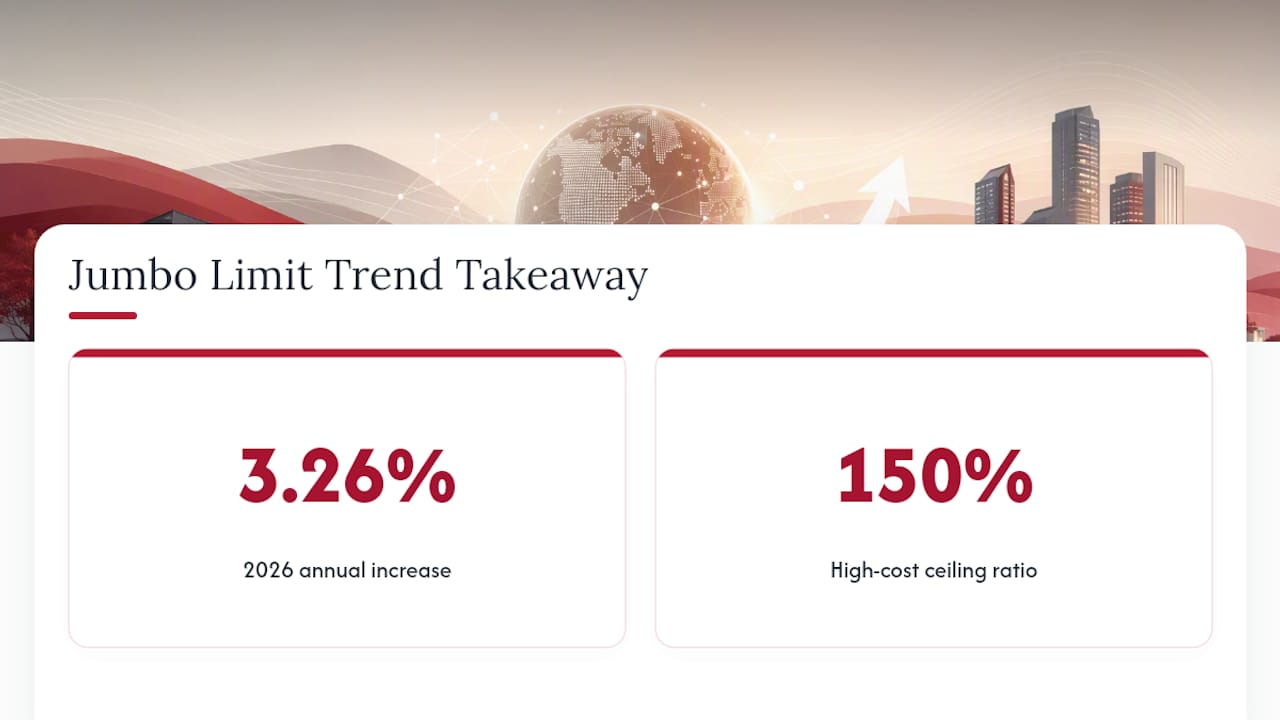
The 2026 increase of 3.26% continues a pattern that's held for several years running: conforming limits climb almost every year, tracking the FHFA's national home price index. That upward drift matters more than any single year's number, because it tells you the conforming/jumbo line is a moving target, not a fixed wall.
For buyers and investors planning purchases 12 to 24 months out, that trend has a practical implication. A property that requires jumbo financing today might slide just under the conforming limit next year if prices in that specific county cool, or the gap might widen further if the county's index keeps climbing faster than the national average. Either way, don't lock your financing strategy to this year's number alone.
The gap between the baseline and the high-cost ceiling has also stayed remarkably stable at the 150% ratio for years, even as both figures rise. That consistency is useful: once you know your county sits at the ceiling, you can reasonably expect it to stay near the ceiling relative to the baseline going forward, even if the exact dollar figure shifts annually.
Investors watching multiple markets should track county-level movement, not just the national headline number. A county that added a lot of high-price sales in one year can see its limit jump disproportionately the next cycle, changing the math on a refinance or a new acquisition almost overnight.
Why Jumbo Loans Often Cost More Than Conforming Loans
Jumbo loans don't automatically cost more, but they usually do, and the reason comes down to who bears the risk. Conforming loans get sold to Fannie Mae or Freddie Mac, which spreads risk across a massive pool of mortgages. Jumbo loans stay on a lender's books longer or get sold into a much smaller secondary market, so lenders price in a premium to compensate.

That premium isn't fixed. During some market cycles, jumbo rates have actually dipped below conforming rates when banks were hungry for high-balance, high-credit-quality borrowers to hold in portfolio. In other periods, the spread widens to half a point or more. The direction depends heavily on where banks want to deploy capital that quarter, which is why shopping multiple jumbo lenders matters more than shopping conforming lenders.
Pricing also varies more between jumbo lenders than it does between conforming lenders, since conforming rates are anchored to nearly identical Fannie Mae and Freddie Mac pricing grids. Jumbo lenders each set their own risk appetite, so the same borrower can see meaningfully different rate quotes from two different banks on the same day. That's not true to nearly the same degree with conforming financing, where the pricing bands are far more standardized across lenders.
Documentation Gaps Between Jumbo and Conforming Applications
Conforming loans lean on automated underwriting systems that can approve a file in minutes once income and asset documents are uploaded. Jumbo loans usually need a human underwriter reviewing the full file, and that person tends to ask for more.
Expect requests for two years of tax returns instead of one, detailed explanations for any large deposits, and often a written letter of explanation for anything that looks like a one-time or irregular income event. Self-employed borrowers and real estate investors feel this gap the most, since K-1s, rental income schedules, and business bank statements all invite extra questions that a W-2 employee simply doesn't generate.
Reserve documentation is another area where jumbo applications diverge sharply. Conforming loans might ask for two months of statements. Jumbo underwriters frequently want a full accounting of every liquid asset account, sourced and seasoned, because the reserve requirement itself is so much larger.
Appraisal documentation differs too. A conforming loan typically needs one appraisal report. Many jumbo programs above certain thresholds require two independent appraisals from separate appraisers, adding both cost and timeline to the process.
Fixed-Rate and ARM Options for Jumbo Borrowers
Jumbo loans come in the same basic structures as conforming loans: fixed-rate and adjustable-rate mortgages, though the mix of available terms tends to skew differently.
Fixed-rate jumbo loans remain the most common choice for owner-occupied luxury purchases, since buyers financing a primary residence generally want payment certainty over a 15 or 30 year term. But adjustable-rate mortgages show up more often in the jumbo space than they do among conforming borrowers, particularly with 7/6 and 10/6 ARM structures that offer a lower initial rate for a fixed period before adjusting.
Investors and buyers planning to sell or refinance within five to ten years sometimes favor a jumbo ARM specifically because the initial rate undercuts a 30-year fixed jumbo rate by a noticeable margin. The tradeoff is exposure to rate resets if plans change and the loan is still outstanding when the adjustment period hits.
Interest-only jumbo options also exist in the market for qualified borrowers, typically those with strong cash flow from investments or business income who want to minimize monthly payments during the interest-only period. These structures carry their own reserve and qualification hurdles beyond standard jumbo underwriting.
Weighing the Tradeoffs of Jumbo Financing Right Now
A jumbo loan lets you finance a property that conforming limits simply won't cover, which is the entire point for most luxury buyers. That access comes with real costs beyond the potential rate premium: larger reserve requirements tie up capital that could otherwise go toward renovations, a second property, or investment diversification.
The benefit side matters too. Jumbo financing preserves liquidity compared to an all-cash purchase, letting buyers keep capital deployed elsewhere while still controlling a high-value asset. For investors, that leverage can meaningfully improve overall returns if the property appreciates or generates rental income above the loan's carrying cost.
The risk side shows up most clearly in market downturns. A jumbo borrower with a smaller equity cushion and a large reserve drawdown has less flexibility if income disruptions hit or if the property needs to sell quickly in a softer market. Reserve requirements exist precisely to buffer against that scenario, which is why lenders enforce them so consistently even for borrowers with excellent credit.
Refinancing Considerations When Your Loan Sits Above Conforming Limits
Refinancing a jumbo loan follows the same underwriting logic as originating one, which surprises some homeowners who assume a refinance is a lighter lift. It usually isn't, especially on a cash-out refinance where the new loan amount climbs even further above the conforming line.
Rising conforming limits can occasionally work in a homeowner's favor here. A loan that was jumbo when it originated might fall under the new baseline or high-cost ceiling a year or two later if the original balance has amortized down and the county's limit has risen. That shift can open up conforming refinance options with more competitive pricing and looser reserve requirements than the original jumbo loan required.
Homeowners considering a refinance should run the same county lookup used at purchase time, since limits change annually and a property's county-specific figure might have moved meaningfully since the original closing.
Why the Standard Jumbo Advice Falls Short for Luxury Buyers
Most jumbo loan guidance treats the topic as a national average problem: hit these credit scores, save these reserves, expect these rates. That framing undersells how much county-level variation actually drives the outcome for Southern California buyers.
A property in coastal San Diego and a similarly priced property in a lower-cost inland county can face completely different financing paths, even with identical loan amounts, because one sits well above its county's limit and the other barely clears it. Generic advice misses that distinction entirely.
The bigger gap, though, is timing. Buyers research credit scores and down payments obsessively but rarely think about lender system update schedules or reserve documentation until they're already under contract, scrambling. That's backward. In a market where luxury inventory moves fast and financing contingencies get scrutinized during multiple-offer situations, having reserves documented and a jumbo-aware lender lined up before you write an offer is worth more than shaving a quarter point off your rate.
— Stu Harvey
Get Local Guidance Before You Shop for a Jumbo-Financed Home
Knowing the 2026 numbers is one thing. Applying them to an actual offer in La Jolla or Rancho Santa Fe is another. Stu Harvey Estates gives buyers something a national lender directory can't: direct experience coordinating financing timelines with the exact lenders, appraisers, and escrow teams active in Southern California's luxury market right now.

Every transaction Stu Harvey handles involves properties that regularly sit above the conforming ceiling, so reserve planning and jumbo-aware lender coordination aren't an afterthought, they're built into how offers get structured from day one. That local knowledge, paired with deep familiarity across La Jolla, Rancho Santa Fe, the Hollywood Hills, and Newport Beach, means fewer surprises once you're in contract and racing a financing contingency clock.
Browse current luxury home search listings to see what's active right now, or reach out directly to talk through financing strategy before you make an offer on your next property.
Sources
- FHFA Announces Conforming Loan Limit Values for 2026 | FHFA
- Loan Limits | Fannie Mae
- Loan limits increase by 3.26% - Freddie Mac Single-Family
- Marquee Jumbo Eligibility & Underwriting Guide
- Jumbo loan limits and requirements in 2026 | Rocket Mortgage