
Luxury home negotiation strategies are specialized tactics that go far beyond price haggling. They combine emotional intelligence, deal structuring, and market data to influence outcomes in high-end transactions. In Southern California markets like La Jolla, Newport Beach, and The Hollywood Hills, where properties routinely trade above $3 million, the difference between a closed deal and a failed one often comes down to how the offer is built and presented. Stu Harvey Estates has closed over 250 luxury transactions by treating negotiation as a repeatable system, not a personality contest.
What makes luxury home negotiations different from standard deals?
High-end property negotiation operates under a different set of rules than a typical residential transaction. Fewer comparable sales exist, privacy requirements limit public data, and the buyers involved often have strong egos tied to the outcome. These factors create a negotiation environment where standard tactics frequently backfire.
The key differences include:
- Emotional drivers. Sellers of $3M+ homes often have deep personal attachment to the property. Status, legacy, and lifestyle identity shape how they receive and respond to offers.
- Fewer comps. Luxury neighborhoods have different market rules than standard areas. Pricing anchors are harder to establish because sales volume is lower and properties are highly individualized.
- Complex stakeholder structures. Many luxury transactions involve attorneys, business managers, family trusts, and financial advisors. Each stakeholder adds a decision layer that slows the process.
- Longer timelines. Patience is a negotiation tool in high-end deals. Rushing a seller in this segment signals desperation, not strength.
- Concession norms. Luxury buyers typically negotiate opening offers 5–10% below list price, with seller-paid closing costs running 1–2% of the purchase price. That context matters when setting your opening position.
The buyers and sellers who succeed in this market understand that the goal is not to win an argument. The goal is to reach a closing that both parties feel good about.
How to structure and present offers in luxury negotiations
A well-structured offer does more work than a high number. Certainty of closing is valued over the highest bid at the $5M+ level. Sellers in this segment have often experienced failed escrows and are acutely sensitive to risk.

The table below shows the core offer elements and their impact on seller confidence:
| Offer element | Impact on seller acceptance |
|---|---|
| Pre-underwritten financing | High. Signals the buyer's file has been reviewed by the lender, not just prequalified. |
| Proof of funds | High. Removes doubt about buyer's ability to close. |
| Pre-scoped 7-day inspection window | High. Limits seller's exposure to prolonged uncertainty. |
| Escalation clause | Moderate. Useful in competitive situations but can signal ceiling. |
| Closing cost credit | Moderate to high. Preserves list price optics while delivering buyer value. |
| Rate buydown credit | High long-term value. A $30,000 credit on a $3M purchase saves more than a $30,000 price reduction. |
Anchoring your offer on recent comparable sales, not the listing price, is the correct starting point. The listing price reflects seller aspiration. Comparable sales reflect market reality. Build your case around data, then present it cleanly.
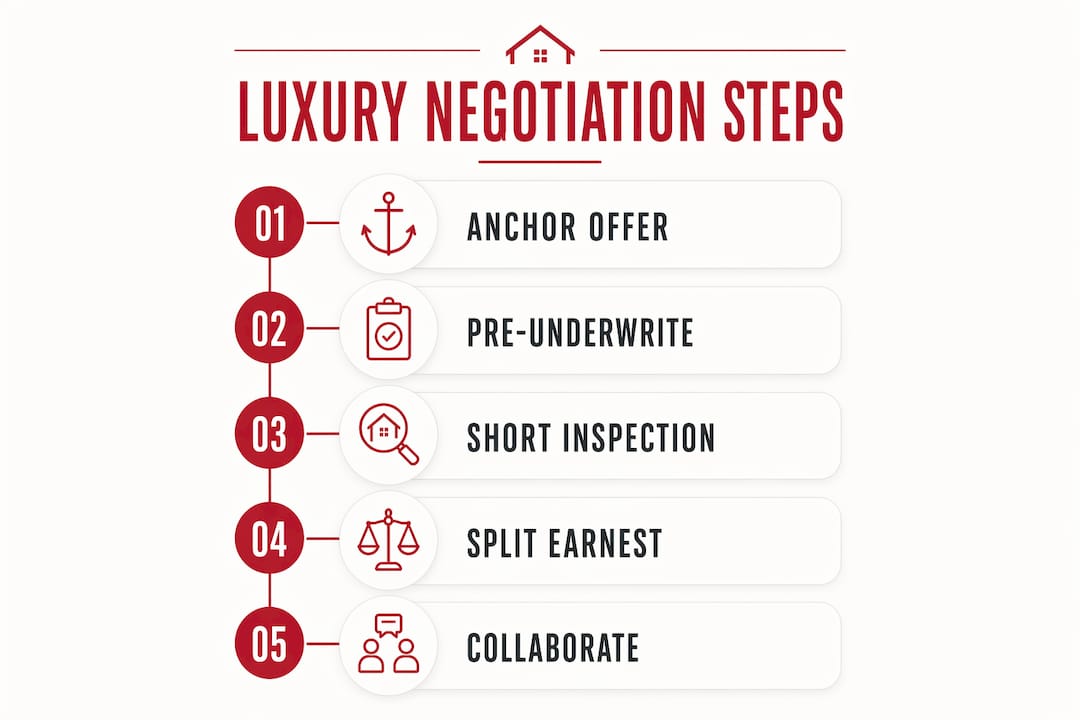
Pro Tip: Request a pre-scoped inspection window of 7 days rather than the standard 17. This signals confidence and reduces the seller's perceived risk, which often matters more than the dollar figure on the offer.
Splitting earnest money deposits into two tranches, one at offer acceptance and one at contingency removal, also signals seriousness without overexposing the buyer early. This structure is common in winning offers at the $3M–$5M level.
What role do emotions and perception play in luxury negotiations?
Luxury negotiations are driven more by emotion, status, and perception than by price. This is not a soft observation. It is the central operating reality of high-end real estate deals.
The most effective negotiators in this space manage the emotional temperature of a deal as carefully as they manage the numbers. Specific tactics that work:
- Control the narrative. Frame the offer as recognition of the property's value, not a challenge to it. Sellers respond better when buyers articulate what they love about the home.
- Respect the ego. Never let a seller feel cornered or disrespected. A defensive seller becomes an irrational one.
- Use strategic silence. After presenting an offer, stop talking. Silence creates space for the other party to process and respond without feeling pressured.
- Pause when emotions spike. Top advisors pause negotiations when emotions run high. A 24-hour cooling period often saves deals that would otherwise collapse.
"Managing the narrative about home lifestyle, scarcity, and value often matters more than price alone in $3M+ deals. Well-structured offers that optimize timelines and inclusions win more deals than aggressive price positions."
Reframing the negotiation as collaborative rather than adversarial is the single most effective perception shift available. Buyers who position themselves as partners in a smooth transaction, rather than opponents trying to extract value, close more deals at better terms.
How can buyers use the inspection phase to negotiate additional value?
The inspection period is not the end of negotiation. It is an active second round. Inspection reports reveal deferred maintenance costs averaging $20,000–$60,000 in luxury homes. That range represents real negotiating leverage when handled correctly.
The right approach follows a clear sequence:
- Complete a thorough inspection. Hire specialists for pools, roofs, HVAC systems, and structural elements. Luxury homes have more complex systems than standard properties, and each system is a potential credit opportunity.
- Get contractor estimates. A professional quote for a failing HVAC system carries far more weight than a general inspector's note. Specific numbers make credit requests credible and harder to dismiss.
- Request credits, not repairs. Requesting credits instead of demanding repairs protects buyer interests without creating disputes over contractor selection or work quality.
- Focus on material issues. Bringing a list of 40 minor items signals bad faith. Presenting 3–5 significant findings with documented costs signals professionalism.
- Time your request carefully. Submit inspection findings promptly but not impulsively. Give the seller's team time to review without feeling ambushed.
Pro Tip: Present inspection findings as a clinical summary with contractor quotes attached, not as a complaint list. The tone of the document shapes the seller's emotional response before they read a single line item.
The inspection phase can yield tens of thousands of dollars in additional credits. Buyers who treat it as a routine formality leave real money on the table.
What are common pitfalls in luxury negotiations and how do you avoid them?
The most common mistake in high-end property negotiation is applying pressure tactics that work in standard markets. Aggressive, time-sensitive tactics trigger defensive seller responses and cause walkaways. Luxury sellers have the financial security to walk. They will use it.
Proven best practices include:
- Prioritize deal certainty over price. A clean offer at $4.8M closes more often than a conditional offer at $5.1M.
- Use calibrated transparency. Share precise, relevant information at the right moment to build trust. Oversharing weakens your position. Secrecy breeds suspicion.
- Keep the deal team small. Every additional advisor in the room adds a potential veto. Narrow the decision circle on both sides when possible.
- Document everything. Verbal agreements in luxury deals evaporate. Written summaries after every call protect all parties.
The comparison below captures the core behavioral contrast:
| Approach | Outcome |
|---|---|
| Aggressive deadlines and ultimatums | Seller defensiveness, deal collapse |
| Calibrated transparency and patience | Trust, continued negotiation |
| Demanding repairs after inspection | Conflict over contractor and quality |
| Requesting credits with contractor quotes | Professional resolution, preserved relationship |
| Highest conditional offer | Seller uncertainty, risk of failure |
| Lower but clean, certain offer | Seller confidence, higher close rate |
Negotiation as a system with clear anchors, timelines, and decision gates produces predictable results. Ad hoc bargaining produces unpredictable ones.
Key Takeaways
Effective luxury home negotiation combines market data anchors, emotional intelligence, and deal structure to close high-end transactions with confidence and consistency.
| Point | Details |
|---|---|
| Certainty beats price | A clean, pre-underwritten offer closes more often than a higher conditional bid at $5M+. |
| Inspection phase is active negotiation | Credits of $20,000–$60,000 are available in most luxury homes when findings are documented professionally. |
| Emotions drive outcomes | Managing narrative and emotional temperature matters more than price position in $3M+ deals. |
| Rate buydown credits outperform price cuts | A $30,000 closing credit saves more long-term than a $30,000 price reduction on a $3M purchase. |
| Patience is a tactic | Aggressive timelines trigger seller walkaways; calibrated transparency builds the trust needed to close. |
What I've learned after 250+ luxury closings
Most buyers and sellers think negotiation is about who blinks first. After more than 15 years and $1.2 billion in closed transactions, I can tell you that framing is wrong. The deals I've seen fall apart almost never collapsed over price. They collapsed because someone felt disrespected, rushed, or blindsided.
The best negotiators I've worked with treat the process as a system. They set anchors based on data, not emotion. They build offers that reduce seller risk rather than maximize buyer extraction. They know when to push and, more importantly, when to go quiet. That discipline is not natural talent. It is a learned operating procedure.
The role of a dedicated luxury buyer agent is to hold that system together when emotions spike on either side. I've paused negotiations mid-call because I could hear a seller's tone shift. That pause saved the deal. No algorithm catches that.
What I tell every client is this: your goal is not to beat the other side. Your goal is to reach a closing where both parties feel the outcome was fair. That mindset, more than any single tactic, is what separates buyers and sellers who close from those who don't.
— Stu Harvey
How Stu Harvey Estates approaches luxury negotiation for clients
Stu Harvey Estates brings over 15 years of negotiation experience and more than $1.2 billion in closed transactions to every deal in Southern California.
Every client receives a tailored offer strategy built on current comparable sales, pre-underwritten financing guidance, and inspection credit planning. Whether you are buying in Rancho Santa Fe, selling in Newport Beach, or evaluating a property in The Hollywood Hills, the process is the same: data-driven anchors, controlled narrative, and a deal structure built for certainty. Browse current luxury listings to see active opportunities across San Diego, Los Angeles, and Orange County, and connect with Stu Harvey directly to build your negotiation plan before you make your next move.
FAQ
What is the typical negotiation range for luxury homes?
Luxury buyers typically open 5–10% below list price. Seller-paid closing costs of 1–2% and inspection credits of $20,000–$60,000 are common in $2M+ transactions.
Why does deal structure matter more than offer price in luxury real estate?
Sellers at the $5M+ level prioritize certainty of closing over the highest number. Pre-underwritten financing and a scoped inspection window reduce seller risk more effectively than a higher conditional offer.
How should buyers use the inspection period in a luxury transaction?
Treat the inspection as an active negotiation phase. Document material findings with contractor quotes and request credits rather than repairs to resolve issues professionally without creating conflict.
What negotiation tactics backfire in luxury real estate?
Aggressive deadlines, ultimatums, and high-pressure tactics trigger defensive responses from luxury sellers. Calibrated transparency and patience consistently outperform pressure-based approaches.
When should a buyer involve a specialized luxury agent in negotiations?
From the first offer. A specialized luxury agent manages emotional dynamics, structures offers for certainty, and navigates multi-stakeholder complexity that standard agents are not equipped to handle.