
Days on Market (DOM) is defined as the number of calendar days a property remains actively listed on the Multiple Listing Service (MLS) before a seller accepts a contract. In luxury real estate, this single number carries more weight than most buyers and sellers realize. Understanding what does days on market mean in luxury sales tells you whether a property is priced correctly, how motivated the seller is, and where the negotiating power sits. Luxury market DOM typically spans 60–120 days, far longer than lower-priced tiers. That gap exists because the pool of qualified buyers for a $3 million or $10 million property is a fraction of the general market.
What does days on market mean in luxury sales, by price tier?
The DOM clock starts the moment a listing goes live on the MLS and stops when a signed contract is accepted. That sounds simple. The reality is more nuanced once you factor in price tier.
| Price Tier | Typical DOM Range | Key Implication |
|---|---|---|
| $2M–$5M | 45–90 days | Competitive tier; pricing accuracy matters most |
| $5M–$10M | 6–12 months | Smaller buyer pool; marketing reach is critical |
| $10M+ (ultra-luxury) | 12–18 months | Patience required; global buyer outreach essential |
| General market (under $1M) | 20–40 days | High velocity; DOM signals are faster moving |

Homes in the $2M–$5M tier commonly take 45–90 days to sell, while properties above $5M can require 6 to 18 months to find the right buyer. That extended timeline is not a sign of failure. It reflects the reality that ultra-luxury buyers are rare, often international, and move on their own schedule.
The comparison to the general market is stark. A well-priced home under $1 million in a healthy market can go under contract in days. A $12 million oceanfront estate in La Jolla or a compound in Rancho Santa Fe operates in a completely different rhythm. Sellers who enter the luxury market expecting mass-market velocity will misread every DOM signal they encounter.
Pro Tip: If you are selling a property above $5M, build your pricing and marketing plan around a 9 to 12 month timeline from the start. Adjusting expectations early prevents panic-driven price cuts later.
How does DOM affect pricing and negotiating leverage?
DOM is the clearest signal of who holds power in a luxury transaction. A short DOM tells buyers the seller has options. A long DOM tells buyers the seller may be willing to deal.
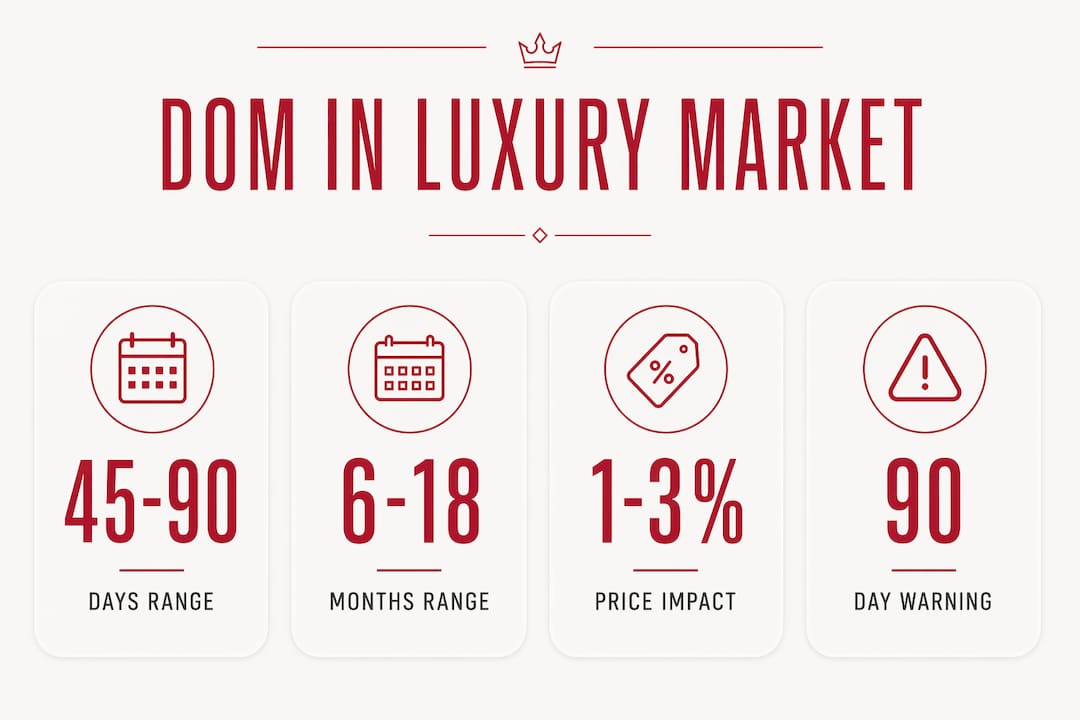
Each additional month a home remains on the market can correspond with a 1–3% decrease in final sale price relative to the listing price. On a $5 million property, one month of excess time costs the seller $50,000–$150,000 in negotiating position. That is not a rounding error.
The psychology shifts dramatically once a listing crosses certain thresholds:
- Under 30 days: Well-priced luxury properties attract qualified buyers and enter contract within the first 30 days, preserving full seller leverage. Buyers rarely negotiate aggressively at this stage.
- 30–60 days: Buyers begin to ask questions. Interest remains, but offers may come in 3–5% below asking.
- 60–90 days: Hitting 60+ days often categorizes a listing as "stale," and buyers start assuming the property has a problem even when it does not.
- 90+ days: Properties on market longer than 90 days are often stigmatized, losing seller negotiating power and triggering buyer assumptions of hidden issues.
The stigma at 90 days is particularly damaging in luxury real estate. Buyers in this segment do extensive due diligence. They notice the listing date. Their agents notice it. A property that has sat for four months in Newport Beach or the Hollywood Hills will attract lowball offers almost by default, regardless of its actual condition or quality.
Pro Tip: Sellers should treat 45 days as their internal warning threshold, not 90. By the time a listing hits 90 days, the damage to perceived value is already done. A pricing or marketing adjustment at 45 days costs far less than the negotiating concessions required at 90.
What is the difference between DOM and CDOM?
DOM and Cumulative Days on Market (CDOM) measure the same concept but with one critical difference. DOM resets when a seller withdraws a listing and relists it. CDOM does not.
CDOM tracks total market exposure even across relistings, revealing the true time a property has been available to buyers. This distinction matters enormously in luxury real estate, where sellers sometimes use relisting as a tactic to make a stale property appear fresh.
Common seller tactics that reset DOM include:
- Withdrawing the listing for 30 days and relisting with a new MLS number
- Switching listing agents to trigger a technical relist
- Making a minor price adjustment that some MLS systems treat as a new listing event
MLS systems vary on DOM calculation and resetting rules. Savvy buyers and their agents always check CDOM alongside DOM to verify the actual listing age. A property showing 15 days on market with a CDOM of 210 days tells a very different story than the fresh listing it appears to be.
For buyers, CDOM is one of the most underused tools in luxury real estate analysis. Asking your agent to pull CDOM data before making an offer takes 30 seconds and can reveal months of hidden market exposure. That information directly informs how aggressively you negotiate.
How can buyers and sellers use DOM data strategically?
DOM is not just a number to observe. It is a tool to act on, and the buyers and sellers who treat it that way consistently get better outcomes.
For buyers: reading DOM as a negotiation signal
- Pull CDOM first. Before analyzing any listing, ask your agent for the cumulative days on market. A reset DOM hides the real story.
- Cross-reference with price history. A property at 75 days with two price reductions signals a motivated seller. That combination justifies an offer 8–12% below current asking.
- Move fast on fresh listings. DOM as a primary signal of seller motivation means a property under 20 days is unlikely to accept a lowball offer. Respect the timeline and price accordingly.
- Use DOM to identify overpriced listings. A luxury property sitting at 120 days with no price change is almost always overpriced relative to market. That is an opportunity, not a red flag.
For sellers: managing DOM before it manages you
- Price correctly from day one. The luxury real estate selling timeline rewards accurate initial pricing more than any other single factor.
- Set a 30-day review checkpoint. If qualified showings are not generating offers by day 30, reassess pricing and marketing before the listing goes stale.
- Invest in marketing before listing. Reaching the right buyer pool from launch day compresses DOM. Specialized channels for luxury buyers, including private networks and international platforms, matter more than standard MLS exposure alone.
- Avoid the relist trap. Withdrawing and relisting to reset DOM rarely fools experienced buyers. Their agents check CDOM. The tactic burns time and credibility simultaneously.
Pro Tip: A pricing strategy built around luxury sales should account for the specific absorption rate in your submarket. A price that works in La Jolla may sit unsold in a slower segment of the same city.
How does DOM vary across luxury markets and what drives those differences?
DOM is not uniform across luxury real estate. A $4 million property in a high-demand coastal market like Newport Beach will behave very differently from a $4 million property in a slower inland market.
Luxury real estate markets differ significantly, with location, marketing strategies, and economic conditions all influencing DOM and sale velocity. The factors driving those differences include:
- Market absorption rate: This measures how quickly available inventory sells in a given period. A market absorbing luxury inventory in 60 days is far more active than one taking 180 days. Sellers in low-absorption markets need longer timelines and more patient pricing.
- Seasonality: Luxury markets in beach communities see peak buyer activity from february through june. Listing a $6 million property in november in those markets adds weeks to DOM by default.
- Agent expertise and marketing reach: Attracting qualified luxury buyers requires access to private buyer networks, international marketing channels, and relationships that standard agents do not maintain. The right agent compresses DOM. The wrong one extends it.
- Economic cycles: Rising interest rates affect luxury buyers less than the general market, but equity market downturns directly impact the net worth of buyers in the $5M+ tier. DOM in ultra-luxury segments lengthens during periods of stock market volatility.
| Market Factor | Effect on DOM | Seller Action |
|---|---|---|
| High absorption rate | Shorter DOM | Price at market; move quickly |
| Low absorption rate | Longer DOM | Build in extended timeline; price conservatively |
| Peak season listing | Shorter DOM | Align launch with buyer activity window |
| Off-season listing | Longer DOM | Compensate with stronger marketing investment |
| Specialized agent | Shorter DOM | Prioritize agent with luxury buyer network |
Understanding these variables helps both buyers and sellers set realistic expectations. DOM data from a comparable sale in a different submarket or season is not a reliable benchmark.
Key Takeaways
DOM in luxury real estate is the single most reliable indicator of pricing accuracy, seller motivation, and negotiating leverage available to buyers and sellers.
| Point | Details |
|---|---|
| DOM definition | DOM counts active listing days from MLS launch to accepted contract. |
| Luxury DOM benchmarks | The $2M–$5M tier averages 45–90 days; above $5M can take 6–18 months. |
| Pricing impact | Each extra month on market can reduce final sale price by 1–3%. |
| CDOM vs. DOM | Always check CDOM to reveal true market exposure across relistings. |
| Strategic use | Sellers should review pricing at 45 days; buyers should use DOM to time offers. |
Why I treat DOM as the most honest number in luxury real estate
Most sellers focus on list price. Most buyers focus on square footage or finishes. I focus on DOM first, because it tells me what everything else is trying to hide.
A property that enters contract in 22 days at $4.8 million tells me the seller priced it correctly, the marketing reached the right buyers, and the agent knew what they were doing. A property sitting at 140 days with two price reductions tells me the opposite, regardless of how beautiful the listing photos are.
The misconception I see most often is sellers believing that a DOM reset through relisting gives them a fresh start. It does not. Experienced buyers in the $5M+ segment have agents who check CDOM as a matter of routine. The reset buys the appearance of freshness for about 48 hours. After that, the property carries the same stigma it had before, plus the added question of why the seller felt the need to relist.
My advice to sellers is direct: price it right on day one, invest in marketing before the listing goes live, and treat day 45 as your action threshold. The luxury market rewards sellers who move decisively. It punishes those who wait and hope. DOM is the scoreboard. The best time to read it is before the game starts, not after you are already losing.
— Stu Harvey
Stu Harvey Estates and your luxury property decisions
Knowing how to read DOM data is one thing. Knowing what to do with it in a specific market, at a specific price point, in a specific season, requires experience that only comes from closing hundreds of luxury transactions.
Stu Harvey Estates brings over 15 years of luxury real estate expertise and more than $1.2 billion in sales volume across San Diego, Los Angeles, Orange County, and Southern California. Whether you are buying or selling, the team applies real-time DOM analysis to every pricing and offer decision. Browse current luxury listings to see active properties with realistic market context, or connect with the buyer services team to put DOM insights to work in your next transaction.
FAQ
What does days on market mean in real estate?
Days on Market (DOM) is the number of days a property is actively listed on the MLS before a seller accepts a purchase contract. The count starts on the listing date and stops when the property goes under contract.
What is a good days on market for a luxury home?
A luxury home priced between $2M and $5M that enters contract within 30–45 days is considered well-priced and well-marketed. Properties above $5M routinely take 6–18 months, so "good" DOM depends heavily on price tier.
How does a high DOM affect a luxury home's sale price?
Each additional month on the market can correspond with a 1–3% decrease in final sale price. At the $5M level, that translates to $50,000–$150,000 in lost negotiating position per month of excess time.
What is the difference between DOM and CDOM?
DOM resets when a seller withdraws and relists a property. CDOM tracks total market exposure across all listing periods, giving buyers and agents an accurate picture of how long a property has truly been available.
When should a luxury seller adjust price based on DOM?
Sellers should review pricing and marketing at 45 days, not 90. By the time a luxury listing reaches 90 days, the stigma of a stale listing has already reduced perceived value and shifted negotiating power to buyers.