
For affluent buyers planning to stay put, buying in a luxury neighborhood almost always wins over renting. You build equity, lock in your housing cost, gain full control over the property, and hold a tangible asset that can anchor an estate plan. The one real caveat: if your horizon is under five years, your capital is better deployed elsewhere, or you genuinely want frictionless managed living, renting is the smarter call. For everyone else, the financial and lifestyle case for ownership is hard to argue against.
Two facts anchor this verdict. Under the Tax Cuts and Jobs Act of 2017, homeowners can deduct mortgage interest on qualifying debt for a primary or secondary residence, producing real federal tax savings for high-bracket buyers. And Zillow's 2026 buy-vs-rent analysis puts the national median breakeven at about 5.9–6.0 years, though that number swings dramatically by metro. Know your market before you decide.
Table of Contents
- Why buying usually beats renting in luxury neighborhoods
- How to calculate whether buying beats renting in your market
- When renting is the smarter choice in a luxury market
- Luxury-specific factors that most buy-vs-rent guides miss
- What to do next if you are ready to decide
- Key Takeaways
- The part most buyers get wrong
- Work with Stu Harvey Estates on your next luxury purchase
- Useful sources and tools
Why buying usually beats renting in luxury neighborhoods
The financial case for ownership in premium markets rests on several advantages that compound over time, not just one big number.
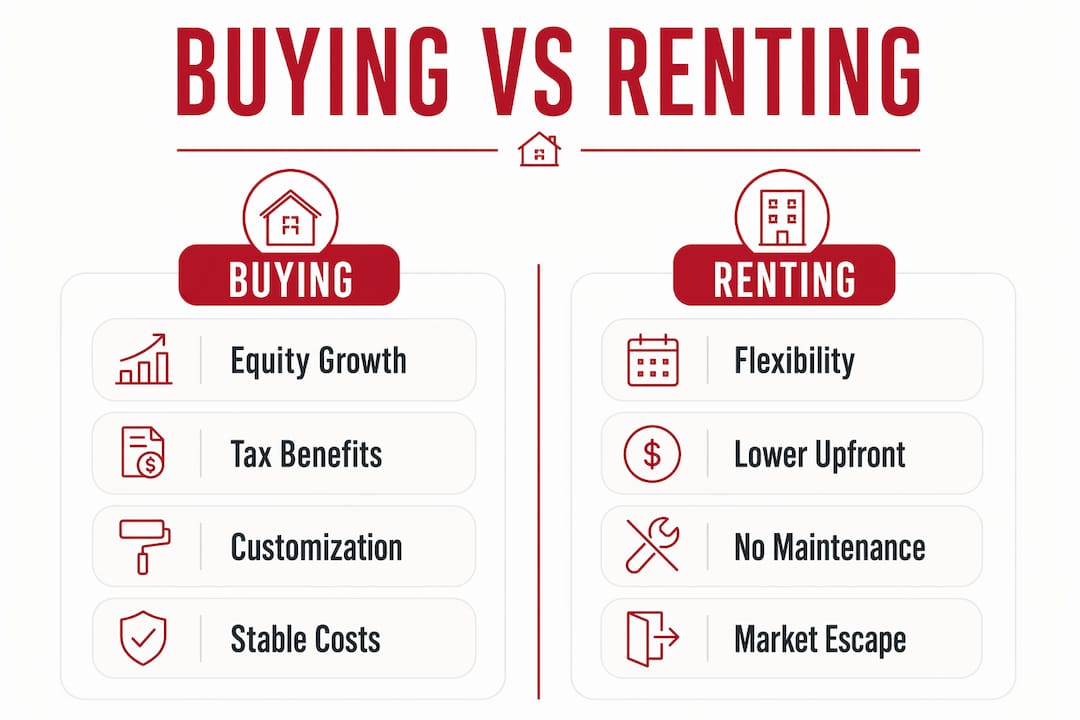
Equity accumulation and long-term appreciation. Every mortgage payment builds ownership stake in an asset that, in supply-constrained luxury markets, tends to appreciate. Prime districts in La Jolla, Newport Beach, or the Hollywood Hills face persistent demand against limited new inventory. That scarcity-driven appreciation makes ownership an effective wealth-preservation tool and a portfolio diversifier. You can also borrow against equity through a HELOC or pledged-asset line without triggering a taxable event, which renters simply cannot do.

A fixed housing cost in a market where rents keep climbing. Luxury rents in major metros have continued rising through 2026. A fixed-rate mortgage locks your principal-and-interest payment for 30 years. Renters in tight-supply markets face repeated repricing, sometimes at double-digit annual increases. Over a decade, that compounding rent growth can easily exceed the total carrying cost advantage a renter enjoys in year one.
Tax advantages worth modeling carefully. The TCJA caps the mortgage interest deduction and limits the combined SALT deduction to $10,000 per year, which bites hardest in high-tax states. Even with those caps, the deductions can produce meaningful savings for buyers in the 37% federal bracket. The picture changes significantly depending on your state, loan size, and entity structure. Consult a CPA before assuming the deduction math works in your favor.
Full control over the property. Owners renovate, redesign, and customize without landlord approval. In a $5M+ home, that control is not cosmetic. It means installing a home theater, a wine cellar, a smart-home security system, or a pool that matches your exact specifications. Renters in luxury properties often face strict restrictions on alterations, and any improvement they fund reverts to the landlord.

Estate, legacy, and succession planning. Real property can be transferred through structures like a Qualified Personal Residence Trust (QPRT), which can reduce estate tax exposure by removing the home's appreciated value from your taxable estate. That kind of planning is only available to owners. Renters have no equivalent tool.
Lifestyle permanence and community standing. Owning in a luxury neighborhood gives you a stable address, access to owner-only amenities, and the kind of community relationships that come from long-term residency. Renters, even in premium buildings, are transient by definition and often excluded from HOA governance and certain owner privileges.
Pro Tip: Most affluent buyers calculate mortgage, taxes, and HOA but forget to model total operational costs: household staff wages, specialist insurance riders (art, jewelry, coastal flood), and major lifecycle upgrades like roof replacement or HVAC systems. Run a full carry model before you commit.
How to calculate whether buying beats renting in your market
The national breakeven average is a starting point, not an answer. Localized breakeven scenarios are what actually matter, and the inputs below are what drive the result.
Inputs you need before running the numbers
| Input | What to gather |
|---|---|
| Purchase price | Confirmed offer price or realistic comp range |
| Down payment | Amount and percentage (typically 20–30% for jumbo loans) |
| Mortgage rate | Current jumbo rate for your loan size and credit profile |
| Loan term | 30-year fixed vs. ARM — affects monthly cost and interest total |
| Property tax rate | County-specific rate; Prop 13 and other state rules vary widely |
| Homeowner's insurance | Standard + specialty riders (flood, earthquake, art, coastal) |
| HOA dues | Monthly amount plus any special assessments history |
| Maintenance reserve | Budget 1–2% of purchase price annually for a luxury home |
| Expected appreciation | Use 2–4% as a base case; do not model peak-cycle numbers |
| Comparable rent | What the equivalent property rents for today |
| Rent growth rate | Historical average for the submarket (3–5% is common in prime areas) |
| Transaction costs | Typically 6–8% of sale price when you exit (agent fees, transfer taxes, title) |
| Holding period | How long you realistically plan to stay |
A worked-example framework
Say you are buying a $4M home in a prime Southern California neighborhood. A 25% down payment is $1M. Closing costs add roughly $80,000–$120,000. Your monthly ownership cost (mortgage at 6.75%, property tax, insurance, HOA, and a 1.5% maintenance reserve) might land around $28,000–$32,000 per month all-in. The comparable rental for the same property is $18,000–$22,000 per month.
On a pure monthly-cost basis, renting looks cheaper in year one. But factor in 3% annual rent growth, 3% annual appreciation on the purchase, and the equity you are building with every payment, and the picture shifts. At year six, the cumulative wealth position of the buyer typically surpasses the renter who invested the down payment difference, assuming the renter actually invested it rather than spent it.
The 5% rule offers a quick triage: multiply the home price by 5% and divide by 12. That is your monthly ownership cost floor, covering the cost of equity, debt interest, and property costs. If comparable rent is well below that number, renting wins on pure cost. If rent is near or above it, buying becomes defensible. For a $4M home, the 5% threshold is roughly $16,700 per month. At $20,000 in rent, buying starts to look rational even before appreciation.
The most dangerous assumption in any buy-vs-rent model is the holding period. Transaction costs on a luxury home sale run 6–8% of the sale price. On a $4M property, that is $240,000–$320,000 out the door when you exit. If you sell at year three, those costs alone can erase two or three years of equity gains. Build your model around your honest move probability, not your optimistic one.
For luxury home budgeting specifics and a carrying-cost checklist, the Stu Harvey Estates resource covers the full picture. Always bring localized inputs to a CPA and a local agent before making a final decision. This article is general information, not tax or legal advice.
When renting is the smarter choice in a luxury market
Renting is not a consolation prize. For a meaningful segment of high-net-worth buyers, it is the correct financial decision. Here is when the math and the lifestyle logic both point toward leasing.
- Short holding horizon or unpredictable relocation. If there is a real chance you move within four years, transaction costs alone will likely make buying a net loss. Business acquisitions, judicial proceedings, or tax-driven relocations can compress timelines in ways that are hard to predict at signing.
- Capital is better deployed elsewhere. Ultra-high-net-worth individuals often have access to private equity, direct acquisitions, or other alternatives that can materially outperform typical home appreciation. Locking $1M+ in a down payment has an opportunity cost. If your next investment opportunity yields 15–20% annually, the math of tying up that capital in a home needs serious scrutiny.
- You want frictionless managed living. Branded residences and managed luxury rentals bundle concierge services, maintenance, and security into one monthly payment. For executives traveling 200 days a year, that model eliminates the operational burden of ownership entirely.
- The local breakeven never arrives. In some high-cost metros, the combination of elevated purchase prices, high property taxes, and modest appreciation means the breakeven horizon stretches past 15–20 years. In those markets, renting and investing the difference can genuinely outperform buying.
- Red flags in the specific property. Deferred maintenance, restrictive HOA rules that limit resale, title complications, or a building with a history of special assessments are all reasons to walk away from a purchase. Renting the same property while you investigate is sometimes the right move.
A rising cohort of millionaire renters has been converting to buyers as top-end rents climbed in 2026, but that trend does not mean every renter should buy. The decision is always situational.
Luxury-specific factors that most buy-vs-rent guides miss
Standard rent-vs-buy calculators are built for median-priced homes. They miss the variables that actually drive the decision at the $3M–$20M price point.
Supply constraints and scarcity in prime districts
Prime luxury neighborhoods have a structural supply ceiling. Coastal zoning, historic preservation rules, and lot-size minimums mean new inventory is rare. In markets like La Jolla, Rancho Santa Fe, or Malibu, supply constraints support long-term values in ways that suburban or high-rise markets do not. Scarcity also affects resale liquidity: there are fewer comparable sales, which means pricing is less transparent and negotiation skill matters more.
Branded residences vs. private estates
These are fundamentally different products. A branded residence (think Four Seasons Private Residences or Ritz-Carlton Residences) comes with bundled services, a recognizable name that supports resale value, and a management structure that handles operations. The tradeoff is higher HOA fees and less customization. A private estate gives you full control and no shared amenity overhead, but you are responsible for every operational decision. The carrying-cost profiles are different enough that they require separate models.
Operational costs unique to luxury ownership
Annual operating costs for a large luxury home, including household staff, specialist insurance, bespoke maintenance contracts, and major lifecycle upgrades, can run well into the tens of thousands annually. Coastal properties add flood and wind insurance. Older estates may require periodic restoration work that runs six figures. These costs do not appear in a standard mortgage calculator.
Ownership structures and estate planning tools
The legal structure you use to hold a luxury property can be as consequential as the price you pay. A Qualified Personal Residence Trust (QPRT) can remove a home's future appreciation from your taxable estate, a meaningful benefit on a $10M property. LLCs, family limited partnerships, and cross-jurisdiction trusts each have different implications for liability, privacy, and succession. Work with an estate attorney before closing, not after.
| Ownership cost or value factor | Notes for luxury buyers |
|---|---|
| Household staff wages | Full-time housekeeper, groundskeeper, estate manager — budget separately |
| Specialist insurance | Art, jewelry, coastal flood, earthquake, umbrella liability |
| HOA or building dues | Verify special assessment history for the past 10 years |
| Security systems and monitoring | Ongoing contracts plus periodic upgrades |
| Major lifecycle reserves | Roof, HVAC, pool systems, structural — 1.5–2% of value annually |
| Restoration and renovation cycles | Historic or custom estates may require periodic six-figure work |
| Ownership structure costs | Legal fees for trust/LLC setup and ongoing compliance |
Pro Tip: When buying a multi-million-dollar primary or second home, model three liquidity scenarios: a planned sale at your target horizon, a forced sale two years early, and a hold-through-a-down-market scenario. The forced-sale case is where most buyers discover their real risk tolerance.
For context on how luxury investment properties differ from owner-occupied homes in terms of tax treatment and operational structure, that distinction matters when you are deciding between a primary residence and a second-home purchase.
What to do next if you are ready to decide
Buying in a luxury neighborhood is the right move for most affluent buyers with a realistic six-year-plus horizon, stable income, and a property that passes a thorough due-diligence review.
Here is how to move from analysis to a signed contract.
Step 1: Assemble localized breakeven inputs. Pull current comps, rental equivalents, property tax rates, and HOA history for the specific submarket. National averages will mislead you. Use a rent-vs-buy calculator as a starting framework, then adjust for your actual numbers.
Step 2: Consult a CPA before you make an offer. Confirm how the mortgage interest deduction and SALT cap apply to your specific tax situation, and discuss whether holding the property in a trust or LLC makes sense for your estate.
Step 3: Consider ownership structure early. An estate attorney can advise on QPRTs, LLCs, or family trust structures. Setting this up after closing is more expensive and sometimes impossible.
Step 4: Commission a pre-offer inspection. In the luxury market, deferred maintenance on a $5M home can mean $500,000 in hidden costs. A specialist inspection covering structure, systems, and coastal or environmental factors is non-negotiable.
Step 5: Pre-approve financing or confirm liquidity. Jumbo lenders have stricter documentation requirements than conventional lenders. Get a pre-approval letter or confirm your liquidity position before entering a competitive offer situation.
Step 6: Engage a specialized luxury agent. The luxury home buying checklist covers what to bring to your first agent conversation. A generalist agent in a $5M transaction is a liability. You need someone who knows the submarket's off-market inventory, negotiation norms, and title quirks.
Key Takeaways
Buying in a luxury neighborhood beats renting for affluent buyers with a six-year-plus horizon, stable capital, and a property that clears due diligence, but the math is always market-specific and structure-dependent.
| Point | Details |
|---|---|
| Breakeven is market-specific | National breakeven varies by market; some metros never break even — run localized numbers. |
| Transaction costs are the hidden risk | Selling costs of 6–8% on a luxury home can erase years of equity gains if you exit early. |
| Operational costs go beyond the mortgage | Staff, specialist insurance, and lifecycle reserves can add tens of thousands annually to true ownership cost. |
| Estate structure matters as much as price | QPRTs and trust structures can materially reduce estate tax exposure — engage an attorney before closing. |
| Stu Harvey Estates is the recommended local partner | For Southern California luxury buyers, Stu Harvey Estates provides market valuation, off-market access, and concierge transaction support across La Jolla, Newport Beach, and the Hollywood Hills. |
The part most buyers get wrong
The buy-vs-rent debate in luxury markets gets framed as a financial question, and it is, but only partly. The spreadsheet tells you when buying breaks even. It does not tell you what you are actually buying.
When you own a $5M home in a prime neighborhood, you are not just buying shelter. You are buying the right to stay. The right to renovate. The right to put down roots in a community that, in many cases, has a genuine waiting list to get in. Renters in the same building or street do not have that. They have a lease with an expiration date.
What I see consistently in the Southern California luxury market is buyers who overthink the monthly cost comparison and underthink the optionality they are giving up by renting. A renter in Newport Beach or La Jolla is one lease renewal away from being priced out or displaced. An owner is not. That asymmetry is real and it compounds over time in ways that no calculator fully captures.
The other thing buyers underestimate is the behavioral finance angle. Most people will not actually invest the down payment difference if they rent. They will spend it, or hold it in cash, or let it sit in a brokerage account they rarely touch. The mortgage is a forced savings mechanism with leverage attached. For buyers who know they lack the discipline to invest the difference systematically, ownership is the better financial outcome almost by default.
That said, I have seen buyers make expensive mistakes by ignoring the holding-period math. If your business, your family situation, or your career has a real chance of moving you in less than six years, do not buy a $6M home. Rent something excellent, stay liquid, and buy when your horizon is clear. The market will still be there.
Work with Stu Harvey Estates on your next luxury purchase
Deciding between buying and renting at the $3M–$15M price point requires more than a calculator. It requires someone who knows what a specific block in La Jolla or a particular building in Newport Beach actually trades for, what the HOA history looks like, and whether the asking price reflects the market or a seller's wishful thinking.
Stu Harvey is a Senior Agent with The Oppenheim Group, with over 15 years of experience and more than $1.2 billion in completed luxury transactions across San Diego, Los Angeles, and Orange County. With over 250 closed deals in premium Southern California markets, Stu Harvey Estates offers market valuation, off-market property access, ownership-structure referrals, and full concierge transaction support from first showing to closing. When you are ready to move from analysis to action, search current listings or reach out directly to schedule a consultation. Bring your target neighborhoods, your timeline, and your honest move-probability estimate. That is where the real conversation starts.
Useful sources and tools
- Zillow Buy vs. Rent Analysis (2026) — national breakeven data and metro-level variation
- PWL Capital: The 5% Rule — framework for calculating true unrecoverable ownership costs
- TCJA mortgage interest and SALT deduction rules — overview of current homeowner tax benefits
- Rent vs. Buy Calculator for high-cost markets — partner tool for running localized cost comparisons
- Why luxury neighborhoods have different market rules — Stu Harvey Estates on scarcity, valuation, and submarket dynamics
- Luxury home buying checklist: 2026 guide — step-by-step preparation for affluent buyers
- Budgeting for luxury home ownership: 2026 guide — full carrying-cost framework including staff and specialty insurance
- Capital gains on a luxury home sale: 2026 guide — tax and transaction-cost considerations when you exit