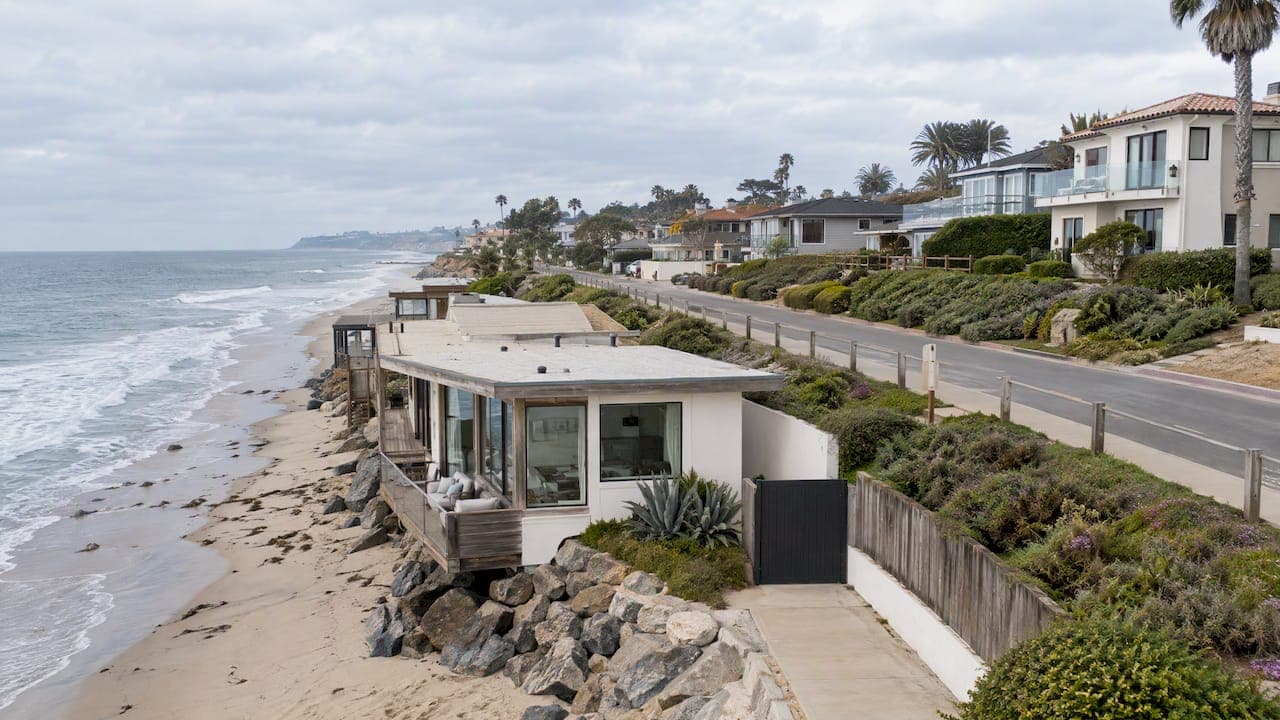
Oceanfront means the property sits directly on the water's edge, with nothing between the home and the ocean. Ocean view means you can see the ocean from the home, but the home may be a block, a hillside or several streets away. The difference shapes the price you pay, the risks you carry and the way you live in the house. In San Diego County, where the coast runs from Coronado and Point Loma up through La Jolla, Del Mar, Solana Beach and Encinitas, those two words can mean a gap of millions of dollars.
There is no single legal definition that applies to every listing, so the words in a listing are a starting point, not proof. This guide explains each term, how to verify it, how it affects value, and what to check before you write an offer.
TL;DR
- Oceanfront means the lot borders the ocean directly. Ocean view means the ocean is visible from the home, with no promise about how much, how far or for how long.
- Beachfront means a beach sits at the property's edge. Oceanfront can also mean a bluff or rocky shore with no sand at all.
- Water views are among the strongest price drivers in appraisal research, but view quality matters more than the label.
- California has no automatic right to keep a view. Unless a recorded easement, HOA rule or local ordinance protects it, a neighbor's future building can change it.
- Oceanfront adds flood, erosion, seawall and permit questions that an ocean-view home on a hill may not carry.
Table of Contents
- The plain-English difference
- Oceanfront, beachfront, bayfront: how the labels differ
- Does an ocean-view home guarantee a clear view?
- How to verify what a listing claims
- How frontage and views affect price
- Risks that come with oceanfront
- Which one fits your situation?
- A buyer's checklist before you make an offer
- Working with Stu on a coastal purchase or sale
- FAQ
- Sources
The plain-English difference
Start with the lot, not the listing photo.
An oceanfront home is one whose property line meets the ocean or the beach directly. A common test is whether a road, another building or a public path sits between the structure and the sand. If it does, many buyers and agents would not call it true oceanfront, even if the walk to the water takes thirty seconds.
An ocean-view home is defined by what you see, not where the lot sits. The ocean may be visible from every room, from a single upstairs window, or only from a deck if you lean over the rail. The phrase tells you the ocean can be seen from somewhere. It does not tell you the view is wide, protected or permanent.
A useful way to hold the two together: every oceanfront home normally has an ocean view, but most ocean-view homes are not oceanfront. Some listings add words like "peek-a-boo," "partial," "panoramic" or "white-water" to describe how much water you actually see. Those adjectives carry more information than the label does, and none of them has an official definition.

Oceanfront, beachfront, bayfront: how the labels differ
Readers often ask whether beachfront and oceanfront are the same thing. Usually they overlap, but they are not identical.
| Term | What it generally means | Typical San Diego County example |
|---|---|---|
| Oceanfront | Lot directly borders the ocean, with or without a sandy beach | Bluff-top home in La Jolla or Del Mar, or sand-level home in Coronado or Mission Beach |
| Beachfront | Lot faces or has direct access to a beach | Sand-level home with its own gate to the beach |
| Ocean view | Ocean is visible from the home, which may be set back | Hillside home in Point Loma or Encinitas looking over rooftops |
| Bayfront | Lot borders a bay rather than the open ocean | Homes on San Diego Bay or Mission Bay |
One source that compares the terms describes beachfront as property that faces or has access to a beach, while oceanfront borders the ocean whether or not a beach is present, so an oceanfront lot can sit atop cliffs or a rocky shore (Ask Difference). That matters on our coast. A bluff-top home in La Jolla may be oceanfront and have no beach at its door, while a sand-level home may be both.
Bayfront is its own category. Bay and sound frontage is generally calmer and quieter than open-ocean frontage, and often cheaper (Sleep by the Beach). You get water, boating access and sunsets, but not surf, and the risks differ: tidal flooding and dock maintenance replace wave exposure and bluff erosion. For a closer look at the local options, see our guide to San Diego waterfront properties.
Does an ocean-view home guarantee a clear view?
No. This is the question that costs buyers the most when they skip it.
California law generally gives you no inherent right to an unobstructed view across a neighbor's land. A view is protected only if something specific protects it: a recorded view easement, covenants or HOA rules, or a local height or zoning ordinance. Absent that, a neighbor who builds within the rules, or a tree that keeps growing, can reduce the view you paid for (general overview from a California law firm resource covers the coastal-access side; confirm view rights for any specific home with a real estate attorney).
So before you pay an ocean-view premium, ask four questions:
- What exactly is visible? Stand in the main living area, the kitchen and the primary bedroom. Note the horizon line, the amount of water and what sits in the foreground.
- What could change it? Look at neighboring lots. Are they built to their maximum height and footprint, or could they add a second story? Are there mature trees on someone else's property?
- Is anything recorded? Ask your agent to pull the title report and review any easements, covenants and HOA documents for view or height restrictions.
- What does the view look like at different times? Coastal fog, the marine layer and season change what you see. Visit in the morning, at sunset and, if you can, on a gray day.
This is also why sellers of ocean-view homes should present the view honestly. Describing a partial view as panoramic invites a renegotiation at inspection or a dispute later. Our guide to seller disclosure for luxury property explains what sellers need to put in writing.
How to verify what a listing claims
Because the words are loosely used, verify them yourself. A practical sequence:
- Check the satellite view. Enter the address in a map app's satellite mode. Look for roads, walkways, other structures or a bluff face between the home and the water. Guidance for travelers suggests comparing the structure's distance to the high-tide line as well (Sleep by the Beach).
- Understand the tide line. California law generally treats land below the mean high tide line as public, which means wet sand and the ocean are open to everyone, while dry sand in front of a home can be privately owned depending on the deed (Wade Litigation). Your title documents and survey show where the property line actually falls.
- Look at public access. Coastal Act policy protects the public's right to reach the sea. A path or easement beside or across a lot is something you want to know about before you imagine a private beach.
- Walk it at different tides. A beach that is generous at low tide may be nearly gone at high tide, especially in winter.
- Ask for the documents. Surveys, permits for any seawall or shoreline structure, and past inspection reports tell you more than the marketing copy.
If you want a second set of eyes on a specific address, contact Stu through the buying page and he can walk the property with you.
How frontage and views affect price
Water views are consistently rewarded by the market, but not equally. An Appraisal Institute article on scenic views notes that view quality depends on the site's geometric relationship to surrounding topography, and that price premiums typically step up from no view to open-space, golf-course and water views, with higher-quality water views earning the highest premiums (Appraisal Institute, 2023).
Translate that into what you will see at a showing:
- Oceanfront carries the top premium because it combines the best view, the closest access and a scarcity that cannot be built around. It also carries the most upkeep and the most risk.
- A wide, high ocean view can approach oceanfront appeal for a lower cost, especially from an elevated lot where the water fills the horizon.
- A partial or filtered view is worth something, but far less. A glimpse between two roofs should not be priced like a sweep of the Pacific.
- Walkability to the beach is its own value. A home several blocks from the sand with a modest view may suit a buyer who wants beach days more than a picture window.
Treat any rule of thumb about "half the price" with caution. Gaps vary by community, lot, condition and year, and the only reliable measure is recent sales of truly comparable homes. We explain the mechanics in how ocean proximity shapes coastal home values, and our San Diego coastal neighborhood comparison helps you see how communities stack up before you narrow to a street.
Risks that come with oceanfront
The view is the pleasant part. The due diligence is where oceanfront and ocean view diverge most.
Flood and wave exposure
FEMA's Flood Insurance Rate Maps delineate Special Flood Hazard Areas, including coastal areas at high risk from storm surge and waves, and in the coastal high-hazard zone known as Zone VE, homes may need to be elevated on pilings (FEMA). An oceanfront or bayfront lot is far more likely to fall in a mapped zone than a hillside ocean-view home, though low-lying inland lots can too. Look up the exact address, and read our guides on flood zones in San Diego and flood insurance and closing delays.
Seawalls, bluffs and permits
Shoreline protection is regulated in California. In one 2018 enforcement matter, California Coastal Commission staff recommended removing an unpermitted seawall and imposing a $500,000 penalty, and noted that seawalls can deprive beaches of sand and public access (California Coastal Commission staff report, 2018). That is one case, not a rule for every property, but it shows why you should ask whether any wall, stairway or revetment on the lot was permitted. Work in the coastal zone often needs a coastal development permit, which we cover in five seller steps for a San Diego coastal development permit.
Insurance
Standard homeowners insurance typically does not cover flood damage, so flood coverage is a separate purchase, and the Consumer Financial Protection Bureau suggests buyers ask about past non-renewals and whether the home is insured through a state FAIR plan (CFPB, 2024). The same page notes you have the right to ask the current owner about flood and other disaster risks, and that many states require sellers to provide information about the property's condition. If you want a plain-language primer on what a flood policy does and does not pay for, this flood insurance basics explainer is a good place to start. Get quotes for the specific address before you remove contingencies, because premiums and availability can change a purchase decision.
Salt, wind and maintenance
Salt air is hard on metal, windows, decks and stucco. Ask about the age of roofing, glass, railings and exterior finishes, and plan on a more frequent maintenance cycle than you would inland. Winter storms are the season when drainage and roof problems reveal themselves, which is why our San Diego rainy-season home checklist is useful for owners of any coastal home.
Which one fits your situation?
Neither is better in the abstract. The right choice depends on what you want from the house.
Oceanfront suits you if
- You want the sound, light and direct access to the water every day.
- You are comfortable with higher carrying costs, including insurance, and with regulatory review of any exterior work.
- You value scarcity and are buying for the long term rather than a quick turnaround.
Ocean view suits you if
- You want the water on the horizon and a lower exposure to wave, flood and erosion risk.
- You prefer more privacy, more usable yard or more square footage for the budget.
- You are willing to verify the view's durability and accept that the beach is a short drive or walk away.
Bayfront suits you if
- You want calmer water, a dock or boating access, and quieter surroundings.
- You will budget for dock maintenance, tidal considerations and any HOA or harbor rules.
The choice also varies by community. The village-scale feel of Coronado, the bluffs of La Jolla and Del Mar, the surf-town character of Encinitas and Ocean Beach, and the hillsides of Point Loma each offer a different version of "ocean" at a different cost. Our piece on what makes San Diego's coastal lifestyle distinctive can help you decide which fits your daily routine.
A buyer's checklist before you make an offer
- Confirm the property line and the high-tide relationship using the survey and title documents.
- Check the FEMA flood zone for the exact address and get an insurance quote.
- Ask the seller about past flood, storm or erosion events and any insurance non-renewals.
- Request permits for seawalls, stairs, decks and any shoreline structures.
- Review HOA documents, view easements and local height limits.
- Study the neighboring lots for what could be built or grown.
- Compare against recent sales of homes with the same frontage and the same quality of view, not merely the same label.
- Visit at different times, tides and weather.
Commission rates and fees are negotiable, and nothing here is legal, tax or insurance advice. For title, easement or view-rights questions, talk to a California real estate attorney, and for coverage details, an insurance professional.
Working with Stu on a coastal purchase or sale
Stu Harvey works with buyers, sellers and relocating clients across San Diego, including Rancho Santa Fe, La Jolla, Del Mar, Solana Beach, Encinitas, Coronado, Point Loma and Ocean Beach, with the marketing platform of The Oppenheim Group behind his listings. He has 15+ years in real estate and 250+ personal career transactions. If you are weighing oceanfront against a view home, start with the buyer page. If you own a coastal home and want to understand how your frontage and view are likely to be valued, request a home valuation, or see how we approach selling a home.
FAQ
Is oceanfront the same as beachfront?
Not always. Beachfront usually means a beach sits at the property's edge or is directly accessible. Oceanfront means the lot borders the ocean, which could be a sandy beach, a bluff or a rocky shore. Many homes are both, but a bluff-top oceanfront home may have no beach at its door.
Can I see the ocean from an ocean-view home?
Yes, by definition you can see it from somewhere in the home, but the amount varies widely. It could be a wide horizon or a narrow slice from one window. Always view the home in person and ask what a neighbor could build or plant that would change it.
Is bayfront cheaper than oceanfront?
Often, yes, because bay and sound frontage tends to be calmer and less exposed than the open coast. Price still depends on the lot, condition, dock access and community, so compare recent sales of similar bayfront homes rather than assuming a discount.
Does California protect my ocean view?
Not automatically. A view is protected only when a recorded easement, HOA rule or local ordinance says so. Ask your agent to review the title report and governing documents, and consult a real estate attorney for questions about a specific property.
Do I need flood insurance for an oceanfront home?
Standard homeowners policies typically exclude flood damage, and lenders may require flood coverage if the home sits in a Special Flood Hazard Area. Check the FEMA map for the address and get a quote before you commit.
Sources
- Beachfront vs. Oceanfront, Ask Difference
- Oceanfront vs. Waterfront vs. Ocean View, Sleep by the Beach
- California Coastal Access Laws Explained, Wade Litigation
- The Price Is Right? The Impact of a Scenic View, Appraisal Institute (2023)
- Features of Flood Insurance Rate Maps in Coastal Areas, FEMA
- California Coastal Commission staff report (2018)
- Flood and disaster risk questions, CFPB (2024)
- Flood Insurance Basics