
Yes, you must disclose known material defects when selling a luxury property in the United States. That obligation applies regardless of price point, and in high-end transactions the stakes for getting it wrong are significantly higher. Before you list, order a pre-listing inspection, pull together permits and repair invoices, complete your state's required forms, and err on the side of disclosing more rather than less. Disclosure is a statement of your current actual knowledge, not a guarantee of perfection.
What luxury sellers should do immediately:
- Order a targeted pre-listing inspection covering structure, roof, pool, hillside, and drainage
- Gather all permits, contractor invoices, and HOA documents
- Complete your state's required disclosure forms (California: TDS and NHD; Florida: flood-disclosure forms effective October 1, 2024)
- Disclose any known federal hazards, including lead-based paint for homes built before 1978
- Consult a real estate attorney for any item you are uncertain about
Transparency is not a liability. Sellers who document and disclose known issues consistently face less post-closing litigation than those who omit and hope.
Table of Contents
- What are seller disclosures and what legal standard applies?
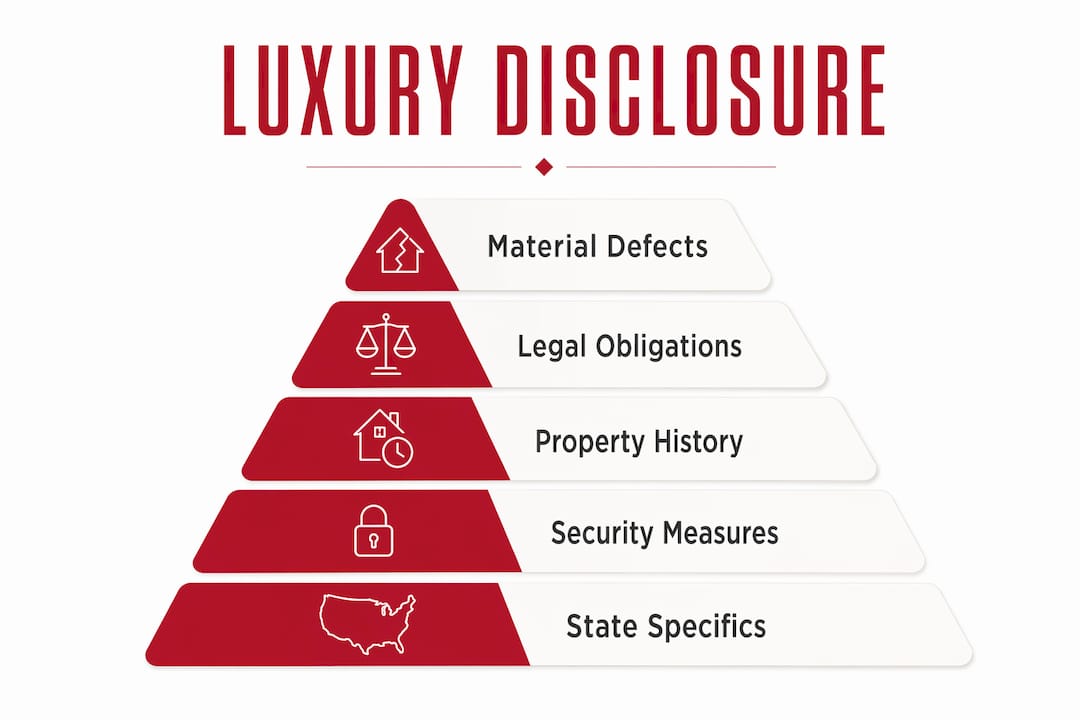
- What do you have to disclose when selling a luxury home?
- How do state laws vary, and what do California and Florida require?
- When and how are disclosures delivered in a luxury transaction?
- What happens legally when a seller fails to disclose?
- How should luxury sellers prepare disclosures to reduce liability?
- A disclosure checklist every luxury seller should use
- How Stu Harvey Estates helps sellers manage disclosure obligations
- Key Takeaways
- Why transparency is the sharpest tool a luxury seller has
- Work with Stu Harvey Estates on your luxury listing
- Authoritative sources and forms to consult
What are seller disclosures and what legal standard applies?
A seller disclosure is a written statement in which you, as the property owner, inform a prospective buyer of known material defects and other legally required facts about the property. Most U.S. states require these statements in writing before a binding contract is executed, and federal rules layer on top of state law for specific hazards.
The operative legal concept is "material defect." A defect is material if a reasonable buyer would consider it significant in deciding whether to purchase or at what price. The standard most states apply is your current actual knowledge, meaning you are not required to warrant conditions you genuinely do not know about, but you cannot claim ignorance of facts you have actively concealed or ignored.
"A seller disclosure is not a warranty. It is a statement of what the seller knows at the time of signing. Buyers are still encouraged to obtain independent professional inspections, and the disclosure does not substitute for those tests." — California DRE, RE 6 / New York DOS Property Condition Disclosure Statement
Buyer due diligence and seller disclosures work together, not in place of each other. A buyer's home inspection may uncover issues you did not know about; your disclosure covers what you did know. In luxury transactions, courts and buyers often interpret "material" more broadly than in mainstream markets. A minor drainage issue in a $400,000 suburban home may be a footnote; the same issue in a $12 million hillside estate can become the centerpiece of a rescission claim.
Even non-occupant sellers, including investors, trusts, and estates, generally retain the duty to disclose known defects. If you have not lived in the property, review transaction records and speak with property managers or prior tenants before completing your forms.
What do you have to disclose when selling a luxury home?
Core categories across most U.S. states
The categories below appear in disclosure frameworks across the country, from California's Transfer Disclosure Statement to Florida's residential disclosure form to New York's Property Condition Disclosure Statement.

| Category | What to disclose |
|---|---|
| Structural issues | Foundation cracks, roof defects, load-bearing wall modifications |
| Water intrusion and mold | Past or present leaks, flooding, drainage failures, mold remediation |
| HVAC, plumbing, electrical | Known defects, age of systems, prior repairs or replacements |
| Environmental hazards | Lead-based paint (pre-1978 federal requirement), asbestos, radon |
| Pest infestation | Termite history, active infestations, prior treatment records |
| Title encumbrances | Easements, liens, boundary disputes, deed restrictions |
| HOA matters | Pending assessments, active litigation, CCR restrictions |
| Prior deaths | Required in some states under specific circumstances |
The federal lead-based paint disclosure applies to every residential property built before 1978, regardless of price. You must provide the EPA-approved disclosure form and give buyers a 10-day window to test for lead.
Luxury-specific items that frequently matter
Standard disclosure forms were not designed with $5 million+ properties in mind. These items come up repeatedly in high-end transactions and demand specific attention:
- Pools and spas: Safety compliance certificates, prior demolition or fill of an in-ground pool, equipment condition
- Guest houses and ADUs: Permitted status, separate utility connections, occupancy history
- Major renovations: Permits pulled, contractor licenses, structural modifications under California Civil Code §1102.6h and equivalent state rules
- Hillside and drainage: Retaining wall history, prior slope failures, drainage system maintenance records
- Security and surveillance systems: Whether systems transfer with the property, camera locations, any privacy considerations for high-profile occupants
- High-value installed systems: Smart-home infrastructure, wine cellar climate systems, elevator maintenance records
Undisclosed unpermitted renovations, historic easements, and past insurance claims related to water intrusion or hillside failure are among the most common pitfalls in luxury sales. A custom wine cellar carved into a hillside without permits is not a charming quirk; it is a material fact.
How do state laws vary, and what do California and Florida require?
Disclosure obligations differ meaningfully by state. California and Florida illustrate the range well.
California
California has one of the most detailed disclosure frameworks in the country. The Transfer Disclosure Statement (TDS) is required for most residential sales of 1–4 units and must be delivered "as soon as practicable" before transfer of title. For installment contracts and lease-option transactions, it must be delivered before execution of those agreements.
The Natural Hazard Disclosure (NHD) report must accompany the TDS and identifies whether the property sits in a seismic, fire, or flood hazard zone. Under California Civil Code §1102.6h, sellers must also disclose contractor-performed structural modifications. If a buyer receives a required disclosure after signing an offer, California law gives that buyer three days (in-person delivery) or five days (mail) to rescind.
Pre-listing inspections in California are strongly recommended. Failing to provide required disclosures by the deadlines written into the purchase agreement can give buyers termination rights that are difficult to cure.
Florida
Florida's 2024 flood-disclosure law, effective October 1, 2024, added significant new requirements. Sellers must now disclose in writing, before executing a purchase contract:
| Disclosure item | Requirement |
|---|---|
| FEMA Special Flood Hazard Area (SFHA) status | Whether any portion of the property lies within an SFHA per FEMA flood maps |
| Flood insurance history | Whether the seller carried flood insurance |
| Prior flood-related insurance claims | History of claims paid on the property |
| Prior flood damage | Known flood damage and remediation history |
Noncompliance with Florida's flood-disclosure statute can allow a buyer to rescind the contract or pursue litigation. For luxury coastal properties in markets like Palm Beach, Miami Beach, or Naples, this disclosure is not a formality.
Other states
Pennsylvania's Seller's Property Disclosure Statement (SPD), published by the Pennsylvania Association of Realtors®, illustrates how state templates structure required information and when forms are required even if the seller was never an occupant. New York's Property Condition Disclosure Statement carries a $500 credit to the buyer at closing if the seller fails to deliver it before contract signing. Every state has its own rules. Verify yours through your state's statute pages, your state realtor association's form library, or a licensed real estate attorney.
When and how are disclosures delivered in a luxury transaction?
Timing is where many sellers get into trouble. The general U.S. practice runs along this sequence:
- Pre-listing (recommended): Complete disclosure forms and assemble supporting documents before the property goes on the market. Buyers in luxury transactions often want disclosure packets available at or before the first showing.
- At listing or with the offer: Many states require delivery before a binding contract is signed. Delivering disclosures with the listing or at the time of offer acceptance is the safest approach.
- Before contingency removal: In states where delivery can follow offer acceptance, buyers typically have a window to review and terminate based on disclosures. In California, that window is three to five days from delivery.
- Before close of escrow: Any material change in the property's condition discovered after the initial disclosure must be updated promptly in writing.
Practical recordkeeping steps:
- Date-stamp every disclosure form at the time of completion
- Retain signed acknowledgments from the buyer confirming receipt
- Keep copies of all inspection reports, repair invoices, and contractor permits in a single folder
- Store both digital and physical copies, and provide a set to your escrow officer
- Log all communications with the buyer and listing agent that touch on property condition
For a deeper look at documentation workflows, luxury home sale recordkeeping covers the full paper trail a high-value transaction requires.
What happens legally when a seller fails to disclose?
The consequences of nondisclosure in a luxury transaction are not abstract. Buyers who discover undisclosed defects after closing have several legal paths available, and high-value properties amplify every one of them.
Common remedies include rescission of the sale, damages for repair costs, diminution in value claims, and fraud or negligent misrepresentation claims. Some jurisdictions also allow recovery of attorney's fees. In Beverly Hills and comparable luxury markets, legal exposure from nondisclosure can include all of the above, plus reputational damage in a market where word travels fast among agents and buyers.
"Water and moisture issues are the most litigated disclosure category in residential real estate. In luxury transactions, a single undisclosed water intrusion event can generate a claim that dwarfs the cost of the original repair." — Industry guidance, luxury listing specialists
The typical sequence: a buyer's inspector finds an issue the seller knew about but did not disclose. The buyer demands repairs or a price reduction. If the seller resists, the dispute escalates to mediation, arbitration, or litigation. In a $10 million transaction, even a "minor" defect can produce a six-figure damages claim once expert witnesses, attorney fees, and carrying costs enter the picture.
If you are involved in any disclosure dispute, retain a real estate attorney before responding to the buyer's demand. The cost of early counsel is a fraction of the cost of a contested rescission.
How should luxury sellers prepare disclosures to reduce liability?
Pre-listing actions
Start before the property goes on the market. Order a targeted pre-listing inspection that covers the structure, roof, pool, hillside or retaining walls, and drainage systems. A pre-listing inspection lets you fix issues proactively or disclose them with supporting documentation, rather than facing a surprise finding during the buyer's inspection that derails the deal.
Pull all permits for work done during your ownership. If a contractor performed structural modifications, verify that permits were obtained and finaled. Run an HOA check for pending assessments or active litigation. Request your insurance claim history from your carrier.
Completing the forms
Answer every question based on your actual knowledge. When you know a fact, be specific: "roof replaced in 2021 by [contractor], permit #XXXX" is more defensible than "roof recently replaced." When you are uncertain, say so rather than guessing. The best-practice guidance from experienced listing specialists is to over-disclose: state the known fact and attach the supporting document.
Sellers commonly assume disclosure is only required when a buyer asks. The actual duty is broader: disclose any known fact that materially affects value or desirability, whether or not the buyer raises it.
Handling security and privacy
Luxury properties often have surveillance systems, gate codes, and security infrastructure that buyers need to know about but that you do not want to expose publicly. Disclose the existence and transfer status of security systems as material facts. Redact specific camera locations, access codes, and guest-list data from any documents that will be distributed broadly. Work with your agent to share sensitive security details only with verified, qualified buyers under a signed NDA or confidentiality agreement.

Pro Tip: Document every contractor who worked on the property during your ownership, including license numbers and permit references. A single folder with this information, organized chronologically, can resolve a buyer's concern in minutes and prevent it from becoming a negotiation issue.
For a full due diligence framework that mirrors what buyers will bring to your transaction, the due diligence guide for luxury investment property is worth reviewing before you complete your forms.
A disclosure checklist every luxury seller should use
Sellers who hand this checklist to their agent or attorney before listing are better positioned from day one. Store digital and hard copies of every item for escrow.
| Document | Notes |
|---|---|
| Pre-listing inspection report | Structural, roof, pool, hillside, drainage |
| Permit and contractor invoice folder | All work performed during ownership, with license numbers |
| HOA documents and recent meeting minutes | Pending assessments, active litigation, CCR restrictions |
| Insurance claim history | All claims, including water, fire, and hillside events |
| Occupancy and use history for guest houses/ADUs | Permitted status, rental history, utility connections |
| Pool safety and compliance certificates | Required safety features per state law |
| Environmental hazard disclosures | Lead-based paint (pre-1978), asbestos, radon test results |
| Copies of previously signed disclosure forms | Prior TDS, NHD, or state-equivalent forms if available |
| Flood zone determination and FEMA map reference | Required in Florida; recommended everywhere |
| Signed buyer acknowledgment forms | Dated receipts confirming delivery of each disclosure |
Attach supporting documents directly to the disclosure form where the form allows it. Date-stamp every file. A one-page disclosure packet summary, organized by category, is a practical addition to any luxury listing presentation and signals to buyers that the seller is prepared and transparent.
How Stu Harvey Estates helps sellers manage disclosure obligations
Navigating disclosure requirements for a high-value property is not a task to hand off to a generalist. Stu Harvey, Senior Agent with The Oppenheim Group, brings more than 15 years of luxury real estate experience and over 250 completed luxury transactions across San Diego, Los Angeles, Orange County, and Southern California to every listing engagement.
What Stu Harvey Estates provides for disclosure management:
- Pre-listing coordination: scheduling targeted inspections, organizing permit and contractor records, and preparing state-required forms before the property goes live
- Vendor sourcing: connections to specialty inspectors for pools, hillside structures, and environmental hazards
- Privacy-aware disclosure handling: structuring sensitive security and occupant information so material facts are disclosed without exposing confidential details
- Documentation and recordkeeping support: building the disclosure packet that protects sellers through escrow and beyond
- Escrow and closing oversight: tracking delivery timelines, buyer acknowledgments, and any required disclosure updates
Sellers who work with a specialist agent consistently face fewer post-closing disputes. Buyers gain confidence from a well-documented disclosure packet, which translates directly into stronger offers and cleaner negotiations. For sellers in markets like La Jolla, Rancho Santa Fe, the Hollywood Hills, or Newport Beach, where a single undisclosed defect can generate a claim in the hundreds of thousands, the value of getting disclosures right is not theoretical.
To understand what questions to ask when evaluating a luxury listing agent's approach to disclosures, questions for a luxury real estate agent is a useful starting point.
Key Takeaways
Luxury sellers who disclose known material defects in writing, document everything, and follow state-specific forms reduce post-closing litigation risk and protect the value of their asset.
| Point | Details |
|---|---|
| Disclose all known material defects | The duty covers any fact that affects value or desirability, whether or not the buyer asks. |
| Federal lead-paint rule applies universally | All residential properties built before 1978 require the EPA-approved lead-based paint disclosure form. |
| State forms and timing vary significantly | California requires TDS and NHD; Florida's flood-disclosure law took effect October 1, 2024. |
| Over-disclosure protects sellers | Attaching supporting documents to disclosure forms limits ambiguity and reduces litigation exposure. |
| Stu Harvey Estates | Provides pre-listing disclosure coordination, vendor sourcing, and privacy-aware documentation across Southern California. |
Why transparency is the sharpest tool a luxury seller has
The conventional wisdom treats disclosure as a legal hurdle, something to clear with minimum exposure. That framing gets sellers into trouble. In my experience working through hundreds of luxury transactions across Southern California, the sellers who fare best are the ones who treat disclosure as a positioning tool, not a liability.
A well-prepared disclosure packet tells a buyer something that no marketing brochure can: this seller knows their property, has nothing to hide, and has done the work. That confidence is contagious. It shortens due diligence periods, reduces the frequency of repair demands, and keeps negotiations focused on price rather than condition disputes. Conversely, a vague or incomplete disclosure invites a buyer's attorney to fill in the blanks, and they rarely fill them in the seller's favor.
The properties I have seen generate the most contentious post-closing disputes share a pattern: sellers who skipped the pre-listing inspection, left permit questions blank, or assumed that a buyer would not notice a drainage issue that had been "managed" for years. In luxury markets, buyers are sophisticated, their inspectors are thorough, and the dollar amounts at stake make litigation worth pursuing. Transparency is not generosity. It is strategy.
Work with Stu Harvey Estates on your luxury listing
Selling a high-value property in Southern California means navigating disclosure obligations that are both legally specific and market-sensitive. Stu Harvey Estates handles the full pre-listing disclosure process: coordinating inspections, organizing permit records, preparing state-required forms, and managing sensitive documentation with the discretion that high-profile sellers require.
Whether you are preparing a La Jolla oceanfront estate, a Rancho Santa Fe compound, or a Hollywood Hills contemporary, the disclosure process starts well before the listing goes live. Stu Harvey Estates offers a pre-listing disclosure review as part of every listing engagement, giving sellers a clear picture of their obligations and a documented paper trail before the first buyer walks through the door. Winning listings in competitive markets depend on preparation, and competitive listing strategies consistently show that well-documented properties attract stronger, faster offers.
Ready to list? Search active luxury listings or contact Stu Harvey Estates directly to schedule your pre-listing disclosure review and valuation.
Authoritative sources and forms to consult
Use these primary sources to verify requirements and download official forms for your state:
- California DRE, RE 6: Disclosures in Real Property Transactions — the California Department of Real Estate's comprehensive guide to required disclosures, including TDS and NHD requirements
- California Civil Code §1102.6h: Contractor-performed work disclosures — statutory text for structural modification disclosure requirements
- Florida Senate Bill / §689.302: Florida flood-disclosure statute (2024) — full text of the flood-disclosure requirements effective October 1, 2024
- NAR Consumer Guide: Seller Disclosures — plain-language overview of material defect standards and federal lead-paint rules
- Pennsylvania Association of Realtors®: Seller's Property Disclosure Statement — example of a state-standard disclosure template and its exceptions
- FEMA Flood Map Service Center: msc.fema.gov — verify SFHA status for any property before completing flood-related disclosures
For state-specific forms outside California, Pennsylvania, and Florida, consult your state's realtor association form library or your state legislature's statute database. Always confirm current requirements with a licensed real estate attorney in your state before finalizing your disclosure packet.